
What the Marigolds See
A surprising connection between a gardener and her sparrows

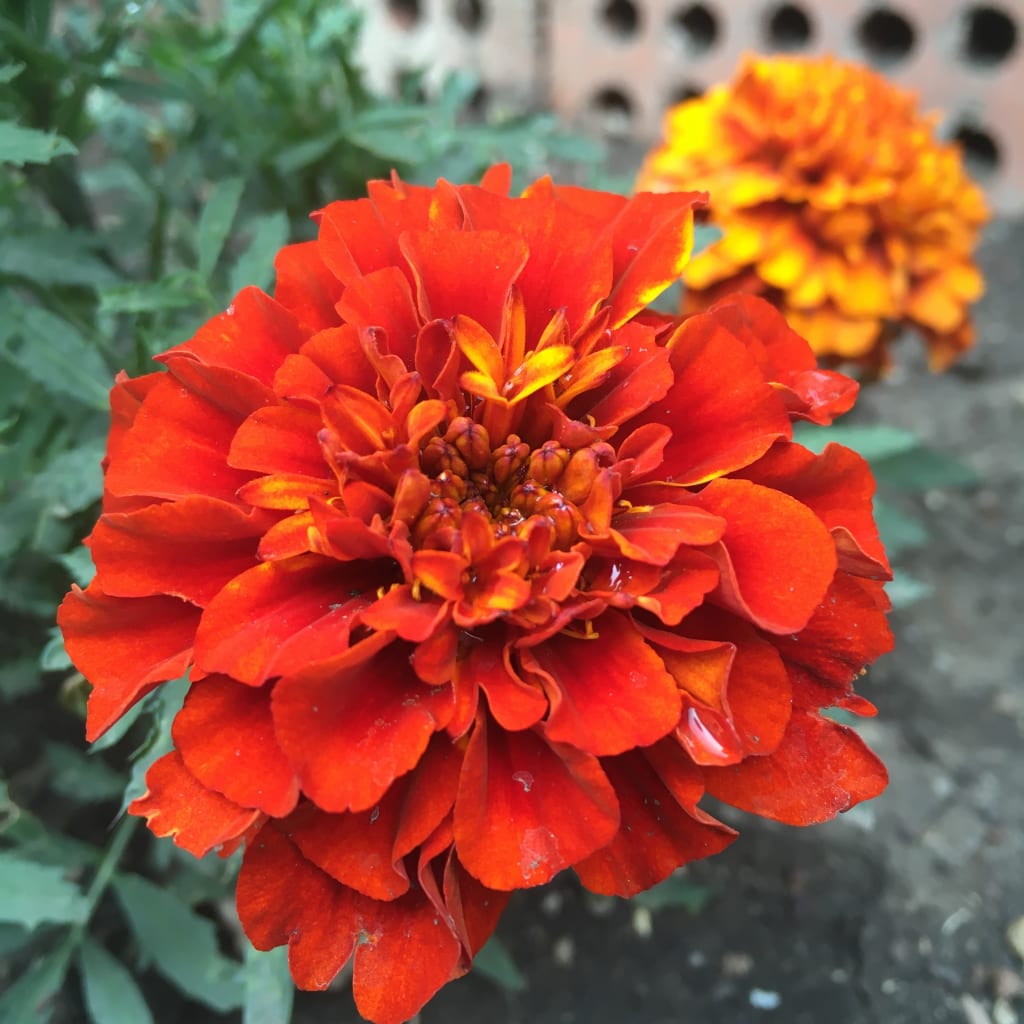
A marigold is called an annual flower, well, at least where I live. I suppose in some locations of the world, marigolds can thrive all year long, but this is not the case in the climate of northern Canada with its cold and snowy winters. Unfortunately, the marigolds die not long into Autumn, and unlike a perennial, they do not come up fresh and new each spring, without any effort of mine. No, for marigolds I venture into the greenhouse each spring. This wouldn't be worth the effort if it weren’t for the fact that with marigolds there is no wait for a bloom, they are happy and cheerful and showy, right when I buy them.
The bright orange, yellow and crimson marigolds I plant in my garden get the inside scoop each spring and summer season. Along with the Lilies, Hostas, and Peonies, they witness all the aspects of bird life that my backyard hosts. Each morning on my short walk from the backdoor to the garage, the sparrows catch my attention, with their catchy chitter and calls. I get a glimpse of their busy morning activities each day, and then again in the evening, upon returning from work. I sometimes stop to watch them curiously, thinking I can afford an extra minute or two between the running drum of work and home duties.
Sparrows, even better than a perennial, are the ‘evergreens’ of birds: a constant in all seasons, in all weather, they remain and never stop carrying on with their busy goal-driven lives. The ‘colonizer’ of birds, they came over from Europe in the 19th century and took over other native bird species... unforgivable if it were their own doing but of course some human is to blame. Their spotted history doesn’t stop my fascination with their layers of striped brown feathers, their chirps and calls, their mating dances, and careful, resilient babe-rearing. They are the life-force of my garden, somehow outcompeting even the bright marigolds for my attention. I can’t imagine my garden without them.
This spring and summer the marigolds have seen a lot more of me among the birds. On leave from work to focus on my own ‘incubation and hatching,’ I’ve surprised myself at the role I have taken on in the garden. Besides the watering and weeding, I have become an ally to the sparrows, a watcher and protector. The sparrows have their own fertility woes it turns out.
I can’t help but notice the constant presence of the sparrow atop the red and yellow birdhouse, viewable from any point in the yard as well as from my kitchen window. The male sparrow with its dark bow-tie is calling his mate – or is he on watch duty? - soon I see the female zoom into the birdhouse. Over weeks I see the trade up of male and female, taking shifts on the eggs. Then, I start to see the little beaks and a very busy mom and dad. All this work and waiting for babes – finally! I’m proud of these little yard mates, and somewhat jealous; when will it be my turn?
Then one day I hear it, a pair of loud obnoxious voices, cackling and calling: it’s the crows. They are the true bullies in the yard and I go outside and try to reason with them. ‘You can come here, but don’t bother my sparrows' I make some extended eye contact, thinking we’ve made an agreement. Two doors over, I see that there's a nest, which affords the crows a bit more understanding. Ah, they too have the goal. I hope that the sparrows stay unharmed.
The next day I see it, a crow on the roof of the garage with something small and pink. It’s one of the sparrow babes and my stomach sinks, my heart races. I quickly look out the window and see the damage: some of the nest’s twigs and grasses on the ground below, and another crow on the house’s roof, just above the birdhouse. The marigolds see me storm outside in my bathrobe, with garden-hat a-swinging. ‘Out! Leave them alone!’ The crows take off. The yard settles quiet. The damage is done and the sparrows and babes are nowhere to be found.
A sad day ensues. Constant glances to the birdhouse, ears on high alert waiting for any little chirp. I feel their pain with deeper empathy than most. Their goal attained, but then, dashed. And then, there it is, that chirping male again, atop the birdhouse roof. He’s back!
Over the coming weeks I see the repetition of efforts, of shifts, of waiting. What quick resilience these birds have. They don’t seem to feel sad; they just keep going on with their goal. I go back to enjoying them, of course still watchful over the crows, eyeing them with suspicion, and doing my best to reason with them.
One dewy morning after a great overnight rain, I step into the kitchen and see that the birdhouse is hanging precariously, its hole facing downwards and one of the sparrows trying to enter without much success. Again, the marigolds see me in my bathrobe, running out and gently taking the birdhouse down, hoping to fix the twine it hangs by. I see four light blue eggs, strewn on the ground below. They are all intact, the lush grass having broken their fall. One by one with great care I put the eggs back in the house and rehang it. I wait with baited breath to see if mom or dad will return, and hope that my mistake of not wearing gloves won’t sour them off the nest.
At last, the sparrow pair return. My hopes return as well, higher than ever that the eggs will hatch again and the sparrows will get to their next step. I wait, on the verge of finding out if my hatch-lings will make it as well. I am with the sparrows, and they are with me in their rocky journey to parenthood. How I wish I had their resilience, and their apparent lack of mourning.
I've become a fixture in the garden, I watch the sparrows to pass the time, and I take in the marigolds’ bright colours and appreciate the distraction. And the marigolds see all of it.
About the Creator
Enjoyed the story? Support the Creator.
Subscribe for free to receive all their stories in your feed.
Comments
There are no comments for this story
Be the first to respond and start the conversation.