
Wallace’s Radio
A stormy night, a minor league game, and the stranger who became a lasting memory

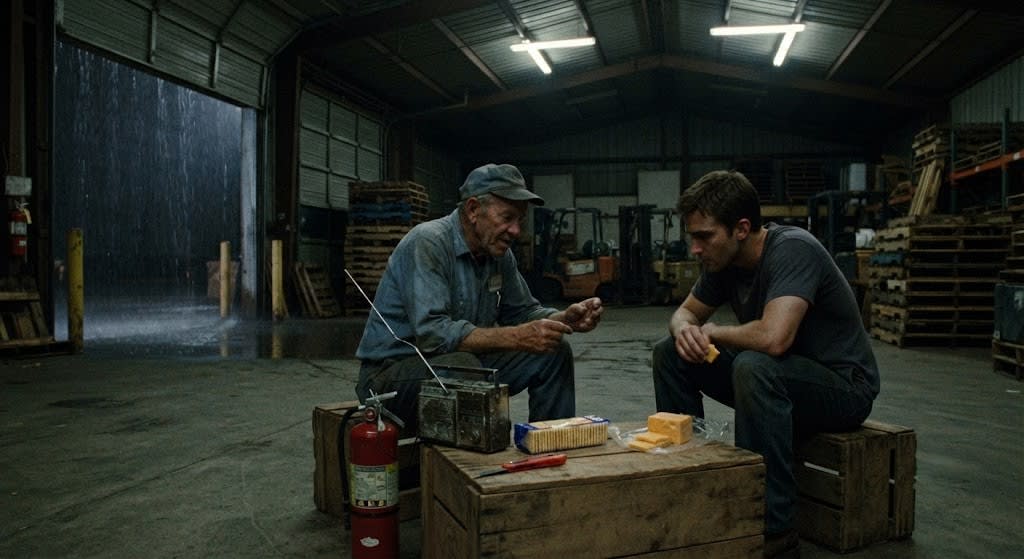
I worked the loading dock the summer after I dropped out of a college program I never much liked, mostly because the pay covered rent and the schedule left my mornings free. The job amounted to little more than moving freight from trucks to shelves and back again, hour after hour, the sort of work that dulls a mind if you let it, though most of the crew found small ways to keep from going numb. Some brought paperbacks to read on breaks. Others ran betting pools on which supervisor would lose his temper first on a given shift. Wallace brought a transistor radio that seemed older than either of us, its antenna bent at an angle that only worked if you propped it against something metal.
The storm rolled in past ten, and every truck scheduled through the dock that night sat somewhere on a flooded highway, going nowhere. Wallace and I stood between rows of empty pallets with nothing left to load and no supervisor around to tell us whether sitting down counted as slacking. We sat down anyway on two crates near the loading bay, and listened to the rain slam sideways against the corrugated roof loud enough to drown out the radio Wallace kept propped against a fire extinguisher.
He worked the dial until he found a ball game three states over, some minor league match nobody in our warehouse would ever care about and left it there. Static rolled through the broadcast every few seconds, swallowing whole innings, so we filled the gaps guessing what happened in between. Wallace claimed a man named Dorsey hit a double off the fence in the fourth. I claimed the shortstop booted an easy grounder in the sixth. Neither claim had proof behind it, and neither of us cared enough to check. That seemed to be the entire appeal of the thing, inventing a game neither of us could actually see, filling in a version that suited us better than the truth might have.
Wallace had worked the dock three years longer than I had, and most nights he stayed sealed off behind whatever mood the shift handed him, the sort of man who answered questions with the fewest words a sentence could survive on. That night the storm loosened something in him. Somewhere near midnight, he produced a sleeve of crackers and a block of orange cheese from his locker, the sort wrapped in plastic that never quite tastes like real cheese and cut it into uneven squares with a box cutter he kept clipped to his belt. We ate slowly, passing the block back and forth, and he told me about growing up near a rail yard where his father worked nights sorting freight cars, how the sound of couplers slamming together used to put him to sleep faster than silence ever could. He described the smell of diesel soaked into the boards of the family porch, a smell he claimed he still caught sometimes on certain streets for no reason he could explain.
I told him about a summer I spent painting houses for a man who paid in cash and never once said thank you, how the paint fumes made me lightheaded by noon most days and how I quit after six weeks over a disagreement about a missing brush he swore I stole. Neither story amounted to much on its own. We told them anyway, because the storm gave us hours to fill and the radio kept losing the game right at the moment something interesting seemed about to happen, forcing us to keep talking through the static rather than sit through it in silence.
At some point Wallace asked whether I planned on staying at the dock much longer, and I told him I hadn't figured that far ahead, which seemed to satisfy him more than any real answer would have. He said he used to think the same way at my age, that a job was only ever a placeholder for whatever came next, until enough years passed that the placeholder became the whole picture. He said it without any sadness attached, the way a man states a fact about weather he has long since stopped fighting against.
Around one, the rain eased enough that we could hear ourselves think, and the broadcast came through clean for a stretch. The game had gone into extra innings, tied since the seventh, and for reasons neither of us examined too closely, we started caring who won. Wallace stood and paced along the dock rail during the tenth, muttering at the radio like the players could hear him from three states away. I found myself gripping the rim of my crate during the eleventh, willing some third baseman I would never meet to lay off a low pitch he clearly had no business chasing. When the home team finally scored in the twelfth on a passed ball, of all things, Wallace let out a sound somewhere between a laugh and a shout and knocked his knuckle against the metal roof support hard enough to leave it sore for a shift or two after.
Neither of us said much once the game ended. We packed up the radio, swept the cracker crumbs off the crates, and went back to standing near the bay doors until the trucks started rolling in around three, soaked and late and full of freight that needed unloading before the sun came up. The rest of that shift blurred into the usual grind, pallet jacks, scanner beeps, the low ache that settles into your legs after a double shift stacked on top of another. By the time I clocked out, the storm had passed and the sky had gone the pale color it turns before real daylight sets in, the sort of color that never quite gets a proper name.
Wallace left the company eighteen months later for a job closer to his family, somewhere out past the coast, and we lost touch the way people do when a phone number changes and nobody bothers chasing it down. I never saw him again after his final shift, a day I remember only because he brought doughnuts for the whole crew and made some joke about retirement that landed flat in the room. Yet if you asked me to name one memory from those three years at the dock, one single evening I could describe in full even now, decades later, it would seldom be the doughnuts or the joke. It would be that storm, the static-choked radio, the orange cheese cut into crooked squares, and a passed ball in the twelfth inning of a minor league game between two towns whose names I have long since forgotten.
I have tried explaining this to people, and it never lands the way I want it to. The story sounds like nothing worth telling: two men waiting out weather, eating snack food, caring for an hour about a game with no real stakes attached to either of our lives. There is no lesson buried in it, no line worth repeating, no reason it should have outlasted the thousand shifts that came before and after it. Wallace never said anything memorable that night. He guessed wrong about a shortstop, ate more than his share of cheese, and cheered too loud over a passed ball nobody outside that dock would ever remember happened.
Still, when I try to picture him now, that is where I go. Never the doughnuts, never the flat retirement joke, never the handshake near the door on his final afternoon. I go back to the dock, to the two crates, to the static swallowing whole innings while rain hammered the roof above us, to a stretch of hours neither of us planned for and neither of us would trade for something grander if given the choice. Some nights, half-asleep, I catch a stray inning of some forgettable game drifting from a radio somewhere down a hallway, and for a moment I am twenty-four again, sitting on an overturned crate beside a man I hardly think about anymore, waiting on trucks that never come, caring more than made sense about a run that hardly mattered to anyone alive, then or now.
About the Creator
Nolan Reed
I write true stories, including unsolved mysteries and events that actually happened.
Enjoyed the story? Support the Creator.
Subscribe for free to receive all their stories in your feed.
Comments
There are no comments for this story
Be the first to respond and start the conversation.