
Voyager 1
The Longest Goodbye in Human History


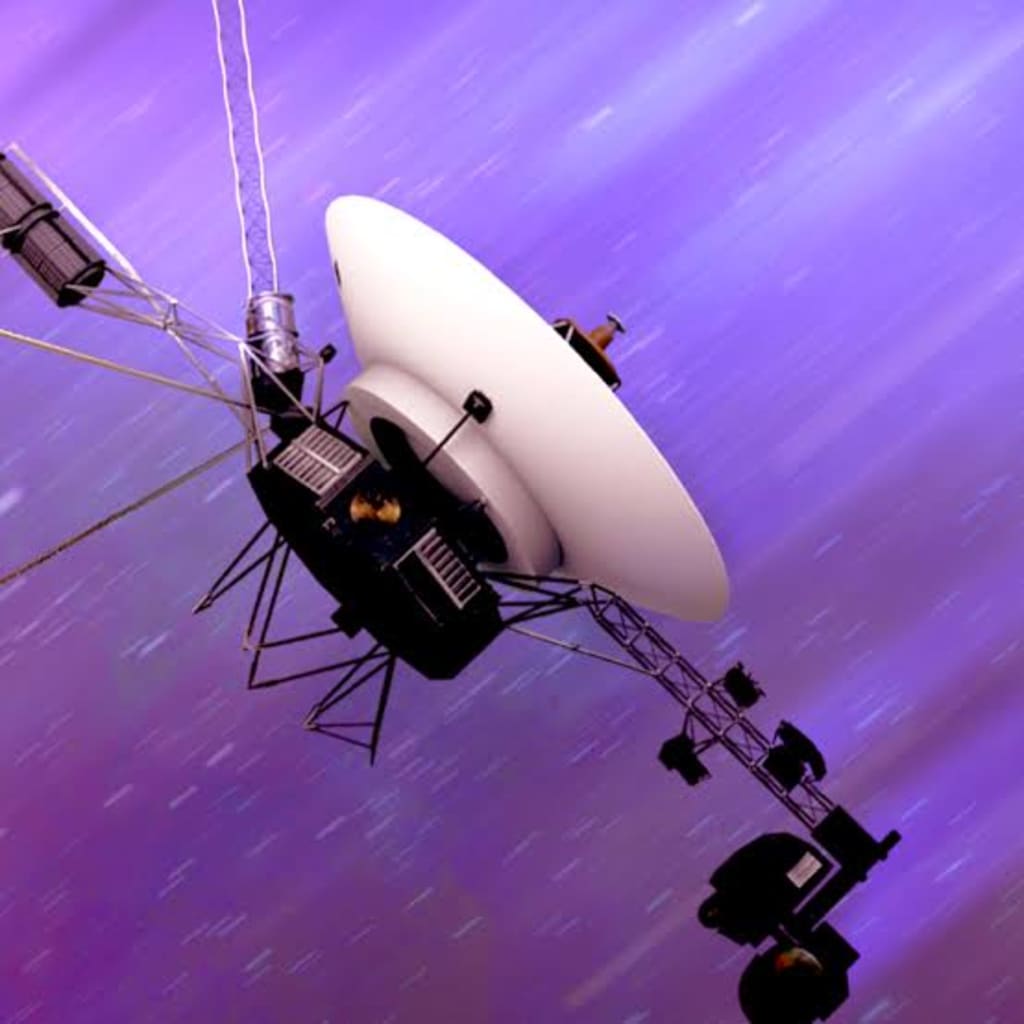
The following story is a true "last call" story about Voyager 1.
The Jet Propulsion Laboratory in Pasadena is a working place where engineers spend their days solving problems most people will never encounter. Computers fill the offices, technical information covers their screens, and conversations revolve around spacecraft, calculations, and systems that have been operating for decades. From the outside, there is little to suggest that this is where people are still maintaining contact with a machine traveling billions of miles from Earth, yet that is exactly what happens here.
Every week, the engineers at JPL call Voyager 1, and when they do, their message begins a journey that takes almost two days to complete. The spacecraft is now more than fifteen billion miles from Earth, traveling through interstellar space at approximately thirty-eight thousand miles per hour, far beyond the region where the Sun's magnetic influence dominates. A command sent from Earth takes roughly twenty-three hours to reach Voyager, and if the spacecraft responds immediately, its answer requires another twenty-three hours to make the return journey. There is no instant conversation, no back-and-forth exchange between Earth and spacecraft. There is only a signal sent into the darkness, followed by a long wait to learn whether the old machine has heard it.
Voyager 1 was launched in September 1977, when the world was still decades away from many of the technologies people now take for granted. The spacecraft was roughly the size of a subcompact car, carrying scientific instruments designed to explore the outer planets and send their discoveries back to Earth. Its original mission was expected to last far less than the lifetime it has ultimately achieved, yet Voyager continued long after its encounters with Jupiter and Saturn, continuing outward as engineers found ways to keep its systems operating and its transmitter pointed toward home. Today, the spacecraft has traveled farther than any human made object, moving into a region of space where the Sun is becoming increasingly distant and the darkness between the stars has become its permanent surroundings.
The signal it sends back to Earth is extraordinarily weak by the time it arrives. NASA relies on the Deep Space Network, a system of enormous radio antennas positioned in California, Spain, and Australia, to hear that distant transmission. As Earth rotates, responsibility for communicating with Voyager moves from one station to another, with each antenna carefully aimed toward the point in the sky where the spacecraft should be. The engineers cannot see Voyager itself, and they have no physical connection to the machine. Their entire relationship with it exists through radio waves crossing billions of miles of space, carrying numbers from an aging computer back to a planet where people are waiting to see whether the spacecraft is still alive.
For decades, those communications were remarkably dependable. Voyager transmitted telemetry, and engineers examined the information to determine whether its systems remained healthy. The routine became part of life at JPL, a weekly reminder that a spacecraft launched nearly fifty years earlier was still answering from the edge of the solar system. Then, in November 2023, the routine suddenly broke. The Deep Space Network established contact with Voyager as expected, yet the data appearing on the engineers' monitors made no sense. Instead of organized packets containing information about the spacecraft and its instruments, the screens filled with a repeating stream of ones and zeros. Voyager was still transmitting a signal, although whatever it was trying to say had become incomprehensible.
At fifteen billion miles, a computer malfunction becomes an entirely different problem from the sort of failure engineers encounter on Earth. There could be no repair crew and no replacement component sent out to the spacecraft, so the people at JPL had to diagnose the problem from billions of miles away using technology designed during the 1970s. Some of the documentation had been created on paper decades earlier, while much of the knowledge surrounding Voyager's systems had been passed through generations of engineers. The spacecraft's Flight Data Subsystem, the computer responsible for preparing information before it was transmitted, operated with only sixty-nine kilobytes of memory. A single low-resolution photograph taken by a modern phone can require more storage than the entire computer.
For five months, the engineers searched through Voyager's ancient computer architecture, trying to determine what had happened. Eventually, they found the problem. A single memory chip had failed, perhaps damaged by a stray cosmic ray or perhaps weakened after decades of exposure to the harsh environment of deep space. The chip represented roughly three percent of the computer's total memory, yet those three percent contained code required to package Voyager's telemetry for transmission. Without that code, the spacecraft could continue sending a signal while being unable to properly assemble the information it was supposed to send, leaving the engineers on Earth with a repeating pattern of meaningless data.
The solution required a form of software surgery that had never been attempted on a spacecraft so distant from Earth. There was no contiguous block of healthy memory large enough to hold the missing code, so the engineers divided the software into fragments and placed those pieces into unused sections of the remaining memory. They rewrote instructions and changed the internal addresses so Voyager's computer would know where each piece had been moved. When the computer reached one section of the program, it had to know where to find the next. Every address mattered, and every instruction had to lead to the correct location, because a mistake could leave the spacecraft permanently unable to communicate with Earth.
In April 2024, after weeks of preparation, the engineers sent the patch to Voyager and began waiting for the result. The command took nearly twenty-three hours to reach the spacecraft, and once Voyager received it, the engineers had another twenty-three hours before they could expect a response. On a Saturday morning, the Deep Space Network began receiving data, and the repeating stream of gibberish that had haunted the monitors for months began to disappear. In its place came clean engineering information. The numbers made sense again. Voyager had accepted the instructions, its computer was functioning, and the spacecraft was once again speaking in a language Earth could understand.
The room erupted in cheers because everyone there understood what had happened. They had saved Voyager from total silence, and they had done it from Earth by sending a carefully constructed piece of software across a distance that would have seemed impossible when the spacecraft was launched. The celebration, however, could only last so long because the larger problem remained. Voyager's power supply had been declining since the day it left Earth, and there was no way to reverse that process.
The spacecraft receives its electricity from three radioisotope thermoelectric generators, which convert the heat produced by the natural decay of plutonium 238 into electrical power. Those generators have been working since 1977, although their output has steadily weakened as the plutonium decays. Voyager loses approximately four watts of electrical power each year, and at this stage of the mission, that small annual loss has become significant. Engineers have spent the past decade shutting down systems, secondary computers, heaters, and scientific instruments so that enough electricity remains for the equipment required to keep the spacecraft communicating with Earth.
Then, during the summer of 2024, another problem emerged, this time involving the thrusters that keep Voyager's antenna pointed toward home. The spacecraft's high gain antenna has to remain aimed directly at Earth, and Voyager maintains its orientation by firing tiny attitude control thrusters in carefully measured bursts. After decades of operation, however, silicon dioxide residue from the hydrazine fuel had accumulated inside the narrow fuel tubes. Openings that originally measured about one hundredth of an inch had gradually narrowed to a fraction of the width of a human hair, leaving the thrusters struggling to push fuel through passages that had become severely restricted.
If the thrusters failed completely, Voyager would begin drifting out of alignment. Its antenna would slowly turn away from Earth, and the radio connection that had survived nearly five decades would eventually disappear. Once again, the engineers had an alternative, although using it required another difficult decision. Voyager carried a second set of thrusters that had remained unused for decades, and switching to them required heaters to bring the fuel lines to operating temperature. The problem was that Voyager had almost no electrical power available for another major demand.
The engineers decided to take a calculated risk. For approximately one hour, they shut down one of Voyager's primary internal heaters so that enough electricity could be redirected to the alternate thruster heaters. They understood the danger because deep space is brutally cold, and some components could have suffered damage during the maneuver. If something went wrong, there would be no technician available to repair it. The maneuver succeeded, the alternate thruster lines warmed, the switch was completed, and Voyager was once again able to maintain its orientation toward Earth.
The victory bought more time, although the power supply continued to shrink. By early 2026, the remaining power margin had become so small that NASA had to make another painful decision. Engineers sent the command to shut down the Low Energy Charged Particles experiment, an instrument that had spent nearly fifty years measuring the strange environment surrounding Voyager as it traveled deeper into interstellar space. Another piece of the spacecraft's scientific life had come to an end, leaving only two scientific instruments still operating.
Those remaining instruments continue to study the plasma and magnetic fields surrounding Voyager as it moves farther from the Sun and deeper into the space between the stars. The information they collect comes from a region of the universe humanity had never reached before Voyager began its journey, and every measurement that reaches Earth carries with it the knowledge that the spacecraft could stop responding at any time.
The engineers at JPL know how the story ends. Sometime during the 2030s, the electrical power produced by Voyager's aging plutonium generators will fall below the minimum required to operate the transmitter. Until that happens, the engineers will continue making difficult choices, shutting down one system so another can survive and stretching the remaining power as far as the spacecraft will allow. They refer to this period as the preservation era, a stage of the mission when exploration gives way to survival and every remaining watt becomes part of the calculation.
Eventually, there will be nothing left to turn off.
A day will come when an engineer sits at a terminal in Pasadena and prepares the final command. The room will probably look much as it has during thousands of previous communications, with computers glowing across the desks and engineers watching the screens while the Deep Space Network antennas turn toward the sky. The command will be sent, and the radio signal will begin its twenty-three-hour journey through the darkness toward Voyager 1, passing beyond the orbit of Mars, crossing the asteroid belt, and continuing through the regions where Voyager once photographed the great outer planets.
The signal will eventually reach the spacecraft, almost a day after leaving Earth. Voyager will receive the command, and its ancient computer will process the instructions, perhaps for the final time. Its transmitter will then awaken and send a last burst of radio energy toward Earth, carrying whatever final status information the spacecraft can provide. The signal will begin its long return journey, and for another twenty-three hours the engineers will wait for it to arrive.
Then Voyager's remaining power will finally fall away.
The transmitter will go dark, followed by the spacecraft's remaining systems as the electricity produced by the aging plutonium becomes too weak to sustain them. On Earth, the engineers will wait through the expected transmission window, watching their monitors as the time for Voyager's response approaches and passes. The antennas of the Deep Space Network will continue listening toward the stars, yet no signal will come back. There will be no second attempt and no replacement component waiting somewhere on Earth. There will be no rescue mission capable of crossing fifteen billion miles of space. The people in Pasadena will understand that the spacecraft has reached the end of its ability to speak with them.
The last call will have ended.
Voyager 1, however, will continue traveling.
The spacecraft will remain in motion through the Milky Way long after its radio transmitter has gone silent. The antennas that once listened for its voice will eventually become part of history, and the engineers who spent their careers keeping Voyager alive will eventually be replaced by generations who know the spacecraft only through photographs, archived data, and stories passed down from the people who worked with it. Voyager will continue moving through the darkness long after the world that launched it has changed beyond recognition.
Attached to the spacecraft is the Golden Record, a copper disc coated in gold and created as a message from Earth to whoever might someday discover Voyager. It contains images of our planet, sounds from our world, music, and greetings spoken in human languages. It carries evidence of a civilization that existed for a brief moment on a small planet orbiting an ordinary star, a civilization that built a machine, sent it into the darkness, and gave it a message to carry.
There is no guarantee anyone will ever find the record. It may drift through the galaxy for millions or billions of years without ever encountering another intelligence capable of understanding what it contains. It may eventually become one more object moving through a universe that gives no indication anyone is listening. Still, the message will remain attached to Voyager, traveling farther into the future than any human life could ever reach.
Voyager began its journey when the world looked very different from the one we know today. It left Earth before the internet, before smartphones, before most of the technologies that now seem essential to daily life. It survived decades of radiation, failing components, declining power, clogged thrusters, computer problems, and a journey across a distance so immense that every conversation with Earth takes nearly two days.
One day, Earth will make its final call.
Voyager will answer for the last time, and then the signal will disappear into the darkness.
The spacecraft will keep moving.
Somewhere beyond the planets, beyond the edge of the solar system, a small machine built by human hands will continue its journey through the Milky Way, carrying a golden record and a message from a world that once looked into the darkness and wondered what might be waiting beyond the stars.
About the Creator
Nolan Reed
I write true stories, including unsolved mysteries and events that actually happened.
Enjoyed the story? Support the Creator.
Subscribe for free to receive all their stories in your feed.
Comments
There are no comments for this story
Be the first to respond and start the conversation.