

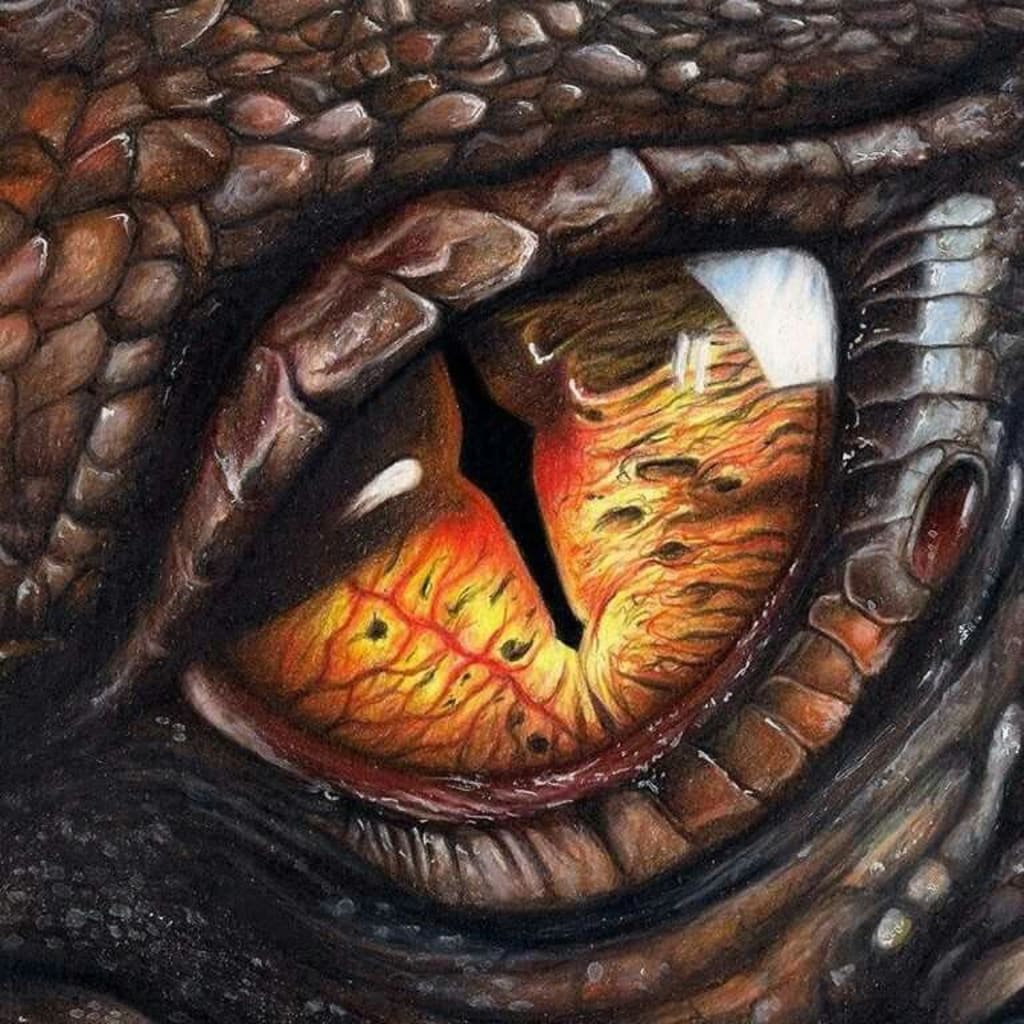
There weren't always dragons in the Valley. There were not always humans, either. Nor the elves before them, or the mysterious Accipita before them. But like the humans and elves, they had come, and as with the coming of every new people, the fertile soil of the Valley would be soaked with the blood.
It was blood, so the elders told, that gave the Valley its fertility in the first place. Centuries of bloodshed as the various peoples came to claim the Valley from those who had claimed it themselves generations before. Though towering purple mountains and sharp crags defined much of the Valley’s periphery, the Valley itself boasted roughly one hundred leagues from Elding Falls in the western Krýna Mountains to the narrow strait separating the Vorth Bay from the Raging Sea in the east. Nearly forty leagues divided the marble spires of Felstath in the south from the everbloom of the old battlefield of Blódvangr, where the blood had flowed thickest two hundred years ago. Between them, verdant forests teeming with game, rich, if small, tracts of farmland, and bitter tundra were held together by the Elv, the great river that spanned nearly a league across and flowed from a yet-undiscovered reservoir deep in the Krýna. It passed through the central and capital city of Dristol, and on to the brackish waters of Vorth Bay, before flowing through the narrow strait of the Gat and finally spilling into the Raging Sea. At the very centre of the Valley stood the Geirr, a single, solitary mountain, almost twice as tall as the Elv is wide, where heroes and villains fought to the death in tales of old, and from where, on a clear day, the entirety of the Valley can be seen. It was on this peak that Dróttinryth first appeared.
At midday, the sharpest eyes among lookouts on the low coastal mountains of Vorth Bay saw what appeared to be a flock of birds, flying so high that their size was impossible to guess, and moving at speed few birds could match. Where most seabirds would descend to rest and roost on the battered outcrops of the strait, this flocked instead carried on inland, until the lookouts had lost sight of them. Not an hour later, black clouds materialised above the pointed tip of Geirr, swirling and churning outwards, as though a hurricane had chosen the peak for its origin. The hurricane grew but did not move, and a warm, heavy breeze could be felt as far away as Felstath. Then, from the eye of the storm, he came.
The great sky dragon, scales the colour of distant lightning, descended from the clouds, and beating his mighty wings, came to rest on the peak. The people Dristol, who had built their capital in the shadow of Geirr, collectively looked up in both awe and horror, as Dróttinryth spoke in a voice that carried through the hurricane winds to the heavy breeze in Felstath:
“Drovin al Kalam!” We have come.
At his words, the rain began to fall and thirteen dragons of different colours appearings in the clouds above him. As thunder cracked and lightning split the sky, these new dragons dove with speed unmatched towards the city. Reports from survivors indicated four fire drakes, three frost dragons, two black dragons with red markings, and five smaller, feathered forest-hunters swept through the city, killing, burning, and freezing indiscriminately. More than three thousand people died that day, and the streets of Dristol were consumed in blood and fire. Only two days later, Felstath was attacked, and the carnage continued, with the dragons’ conquest showing no signs of slowing.
But the complete and utter obliteration of an entire people is a lengthy process, even for dragons. With nearly ten thousand humans for every dragon, the dragons suffered wounds of their own. Several were injured, and although their carcasses were never recovered, the black dragons were reportedly killed and not seen again. Even so, dragons with wounds that appeared to be fatal would flee, only to be seen again as soon as a few days later, bearing the scars of their apparent defeat. Many people, as humans are wont to do when encountering something greater than themselves, hailed the dragons as gods, come to rid the Valley of the impious and cleanse it of sin. In the weeks and months that followed, people turned from the old pantheon in the hundreds, giving the dragons soldiers to aid in their conquest. Those that did were allowed to return to Dristol and Felstath, now called Drovinkaas and Korlatha respectively, in the tongue of their new masters. Two priests were selected from the masses of the faithful, and governorship of the cities was given to them. Throughout the onslaught and the days that followed, Dróttinryth remained on the peak of Geirr, and the eye of the storm which he had brought with him continued to swirl around him.
As more cities and townships were bathed in fire and ice, the survivors fled into the labyrinth of mountain tunnels. A few of the brave went into the darkest parts of the forest, where the underbrush of kilometre-high trees helped keep them hidden. It is there, seven years after the fall of Dristol and Felstath, that an unlikely encounter would set in motion the final fates of both humans and dragons alike.
About the Creator
Enjoyed the story? Support the Creator.
Subscribe for free to receive all their stories in your feed.
Comments
There are no comments for this story
Be the first to respond and start the conversation.