
Two Ls, One T
The label was six inches of blue tape

The part Elliot remembered took less than half a minute.
It happened during final dress, while somebody in the wings tested the doorbell for the fourteenth time and the woman playing his mother shouted that her left shoe had disappeared. The stage manager was on headset saying, “No, the other fireplace,” with the patience of someone being slowly poisoned. From the house, the director called for everyone to please stop touching the curtains.
Nothing stopped for Elliot. No one gathered around. Marty Bouchard replaced a piece of tape.
That was all.
The theater had once been the meeting hall of a veterans’ post. Its ceiling tiles were the color of weak tea, and the dressing rooms had been made by dividing the old coatroom with walls that did not quite reach the ceiling. Everyone could hear everything: warm-ups, gossip, a zipper giving up under pressure, the men in the next room trying to remember which side of a cummerbund faced out.
Marty had built the dressing-room counters himself sometime in the late nineties. He had also built the false fireplace currently facing the wrong direction, three rehearsal cubes of slightly different heights, and a staircase that looked convincing from the audience but led nowhere. At seventy-one, he moved through the building with a pencil behind one ear and a tape measure clipped to his belt, fixing things before most people knew they were broken.
He labeled everything.
PROP—DO NOT USE was taped across a real pitcher.
BROKEN—DO NOT THROW AWAY appeared on a lamp with no shade and no cord.
One drawer in the scene shop simply said OTHER SCREWS.
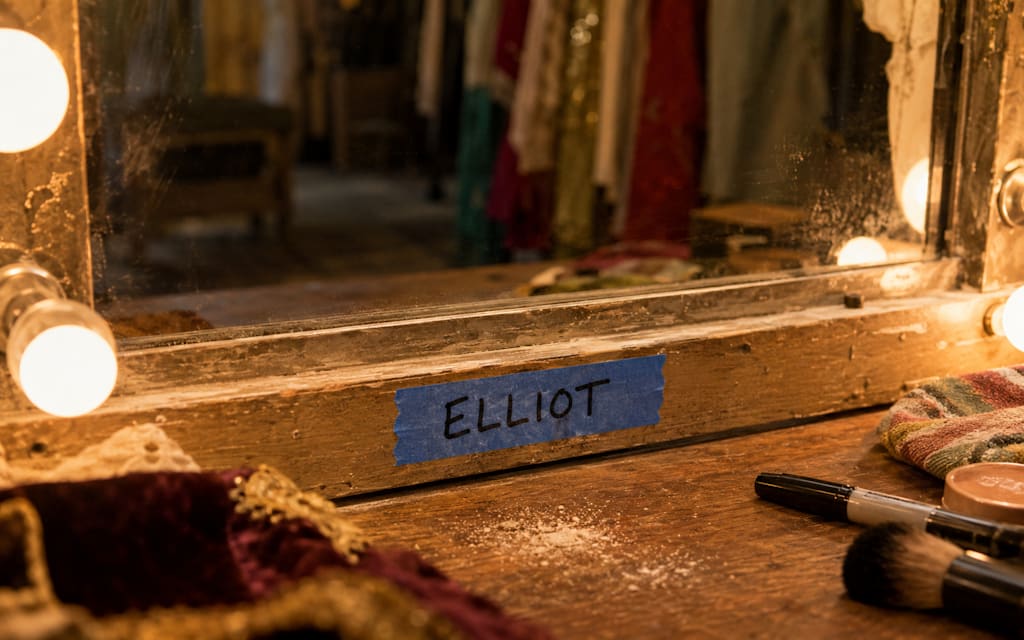
That afternoon, he had put strips of blue painter’s tape along the dressing-room mirrors so each actor would know where to sit. The labels ran in a tidy line beneath the bulbs: June. Rafael. Beth. Connor. Then the name Elliot had stopped using.
He stood in front of it with half his costume on, holding a pair of brown trousers against his chest.
The name was written in thick black marker. All capital letters. It had come from the audition form he filled out in February, before he knew anybody here and before he had decided whether this could be one more place where correcting people cost more than staying quiet.
By the first music rehearsal, June was calling him Elliot. By the second, Rafael was calling him Eli because Rafael shortened everyone’s name whether invited or not. The director changed it in her score. The stage manager changed it on the contact sheet. No announcement had been made. Elliot had simply written the name he wanted on the top of his music, and the room followed.
The official roster had not.
Official things rarely did.
At school, his name lived correctly in exactly three places: the drama club group chat, the library account a sympathetic aide had changed without permission, and the inside cover of his chemistry notebook. Everywhere else, the old name arrived first—attendance, medical forms, substitute teachers, the envelope containing his PSAT scores. Each time, he had to decide whether correcting it was worth turning a routine interaction into a conversation.
Usually, people wanted a reason.
Sometimes they wanted proof.
Once, a guidance counselor had leaned forward and asked, very gently, whether this was “a permanent decision,” as though Elliot had requested a tattoo across his forehead instead of seven letters in a database.
The blue tape on the mirror wasn’t cruel. That almost made it worse. Cruelty could be hated cleanly. This was only paperwork making it all the way into the dressing room.
“Places for the top of Act Two,” the stage manager called over the backstage speaker.
Around Elliot, chairs scraped and hangers clicked. June pushed three pins between her lips and left wearing only one false eyelash. Rafael squeezed past in a brocade vest, smelling of drugstore cologne and the vanilla protein shake he brought to every rehearsal.
“You coming?” he asked.
“Yeah. Costume thing.”
Rafael looked at the trousers Elliot was still holding, apparently accepted this as an explanation, and disappeared through the doorway.
Elliot put the trousers down. He picked at the corner of the tape with his thumbnail. It came up enough to gather a gray ridge of makeup dust, then tore down the middle.
“You planning to take the mirror with it?”
Marty stood behind him, carrying the missing left shoe.
Elliot dropped his hand. “No.”
“Good. I don’t have another mirror.”
Marty placed the shoe on Beth’s chair. A clothespin attached to its strap said LEFT in Marty’s handwriting. He glanced at Elliot’s station, then at Elliot, then back at the torn tape.
“I copied the audition list,” he said.
“I figured.”
“List’s wrong?”
The speaker crackled again. “Elliot, we’re holding for you.”
From the stage came Rafael’s voice, too loud and much too close to someone’s microphone. “He’s fixing his pants.”
The cast laughed. Elliot felt heat climb the back of his neck.
Marty did not look toward the stage. He put one thumbnail under the tape and peeled it from the mirror in a single clean strip. The adhesive made a soft, dry hiss.
“What should it say?”
Elliot had answers prepared for other questions. He had one for when did you know, though it changed depending on who was asking. He had one for have you told your parents. He even had one for what if you change your mind, which was nobody’s business but came up often enough to deserve a script.
He had no prepared answer for a man holding a roll of blue tape.
“Elliot,” he said.
Marty tore off a new strip against the metal edge of the dispenser and flattened it across his palm. He uncapped the marker with his teeth.
“Two Ls, one T?”
“Yes.” Elliot swallowed. “Two Ls, one T.”
Marty printed it in the same square capitals he used for everything else.
ELLIOT.
He pressed the tape beneath the mirror, smoothing it once with the side of his thumb.
“There.”
Elliot stared at it.
Marty followed his gaze, checking his work. “Spelled it right, didn’t I?”
“Yeah.”
“Then get your pants on. They’re holding the act.”
He walked out with the old strip stuck to the back of his hand, already calling toward the wings, “Who turned the damn fireplace around?”
Elliot laughed. It came out once, sharp and surprised.
He changed quickly, missing one belt loop and deciding it did not matter. At the doorway, he looked back. His new label sat between Connor and June as though it had always been there, no larger and no smaller than anyone else’s.
Onstage, nothing went particularly well. The doorbell rang before anyone touched it. Beth entered with one shoe. Rafael skipped four lines and then repeated two of them. When Elliot crossed behind the sofa, his trouser cuff caught on a furniture tack and nearly sent him into the fireplace, which had finally been turned the right way.
The director stopped them.
“Again from the entrance,” she said. “Elliot, watch the corner.”
“Got it.”
That was the first time his name was spoken into the empty house. It traveled past the front row, up through the tired red seats, and into the dark booth at the back. Nobody reacted. The lighting operator adjusted a cue. The stage manager called the page number. Marty knelt beside the fireplace with a hammer between his teeth.
They did the scene again.
The production ran for three weekends. People laughed where they were supposed to and sometimes where they were not. On closing night, Elliot’s parents sat in the fourth row. His father read every word in the program before the lights went down and said nothing about the name printed beneath ENSEMBLE. His mother squeezed his arm in the lobby afterward and told him the costumes were beautiful.
Neither moment was the one he kept.
After the final performance, the cast struck the dressing rooms. Wigs went back into boxes, costume pieces into plastic bins. June found the missing eyelash attached to the bottom of her makeup bag. Rafael stole the PROP—DO NOT USE sign and taped it to his own chest.
Marty moved along the mirrors, peeling off names and rolling the used tape into a blue-gray ball.
When he reached Elliot’s station, Elliot stopped him.
“Can I have that one?”
Marty looked at the strip between his fingers.
“This?”
“Yeah.”
“It’s trash.”
“I know.”
Marty considered this for no more than a second. Then he pressed the tape inside the back cover of Elliot’s script, rubbing it flat with his thumb.
“Waste of good spelling,” he said.
Years later, Elliot would forget most of the play. He would forget the melody of his entrance music and which actor had caused the doorbell problem. He would forget what his parents wore on closing night, the director’s speech, and the name of the restaurant where everyone went after strike.
The script would survive four apartments, a flooded storage unit, and one boyfriend who insisted every book needed to be alphabetized by author. The tape would lose its blue and fade almost to gray. Eventually, the adhesive would give up altogether, and Elliot would keep the strip tucked between the final page and the cardboard cover.
Marty did not keep anything from that show. He had enough old screws, programs, coffee cans, and pieces of wood he might need someday.
But at the first rehearsal of the next production, he did not copy the audition roster.
He carried the blue tape from room to room, marker in hand, and asked each actor himself.
“What should this say?”
About the Creator
Jason Hair-Wynn
Theatre artist, director, choreographer, and arts leader writing on accountability, equity, and culture in the performing arts, with a deep belief in storytelling, truth, and spaces rooted in care. And some travel content along the way
Enjoyed the story? Support the Creator.
Subscribe for free to receive all their stories in your feed. You could also become a paid subscriber, letting them know you appreciate their work.
Comments
There are no comments for this story
Be the first to respond and start the conversation.