
to inherit the earth
finding Commodore’s Mad Stone

She wept as she stood waving farewell to her son Jay Dee and his wife, the still and silent walls mutely observing the old woman’s grief as their car rounded the bend on the north side of the railroad trestle, the morning sun barely an hour above the eastern horizon facing her door. Gazing past the shadow beneath the bridge, past comings and goings crowded her thoughts, each burdened by the weight of time and memory, some moments inflated by the hope of joy while others could only be quietly endured.
Sadly, life is not lived exclusively for or in the bright moments, the empty spaces remaining sometimes making it seem long in spite of its surprising brevity – much too short to live apart from those she holds most dear.
Wiping the tears from her eyes she returned to the kitchen and covered the uneaten biscuits, the scent of breakfast floating like a melancholy song in the air, the sound of her gentle footsteps barely rising above the linoleum as she moved about the room with practiced hands returning glasses and dishes to the cupboards and utensils to their awaiting drawer.
Absently departing the straightened room her thoughts probed the surrounding emptiness in search of something she desperately wished to remember, her passage delayed by unconscious fits and starts, her footsteps almost coming to a stumbling halt.
Once reaching the sitting room she stared in brief surprise at the old RCA before bending to turn it on, the atmosphere briefly awakening with the sound of its unexpected voice. No chance of rain till Friday, she whispered to herself as she turned it off again a few moments later, the television serving its final remaining function, the morning’s solemn silence returning as abruptly as its former disturbance.
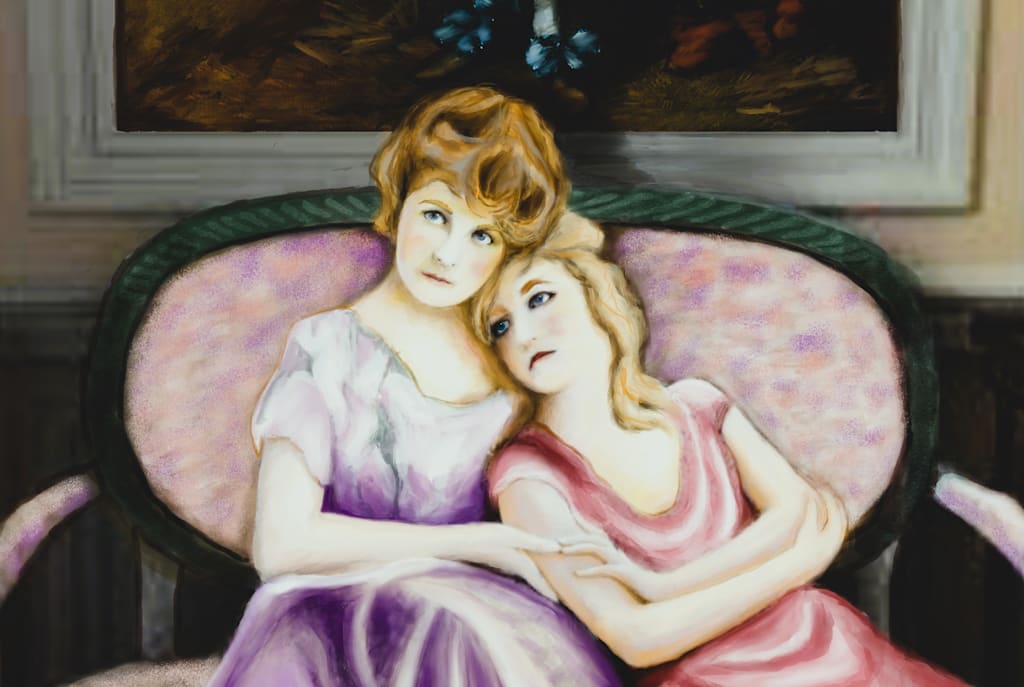
But here as in the dining room her mind returned to distant and forgotten things, the emotion generated by their absence surprising her as she steadied herself momentarily, her hand braced on the obliging television’s body. Looking about the room for some answering clue her eyes lit unexpectedly on the painting hanging on the wall, the beautiful women on its surface returning her gaze, the sitting room returning to uneasy life, briefly animated by the dreams that once upon a time filled it with hope and awe.
Every decoration and piece of furniture still testifies to its former glory, the matching Queen Ann mahogany coffee and end tables waiting stoically for meaningful use, the tarnished silver tray atop the former reclining next to an ornate cigarette lighter standing stiffly at attention, the sleeper sofa dozing nearby as the stuffed armchair and lazy boy wait silently with expectant and open arms.
Turning away from the painting and curious gaze of its beautiful inhabitants the old woman lifts her hand nervously to her mouth, staring for a brief moment into empty amorphous space, the hazy outlines of unremembered events still struggling to form in her mind, the surrounding silence a mocking echo of the precious and forgotten memories she forlornly seeks. As the reawakening past merges with the forgotten present she feels a brief wave of disorientation, standing in the once familiar room suddenly becomes dishearteningly foreign.
But the room remembers even if she does not, the memories flickering like lightening so distant that the thunder never quite reaches the ears, early images formed four decades past when the walls were still fresh and clean is as present and alive in the space surrounding her as the shadowy steps she had taken from the kitchen to the sitting room only moments before. Her hand still held nervously at her mouth, ghostly children, grandchildren, and finally great grandchildren cross her threshold to visit and then depart again, memories winding around her like swirling mists in time, remembered joy and sadness suffusing the surrounding atmosphere.
In those former days when her grandchildren were still young and impressionable, returning to the old woman‘s home was a little like riding a time machine into a simple and languid past, children who ordinarily preferred automotive transport to ferry them to and from their intended destinations would wander about with the old woman, strolling for distances far greater then they would have ever voluntarily walked in any other environ.
Long since grown to adulthood they fondly remember walking with her to the nearby Soldier’s Cemetery or making the longer trek to the shady park to wander among the stately pines or play on the swing sets, monkey bars, and the big silver slide. On the Lord’s Day they had donned their Sunday best and walked stiffly to the church on Tate, the only time the old man wore a suit rather than bib overalls, his tanned and muscular shoulders briefly hidden within the hot and itchy fabric. The old woman never learned to drive a car; her husband who did never owned one.
In the fifties and sixties the quaint flower petal shaped covers on the streetlamps cast the shadows of a simpler and earlier time as grandchildren perched on the old porch glider watching the lightening bugs glow in the dark evening air and listening to the old man tell tales of the old South. By the seventies, contemporary, utilitarian lamps lit the street overlooking the home’s concrete porch as rural Mississippi began to slowly modernize, but somehow the little brick house, like an island in a swirling sea did not change, becoming instead a singular refuge from the frantic hustle and bustle of a restless and changing world.
But something compelled her into the bathroom without reasoning why, her hands like automatons searching the medicine cabinet, pushing aside aspirin, rubbing alcohol and calamine lotion as she diligently searches for the folk remedies from her deep past. Closing the cabinet, she gazes unexpectedly at her reflection, the subliminal darkness hidden within her expression triggering a memory seared long ago in the living tissue of her brain. Its consequent signal reawakens the ancient scene with its resultant emotion together, her baby’s pinched face reappearing as if the former moment had never truly ended and her arms still hold him tenderly even now.
His tiny face red with the desire to live, she never again experienced the dread she knew in the following days and nights, expecting each withering breath to be his last. But the old man missed it all, off drinkin’ with his buddy’s as he so often had when he was really needed.
Thank God for mama, she whispers aloud. She could not have returned death’s cruel stare alone, not with three other children to love and nourish as well. The old man only returned once death’s terrifying shadow had passed and she knew in her heart that her precious son would live.
But the memory revives an old feeling of betrayal that she has never fully shaken, an awareness rising of an unnoticed hard place within, like a whet stone lodged within the lining of her stomach wall. She forgave the old man long ago, but it does not change the defining event of their life together or drive away the feelings birthed by its harsh trial. It all might have been different, she can’t help but think, if wasn’t for the booze.
Her hand begins to reach for the medicine cabinet again before reflexively pulling back and opening the bathroom closet instead. They have to be here somewhere she thinks as she leans her body into the space, her arm outstretched as it gropes within its darkened and secret corners. Where are the Solomon’s seal, Slippery Elum, and Commodore’s liniment? –she wonders as she draws her arm back out in exasperation.
Moving into her bedroom she searches as if she knows what she is seeking even if she has forgotten its name. Her hands rapidly root through each drawer of her sewing table before walking into the other bedrooms and carefully searching each in turn. Finally, she returns to the kitchen to search her junk drawer and then to the dining room to sort through the craft supplies within the old chifforobe.
Sitting in exasperation on one of the dining room chairs, her father’s cracklin’ voice suddenly declares in her thoughts, You can’t use any ole stone, only one from the belly of the white deer.
Her eye’s sparkling with surprise she exclaims aloud, Granddaddy’s mad stone. But where is it? Commodore died in 1947 and must have left the stone to her father, but what happened to it when he died as well?
Family legend had it that a Chickasaw medicine man gave it to Commodore on one of his sojourns into the heart of the Mississippi forest before it was all cut down. In the old days there was no other treatment for rabies or snake bite. People who were bitten would travel or were carried on litters to her grandfather’s house since its magic would not work if taken to the home of the victim.
Before applying it Commodore would boil it in sweet milk till the liquid turned green and while still hot he placed it on the bite marks where it would stick, sometimes for hours as it drew the poison from the wound. Once it fell off he would boil it again and replace it on the entry point, repeating as often as needed until it no longer adhered when placed upon the victim for the final treatment.
She knew that Commodore had used it many times to draw out the poison from Water Moccasin or Copperhead bites but she didn’t remember hearing that he ever treated anyone for rabies. Her daddy told her that a man in Oklahoma bit by a rabid horse was cured by a healer with three stones, but she often wondered at the truth of it.
The thought returning of the old man’s drinking, a disjointed anger rises in her chest as she thinks to herself – I needed that stone, before helplessly shaking her head, realizing the foolishness of the thought. Not even a mad stone could draw out the poison that drives a man to drown his failures in drink.
The old man thought he could control the terrible urge, but he continued to drink whisky everyday up to the night before he died. Lassie Boy did not give it up until the delirium tremens were already well advanced, his back already bowed beyond his years, the damage sown too great to ever fully amend. Koot’s life increasingly fragmenting, he has turned more and more to drink to help him cope, the quiet desperation in his eyes a look that she knows only too well. But she cannot seem to find the magic to bring him to back to his senses.
Blessed are those who mourn for they shall be comforted, Jesus once said, but a point comes in a boy’s life when he crosses the tenuous bridge to manhood and his mother’s arms are never quite the same again, the comfort the little boy once found in them vanishing forever into the mists of time.
On the other side of that bridge the test of living in a world fraught with terrors begins. His mother – who once upon a time stood protectively at his side – now peers from a distance into the life she long since birthed, nursed, and helped shape for the journey. Once he leaves home, she can do little more than celebrate when he triumphs and mourn when he fails.
But the one thing she can never do is bear the burden of his life in his place. If he suffers, she will suffer in equal and lasting measure but with this difference – she cannot lay down her life or bear on his behalf the afflictions once they have entered his life. He must carry those alone.
That in a word is the defining tragedy of the old woman’s life. For her the suffering of any creature great or small is intolerable. No other character trait so clearly defines her as this one. But the suffering of one of her children is made more intolerable still by the years she laid down her life for each. A love of that magnitude only comes at a terrible price. The pain of watching her child suffer when no balm is at hand to heal seems magnified a thousand-fold.
If the inanimate might grieve, water would bead upon the surrounding walls like perspiration on the skin, for who but the walls ever witnessed her silent grief, or knew the torments of her inmost soul?
She never sought blessings for herself, but only the power to confer blessings on others. She never sought to inherit the Earth, but only to prepare the way for others who one day will.
About the Creator
John Cox
Where would you like to travel? Who would you like to meet? No ticket required, a surprise at every destination guaranteed. Strap on your time travel goggles and bring a compass. It's sometimes bumpy in my imagination, so hold on tight!
Enjoyed the story? Support the Creator.
Subscribe for free to receive all their stories in your feed. You could also become a paid subscriber, letting them know you appreciate their work.
Comments
There are no comments for this story
Be the first to respond and start the conversation.