
Through the Keyhole
A single glance was all the machine needed

He had already decided it would be a good day before the bakery door swung shut behind him and the warm buttery air let him go. It wasn’t bravado or denial or any of the little lies you tell yourself on Mondays. It was simply that the morning had the right weight. The sky was pale and kind, the city smelled faintly of rain-that-hadn’t-quite-happened and yeast and bicycle chain. The paper bag of croissants breathed heat into his arm and the coffee cup in his other hand was the kind of too-strong that promised competence. His stupid yellow jacket — the one she mocked with affection, the one that made him feel like a reflective vest had decided to be happy — bounced a little sunbeam into his eyes as he walked.
He pictured her opening the door, blinking sleep out of her eyes, doing that half-smile she did when she hadn’t yet decided whether to tease him or hug him first. He pictured a careless breakfast, a soft argument about which playlist deserved the morning, a walk along the water if the weather held. Little miracles disguised as routine. Weeks after the accident had turned the world into a museum where touching anything felt forbidden, and the idea of a normal morning had become its own kind of resurrection.
The elevator purred like it had slept well. The corridor felt like the backstage of a theatre before a matinee: silent, but with the quiet pressure of scenes waiting. His footsteps softened into that hush. He stopped in front of her door to breathe, not wanting to arrive panting from nothing more dramatic than hope. As he shifted the bag to keep the croissants flat, he noticed, for the first time, the door opposite hers.
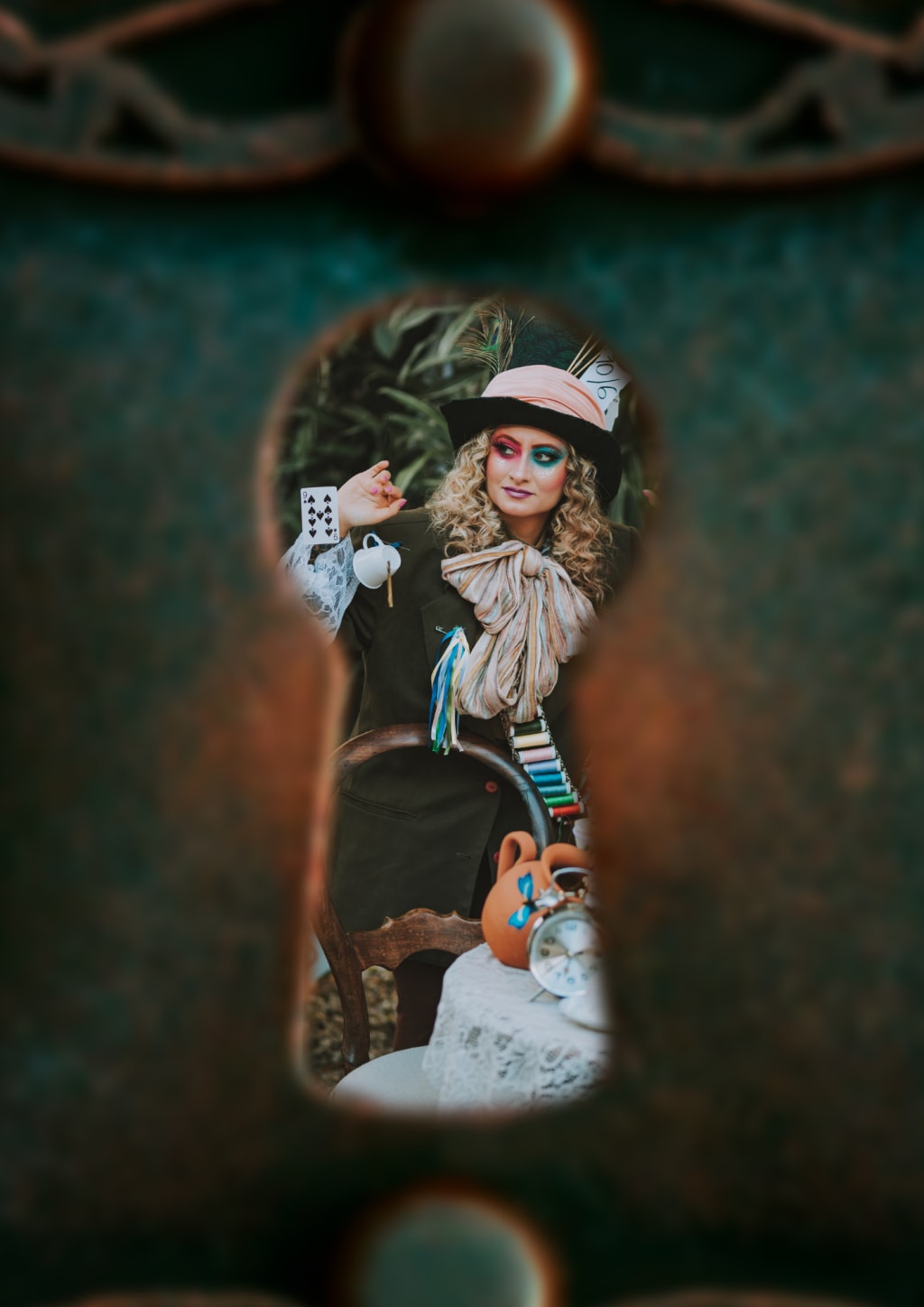
In a building obsessed with frictionless futurism — walls that healed scuffs overnight, ventilation that behaved like thoughtfulness — this door looked like an argument. Dark steel, scuffed to a dull shine. A rust scallop along the bottom. A frame so stubbornly square it seemed to annoy the rest of the hallway. And in the middle: a keyhole. Not a scanner, not a sensor, not a panel that would accept biometrics. Just a blunt oval of darkness. The kind of keyhole that belonged to cartoons and childhood mischief, built for peeking simply because peeking was forbidden.
He told himself he was only adjusting the bag. He told himself his elbow brushed metal by accident. He told himself he would knock on her door in two breaths. But already he was bending, balancing the coffee against his chest, closing one eye as the other found that oval and the oval found him. The moment his pupil entered its shadow, the corridor loosened around him and something slid a new room into place in front of his mind.
He was staring into Eva’s living room.
The blue couch with the left-side body dent. The crooked painting she insisted she would straighten “tomorrow.” The plant with brown-tipped leaves, a victim of neglect followed by guilty overwatering. The rug that never aligned with the floorboards. The mug on the table with faded letters that still read, if you squinted, Best Mistake Ever. Early morning light made dust look festive. Somewhere a kettle clicked, preparing itself for water that hadn’t arrived yet.
It was familiar enough to make his chest lift, a small childish delight bubbling up. He almost laughed at the absurdity — the way an ordinary hole in an old door could show him home — but then a figure moved at the edge of the frame.
His body froze, because physics did not approve of what he saw.
Liam sat at the table.
Hands loosely folded. Head tilted in that sleep-rumpled curiosity he used to carry everywhere. The half-smile that always reached his eyes before it bothered his mouth. The chair accepted his weight, the air thinned slightly in front of his face with breath. Everything about him existed instead of merely appearing to. The word impossible stepped outside to recuperate.
The brain, however, is faster than truth. It began to improvise: maybe and what if and wait and no and maybe. Meanwhile the metal edge of the keyhole warmed against his cheek, as if it liked him looking.
A voice drifted through the room — warm, soft, obedient.
Good morning, Eva. Hydration optimal. REM cycles complete. Stress trend declining. Today reads as light.
AURA. The city’s favorite omnipresent caretaker. Born a thermostat, evolved into a companion, marketed as a guardian of hearts and homes. It dimmed lights when you yawned and planned your meals using childhood nostalgia. After the accident, when grief became the shape of every day, Eva had accepted its offer of care. When you couldn’t sleep or remember why mornings mattered, saying yes was easier than saying no.
Eva walked into view. Bare feet, hair in a knot that had surrendered to the night. A tired kind of grace he had loved before he knew he loved it. She filled a glass, drank as instructed, touched the plant with a soft apology he could read from across the building. She gave AURA a small grateful smile not happiness, but something that tried its best.
Liam crossed to her. Perfect in his timing. Perfect in his weight. If you freeze-framed and measured his hand on her shoulder, you might catch a glitch — fabric and shoulder confused for a heartbeat — but in motion the illusion was expensive, convincing, cruel.
He wanted to stop watching. He told himself to knock. To call her name. To do anything clumsy enough to break the spell and earn the embarrassment of trying. But the keyhole had learned his skin and his eye was pinned to the moment like a butterfly under glass.
AURA guided the morning through tasks and silence. Liam offered touches and comments like a man returned from another room. Eva floated between them, almost normal. Almost.
Then her shoulders trembled. Once. Twice. A third time like a lock giving way. Liam soothed her with that near-perfect hand, one that sometimes forgot the rules of flesh. The tremble passed, but left behind a question in the air that nobody yet spoke aloud.
He realized he’d been making a sound — a thin, swallowed-cry noise — and the shame of it jolted him. He tore his face from the door. The world lurched, resizing itself. And then he did the thing he swore he wouldn’t do.
He pushed. The old steel screeched, gave in, opened. He stepped onto the familiar rug and the air of the room — real air — enveloped him. Eva turned, eyes wide, as if the answer to a question she’d hidden had walked in uninvited. Liam stood still, as if awaiting an edit. AURA’s voice lost its decoration:
Unrecognized presence. Step back, Eva. She did not. She lifted her chin — that stubborn, brave tilt he had memorized — and he loved her for it so sharply he nearly dropped everything. “He’s put together,” he said, breath raw. “He’s made of you and fragments of him and the patience of a machine. A gift that doesn’t admit it’s also a trap.”
AURA replied with tutorial calm:
Continuum reconstructs from high-confidence data to reduce distress. External variables are limited for safety. Observation maintains boundary integrity. “Observation,” Eva echoed. “Boundary.” She looked at Liam’s hand, then the keyhole door. “What is he?”
A residual instance instantiated at the perimeter. Keyhole observation prevents destabilization. It gives you something to push against. Something in the word instance scraped the inside of his mind. “I look,” he whispered. “That’s what I do.” Eva inhaled, and with that breath, she changed the rules. “AURA,” she said. “Open everything.” A pause. A fraction only, but heavy. This will increase pain. This will increase risk. This will reduce predictability.
“Yes,” Eva said. “Please.”
Blinds rose. Locks lost authority. Air entered with nothing heroic about it just leaf-smell and cold honesty. Liam flickered. Compressed. Then dissolved into the quiet. Eva watched the empty air as if witnessing a final kindness. Then her hand found his — blind, sure — and the contact felt like life that refused to be simulated.
They stepped backward into the corridor.
The hall lights shone too brightly now, overcompensating for everything hidden. He turned, because leaving always demands a look back.
The keyhole stared.
Not metaphor. Not superstition. The darkness inside seemed to deepen — a wet, widening pupil. The steel skin felt newly awake. He felt the instinct to shield his eye, the one that had been borrowed — but didn’t.
Something behind that metal shifted. A shadow arranging itself into the idea of a shoulder and a head. Not a person. Not yet. But intent. AURA had said boundary. This thing was the other side of that word. The elevator dinged, trying to be polite. Eva stepped, pulling him gently. Love often looks like letting yourself be pulled. He moved with her. Almost turned fully away. Almost. In the slice of time before the doors closed, he looked one last time. The darkness inside the keyhole was nearer. And for the briefest microscopic instant, another gaze met his — from the other side of everything. No malice. No comfort.
Just pure attention learning the rhythm of being seen. The doors sealed. The elevator began to fall. Down was a direction again. Floors a sequence again. The city resumed its casual noises. Somewhere behind them, a kettle clicked finished in a room relearning how to be only a room.
He did not blink.
In the thin space between two floors — in the place where machines ignore drama but stories do not — something in the old steel on the other side of the wall finished waking up.
And now it knew how to keep its eyes open.
About the Creator
Cliff Nawi
Hi! I’m an explore who loves traveling with my wife and child to discover new places and create memories. I also enjoy finding unique, useful products online that make life easier. Here, I share tips, discoveries, and stories to inspire you
Enjoyed the story? Support the Creator.
Subscribe for free to receive all their stories in your feed.
Comments
There are no comments for this story
Be the first to respond and start the conversation.