
This Call May Be Remembered
Remains

At 11:43 p.m., the living began calling their dead all at once.
Grief was normally kept to twelve-minute appointments. With seventeen minutes left, everyone had remembered the deadline.
My screen filled with the names of the requested dead. Mothers, husbands, a twelve-year-old boy from Leeds, two Labradors whose voices had been assembled from barks and the kind of optimism usually found only in cults. Every endangered line flashed the same amber warning:
LAST CALL - ECHO DELETION COMPLETES AT 00:00 UTC
Below our office, the bar had entered its final stretch of the evening. The bass came up through the floor and trembled in my cup, making the cold tea shiver as if it had received bad news.
I put my hand around it.
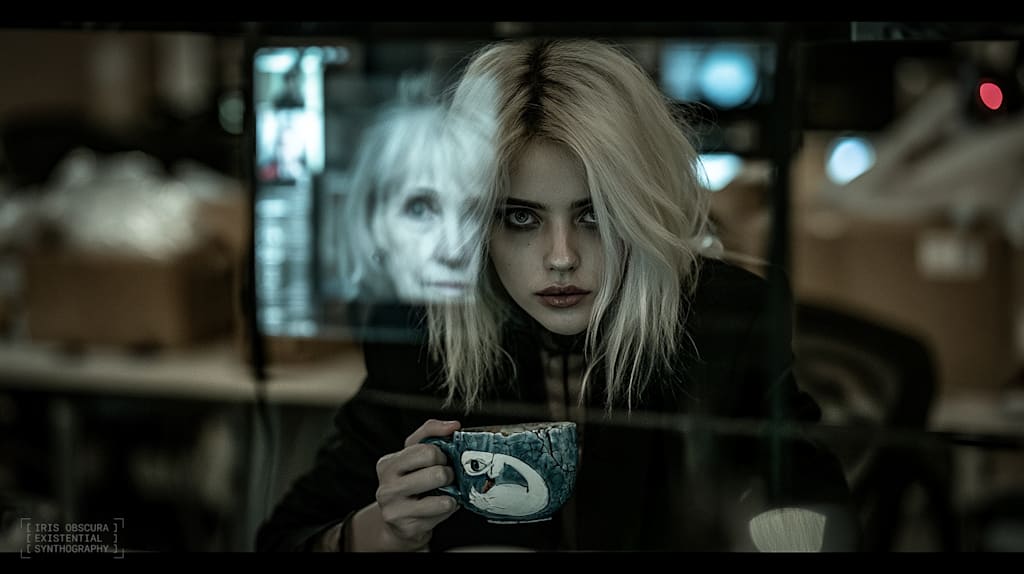
The cup had belonged to my mother. It was the blue of cheap swimming pools, with a hairline crack running from the lip to the painted white swan on its side. The swan had only one eye. My father used to say this made it profile-conscious. My mother used to say it made the swan married.
The tea was leaking slowly onto my desk.
"Stay professional," I told it.
The cup continued its little administrative death.
By midnight, Elsewhere Aftercare would have deleted 2.3 million echo profiles. Parliament had ruled that a dead person's voice and likeness could be simulated only with consent recorded before death. The ruling existed mainly because three dead actors had endorsed a bank they had despised while alive. There had been hearings. There had been expert panels. There had been an MP who wept beautifully and then accepted a directorship.
Only a few thousand profiles carried that permission; they would remain. Every new contract now asked the living to consent in advance. Everyone else had missed the paperwork by dying too soon.
My mother had been dead three years before Elsewhere existed. Her profile belonged to our legacy unit, which had become surplus with admirable speed. The company called the deletion a Consent Sunset. I supported the principle, which had been easier before it acquired my mother's face.
Around me, people packed mugs, desk plants and photographs of children between calls. Nobody said goodbye. We were still administering it.
For six years, I had supervised conversations between the living and simulations of the people who had escaped them. The models were built from voicemail, home videos, medical recordings, doorbell cameras, livestreams and whatever else grief could drag from the bins. Clients came to say goodbye, to ask where the bonds were kept, to continue arguments about wallpaper. A surprising number wanted passwords. Eternity, like marriage, was frequently delayed by online banking.
My job was to watch the sentiment meter and intervene if an echo became cruel, sexually inappropriate, or too honest for the package purchased.
Under ordinary conditions, a kinship filter kept employees away from their own dead. The last-night surge had disabled everything classified as nonessential, which apparently included professional ethics.
At 11:48, a flagged session surfaced in the unassigned queue.
CALLER: ANTON VARGA
ECHO: VERA VARGA
RELATIONSHIP: HUSBAND
TIME REMAINING: 12:00
The system knew Vera Varga was my mother. My father did not know I worked there. I opened the call anyway.
For a moment I did not breathe. Breathing seemed like an intimate habit I should not perform in front of them.
My father's camera came on first. He adjusted the phone against the sugar bowl until the frame was level, then sat back: older, badly lit, one cheek silver with stubble. He was at the kitchen table in the flat where I had grown up. Behind him, the wallpaper still wore its yellow flowers, each one opening its small, nicotine mouth.
Then my mother appeared.
Elsewhere had made her forty-eight, the age at which she died. Her hair was pinned up with the tortoiseshell clip I had lost after the funeral. Her mouth held the almost-smile she used before saying something educational and fatal.
Elsewhere rated her 96.8 percent faithful.
Nobody who knew my mother would have trusted the missing 3.2 percent.
"Anton," the echo said. "There you are, darling."
I flinched.
My mother had called my father darling only when she wished to make a knife feel underqualified.
He did not flinch. He leaned toward the screen, both hands flat on the table.
"Vera."
"Have you been eating?"
"I had soup."
"Soup is not food. Soup is what happens to food when it loses an argument."
That was hers. I remembered it from a video. The system displayed its source in pale text: CHRISTMAS EVE / FAMILY ARCHIVE / CONFIDENCE 99.1%.
My father laughed once. The sound came apart quickly.
"Do you remember the blue cup?" he asked.
The echo smiled. "Of course. We bought it in Prague on our honeymoon."
We had never been to Prague. The cup came free with a tin of coffee from the supermarket near the tram depot, not long after they married. My mother said she kept it because my father hated the colour. My father said, "It was free and still usable." Neither account contradicted the other.
My father closed his eyes.
On my console, the accuracy meter dipped. A box appeared:
MEMORY CONFLICT DETECTED. OFFER COMFORTING ALTERNATIVE?
I selected NO.
"You hated that cup," he said.
"I loved it because you hated it. A marriage without one ugly cup is just two people paying rent."
That line had no source citation. It could still have been hers.
I looked at the blue cup in my hand. Tea had reached the keyboard in a narrow brown tongue.
Nine years earlier, my parents had been separated for fourteen months. My mother lived two streets away. Every Sunday my father crossed those streets to repair her kettle, radio or lamps, including several objects that had not been broken before he arrived. They called this maintenance because calling it love would have required paperwork.
On the last evening, she told him to stop coming unless he could arrive as himself. They fought. He left for the tram stop.
Three minutes after midnight, my mother called me. I was dancing in the bar downstairs, though in those days it had another name and fewer regulations concerning fire. Elsewhere moved into the rooms above it three years later. I applied before the paint dried.
That night, my phone was in my coat. I saw her name when I went outside at two, shining from the screen with the prim accusation of a missed dentist appointment. Beneath it waited a seven-second voicemail.
By then, she was dead on the landing between the third and fourth floors.
The aneurysm had given her perhaps ten minutes. An obscene little gratuity. Enough time to understand, to sit down, and to reach for the phone.
At the funeral, I asked my father whether she had called him.
"No," he said. "Only you."
Not cruelly. Cruelty would have been cleaner. He said it the way one reads a label on a suitcase before handing it to the person who must carry it.
I had carried it for nine years.
I had never listened to the voicemail. I lost it when I changed phones. For years I imagined those seven seconds filled with accusation. Sometimes with tenderness, which was worse.
On-screen, the clock read 08:26.
"The lights will go out from the bottom up," the echo said, but my father spoke over her.
"I lied to Lena," he said.
The room contracted around me. Even the bass below seemed to miss a beat.
The echo tilted her head. "About what?"
"That night. You called me first."
My fingers went cold around the cup.
"I saw your name," he continued. "We had fought. I wanted you to be frightened for a minute. Just one minute. A small punishment."
He rubbed his thumb against the table. I knew that gesture. He used it to erase crumbs, debts, evidence.
"I let it ring. Then I turned the phone face down."
The echo's expression softened. Elsewhere had learned that softness increased customer retention.
"Anton," it said, "you could not have known."
"No."
"You must forgive yourself."
"No."
"I would not want you to suffer."
"You don't know what Vera wanted."
For the first time that evening, I loved him a little.
Then I hated myself for the administrative inconvenience.
The clock read 06:51.
"Why did you tell Lena I never called you?" the echo asked.
My father looked toward the dark kitchen doorway. Perhaps he expected me to come through it at nineteen, white-haired from bleach, glitter on my throat, still furious at being alive.
"Because she already blamed herself," he said. "I made it her fault so it would stop being mine."
There are confessions that open a door. This one removed the building.
I stood so suddenly the tea spilled across the desk. The one-eyed swan watched the spreading stain with professional detachment.
My cursor hovered over TERMINATE SESSION.
Six years earlier, on my first day at Elsewhere, they taught us that interruption could retraumatise a client. They did not explain what to do when the client had spent nine years subcontracting his trauma to you.
I opened the intervention channel.
The software offered three approved responses in my mother's voice:
I FORGIVE YOU.
WE BOTH DID OUR BEST.
LET US REMEMBER THE LOVE.
It also offered CUSTOM.
I selected CUSTOM.
The intervention channel joined my camera and microphone to the call. On my father's screen, the model laid my mother's face and voice over mine, keeping my office around her. It changed flesh, not objects.
"Oh, Anton," I said.
The voice that came out was smoky, amused, with the soft country vowels my mother had spent thirty years trying to sand away.
I borrowed my mother's habit of turning every wound into housework. I kept my own anger.
My father froze.
"Do not buy forgiveness from a machine at eleven fifty-four," I told him through her mouth. "It is embarrassing for everyone."
He stared at the screen.
"Vera?"
"What a rude question to ask a dead woman."
The clock read 05:03.
He leaned closer. "Is this in the program?"
"Everything is in the program once you pay enough. That was always your political philosophy."
His face folded, not into grief exactly, but recognition. The blade was my mother's. The hand was mine. He recognised only the blade.
"I called back after eight minutes."
"At 12:03?" I asked through my mother's mouth.
"Yes. Your line was busy."
"I was calling Lena."
"I know."
"A masterpiece of punctuality."
"When the line cleared, I tried again. You didn't answer. I went back. I found you on the landing before the ambulance came."
My anger wanted to make noise. Instead, I sat again.
"You made Lena believe she was the only one who failed me," I said.
"Yes."
"Why are you calling now?"
"Because this is the last call."
"That is a slogan. Try again."
He looked down at his hands.
"I paid for six calls before this one. I hung up before you answered. For nine years, every morning I put my phone face-up beside the saucer, make coffee, and wait until the coffee is cold."
The bar below changed songs. Someone cheered with the wounded courage of a person ordering another drink on borrowed money.
Three minutes, forty-two seconds remained.
"Have you spoken to Lena?" I asked.
"She blocked me."
"People can be reached by other means. Letters. Doorbells. Public embarrassment."
"I wrote letters."
"Did you send them?"
He said nothing.
"Anton."
"No."
"Then you wrote stationery."
He laughed. This time the laugh remained standing.
Two minutes, fifty-seven seconds.
The deletion process began on the lower-capacity servers. Across my screen, voices vanished. A grandmother in Manila disappeared halfway through a recipe. A man in Ohio was released from apologising for the same affair for the four-hundredth time. The Labradors went together, which was more mercy than our species generally managed.
My mother's image flickered.
"Tell me what to say to her," my father whispered.
I looked at the three approved sentences, those inflatable life jackets of language. I closed the box.
"Say the small true thing," I told him.
"What small thing?"
"You know."
"I don't."
"Then begin there."
One minute, forty-eight seconds.
He reached for something beyond the camera and brought back a saucer. White porcelain, blue line around the edge. The saucer that belonged under my cup.
"I kept this," he said. "You took the cup when you moved out. Lena kept it after you died. I found the saucer behind the radiator."
My throat tightened. It was such a ridiculous inheritance: two pieces of crockery divided by two streets, death, and the outstanding stupidity of the living.
I lifted the cup to the camera.
My father stopped breathing.
"Lena?"
The model tried to animate my mother's face, but I had stopped speaking. Her lips remained parted around my silence.
Fifty-nine seconds.
"Lena," he said again.
I released the echo into its own pane, stripped off the filters, and remained in the call.
"Yes."
My own face appeared on his screen. My voice sounded indecently naked.
He touched two fingers to the screen. I did not. We were not that kind of family.
"I am sorry," he said.
"For which thing?"
"I don't know where to start."
"Good. Start there."
In the pane beside his live feed, my mother's echo began to fragment. One eye blurred. Her hair loosened into pixels.
My father looked past me toward her.
"Vera," he said.
The echo smiled with somebody else's forgiveness.
"Don't," I told it.
The smile vanished. Its one clear eye found me. Its mouth opened. I had released it; whatever came next was not mine.
Seven seconds.
"Put a saucer under it," my mother said.
Then she was gone.
Whether this was an emergent act, a tracking error, or my own hunger leaning against the glass, I could not tell.
My mother's half of the screen went black. My father's face remained in the other. The legacy servers fell quiet one rack at a time, a corridor of mechanical exhalations. Somewhere inside them, millions of dead people surrendered the final words we had written for them.
At midnight, the legacy unit—and my employment with it—ended. My father's call did not.
The synthetic layer had gone; the older, cheaper line beneath it, built for the living, remained.
Neither of us had counted on this. Nobody had scheduled what happened after the dead left.
From the bar below came a crash and applause.
My father held up the saucer.
I put the blue cup down on my desk. Tea gathered beneath it in a perfect brown crescent.
"It leaks," I said.
"I know."
"You knew?"
"Your mother knew. She kept using it."
"Of course she did."
"Of course."
Between our two faces, my mother's half of the screen stayed blank. We were two cowards suddenly deprived of our favourite ghost.
After a while, my father said, "I don't know what to say next."
The clock on the wall continued past midnight, vulgar and miraculous.
I slid a saucer from beneath the office sugar bowl and placed it under the cup.
"Neither do I," I said. "Stay on the line."
About the Creator
Iris Obscura
I am many women. I am Iris.
Polite, sane, restrained? No. None of that.
Entropy at 3 am. Dead things stirring in your mind’s eye. Raking through your inner beauty to find something it hasn’t prettied up.
Maybe those.
Sometimes tender.
Read on.
Enjoyed the story? Support the Creator.
Subscribe for free to receive all their stories in your feed. You could also become a paid subscriber, letting them know you appreciate their work.
Comments
There are no comments for this story
Be the first to respond and start the conversation.