
They Waved Back
The village understood before they did

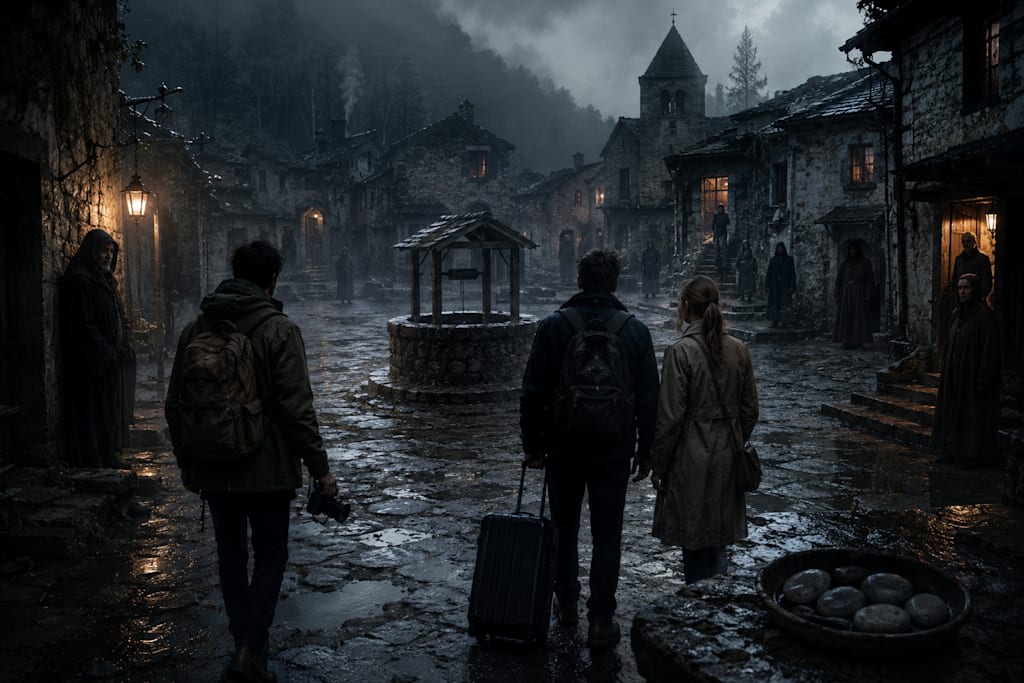
The first mistake was the shoes.
Not the road. Not the weather. Not the fact that they arrived after dark, though everyone later agreed that arriving after dark was unwise.
It was the shoes.
White soles. Clean leather. Bright laces that caught the last gray light as the three visitors stepped from the rental car and looked at the village as if it were something arranged for them.
The village watched without appearing to.
No curtains moved. No doors opened wider. Smoke continued lifting from chimneys in the same narrow lines. The dogs, who usually barked at anything with wheels, lay quiet beneath doorways and did not raise their heads.
The tallest of the visitors checked his phone.
"No signal," he said.
The woman beside him laughed softly, as if this confirmed a charming inconvenience.
The third man lifted a camera and took a picture of the square.
He did not ask.
That was the second mistake.
Across the square, Old Tomas stood beneath the awning of the closed bakery and counted them with his eyes.
Three.
Too few to be official.
Too many to be lost.
The visitors crossed the square toward the inn, their shoes bright against the dark stone.
No one in the village wore white soles.
Not because of mud.
Because white showed where you had stepped.
Inside the inn, Mara heard them before she saw them: the rolling scrape of luggage wheels over the threshold, the careless rhythm of people entering a place that had not invited them.
She looked up from the ledger.
The tall one smiled first.
"We have a reservation," he said.
His voice carried the polished certainty of cities, where every closed door is assumed to contain a mechanism for opening.
Mara turned the ledger toward herself.
"Name?"
"Daniel Reeves. Two rooms. Three nights."
He placed his passport on the counter before she asked for it.
The woman, Elise, stood slightly behind him, scanning the room. Her eyes moved over the blackened beams, the low ceiling, the row of keys hanging on numbered hooks, the clay bowl beside the door filled with small gray stones.
"What are those for?" she asked.
Mara followed her gaze.
"For leaving," she said.
Elise smiled, uncertain.
Daniel glanced at the bowl. "Local tradition?"
Mara did not answer.
The third visitor, Simon, raised his camera toward the hearth.
"No photographs inside," Mara said.
He lowered it halfway. "Just the room. It’s beautiful."
"No photographs inside."
Something in her tone made him drop the camera fully.
For a moment they all listened to the fire.
Outside, the square had darkened.
Mara gave them keys for rooms four and five.
"Breakfast is at seven," she said. "Do not open the east shutters. Do not go to the well after sunset. If someone knocks before dawn, wait until they knock twice."
Daniel laughed once, then stopped when no one joined him.
"Is that serious?"
Mara slid the ledger closed.
"Here, things are serious before they are explained."
Elise looked toward the door.
Behind the glass, the square was empty.
But not unwatched.
They should have left then.
People later said this without blame. By then blame had become too simple, and too late.
They should have turned around, driven back through the forest, crossed the bridge before the fog came down, and returned to whatever place had taught them that understanding was a right.
Instead, Daniel thanked Mara.
Simon asked about Wi-Fi.
And Elise picked up one of the gray stones from the bowl.
Mara’s hand closed around her wrist.
Not hard.
Fast.
Elise froze.
"Put it back," Mara said.
The room changed around them.
The fire lowered. Or seemed to. The air pulled tight.
Elise placed the stone back in the bowl.
Mara released her.
"Sorry," Elise said.
Mara looked at the stone until it settled among the others.
"No," she said. "Not yet."
That night, in room five, Elise opened the east shutters.
She did it because the room was hot and because the window faced the hills and because rules, when not explained, begin to feel decorative to people accustomed to choosing which instructions deserve obedience.
The shutters stuck at first.
Then gave.
Cold air entered the room in one slow breath.
Outside, the hills were black shapes against a paler black sky. No stars. No moon. Only the dark line of the forest and, below it, the village roofs crouched close together.
Elise leaned out.
At the edge of the square, near the old well, someone was standing.
A woman, maybe.
Or a man with long hair.
Difficult to tell at that distance.
The figure raised one hand.
Elise stepped back and closed the shutters.
Not because she was afraid.
Because she did not want to explain why she had opened them.
In room four, Daniel slept badly.
He dreamed of footsteps in the corridor and woke to find wet soil on the floor beside his bed.
A narrow trail of it led from the door to the window.
He sat up, listening.
From the other side of the wall, Simon whispered, "Are you awake?"
Daniel frowned.
"You’re in the wrong room."
A pause.
"No," Simon whispered. "I’m still in mine."
The voice was coming from the wall itself.
At breakfast, no one mentioned sleep.
The dining room smelled of dark bread, boiled coffee, and woodsmoke. Villagers sat at three tables, speaking softly. When the visitors entered, the conversations did not stop. They thinned.
Mara placed bowls in front of them.
"Eat before speaking," she said.
Simon looked at the bowl.
"What is it?"
"Breakfast."
He smiled. "Right. But what kind?"
An old woman at the next table closed her eyes.
Daniel touched Simon’s sleeve under the table.
They ate.
It was warm and sour and unfamiliar. Elise finished hers. Daniel managed half. Simon pushed his around with his spoon until Mara came to remove the bowls.
"You didn’t eat," she said.
"I’m not very hungry."
"No," Mara said. "You are careful too late."
Simon laughed because he thought she might be joking.
Outside, fog pressed against the windows.
The village looked smaller in daylight, but not clearer.
Houses stood with their backs slightly turned to the road. Doorframes were marked with thin vertical scratches. At each threshold sat a gray stone like those in the inn bowl. Some stones were smooth. Some were cracked. One, outside the smithy, was tied with red thread.
Simon photographed it.
A child across the street saw him and ran inside.
Daniel lowered Simon’s camera.
"Maybe don’t."
"It’s public space."
"Is it?"
Simon looked around.
No one was openly watching.
That made it worse.
They walked toward the well.
Not intentionally, they later insisted. They were exploring. There were only three streets and all of them seemed to curve inward, toward the square, toward the dark circular mouth of the well at its center.
During the day, the well looked ordinary enough. Stone rim. Iron crank. Wooden cover pulled halfway across.
Elise stood a few feet away.
"This is where she said not to come after sunset," she said.
Daniel checked the sky. "It’s morning."
Simon leaned over the rim.
"Careful," Daniel said.
Simon laughed. "You’re getting superstitious."
His voice dropped into the well and did not echo back.
That silenced them.
Simon leaned farther, listening.
From below came a sound like water moving under ice.
Then, faintly, someone knocked.
Once.
They stepped back together.
The village doors remained shut.
The dogs had gone indoors.
Elise whispered, "We should go."
Daniel nodded.
Simon did not move.
He stared into the well as if someone had said his name from far below and he was trying to decide whether politeness required an answer.
"Simon," Daniel said.
The second knock came from beneath the stones at their feet.
The well cover slammed shut.
Not by wind.
Not by hand.
The sound cracked across the square.
A door opened.
Old Tomas stood in the bakery entrance.
"Back to the inn," he said.
No one argued.
That should have been the end of it.
It was not.
By afternoon, the fog had swallowed the road.
Daniel went to the car and found the tires packed with clay up to the rims, though the square itself was dry. The windshield was covered in thin vertical scratches, identical to those on the village doorframes.
Simon took photographs until his camera stopped working.
Elise sat in the inn parlor with Mara, watching the fire.
"What is this place?" Elise asked.
Mara mended a tear in a tablecloth with black thread.
"A place," she said.
"You know what I mean."
"Yes."
"Then answer."
Mara pulled the needle through cloth.
"You came here thinking places wait to be understood. They don’t. Some places continue with or without your understanding."
Elise looked toward the window. The fog outside moved against the glass like breath.
"Can we leave?"
"Not today."
"Tomorrow?"
Mara tied off the thread.
"If you stop asking the wrong questions."
Upstairs, Simon opened the east shutters in room four.
His room had no east window.
That was what Daniel kept saying afterward. Room four faced the square. Room five faced east. Room four had one window, west-facing, above the kitchen roof.
But when Simon opened the shutters, the hills were there.
Dark.
Close.
Waiting.
He lifted his camera, though it had stopped working.
In the viewfinder, the hills moved.
Not the trees.
The hills.
As if something beneath them had shifted its weight.
Simon lowered the camera.
At the edge of the forest, three figures stood in a row.
One raised a hand.
Simon raised his back.
Downstairs, Mara dropped the needle.
At sunset, the knocking began.
Not at the inn door.
At every door.
Once.
The village held its breath.
No one moved.
Inside the inn, Daniel, Elise, Simon, and Mara stood in the corridor between the rooms and the stairs. The fire had gone nearly out.
"What do we do?" Daniel whispered.
Mara looked at Simon.
"What did you answer?"
Simon’s mouth opened.
"I didn’t -"
Mara stepped toward him.
"What did you answer?"
"I waved," he said. "That’s all. Someone waved, so I waved back."
Elise covered her mouth.
Daniel said, "That can’t matter."
Mara turned to him.
"That is why it matters."
The second knock came.
Every door in the village answered at once.
Wood trembling in frames. Locks shivering. Hinges tightening. A sound like the place itself being asked to open.
Mara moved fast.
She took three stones from the bowl by the inn door and placed one in each visitor’s hand.
"Hold these until morning."
The stones were cold.
"Do not speak if you hear your name."
"What happens if we do?" Elise asked.
Mara looked at the staircase.
"Then it knows which voice to keep."
The third knock came only at the inn.
Not on the front door.
On room four.
Simon’s room.
He dropped the stone.
It hit the floor once and split cleanly in half.
Mara closed her eyes.
From behind the door came Simon’s voice.
"Let me in."
Simon stood beside them in the hall.
His face emptied.
Behind the door, his voice laughed softly.
"Please," it said. "I don’t understand."
No one moved.
The handle turned.
Mara picked up the broken stone too late.
The door opened inward.
What stood inside room four was not visible in any way that could be remembered cleanly. Later, Daniel would describe height. Elise would describe wet hair. Mara would say nothing at all. Simon would not be available to ask.
It wore the shape of invitation.
That was the closest Elise came to language.
It stood in the wrong room, in front of the wrong window, with darkness behind it where the wall should have been.
Then it reached for Simon.
Daniel grabbed him first.
For one second they held him between them: Daniel pulling backward, the room pulling forward, Simon suspended in the narrow grammar of rescue.
Simon screamed once.
Not in pain.
In recognition.
The room took him.
The door closed.
The inn became very still.
No one slept.
At dawn, room four was empty.
No east window. No soil. No scratches on the floor.
Only Simon’s camera lay on the bed, dry and broken, its strap tied neatly in a knot.
Mara took it without touching the lens.
Daniel sat on the hallway floor, shaking.
Elise stood at the top of the stairs, looking older than she had the day before.
"We need to leave," Daniel said.
Mara nodded.
"Yes."
The fog had lifted from the square but still covered the road beyond the bridge.
Villagers stood at their thresholds, each holding a gray stone.
No one spoke to the visitors as they crossed to the car.
The tires were clear now. The windshield unmarked. The engine started on the first try.
Elise looked back once.
At the inn door, Mara stood with Simon’s camera in her hands.
"Where is he?" Elise asked.
Daniel gripped the wheel.
Mara did not answer.
Old Tomas stepped into the road ahead of the car.
Daniel braked.
The old man approached the driver’s window and looked not at Daniel but at Elise.
"You will want to explain," he said.
She did not deny it.
"Don’t."
Daniel stared at him. "People will ask."
"Let them."
"We can’t just -"
"You can," Tomas said. "You must."
He placed one gray stone on the dashboard.
It was the stone Elise had picked up from the inn bowl the first night.
Whole again.
"Do not bring anyone back," he said.
Then he stepped aside.
Daniel drove.
No one stopped them.
The village remained in the rearview mirror longer than it should have, then vanished all at once as the road dipped between trees.
For twenty minutes, no one spoke.
Then Daniel’s phone found signal.
It chimed six times.
Messages. Missed calls. Weather alerts. Ordinary proof of an ordinary world.
Elise began to cry without sound.
Daniel pulled over near the first gas station.
He got out and stood in sunlight beside a pump, breathing hard.
A woman filling her car glanced over.
"You folks all right?" she asked.
Daniel opened his mouth.
Elise touched the gray stone on the dashboard.
From inside the trunk, Simon’s camera clicked once.
No one moved.
The woman at the pump frowned.
"You need help?"
Daniel looked at Elise.
Elise looked at the trunk.
The camera clicked again.
Once.
Then the smallest pause.
As if waiting to be answered.
About the Creator
Alain SUPPINI
I’m Alain — a French critical care anesthesiologist who writes to keep memory alive. Between past and present, medicine and words, I search for what endures.
Enjoyed the story? Support the Creator.
Subscribe for free to receive all their stories in your feed. You could also become a paid subscriber, letting them know you appreciate their work.
Comments
There are no comments for this story
Be the first to respond and start the conversation.