
They Shouldn’t Have Come Here
A story about a place that does not forgive misunderstanding

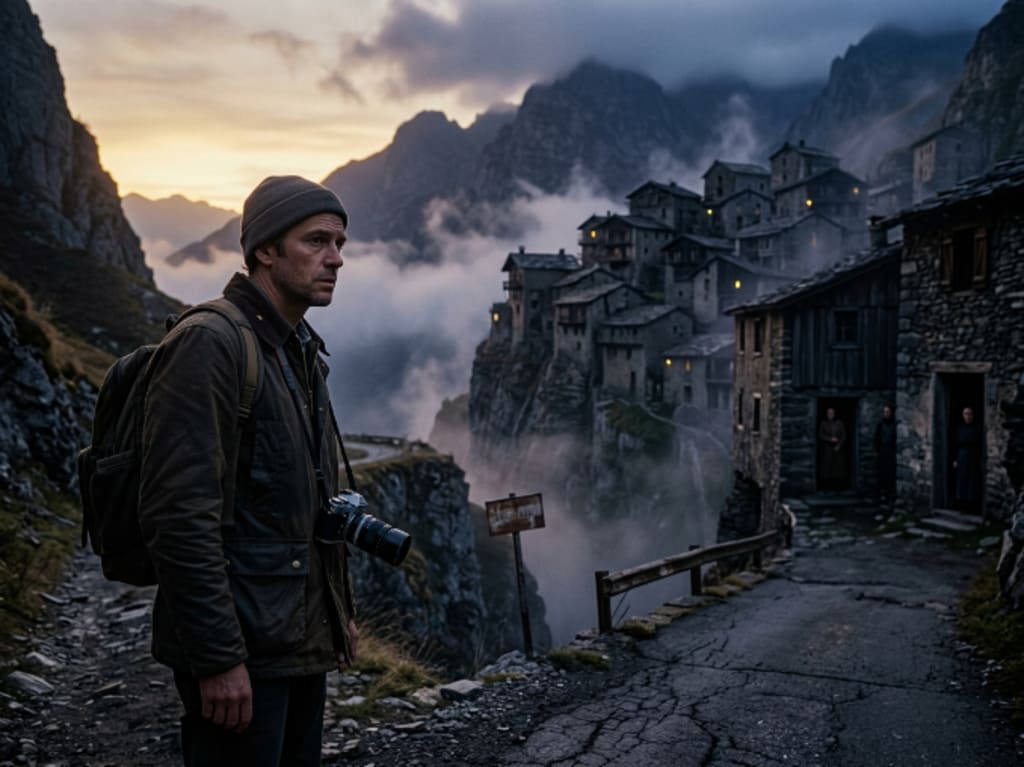
The road ended long before the village appeared.
That was the first thing Elias noticed—but not the last thing he ignored.
He stood beside the cracked jeep, dust clinging to his boots like it had decided to keep him. The driver had already turned around without a word, as if silence was part of the payment. Behind Elias, the mountains rose like ancient, watchful things. Ahead, somewhere beyond the heat shimmer, was the place he had come for.
A village not on most maps.
A story someone had called “perfect for a journalist.”
“They don’t like outsiders,” the driver had warned.
Elias had smiled at that. He had heard it before.
Now, he wasn’t smiling.
The village appeared slowly, as if it was deciding whether to be seen.
Stone houses stacked like they were trying to climb back into the mountain. Narrow paths that bent where they shouldn’t. No signs. No noise. Even the wind felt quieter here, like it was careful not to disturb anything.
The first child saw him before the adults did.
She stopped mid-step, a basket of dry grass in her arms. Her eyes locked on him—not curious, not afraid. Measuring. Like she already knew how this would end.
Then she ran.
By the time Elias reached the center of the village, people were watching from doorways, windows, shadows. No one greeted him. No one asked his name. They just… recorded him with their eyes.
Elias lifted his camera anyway.
That was mistake number one.
He introduced himself to the elder that evening.
The man sat under an old mulberry tree, carved into the ground like he had grown there. His face did not move when Elias spoke.
“I’m here to document your traditions,” Elias said. “Your way of life. It’s important people know.”
The elder finally looked at him.
“That is why they come,” he said quietly.
Elias didn’t understand the weight in those words.
Not yet.
The first night, someone left bread outside his door.
The second night, the bread was gone.
The third night, the door had scratches on it.
Elias began noticing things he couldn’t explain. Conversations that stopped when he entered. Names that were not spoken when he asked. A bell that rang at dawn, though there was no bell tower.
And always—always—the feeling that the village was watching him even when no one was visible.
Still, he worked.
He recorded interviews that ended too quickly. He photographed faces that turned away just before the shutter clicked. He wrote notes that felt heavier each time he read them.
He told himself this was normal. Cultural distance. Fear of outsiders. He had studied this in books.
Books, he would later realize, do not warn you when you are being tolerated instead of welcomed.
On the seventh day, he followed a group of villagers into the hills.
He didn’t ask permission.
He thought he was being careful.
They walked for hours until the village disappeared completely behind stone ridges. There, carved into the mountain, was something Elias had not expected.
A wall.
Not built to protect.
Built to hide.
Symbols covered its surface—old, layered, repeated so many times they had become something like language and something like warning at the same time.
Elias raised his camera.
And for the first time, someone spoke sharply.
“No.”
The voice wasn’t loud. It didn’t need to be.
Elias lowered the camera slowly. “What is this place?”
No one answered.
But the wind did something strange then. It shifted direction, carrying a sound that didn’t belong to it.
A whisper—or maybe memory.
That night, the village changed.
Doors closed earlier. Lamps stayed unlit. Even the children were gone from the paths.
Elias felt it before he saw it: something had broken, or been disturbed.
At midnight, the elder came to his door.
“You went to the wall,” the man said.
It wasn’t a question.
Elias hesitated. “I was just documenting—”
“No.” The elder’s voice cut through him like stone. “You were looking.”
Silence stretched between them.
Then the elder added, softer, “That is worse.”
They took him before sunrise.
Not violently. Not quickly. Just… inevitably.
The same paths he had walked freely now felt narrower. The same village that had ignored him now guided him without words. He tried to speak, to explain, to offer apology or logic or journalism—but language seemed suddenly useless here.
At the wall, they stopped.
The elder stepped forward.
“This place is not forgotten,” he said. “It is contained.”
Elias frowned. “Contained?”
The elder finally looked at him like he was something fragile and already broken.
“Some things,” he said, “should not be remembered too clearly.”
They didn’t harm him.
They didn’t need to.
They simply made him leave.
By the time he reached the edge of the mountains again, his recordings were gone. His notebook was empty. Even his camera memory card—wiped clean, no sign of corruption or deletion.
Just absence.
The driver was waiting where the road resumed, as if nothing had happened.
As Elias climbed into the jeep, he looked back once.
The village was no longer visible.
Or perhaps it had never been meant to be.
Months later, Elias tried to write about it.
He couldn’t.
Every sentence felt like it was slipping away before it finished forming. People who read his drafts said they sounded… incomplete. Like something essential was missing, though they couldn’t say what.
Sometimes, at night, he would wake up thinking he still heard the dawn bell.
But there was no bell.
Only silence.
And the memory of a place that had decided he should not take it with him.
About the Creator
Muhammad Zeeshan
I’m Muhammad Zeeshan, a curious student who loves science, geology, and exploring how the Earth works. I write to share ideas, stories, and knowledge that inspire thinking and discovery.
Enjoyed the story? Support the Creator.
Subscribe for free to receive all their stories in your feed.
Comments
There are no comments for this story
Be the first to respond and start the conversation.