
The Wrong Road
For "They Shouldn't Have Come Here" Challenge


July 19, 1994
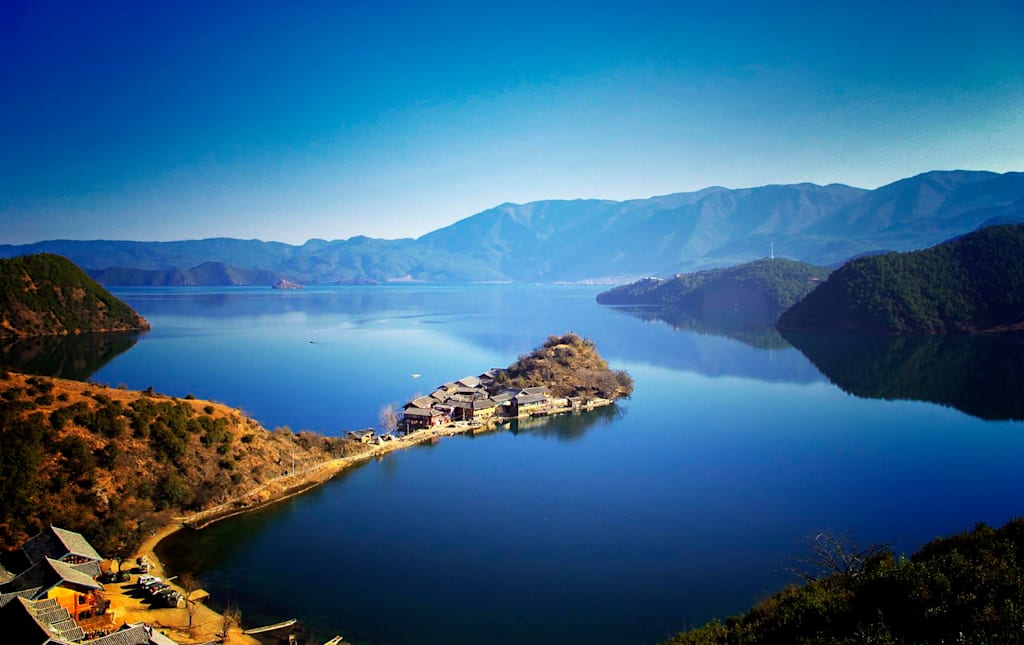
Wei was standing on the shore of a beautiful lake the name of which he didn’t know. He’d thought it was just a pit stop on their way to his final destination in Tibet, as his driver had stopped his overheating BJ212 military surplus vehicle and opened up the hood, trying to cool it down. Wei got out of the Jeep-looking car and went to the lake shore, admiring its breathtaking beauty. When he heard the car start and turned around, he saw his bag on the ground and the car driving off. Wei shouted at the driver to wait for him, but the driver just waved him off and said something that he’d reached his destination. Or brought Wei as far as he could.
Frustrated, Wei picked up his bag, went back to the lake shore and plopped himself on the sand. He needed to collect his thoughts. The day started out strange. Early in the morning, he was in a Kunming tea house getting a bribed permit to enter Tibet and negotiating a drive there with his fixer. His mom had taught him smooth Mandarin. He felt capable, confident, and prepared. That would be the last time he’d feel like that in the country he’d always longed to go.
His fixer arranged for a driver with a Land Cruiser and said that they’d have to make a couple of stops and possibly change cars and drivers because of the challenging mountainous roads, but Wei didn’t realize what it could mean. He was eager to get on the road and they left right away.
When they reached Dali around noon, his driver suddenly said that he couldn’t go further and that his cousin would take Wei to Diqing, where he’d have to spend the night before going all the way to Chamdo in Tibet. The cousin arrived in a beat-up BJ212 that had obviously rode too many a mountainous road and looked incredibly uncomfortable with its rugged seats, but Wei had no choice.
The driver was not particularly talkative and even though the road was rough, Wei managed to doze off a little. It must have been at that time that the driver took a road branching off slightly east rather than true north and ended up at Lugu Lake instead of Diqing. It was easy to do in 1994 with no GPS, poor signage, and winding mountain roads. But Wei didn’t know that yet.
He was surprised that the driver just left him there without helping him find a place to stay. There must have been some confusion in translation or cultural misunderstanding, he told himself admiring the lake. Located at high altitude and ringed by mountains feeding it with glaciers and mountain rivers, it was impossibly clear. Wei pulled out a faded photo from his bag with the image of a teenage girl in traditional Tibetan clothing. The back of the photograph said, “Jinpa, Chamdo, summer 1969.”
“I’ll find you, mom,” Wei said to the photograph. “Whatever it takes. I am just a day’s travel away.”
It was getting late. Sitting on the shore, Wei didn’t even register that he was watching the most stunning sunset, with the scarlet red of the sun reflecting on the lake’s mirror.
Suddenly Wei heard voices. Turning around, he saw a group of people moving toward him. He got up and approached the oldest man he could spot, asking in confident Mandarin where he was and if it was the road to Tibet. The man smiled at him pleasantly and gestured toward a woman nearby without a word. Wei assumed the man didn't understand his Mandarin and approached the woman.
The woman looked anywhere between 65 and 80, and Wei heard others addressing her as Ami. She assessed Wei in about five seconds and waved at him to follow her to a large rectangular two-story house. He was given a small outer room on the ground floor, with a sleeping mat and an oil lamp. He offered money and received a slightly offended look. His effusive Mandarin thank-yous landed on deaf ears. People around him moved quickly and without a word.
While walking around the compound, Wei ran into Seba, a young good-natured man speaking fragments of Mandarin. He managed to explain that they were in the Mosuo community where the language is different and women run households over men, which Wei found hard to believe and wrote off to Seba’s struggling Mandarin. Still, Wei was relieved that he could talk to at least someone.
As the large household gathered for a simple dinner of rice and fish with lots of fruits and vegetables, Wei observed the family interactions. He couldn’t put his finger on it: Who leads, who follows, how they are related, and who are the parents to the 16 young children living in the house. He watched like someone watching a film with no subtitles, reaching for patterns that kept falling apart. The only clear pattern was that everyone obeyed Ami.
After dinner he fell asleep still trying to make sense of the day, with Jinpa’s photograph on the mat beside him, to the sound of the lake washing the shore.
July 20, 1994
In the morning, failing to explain that he needs to get on the Tibet road, Wei tried to be useful. He was redirected twice from the tasks performed by women: once hoeing weeds on a vegetable patch and the second time carrying water in large buckets for pigs. The women refused his help gently, without explanation, and both times he was told to go to Seba. The women found his confusion amusing. Wei didn't know why, which made him feel even worse.
Seba took him fishing on a boat, and Wei asked a lot of questions about the household and its way of life. Seba was polite but showed no interest in explaining his world to an outsider. Wei kept waiting for Seba to give him some clues about what to do and how to behave. He never did.
But he was keenly interested in Wei’s life story.
Growing up in Evanston, Illinois, Wei never knew he was adopted. His mother was a naturalized Chinese American and worked all her life as a medical nurse. His father was a white American, a professor of Buddhism at Northwestern University. The only child of his loving parents, Wei had a good, safe childhood. He went to Northwestern straight after high school to study computer science. In his senior year, on his 21st birthday, his parents told him that he had been adopted.
They knew nothing about his biological father, but his mother’s name was Jinpa (‘generosity’ in Tibetan) and she was only 16 when she had Wei in 1970. Life in Tibet was incredibly hard then for a single girl from a poor family and one day she brought the baby to the Christian church where Wei’s father was a missionary and left, crying. Wei’s parents managed to furnish the papers saying he was their child and took him to the United States when he was about two.
Wei was shocked but not angry with his parents as he knew they always loved him. When they told him about the plight of Tibetans, Wei was even more eager to find his mother. His parents encouraged him to do so as well.
After he graduated and started working for an IT company, Wei spent two years to save enough money for a trip to China. He was finally here, but where exactly? He had a vague suspicion that he ended up somewhere where he was not supposed to, as on his map Diqing had no lake in its vicinity.
“Diqing?” Seba asked in disbelief and showed north. “It’s way out there!”
They returned to the village with 21 fish, and the women happily took them for cleaning.
No stranger to cleaning fish that his father taught him to do as an important male task, Wei tried to insert himself between the two women doing it. He was gently pushed aside, and the women looked amused and confused. He was confused even more, thinking “Why wouldn’t they let me do this unpleasant and smelly task for them?” But again, it was not his place to insist.
Later he tried to join a conversation between two men who were clearly talking about him. They almost immediately got called in by women and went about other business. Wei had a feeling that he was not wanted in this community. Tolerated, but not wanted.
The strangest thing happened at night. Tea was the first sign, though Wei didn't know how to read it.
She brought it twice that afternoon: once when he was sitting with Seba, and later when he was alone watching the lake go red in the setting sun. Both times she set the tea down next to him and left without lingering. Both times he said thank you in Mandarin and she gave him a small, polite smile that told him nothing. Her name was Namu. She was perhaps twenty-five and pretty. He had noticed her earlier the way he noticed everything here, from a distance, as if he were an anthropologist trying to observe the community without interruption.
He was almost asleep when she came to his room. He heard the door and assumed it was Seba, but when he opened his eyes, he saw Namu standing in the doorway with the ease of someone who had every right to be there. She probably did, as all the women in the household behaved as if they owned the place. She was looking at him with an expression he couldn't decode: direct, but not aggressive, calm, but curious.
He sat up.
In the three seconds that followed, his brain ran through every possible explanation and settled on the worst one. By now he figured out that only men lived on the first floor, while women had individual rooms upstairs. He must have taken someone's room. A husband, a brother, someone with a prior claim was either behind her or about to appear.
"I'm sorry," he said, in Mandarin, getting up and taking his bag. "I think there's been a misunderstanding. I didn't… Ami said this room was available… I can move, I'll leave right away…"
Namu’s expression went from curious to surprised. She looked at him for another second, not angry, not wounded, but with a cool and aloof disappointment. Then she turned and left.
He stood in the blue-dark room for some time. He needed to talk to someone about what just happened. He found Seba near the cooking fire, turning potatoes over in the coals with a stick. Wei sat down beside him and stared at the fire, trying to figure out where to begin.
"Namu," he finally said. "She came to my room."
Seba kept turning potatoes, unfazed. "Uhm."
"I think I… may have offended her. I didn't understand what she wanted. I thought I was in the wrong place, I said I was sorry…" he stopped. "I panicked and tried to leave."
Seba looked up at him, “And then?”
"She left," Wei said.
Seba tried to suppress his laughter. It was the uncomfortable laughter of someone imagining an entirely preventable disaster unfold in slow motion. Confused, Wei just sat next to him and watched the fire, waiting.
"She was honoring you," Seba finally said, carefully looking for words in Mandarin. "This is a walking marriage, she chose you. She came to you first. Usually a man does it, but she knows you are clueless."
Wei said nothing. He’d never heard of a walking marriage before and just the sound of it scared him. Marriage is not to be taken lightly, even on the second day of the visit.
"You said sorry," Seba started laughing again. "In Mandarin."
"I didn't know."
"No," Seba tried to show empathy. "You didn’t know."
They sat with the fire for a while. They heard voices in the house, and Wei recognized Ami and Namu talking. Then, the sound of a door closed loud enough to suggest displeasure if not anger.
"Will she be OK?…" Wei asked, concerned. "Did I disgrace her?"
"She is fine," Seba said, with the confidence of someone who understood the community's rules far better than Wei ever would. "You were…" he searched for the word, "confusing to her. Not hurtful. Just confusing. Any man would have taken her…"
Wei thought about the expression on Namu’s face when she left. He wasn't sure confusing covered it and felt more context was needed to explain.
"I thought someone was going to…" he stopped. "I thought there would be… I don't know… Someone angry."
Seba considered his words and asked, "Why would someone be angry?"
Wei opened his mouth and shut it. Why would someone be angry, indeed. He mulled over the question. His panic was built on assumptions that didn't exist in this community: ownership, transgression, a kind of male anger he had been bracing for, without realizing it. He had based all of those misinterpretations and expectations in his own cultural references, brought as baggage alongside the photograph, the bribed permit and the textbook Mandarin. And it made him flinch at something that was never a threat.
"I don't know," he said honestly.
Seba nodded, as if he understood. He rolled potatoes out from the coals and handed one to Wei. They ate in silence as the household settled for the night. Above the lake, more stars were popping up, making Wei think about how small and insignificant all humans were.
As he tried to fall asleep, Wei remembered Namu's expression when she came in, that of expectant, direct calm. He’d read it as confrontation, which it wasn't. He didn't have a word for what it actually was, and he was beginning to suspect that was the point. The whole place was running on the meaning he didn't understand, and every time he reached for a translation, he landed somewhere wrong.
July 21, 1994
In the morning, Wei was eagerly waiting for an opportunity to talk with Ami. He'd decided she was the key, as everyone obeyed and respected her. He watched her mediating a small dispute between two young mothers about their boys playing and fighting each other. Wanting to speed it up, Wei stepped in, offering his opinion from the male perspective. He thought he was trying to help but he read the situation completely wrong.
Ami sighed and looked at him with the controlled patience extended to someone who doesn't know any better. Then she resolved the matter in two minutes.
Wei stood there, out of moves. He pulled his courage and took out the photograph from his pocket, explaining to Ami that he was looking for his mother. Seba appeared out of nowhere and helped Wei translate what he was saying. Ami looked at it for a long moment, asking to read the name and sounding it out loud. She studied the woman’s clothing and the photo’s background.
Finally, she said in Mosuo, while Seba translated, carefully selecting the words, "This is not a Mosuo woman. But she came from the same place we came from, long ago. You are going in the right direction. You are just not there yet."
She pointed at the mountains ahead and added, “Long ago, our ancestors came down here, passing through those mountains. It took them many months, through deep snow. Now, there is a road. But you have to go back to Lijiang to take it. It’s a big hook.”
Wei looked at the photograph. Then at the lake. Then at the mountains north of it, which held the clue to what he came to find. He went back to his room to take his bag, and when he came out, he realized that Ami had prepared everything for him to leave, without asking him.
Seba stood next to Ami with a small pack. He handed Wei a note with the directions in Mandarin, written in a careful hand, how to get back to the Lijiang road, which junction to take, and a name in the next village of someone who can help with the onward route to Tibet. Ami handed him cloth-wrapped food for the road. Then she said through Seba, “I hope you find her. What you came from is behind you, but what is ahead will explain it."
Thanking Ami for her help and wisdom, Wei set off on the road she pointed at. Seba overtook him, “I’ll take you to the next village.” He kept steady pace a few steps in front, unconcerned if Wei was keeping up. Wei tried to keep up and suddenly thought about Namu. He felt a wave of embarrassment move through his body again, but then it was washed off by the realization that she’d seen something in him to have chosen him, however briefly. That's more than he managed with Ami, whom his brain still couldn’t compute.
“So, Ami…” he said to Seba, “is a beautiful name. Who is she to you, grandmother?”
Seba laughed and said, “Not a name. Ami is… a… title? Her name is Zoma. She is my grandmother, but also to everyone else in the house. You won’t understand…”
Wei didn’t ask to explain. He decided he’d read up on Mosuo community later. Right now, he was on a more important quest of finding his mother. Wei was grateful to Seba for helping him to get back on track. He shouldn’t have come to Lugu Lake but he didn’t regret that he had.
***
Author's note: I wrote this story as happening in 1994 because the Mosuo matrilineal culture is rapidly changing in the 21st century due to the better road access and interest by tourists, modern technologies, and the Chinese government requiring the Mosuo marriages to be registered. Today's Wei would have probably immediately recognized where he ended up.
About the Creator
Lana V Lynx
Avid reader and occasional writer of satire and short fiction. For my own sanity and security, I write under a pen name. My books: Moscow Calling - 2017 and President & Psychiatrist
@lanalynx.bsky.social
Enjoyed the story? Support the Creator.
Subscribe for free to receive all their stories in your feed. You could also become a paid subscriber, letting them know you appreciate their work.
Comments
There are no comments for this story
Be the first to respond and start the conversation.