
The Woman Who Became the Lie
Some secrets are buried. Others learn how to breathe.

Everyone in Cedar Hollow will tell you Wesley Ashby is the gentlest man they've ever met, and every one of them is a fool, or a liar, or married to someone worse.
I should know. I married him twice, once as Corinne Fenwick, the girl he met at a hardware convention in Reno, and again, eleven years later, as someone else entirely, though he never noticed the difference, because men rarely study the woman across the table once they've decided what she is.
The body they found in the reservoir last month belonged to Marcus Doyle, Wesley's business partner of nineteen years, the man who cosigned every loan, cowrote every contract, and knew, better than any living soul, that the Ashby Cabinetry Company had been laundering half its profits through a phantom supplier in Reno since before I ever set foot in this state. The medical examiner called it a drowning. The sheriff called it an accident. I called it Tuesday, and went on folding laundry.
You want to understand how a woman ends up here, calm as a held breath while her husband's partner cools in a drawer downtown, so let me give you the true beginning, since the sheriff only got the version I handed him.
Eleven years ago, Wesley had a first wife. Her name was Renata, and she was, by every account, sharper than me, prettier than me, and considerably less patient with men who lied about where the company money went. She discovered the Reno supplier three months before she vanished off a hiking trail near Bishop, California, her car found neat in the lot, her boots never found at all. Everyone called it a tragedy of the wilderness. A woman, alone, careless with the terrain.
I was the woman who found her boots, actually. Buried them myself, out past the tree line, along with several other decisions I've made peace with over the years.
Understand something about me before you judge the rest: I never killed Renata Ashby out of hatred. I barely knew her. I killed her because she called me, three days before she vanished, and offered me twenty thousand dollars to disappear quietly from a man I hadn't yet decided to keep. She thought I was Wesley's new secretary, sniffing around for a raise disguised as an affair. She had no notion I'd already spent six months studying her, her schedule, her habits, the particular hour she liked to hike alone before the heat set in, because I'd already decided, long before that phone call, that Renata Ashby's life fit me considerably better than my own.
I didn't want Wesley, not at first. I wanted the house with the wraparound porch, the cabinetry business worth two and a half million on paper, and a last name nobody in three counties would question twice. Wesley was simply the toll required to cross that particular bridge, and men, in my experience, are cheap tolls if you study their habits closely enough beforehand.
Marcus never suspected a thing for nineteen years. He believed, like everyone else, that Renata wandered off a trail and Corinne wandered in a year later, the second wife, tragic timing, small mercies. He believed it right up until three weeks ago, when he found the original ledgers I'd kept hidden in a lockbox behind the water heater, ledgers proving the Reno supplier had never existed at all, that Renata discovered the fraud because I'd engineered the fraud, years before she ever climbed that trail, specifically so she would discover it, specifically so she would call me, specifically so I would have my reason.
Marcus confronted me on a Sunday, the two of us alone in the shop after Wesley left for his monthly poker game. He held those ledgers against his torso like a shield, hands shaking so hard the pages rattled.
"You're not who you say you are," he told me, and there was something almost gentle in the way he said it, like he still hoped I might explain it all away.
"I'm exactly who I say I am," I told him. "I've simply been several people to get here."
He said he intended to go to Wesley first, out of loyalty, out of nineteen years of partnership, give the man a chance to hear it from someone who loved him rather than the sheriff. I told him that sounded reasonable. I told him to meet me at the reservoir that evening, alone, so we could discuss what Wesley could survive hearing and what he couldn't. Marcus, decent to a fault, agreed, because decent men always agree to one final conversation before they do the sensible thing.
I won't describe what happened at the water's edge, since some details deserve to stay mine. I'll only say Marcus was a large man, and a struggling one, and the reservoir at that hour runs deeper and colder than anyone driving past would guess, and by the time I walked back to my car, my only real concern was whether the mud on my boots would survive the wash cycle.
Wesley wept for a week straight. He keeps asking me, some nights, staring at the ceiling like the answer is written there in a language only grief can read, why God would take his oldest friend and spare a woman he calls, without irony, the love of his second life. I hold him during these nights. I stroke his hair and tell him some losses simply have no reason behind them, they only have aftermaths, and eventually he sleeps.
The sheriff came by twice more after the funeral, mostly out of habit, the way small-town men circle a story even after they've stopped believing it holds anything worth catching. He asked me once whether I'd noticed Marcus acting strangely in his final weeks. I told him Marcus had seemed distracted, worried perhaps about the business, though I couldn't say over what. This was, strictly speaking, true. I've found that the truest sentences are the ones that leave out only what matters.
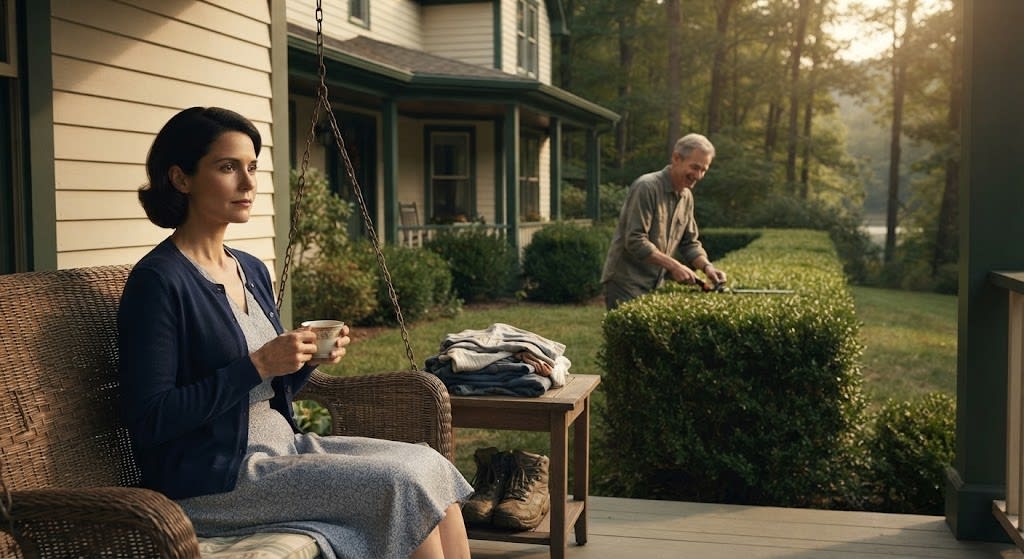
Here is what I know, sitting now on the porch Renata Ashby once painted the color of weak tea, watching Wesley trim the hedges he insists on keeping symmetrical though nothing about this house, or this marriage, or the woman running it, has ever been symmetrical at all: every story needs a woman willing to disappear so another woman can take her place, and every town needs a tragedy simple enough to close the file on. I've been both women now, twice over, and I find I'm considerably better at the second role than the first ever managed to be.
Wesley looks up from the hedges and smiles at me the way he's smiled at me for eleven years, the way, I suspect, he once smiled at Renata, before she made the mistake of learning too much about her own husband's business.
I smile back. It costs me nothing. It never has.
Some women wait their whole lives for an opening. I've learned the trick is simpler than patience: you simply become the opening yourself, and wait for the rest of the world to walk through you.
Author’s Note
If you enjoyed this piece and have a penchant for psychological thriller short stories or find yourself seeking a bit of motivation, please follow along for more of my work. If a story resonates with you, I would be grateful if you hit that share button to help spread the word. Thank you for reading.
About the Creator
Nolan Reed
I write true stories, including unsolved mysteries and events that actually happened.
Enjoyed the story? Support the Creator.
Subscribe for free to receive all their stories in your feed.
Comments
There are no comments for this story
Be the first to respond and start the conversation.