
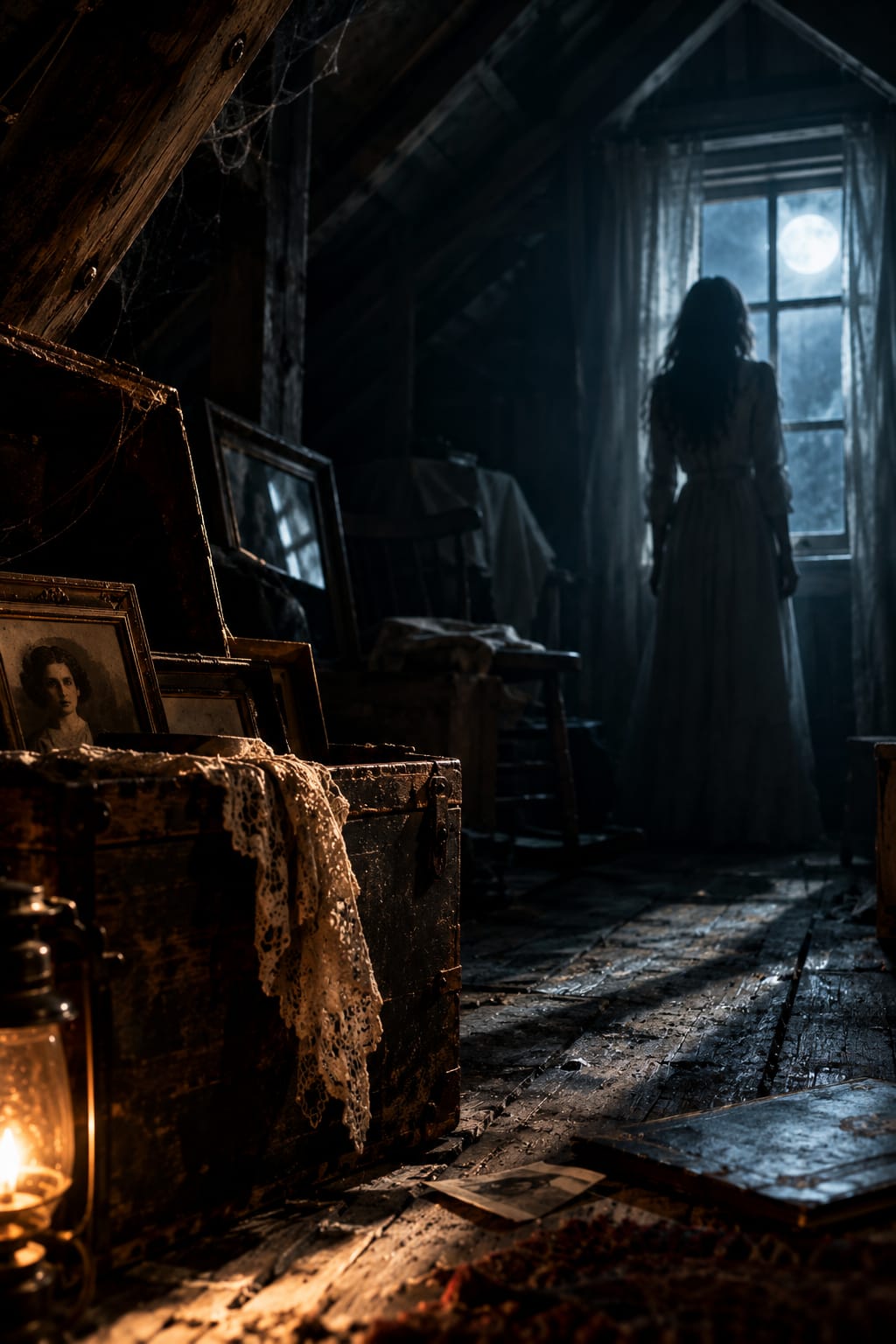
Chapter One: The House on Blackthorn Hill
The first time Emily heard the woman crying, she thought it was the wind.
It was late October, and rain had been falling for three days. The old house on Blackthorn Hill stood surrounded by bare trees, its windows dark and its wooden walls creaking whenever the wind grew stronger.
Emily had inherited the house from a grandmother she barely remembered.
Her mother had never spoken much about that side of the family. Whenever Emily asked questions about her grandmother, the answers were always the same.
"Some things are better left in the past."
Now, at twenty-nine, Emily had returned to the village to settle the inheritance and decide what to do with the property.
She intended to stay for one week.
The house had other plans.
On her first night, Emily woke at precisely 2:17 a.m.
A woman's voice drifted through the ceiling.
Soft.
Broken.
Almost musical.
Someone was crying upstairs.
Emily sat up in bed and listened.
The sound stopped.
She waited several minutes before getting up. The hallway was cold, and the old wooden staircase groaned beneath her feet.
At the end of the corridor was a narrow door she had noticed earlier that afternoon.
It led to the attic.
The door was locked.
Emily tried the handle anyway.
From the other side came three slow knocks.
She stepped back.
Then a whisper slipped through the wood.
"Please."
Emily held her breath.
"Please, don't leave me here."
She ran downstairs and locked herself in her bedroom.
The next morning, she convinced herself that exhaustion had played tricks on her mind.
But when she returned to the attic door, she discovered something that made her blood run cold.
Someone had written a message across the dusty wood.
SHE KNOWS YOU'RE HERE.
Chapter Two: The Photograph
The following afternoon, Emily visited the village antique shop.
She wanted to find out more about the house and the family who had lived there before her.
The shopkeeper, an elderly woman named Mrs. Whitmore, became unusually quiet when Emily mentioned Blackthorn Hill.
"Your grandmother lived there alone for many years," she said.
"Was she afraid of something?"
Mrs. Whitmore looked toward the window.
"She was afraid of what people might discover."
Emily leaned forward.
"What does that mean?"
But the old woman shook her head.
Instead, she reached beneath the counter and produced a small photograph.
It showed a young woman standing beside the attic window.
She had long dark hair, pale skin, and a sorrowful expression.
On the back, someone had written a name.
Clara Whitmore — October 31, 1958.
"Who was she?" Emily asked.
Mrs. Whitmore's hands began to tremble.
"My sister."
Emily stared at her.
"Your sister?"
"She disappeared when she was twenty-three. The police searched the village, the woods, even the river. They never found her."
"What does that have to do with my grandmother?"
Mrs. Whitmore looked directly at Emily.
"Your grandmother was the last person who saw Clara alive."
That evening, Emily returned to Blackthorn Hill with the photograph in her coat pocket.
She climbed the stairs and stood before the attic door.
This time, the lock was open.
Inside, the air smelled of dust, damp wood, and dried roses.
Old furniture stood beneath white sheets. Boxes filled the corners, and faded portraits leaned against the walls.
Moonlight entered through a small window.
And beside it stood a woman.
She wore a long white dress.
Her hair fell across her face.
Emily couldn't move.
The woman slowly turned.
Her features were almost identical to those in the photograph.
"Clara?" Emily whispered.
The woman smiled sadly.
"You look so much like her."
"Like whom?"
Clara lifted one pale hand and pointed toward a dusty mirror.
Emily stepped closer.
Her reflection stared back at her.
But someone was standing behind her.
An elderly woman with silver hair.
Her grandmother.
Emily turned around.
Nobody was there.
When she looked back at the mirror, Clara had disappeared.
On the floor lay a small brass key.
Chapter Three: The Locked Room
The key opened a wooden chest hidden beneath the attic window.
Inside, Emily discovered a collection of letters tied together with a faded red ribbon.
The earliest letter was dated October 1958.
It was addressed to Clara.
My dearest Clara,
I have tried to convince myself that silence will protect us both, but I can no longer bear what has happened. Your sister knows the truth. If anything happens to me, you must leave this house before Halloween.
The letter was unsigned.
Emily continued reading.
The next letters were more disturbing.
They spoke of arguments, accusations, and a secret that threatened to destroy the family.
In the final letter, written in hurried handwriting, Clara had left a message for someone named Margaret.
She has locked me upstairs. She says it is for my own good, but I know she will never let me leave.
Emily felt sick.
Her grandmother had a sister.
A sister nobody had ever mentioned.
A sister who had vanished.
Suddenly, footsteps sounded below.
Emily rushed to the attic door and looked into the hallway.
A shadow moved across the wall.
"Emily?"
It was her grandmother's voice.
But her grandmother had been dead for six months.
"Come downstairs, darling."
Emily backed away.
The footsteps climbed the stairs.
Slowly.
One step at a time.
"There's something I need to tell you."
Emily gripped the brass key.
The footsteps stopped outside the attic.
Then the door slammed shut.
The handle began to turn.
"Emily," the voice whispered. "You shouldn't have opened the chest."
A cold breeze swept through the room.
The mirror cracked from top to bottom.
And from somewhere inside the walls came a scream.
Emily dropped the letters.
Behind her, Clara appeared.
"Listen to me," she said urgently. "You have to find the room beneath the stairs."
"What room?"
"The room where she buried the truth."
Before Emily could ask another question, Clara vanished.
The attic door swung open.
The hallway was empty.
But at the bottom of the stairs, a trail of wet footprints led toward the cellar.
Chapter Four: What the Walls Remembered
Emily found the hidden room behind a wooden panel beneath the staircase.
The brass key opened its lock.
Inside, there was a narrow bed, a broken chair, and a small table covered in dust.
The walls were scratched with hundreds of marks.
Days.
Weeks.
Months.
Someone had counted the passage of time.
On the table lay a diary.
Emily opened it.
The first pages described an ordinary life: village festivals, family dinners, walks in the woods.
Then the entries changed.
Clara wrote about being watched.
About doors being locked.
About a woman who insisted she was ill and could not be trusted outside the house.
The final entry was dated October 31, 1958.
She came into my room tonight. She said nobody would believe me if I told them what she had done.
She took the key.
I can hear her walking above me.
If anyone ever finds this diary, please tell my sister I tried to come home.
Emily stopped reading.
Her grandmother had not been protecting a family secret.
She had been keeping someone prisoner.
A sound came from behind her.
Emily turned.
Clara stood in the doorway.
For the first time, her face was clear.
She looked exhausted, frightened, and impossibly young.
"Why didn't you leave?" Emily asked.
Clara lowered her eyes.
"Because I believed she loved me."
Emily felt tears gathering in her eyes.
"What happened to you?"
Clara glanced toward the ceiling.
"Ask the woman who inherited the house before you."
The room grew colder.
Emily suddenly understood.
Her grandmother had never spoken about her sister because she had spent her entire life trying to erase what she had done.
But Clara's final words left Emily with another question.
If Clara had died in 1958, why had Emily heard her crying only now?
Clara stepped closer.
"Because tonight is Halloween."
Outside, the church bells began to ring.
Midnight was approaching.
"And tonight," Clara whispered, "the house remembers everything."
Chapter Five: The Woman in the Mirror
At midnight, Emily returned to the attic.
She carried Clara's diary and the old photograph.
The wind howled outside, rattling the windows.
The woman in white stood before the mirror.
This time, she was not alone.
An elderly woman stood behind her.
Emily recognized her grandmother immediately.
Her grandmother's reflection was smiling.
But the real woman was crying.
Emily watched as the mirror filled with images.
A young Clara, laughing in the garden.
Clara standing at the attic window.
Clara pounding on the locked door.
And finally, a dark cellar where a woman lay motionless beneath a blanket.
Emily covered her mouth.
Her grandmother had not merely imprisoned Clara.
She had allowed her to die.
For decades, she had lived in the house with the knowledge of what she had done.
And when death finally came for her, the secret remained.
Clara turned toward Emily.
"I don't want revenge," she whispered.
"What do you want?"
"To be remembered."
Emily looked at the diary in her hands.
For years, Clara had existed only as a missing person, a name whispered by the villagers, a photograph hidden in an antique shop.
Her life had been reduced to a mystery.
Emily understood that the truth had to leave the house.
She had to tell someone.
She had to make sure Clara's name was no longer buried beneath silence.
The mirror began to tremble.
Her grandmother reached toward Emily from inside the glass.
"Don't tell them," she pleaded. "You'll destroy everything."
Emily stepped closer.
"You destroyed everything when you locked her away."
The mirror shattered.
A terrible wind swept through the attic, scattering the letters and extinguishing the candle.
For a moment, the room was completely dark.
Then Emily heard a soft laugh.
Clara stood beside the window.
The moonlight illuminated her face.
"Thank you," she whispered.
And for the first time, she looked peaceful.
She stepped toward the glass.
Her reflection appeared beside her.
Then both disappeared.
The attic fell silent.
At dawn, Emily opened every window in the house.
For the first time in decades, sunlight entered the rooms.
She took Clara's diary and letters to the police, along with the photograph that had started everything.
The investigation that followed revealed the terrible truth about the missing woman.
The house was no longer a mystery.
But Emily knew that something inside it had changed.
The crying had stopped.
The footsteps had vanished.
And the attic door remained open.
Epilogue: One Year Later
Emily never sold Blackthorn Hill.
Instead, she restored the house and turned it into a place where the history of the village could be preserved.
Clara's photograph was placed in the entrance hall.
Beneath it, Emily wrote a simple sentence:
She was here. She lived. She was loved. She will not be forgotten.
On the anniversary of Clara's disappearance, Emily returned to the attic.
The room was empty.
The mirror had been replaced.
The windows were clean.
But as Emily prepared to leave, she noticed something on the windowsill.
A single dried rose.
She picked it up carefully.
Then she heard a whisper behind her.
"Goodnight, Emily."
She turned.
For a fleeting moment, a woman in a white dress stood beneath the rafters.
She smiled.
And disappeared into the morning light.
Emily walked downstairs, closed the front door, and stepped into the garden.
For the first time, Blackthorn Hill felt like a home.
But somewhere deep inside the house, behind a wall nobody had yet opened, another door waited.
And
About the Creator
Enjoyed the story? Support the Creator.
Subscribe for free to receive all their stories in your feed.
Comments
There are no comments for this story
Be the first to respond and start the conversation.