
The Winter That Came in September
In Bellwether, the calendar is a lie. The snow doesn't land. And the door beneath the town is always early.
September 24
The phone rang at 3:14. I was parked outside the Bellwether Public Library with the engine off and the windows down. The dashboard said September 24. The heat came in like something with a body.
My mother said: “You’re back.”
“I’m outside the library.”
“Did anything bloom?”
“What?”
“Did anything bloom?” she said again. Not a question. A diagnostic.
I looked at the dead grass. “Mom, it’s ninety-eight degrees.”
“Look carefully. Come home before four.”
She hung up.
I got out of the car. The air smelled like frozen earth and damp pine, a December smell in a September heatwave. I walked past the diner, past the hardware store with its Halloween decorations up since August, past the church with its bell tower silent and its doors propped open to let the heat out.
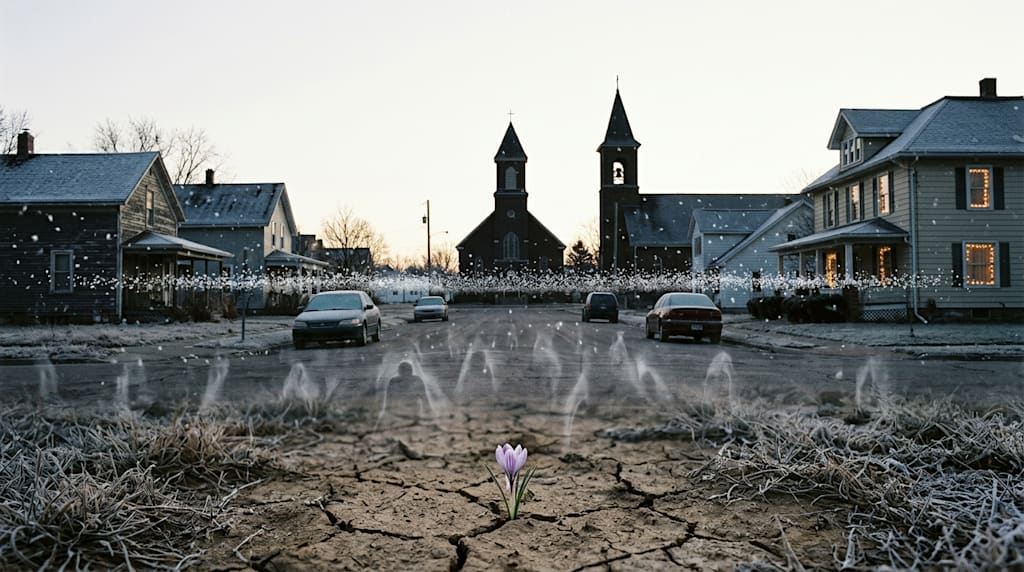
At the edge of the green, in the shadow of the war memorial, I saw it.
A crocus. One flower, purple-white, pushing through the baked soil. I knelt. The petals were cold. Not cool. Cold. Like a windowpane in January.
More of them. A line, threading from the memorial toward the woods. A path of February laid down in September.
My phone said 3:16.
I started walking.
At 3:17, the frost came.
It didn’t fall. It arrived. One moment the grass was brown; the next it was white, furred with a thin crystalline skin that crackled under my shoes. The air went from ninety-eight to thirty in a breath. My sweat turned to ice.
Every windshield turned white. Every window fogged. Then the clocks stopped. The diner’s neon flickered and died. The bank’s digital display froze at 3:17. A clock radio began to beep and beep and beep, an alarm for a time that was not passing.
I ran.
My mother was standing in her doorway with a coat over her nightgown and her hand over her mouth.
“Did anything bloom?” she said.
“Yes.”
She closed her eyes. “Then it’s early.”
Inside, the furnace ran full blast against the frost on the windows. She made tea and set it in front of me and didn’t drink hers.
“You were an only child,” she said.
“I know.”
“You were an only child,” she said again, “and you have a sister.”
The teacup stopped halfway to my mouth.
“She’s in the back bedroom. She’s been there since 1989. She’s not one of the found. She’s not one of the missing. She’s the three who never woke. She’s what was left in your place when the winter took you.”
“That’s not…”
“Drink your tea.”
I drank my tea.
The knocking started at dusk. Three knocks. A pause. Three knocks.
It came from the walls, from the floor, from the pipes, from the ground beneath the house. My mother didn’t react. She sat with her hands folded, eyes on the window where the frost was thickening into patterns.
“That’s them,” she said. “Counting.”
“Counting what?”
“Themselves. They’re three. They knock three times, they pause, they knock three times. It’s how they know where each other are. It’s how they know where the door is.”
“The door.”
“The winter didn’t take us,” she said. “It took the time we belonged to. It folded a piece of the calendar and put it away. Everyone inside that piece has been waiting for it to unfold. The thaw in 1990 let some out early. It let you out early. It didn’t let the others out at all.”
“Why me?”
“Because you came back awake. Because you brought something out with you.” She looked at me. “You dream about bells. You’ve always dreamed about bells.”
I didn’t ask how she knew.
At 4:00, the temperature dropped twelve degrees in twelve minutes. The frost on the windows grew inward. The knocking grew louder, three, pause, three, pause, and at 4:17, every clock stopped again.
The refrigerator died. The furnace cut out. The house went silent, and in the silence I heard the bells.
They came from below, not from the church tower. From under the floor, under the foundation, under the town. A deep, slow, patient ringing.
My mother stood up.
“Go to the back bedroom,” she said. “She’s been waiting.”
The door wasn’t locked. The room was cold, colder than the rest of the house, cold with intention. There was a bed, a window, and a Christmas tree.
A Christmas tree. In September. Four feet, strung with a single strand of lights that glowed a soft gold. Underneath it, three presents wrapped in yellowed paper.
A girl sat on the bed. Maybe thirty. My mother’s eyes, my father’s jaw, and something else, a flicker at the edges, like a photograph taken while she was moving.
“You’re early,” she said.
“I don’t…”
“You weren’t supposed to come back yet. In 1990. You came back before the door was ready. And now you’re here, and the door has to open, and it’s September, and it’s not time.”
“What are you?”
“I’m the three,” she said. “I’m the ones who didn’t wake. I’m the part of you that stayed behind. I’m what the winter left in your place so your mother wouldn’t be alone.” She tilted her head. “You brought the bells back with you. You’ve been carrying the door in your chest for thirty-six years. Did you think it was a dream?”
The knocking had stopped. Outside the window, snow was falling, thick, slow, impossible snow, falling in September, falling on the dead grass and the frozen crocuses. It never landed. It hung a foot above the earth, a ceiling of white.
“Come on,” the girl said. “It’s time to open it.”
We went outside. My mother came with us. The street was full of people, neighbors, strangers, faces I half-remembered, all standing in the impossible cold, all staring at the snow that wouldn’t land. No one spoke. The bells were louder now, ringing from under the earth.
And then the ground opened.
The ground became transparent, the way ice becomes transparent. Beneath it I saw them: the seventeen, standing in a place that wasn’t a place, in a light that wasn’t light. Some looked exactly as they had in 1989. Some were older. One was still a child.
They rose. Through the snow that wasn’t snow, through the transparent earth. They rose and stepped onto the street and stood among us, blinking, shivering.
The girl who was three stood beside me. She took my hand.
“You can stay,” she said.
“I don’t…”
“You can stay. Or you can go. You already went in once. You already came out once. The door is open either way. But if you stay, you close the loop. If you go, it stays open, and it will open again, and next time it might be July, or April, or a day that doesn’t exist at all.”
My mother had collapsed. She was sitting on the frozen grass with her hands in her lap, and the snow that wasn’t snow was falling around her, and she was smiling. The seventeen stood in a loose ring, six, three, five, three, and they were all looking at me, and the bells were ringing, and the crocuses were blooming under the frost, and the sky was July and the calendar said September and none of it mattered anymore.
I looked at the girl. I looked at my mother. I looked at the seventeen, who had waited thirty-seven years.
“I stayed,” I said.
They took a photograph. I don’t know who took it. It shows my mother, my sister, and me, standing in the middle of a street in Bellwether, surrounded by seventeen people who had disappeared in the winter of 1989. It shows snow falling but not landing. It shows the crocuses blooming in the frost. It shows the Christmas tree lights still glowing in the back bedroom window.
I keep the photograph in my wallet. I have not aged since that night. Neither has the girl who is three, or my mother, or any of the seventeen.
The calendar in Bellwether still says September 24. It has said September 24 for a long time now. The clocks stopped at 4:17 and never started again. The crocuses have not died. The snow has not landed.
And every year, when the heat comes, and the sky turns the color of a laundered sheet, I hear the bells underground, faint, patient, counting, and I know that somewhere beneath the town, the door is waiting.
It is always waiting.
It is always early.
About the Creator
Jin
Writer of reamstories
https://reamstories.com/jin
Enjoyed the story? Support the Creator.
Subscribe for free to receive all their stories in your feed. You could also become a paid subscriber, letting them know you appreciate their work.
Comments
There are no comments for this story
Be the first to respond and start the conversation.