
The Wheel in January
A carnival that shouldn't exist, exactly when it's needed most
Jo Calloway woke before dawn because her old dog wouldn't settle, pacing the hall and scratching at the door like something outside had called his name. She pulled on her coat over her nightclothes, grumbling the whole way down, and when she opened the door the cold hit her like a slap, sharp enough to sting her eyes. That was when she saw the glow coming from the square, three streets over, painting the low clouds the color of a peach.
She stood on the step a long moment, watching that glow pulse and swell, and something old turned over in her stomach. It had been sixty-one Junes since she'd seen that particular color of glow, and every one of those Junes had ended the same way: the carnival folding its tents at dawn on the seventh day and slipping out of town before anyone woke to say goodbye. Delacroix's Wonder Show, they called it, though nobody living could say where Delacroix had come from or where he went each winter. He'd died, everyone assumed, sometime around 1985, when the show simply failed to return one summer and never came again.
Jo called her grandson Sam, who was staying with her for the season while he sorted out a divorce he didn't much want to talk about, and told him to get dressed and get his boots on. He came down the stairs still buttoning his shirt, squinting at her the way he did when he thought she'd finally lost her grip on the year.
"Grandma, it's twenty degrees out. Whatever's burning down there, the fire department can handle it."
"It isn't burning," she said. "It's glowing. There's a difference, and you'd know it if you'd ever seen the Wonder Show."
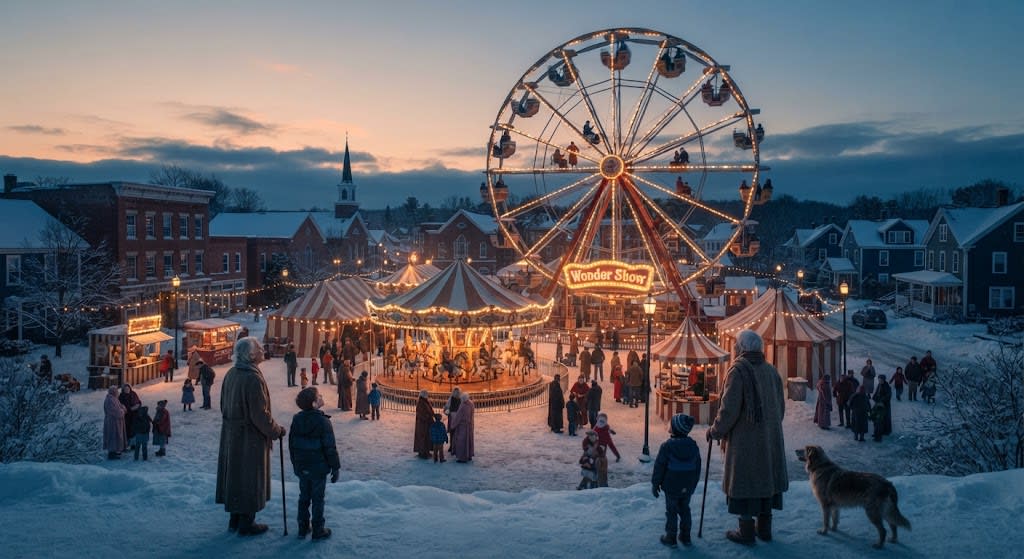
They walked down together, her cane tapping the frozen ground, her breath coming out in long ribbons ahead of her. The square came into view slowly, through the gaps between the brick buildings, and each new glimpse made her chest tighten a little more. First the striped canvas of a tent, snapping gently though there was hardly a breath of wind to move it. Then the carousel, its horses caught mid-leap, their painted eyes bright and wet-looking under strings of small round bulbs. Then, rising over the rooftops, the great slow wheel itself, turning through the dark with nobody riding it, each empty seat swaying just slightly as it climbed.
Sam stopped walking entirely. "That's a carnival."
"That's the Wonder Show," Jo said, and her voice came out smaller than she meant it to.
By the time they reached the square, a dozen other townsfolk had gathered at its border, most of them still in robes and coats thrown over pajamas, all of them staring at the same impossible sight: a full summer carnival, canvas and bulbs and cotton-spun sugar smell, standing in a foot of packed snow under a sky still hours from sunrise in the deepest part of January. The Ferris wheel turned in complete silence, its motor humming so low it barely registered, and the carousel horses rose and fell to a tune nobody could quite place, something bright and brassy that seemed to come from everywhere and nowhere at once.
Deputy Ruiz stood near the front of the crowd with his radio held to his mouth, though he hadn't pressed the button to speak. He looked over at Jo when she came up beside him, and something in his face told her he already knew this was beyond anything his training covered.
"You remember this thing," he said. It wasn't a question.
"I rode that wheel every June from the time I was six until I was seventeen," Jo told him. "My mother rode it before me. There's a man who used to run it, called himself Delacroix, and he stopped coming the summer I turned twenty-four. That was the summer my daughter was born, so I remember it clear."
"And now it's here in January."
"Now it's here in January," she agreed, and neither of them had a single further word to add to that.
The crowd grew as the sun came up gray and reluctant behind the clouds, until half the town stood ringed around the square, arms crossed against the cold, watching the wheel turn and the horses rise and fall. Children who had never once heard of the Wonder Show tugged at their parents' sleeves, begging to ride, and a strange argument broke out among the adults about whether any of this was safe to touch, let alone climb aboard.
It was Sam, of all people, who finally crossed the border of packed snow into the carnival itself. He walked toward the ticket booth like a man approaching a dog he wasn't sure would bite, and Jo hurried after him as fast as her cane would allow, calling for him to slow down and wait.
Inside the booth sat a man who looked to be somewhere between forty and sixty, his coat cut in a style that hadn't been common since before Jo was born, his collar high and his hat tilted low over eyes that caught the strung bulbs and threw the glow back oddly bright. He smiled at Sam as though he'd been expecting him for hours.
"One ticket for the wheel," the man said, "or would you rather the carousel first? Most people start with the carousel. Builds the courage."
Sam glanced back at Jo, then at the man again. "Are you Delacroix?"
"I've been called that," the man said, "among other things." He turned his strange bright eyes on Jo, and his smile deepened into something almost gentle. "Josephine. You've gone and gotten old on me."
Jo's cane nearly slipped from her grip. She hadn't given this man her name, and she certainly hadn't told him it was Josephine, not since her mother had stopped calling her that decades ago. Yet here he sat, exactly as he had looked the last summer she saw him, not a single line added to his face, not a single gray hair sprouted at his temple, while she had gone and turned seventy-eight without him.
"You stopped coming," she said, and her voice cracked on the second word. "We thought you'd died. We thought the whole show had folded up and gone with you."
"I never stop coming," Delacroix said. "I only come when I'm needed, and this town hasn't needed me in a long while. Summer's easy. Summer takes care of its own. It's the cold months that swallow people whole, Josephine, and nobody ever thinks to build a wonder for January."
Behind him, the carousel horses kept their steady rise and fall, and somewhere in the crowd a child laughed at the sight of them, a high bright sound that carried clean across the packed snow. Jo felt something in her own chest loosen at that laugh, some old ache she'd carried since she was twenty-four and pregnant and watching the tents fold for what she'd assumed was the final time.
"Why now?" Sam asked. "Why show up in the middle of a cold snap, of all times?"
Delacroix only tipped his head toward the square itself, toward Deputy Ruiz directing cocoa stands like traffic, toward a woman still in her bathrobe pressing a wool blanket into a stranger's arms, toward two boys pulling their grandfather by the sleeves toward the carousel while he pretended to resist. "Look around you," he said, "and tell me I'm wrong to come."
He stood then, unfolding himself from the booth with a grace that seemed to belong to a much younger man, and gestured out at the wheel with one long arm. "Ride it or don't. Stay an hour or stay all week. I'll fold the tents when this town's had its fill, and not one moment before."
The town, as it turned out, filled up rather slowly.
By noon the square had packed itself entirely, and Deputy Ruiz had long since given up trying to clear anyone out, choosing instead to direct cocoa stands and blanket donations with the same seriousness he usually reserved for traffic accidents. The high school band, roused from winter break by a call from the mayor, set up near the carousel and played along with its brassy tune, badly but happily. Somebody strung extra bulbs between the brick storefronts, and by evening the whole square glowed like a June night dropped whole into the middle of the coldest month anyone could remember.
Jo rode the wheel twice. The first time she rode alone, wrapped in a wool blanket someone had pressed into her arms, watching the town spread out below her, its rooftops dusted white, its chimneys sending up thin gray ribbons against a sky gone the color of a bruise. The second time she rode with Sam beside her, and somewhere near the top of the climb, with the whole square glowing below them like a coal caught in snow, he finally said the thing he'd been carrying since he arrived that season.
"I didn't want to come stay with you, you know. After everything with the divorce, I figured I'd just sit in your back room and feel sorry for myself until spring."
"I know it," Jo said. "You've done a fair job of it too, these last months."
He laughed, short and a little rough, and looked out at the lit square rather than at her. "This is the first thing that's felt like anything since October."
Jo reached over and took his arm, the way she used to when he was small and frightened of the wheel's first sudden drop, and left it at that.
They stayed until nearly midnight, until the cold had crept in past even three cups of cocoa and the band had long since packed away their instruments. When Jo finally turned to head home, she found Delacroix standing near the booth again, watching the last of the crowd drift off toward their houses with something like satisfaction settled into his strange bright eyes.
"You'll go again," she said. It wasn't a question either, not this time.
"I'll go again," he agreed, "though possibly not for a good while yet." He tipped his old-fashioned hat to her, and the gesture carried a courtesy that had gone out of style before she was born. "Get some rest, Josephine. You've earned it, keeping that dog of yours awake enough to fetch you down here."
She laughed at that, a real laugh, the kind she hadn't managed since sometime before Sam's divorce and her own husband's passing four winters back. "You always did know exactly when a person needed fetching."
"That's the whole trade," Delacroix said, and turned back toward his booth, where the last of the bulbs still glowed warm against the snow. "Knowing when."
By the time the town woke the next morning, the square stood empty again, packed snow undisturbed except for a single wide ring pressed into the white where something heavy had stood and turned through the night. No canvas, no bulbs, no brassy tune drifting on the cold. Only the ring remained, and the memory of a whole town standing under a summer wheel in the dead of January.
Jo still checks the sky some winter mornings when her dog won't settle, watching for that particular peach-colored glow against the clouds. She hasn't seen it since, not in all the winters that followed, though she keeps a blanket folded by the door just the same, ready for whenever the wheel comes back home.
About the Creator
Nolan Reed
I write true stories, including unsolved mysteries and events that actually happened.
Enjoyed the story? Support the Creator.
Subscribe for free to receive all their stories in your feed.
Comments
There are no comments for this story
Be the first to respond and start the conversation.