
The Weight of a Single Match
The Quiet Persistence of Ordinary Light

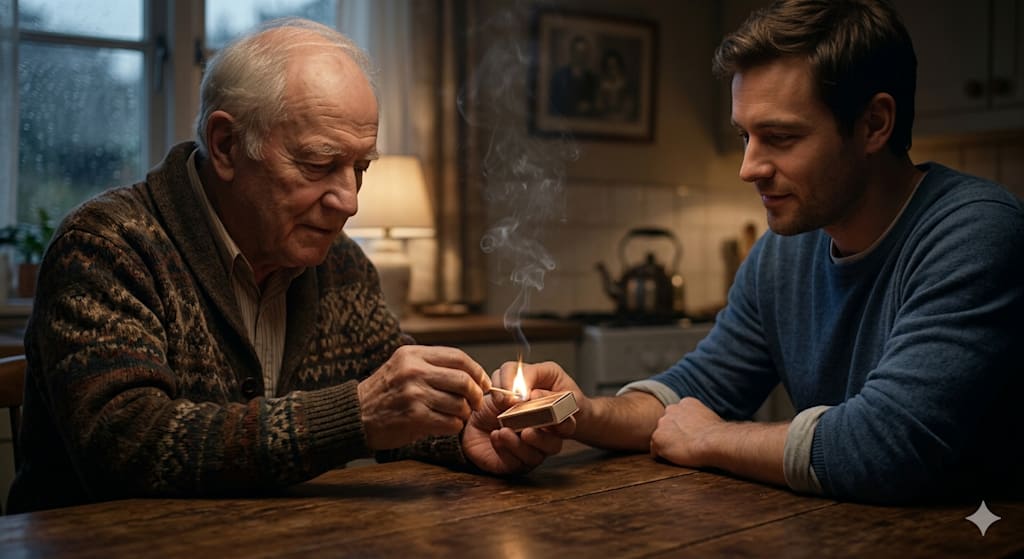
The radiator in Apartment 4C didn't knock; it wheezed, a wet, metallic sound that seemed to pull the dampness of the October rain right through the brickwork. Inside, the air smelled of floor wax and the faint, citrusy ghost of Earl Grey tea.
Joseph was eighty-four, and his hands had recently begun to betray him. They didn't shake with a dramatic palsy; they simply drifted, like a boat losing its mooring. It made the small things—threading a needle, buttoning a cardigan, or striking a match—feel like navigating a gale.
His grandson, Leo, sat across from him at the scarred oak table. Leo was twenty-four, buzzing with the frantic energy of a young man who lived his life in pixels and high-speed commutes. He had stopped by for "twenty minutes" three hours ago. He kept checking his phone, the blue light reflecting off his glasses like a rhythmic distress signal."
I can do that, Grandfather," Leo said, his voice tight with the subconscious urge to optimize. He reached for the small box of wooden matches sitting next to the stovetop.
Joseph pulled the box closer to his chest. "No," he said softly. "I want to do it."
To anyone looking through the window, it was a mundane scene: an old man trying to light a stove to boil water for tea while a restless young man watched. It wouldn't make a photograph. It wouldn't be a story told at a wedding. But in the silence of that kitchen, a decade of unspoken history was being compressed into the space between a match head and a strike pad.
Joseph’s wife, Martha, had died two years prior. She had been the "lighter" in the house. She lit the candles, the stove, the fireplace, and, metaphorically, the room. Since she left, the apartment had grown cold in ways the furnace couldn't fix. For Joseph, lighting this stove wasn't about tea anymore. It was about proving that the fire in the house hadn't gone out for good.
He took a breath. His fingers, gnarled like driftwood, fumbled with the drawer of the matchbox. He slid it open. One match fell out, clattering on the table with a sound like a falling bone.
Leo twitched. He wanted to grab the match, strike it in one fluid motion, and be done with it. He thought about his commute, his unread emails, and the way his life felt like a race he was losing. He saw his grandfather’s struggle as a delay.
Joseph picked up the match. He held it between his thumb and forefinger. He pressed the red tip against the phosphorus strip.
Scritch.
Nothing. A thin grey line appeared on the box.
Scritch.
The match head crumbled slightly. A faint whiff of sulfur filled the air—that sharp, primordial scent of potential."
Grandpa, really, the water’s getting cold," Leo whispered.
Joseph didn't look up. "The water isn't even in the pot yet, Leo. Sit. Watch the light."
Leo paused. He actually looked at his grandfather’s face. He saw the concentration in the creases around Joseph’s eyes, the way his jaw was set. He realized that Joseph wasn't fighting the match; he was fighting the fading of his own agency.
Joseph tried a third time. This time, he gripped the match lower, near the head, the way Martha used to. He swung his arm in a short, deliberate arc.
Ff-shhh.A spark. A bloom of brilliant, cerulean-edged orange. The flame caught, wobbling at first, then standing tall and steady. The small orb of light reflected in Joseph’s cataract-filmed eyes and in Leo’s glasses.
For three seconds, neither of them moved. The room, which had felt cluttered and stressful, suddenly felt vast and hushed. The tiny flame was the only thing that mattered in the world. It was a victory. It was a bridge. It was the warmth of a woman who wasn't there, passed through the shaking hands of a man who was still trying, into the heart of a boy who had forgotten how to slow down.
Joseph leaned forward and touched the flame to the gas burner. Whump. The blue ring of fire sprang to life, a crown of heat. "There," Joseph said, his voice thick. He blew out the match. A single curl of white smoke drifted toward the ceiling.
Leo didn't check his phone. He reached out and placed his hand over his grandfather’s shaking one. "Good job, Grandpa," he said. And he meant it more than any "I love you" he had uttered in years.
They sat in the kitchen, which was growing darker, waiting for the whistle of the kettle. To the neighbors and the world outside, it was just Tuesday. To them, it was the moment the light stayed on.
About the Creator
Meko James
"We praise our leaders through echo chambers"
Enjoyed the story? Support the Creator.
Subscribe for free to receive all their stories in your feed. You could also become a paid subscriber, letting them know you appreciate their work.
Comments
There are no comments for this story
Be the first to respond and start the conversation.