
The Warmth Beyond the Snow
The first thing Samuel Reed noticed was the smoke.

Not the thin gray ribbon that usually rose from a chimney on a winter morning.
This smoke was black.
It climbed straight into the pale sky above the frozen valley, thick enough to look like a storm cloud hanging over the mountains.
Samuel stopped his horse.
He pulled his coat tighter around his chest and stared.
“Smoke?” he whispered.
Behind him, his wife, Clara, was struggling to keep their little wagon moving through the snow.
“Samuel!”
He turned.
Clara was holding their youngest daughter, Rose, beneath a wool blanket.
“She can't feel her fingers.”
Samuel jumped from the horse.
He knew what that meant.
The winter of 1897 had already killed three men in their county.
The river had frozen solid.
The roads had disappeared.
Farm animals were dying in their barns.
And for nearly two weeks, the snow had fallen without mercy.
They had been traveling toward the town of Bell Creek because Samuel had heard there was still coal there.
Now their coal was gone.
Their food was almost gone.
And Rose's lips were turning blue.
Samuel looked again at the black smoke.
“There's a house up there.”
Clara shook her head.
“Samuel, the road is gone.”
“Then we'll make our own.”
They climbed.
For nearly an hour, Samuel dragged the wagon by hand while Clara carried Rose.
When they finally reached the top of the hill, they saw something impossible.
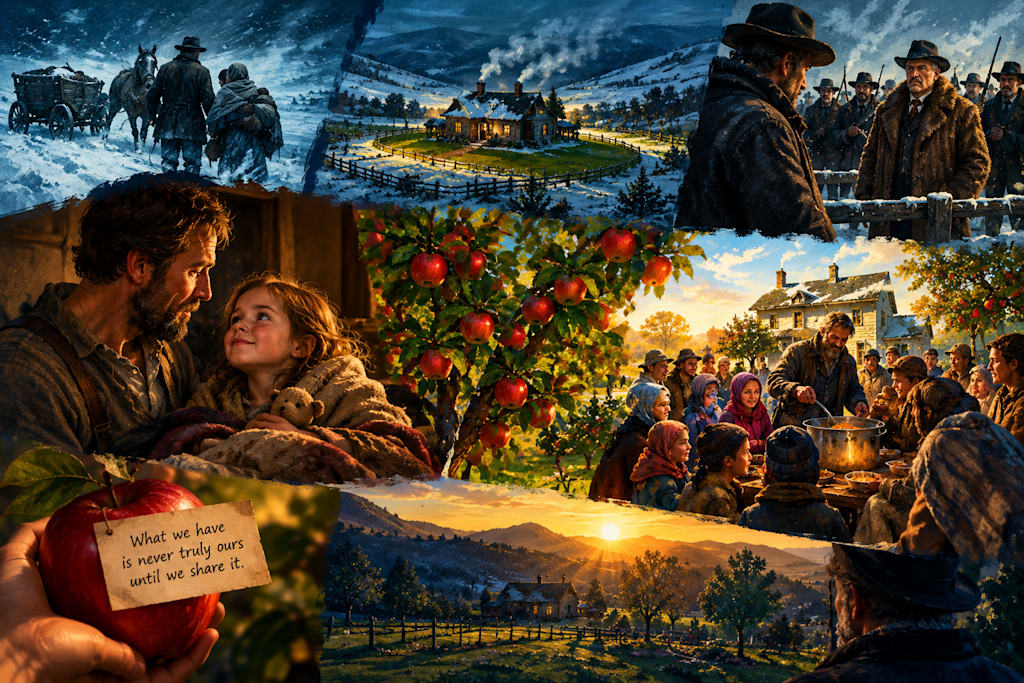
A farmhouse stood in the middle of the frozen valley.
Its windows glowed orange.
Smoke rose from three chimneys.
And around it, the snow had melted into a perfect circle.
Grass grew around the house.
Green grass.
In January.
Samuel stopped walking.
Clara stared.
“What in God's name...?”
Samuel didn't answer.
A man stepped onto the porch.
He was old, perhaps seventy, with a long gray beard and a rifle resting against his shoulder.
“Don't just stand there,” he shouted. “Bring that child inside!”
Samuel hurried forward.
The old man opened the door.
Warm air struck Samuel's face.
Rose began crying.
It was the first sound she had made in hours.
The old man's expression softened.
“Put her by the stove.”
Samuel carried her inside.
There were already twelve people in the farmhouse.
Some were strangers.
Some were families from nearby farms.
All of them looked exhausted.
The old man introduced himself as Elias Mercer.
“This is my farm,” he said. “Or what's left of it.”
Samuel looked through the window.
Beyond the circle of green grass, the world was buried beneath snow.
“How is this possible?”
Elias shrugged.
“Been asking myself that for three weeks.”
Three weeks?
Samuel looked at him.
“You mean this place has been warm for three weeks?”
“Warmer every day.”
A woman sitting near the stove whispered, “The snow won't cross the fence.”
Samuel looked outside.
She was right.
Snow covered everything beyond the wooden fence.
Inside it, flowers were growing.
That night, Samuel learned the strange history of the place.
Elias had planted an old apple tree beside the farmhouse when he was a boy.
During the first week of the terrible winter, the tree had suddenly blossomed.
Then the ground around it became warm.
Then the grass appeared.
Then vegetables began growing.
Nobody knew why.
Some called it a miracle.
Others called it witchcraft.
Elias called it “a gift that wasn't mine to keep.”
By morning, there were twenty-seven people inside the farm.
By the third day, there were nearly sixty.
Elias gave everyone food.
He gave them blankets.
He gave away firewood.
He even opened his small grain store.
Samuel watched him work until his hands trembled.
“You'll have nothing left,” Samuel warned.
Elias smiled.
“Then I'll have nothing left.”
“You can't feed everyone.”
“No.”
Elias looked toward the crowded farmhouse.
“But I can feed the person standing in front of me.”
Samuel never forgot those words.
For several weeks, the farm became a refuge.
People planted vegetables.
Children gathered apples.
Men repaired fences.
Women cooked enormous pots of stew.
People who had once been strangers began sleeping shoulder to shoulder in the barn.
Then one afternoon, a man arrived on horseback.
His name was Gideon Price.
Samuel knew him.
Everyone did.
Gideon owned the largest general store in Bell Creek.
He also owned most of the coal in the county.
He rode into Elias's farm wearing a fur coat and carrying a silver-handled walking stick.
Behind him came six armed men.
Gideon looked around.
“Well,” he said. “You've built yourself quite a little kingdom.”
Elias wiped his hands on his coat.
“It isn't a kingdom.”
Gideon smiled.
“Everything is a kingdom when other people need what you've got.”
He pointed toward the fields.
“I'll buy this place.”
“No.”
“I'll pay you more money than this farm is worth.”
“No.”
“Then I'll buy the harvest.”
“No.”
Gideon's smile disappeared.
“You don't understand, Elias. The people outside are desperate. They'll pay anything for food.”
Elias looked toward the road.
“Then give it to them.”
Gideon laughed.
“You really are a fool.”
He turned his horse around.
Before leaving, he looked at Samuel.
“You've got a family, don't you?”
Samuel said nothing.
Gideon smiled.
“Remember that.”
The following morning, three men arrived from Bell Creek.
They were starving.
Elias welcomed them.
Then three more came.
Then ten.
Then twenty.
Soon the road became a line of exhausted people.
The farm could barely keep up.
Samuel worked from dawn until midnight.
But something strange happened.
The people who arrived with nothing began giving something back.
A carpenter repaired broken wagons.
A blacksmith fixed tools.
A schoolteacher began teaching children beneath the apple trees.
A widow who had arrived nearly frozen began making bread for everyone.
Even the old and sick found ways to help.
The refuge was becoming a community.
Then, one night, the gunshots began.
Samuel woke to shouting.
He ran outside.
Gideon Price stood beyond the fence.
Twenty armed men stood behind him.
“Open the gate!” Gideon shouted.
Elias stepped forward.
“No.”
“You have food enough for months.”
“Not if I give it to everyone.”
Gideon raised his voice.
“Exactly!”
The men behind him loaded their rifles.
Samuel felt his stomach tighten.
Gideon pointed toward the farmhouse.
“Hand over the grain, the vegetables, and the livestock. We'll decide who gets what.”
Elias shook his head.
“No.”
“You're willing to risk all these people?”
Elias looked behind him.
Hundreds of exhausted faces were watching.
Then something unexpected happened.
The schoolteacher stepped beside him.
Then the blacksmith.
Then the widow.
Then the carpenter.
Samuel moved forward.
Soon dozens stood beside Elias.
They carried shovels, axes, farming tools, and wooden poles.
They had almost no guns.
But they had something Gideon had not expected.
They were together.
Gideon laughed nervously.
“You think farming tools will stop rifles?”
Elias answered quietly.
“No.”
He looked around at the people.
“But I think hungry people who have finally found something worth protecting are harder to frighten than you imagine.”
Nobody moved.
The wind howled.
Snow began falling.
For several long seconds, the only sound was the cracking of ice beneath Gideon's boots.
Then a young boy stepped out from the crowd.
He was perhaps ten years old.
He carried a small basket of apples.
He walked toward Gideon.
“My mother says you're hungry.”
Gideon stared at him.
The boy held out the basket.
“You can have these.”
Nobody spoke.
Gideon looked at the apples.
Then at the boy.
Then at the hundreds of people standing behind him.
Something changed in his face.
He lowered his rifle.
One of his men followed.
Then another.
Finally, Gideon turned his horse.
“Come on,” he muttered.
They rode away into the snow.
Samuel watched until they disappeared.
The boy looked up at Elias.
“Did we win?”
Elias smiled.
“No, son.”
He took one apple from the basket.
“We shared.”
The boy smiled.
Months later, the snow finally disappeared.
The mysterious warmth around Elias's farm slowly faded.
The grass turned brown.
The strange trees stopped producing fruit.
By summer, the farm looked ordinary again.
But nobody who had survived that winter ever forgot it.
Samuel eventually returned to his own farm.
Gideon reopened his store, but people remembered what he had tried to do.
And Elias?
He never became rich.
He never claimed the miracle as his own.
Every autumn, when the apple trees produced their harvest, he sent baskets to the poorest families in Bell Creek.
Years later, Samuel's daughter Rose—now a grown woman—asked him about the winter that almost killed her.
“Was the warm farm really a miracle?”
Samuel smiled.
“Maybe.”
“Then what was the miracle?”
Samuel thought for a moment.
“The warmth helped us survive the cold.”
He looked toward the fields.
“But the people helped each other survive everything else.”
And beneath the old apple tree, where the first green leaves had appeared during the worst winter anyone could remember, a small wooden sign remained:
WHAT WE HAVE IS NEVER TRULY OURS UNTIL WE SHARE IT.
About the Creator
Behind the Curtain
"Exploring the untold stories and hidden truths. From royal rumors to cultural deep dives, Behind the Curtain brings you bold, insightful narratives that spark curiosity and conversation."
Enjoyed the story? Support the Creator.
Subscribe for free to receive all their stories in your feed.
Comments
There are no comments for this story
Be the first to respond and start the conversation.