
The Village Beneath the Fog
Lost in a forgotten mountain village, a stranded traveler discovers that the locals were never trying to keep something out — they were waiting to bring something in

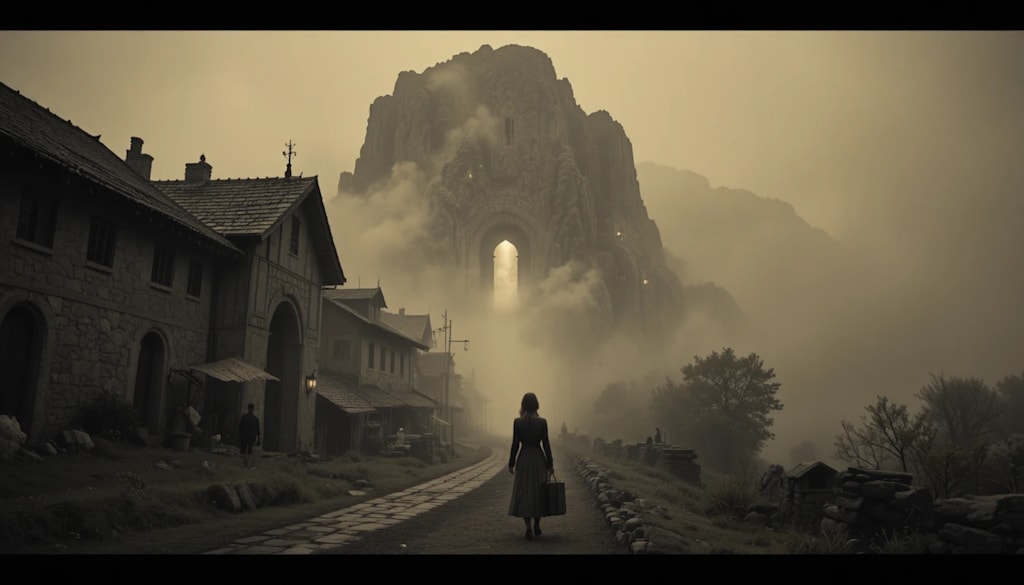
The bus should not have stopped there.
Mara realized that the moment the driver opened the door and cold air rolled inside carrying the smell of wet earth and something older—something metallic, almost like blood left too long in rainwater.
“This is impossible,” she said, checking her phone again.
No signal.
The driver did not answer. He only stared ahead through the fogged windshield as if he could not hear her anymore.
Outside, the village waited.
Six or seven stone houses crouched beneath a mountain ridge swallowed by white mist. No signs. No lights except for a single yellow lantern hanging outside what might have been an inn.
The place did not appear on the map she downloaded earlier that morning.
“You said this bus goes to Brindle Cross.”
Silence.
Then, without warning, the doors closed behind her.
The bus disappeared into the fog before she could even shout.
Mara stood alone with her suitcase beside the empty road.
Somewhere nearby, water dripped rhythmically.
Not rain.
Something else.
The village seemed abandoned at first. Curtains remained tightly shut. No voices. No dogs barking. Even the wind moved carefully here, as though afraid to disturb something sleeping beneath the mountain.
Then she noticed them.
People watching from windows.
Not hiding exactly.
Just… observing.
An old woman emerged from the inn carrying a lantern.
“You arrived early,” she said.
The sentence unsettled Mara immediately.
“Early for what?”
The woman ignored the question.
“You shouldn’t stand outside after dark.”
“It’s four in the afternoon.”
The old woman glanced toward the sky.
“Not here.”
Inside the inn, the air smelled of smoke, herbs, and damp wood. Strange symbols had been carved into the ceiling beams—circles crossed by vertical lines.
Mara tried to smile politely.
“My car broke down about fifty kilometers back. The bus driver said—”
“The buses stopped coming years ago,” the woman interrupted.
A pause followed.
Mara laughed nervously.
“That’s not funny.”
The woman did not laugh.
Her name was Elspeth. She served thick stew without asking whether Mara was hungry and insisted she take the upstairs room facing away from the mountain.
“Keep the curtains closed tonight,” she warned.
“Why?”
Again, silence.
The villagers emerged slowly after sunset.
Mara watched them from the dining room: pale-faced people moving between houses carrying lanterns covered in dark cloth that dimmed the light to narrow red slits. Nobody spoke above a whisper. Several glanced toward the mountain repeatedly.
Fear lived here openly.
Around midnight, Mara woke to a sound like distant singing.
Not beautiful singing.
Something low and uneven.
Human voices trying to imitate the wind.
She sat up.
The curtains were open.
She was certain she had left them closed.
Beyond the glass, the mountain loomed enormous and black against the fog.
Lights moved along its slope.
Dozens of them.
A procession.
Curiosity overcame caution.
By the time Mara reached the village square, nobody stopped her. In fact, the villagers avoided looking directly at her, as though refusing responsibility for what might happen next.
The singing grew louder near the mountain trail.
Mara followed.
Mist thickened between the trees. Strange shapes hung from branches—bones tied together with red thread. Animal skulls. Small carved figures with missing faces.
Then she heard crying.
A child.
She pushed forward until the procession appeared ahead in a clearing.
Villagers knelt in a wide circle holding their dim lanterns toward a stone doorway built directly into the mountain.
The doorway was ancient—older than the village itself.
Black symbols covered the rock around it.
At the center stood Elspeth beside a young boy no older than ten.
The child was weeping silently.
“What is this?” Mara whispered.
Every head turned toward her simultaneously.
The singing stopped.
Elspeth’s expression changed from fear to horror.
“You came here?” she said softly.
Then the mountain answered.
A sound emerged from behind the stone doorway—not loud, but impossibly deep, like the earth itself inhaling.
The villagers lowered their heads instantly.
Mara felt pressure building inside her skull.
The doorway trembled.
One of the symbols began glowing faintly red.
“Someone new arrived,” whispered a man beside her. “It knows.”
The stone door opened a fraction.
Darkness moved inside the crack.
Not shadow.
Movement.
Watching.
Mara stepped backward instinctively.
The child suddenly broke free and ran toward the trees.
Screams erupted.
The villagers scattered in panic as the doorway opened wider with a grinding roar.
Something unfolded inside.
Too large to fully emerge.
Mara saw only fragments:
jointed limbs slick with moisture,
a cluster of pale eyes blinking independently,
and teeth arranged not in a mouth but spiraling downward into darkness.
The air smelled suddenly of deep caves and rotten water.
Elspeth grabbed Mara violently.
“You shouldn’t have come here!” she hissed.
The thing moved.
Not toward the fleeing child.
Toward Mara.
Understanding struck Elspeth’s face too late.
The outsider was never a victim.
The outsider was an offering.
The villagers had not feared her ignorance.
They had needed it.
The creature surged halfway through the doorway, dragging impossible shapes behind it, and every lantern in the clearing shattered simultaneously.
Darkness consumed the mountain.
And somewhere within it, Mara heard the bus driver speaking calmly beside her ear:
“You arrived right on time.”
About the Creator
Algieba
Curious observer of the world, exploring the latest ideas, trends, and stories that shape our lives. A thoughtful writer who seeks to make sense of complex topics and share insights that inform, inspire, and engage readers.
Enjoyed the story? Support the Creator.
Subscribe for free to receive all their stories in your feed. You could also become a paid subscriber, letting them know you appreciate their work.
Comments
There are no comments for this story
Be the first to respond and start the conversation.