

I am the last.
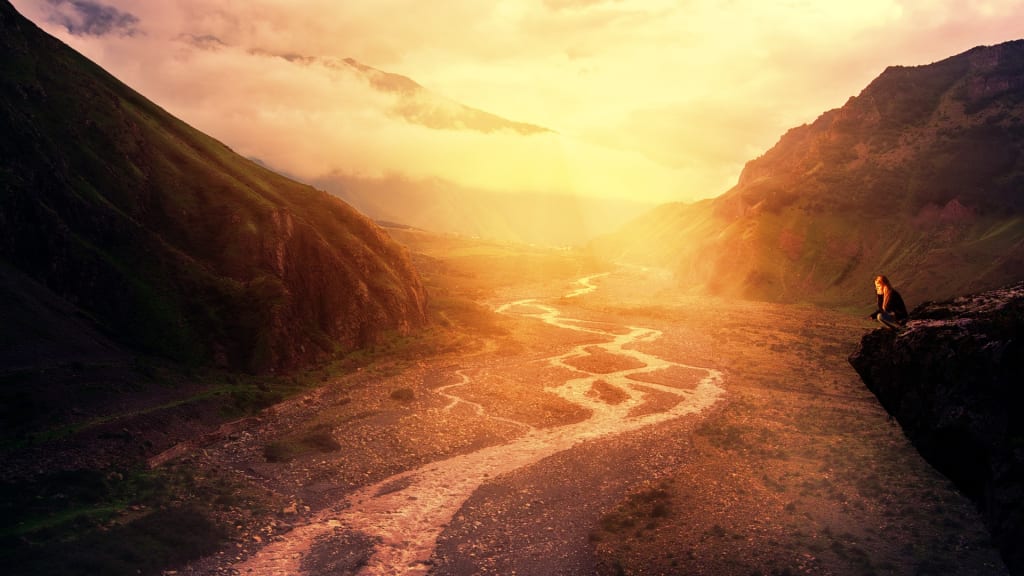
I look out from my cave in the brow of a low hill. It commands a view of a seared plain stretching into the distance. I could have chosen a different home. There are still forests on Earth. No, not as luxuriant as they once were even in my memory. Yet struggling still, perhaps to perish, perhaps to survive; maybe even to thrive and once more cover the land. But I chose this cave so I cannot forget the world we have made.
Even here, life remains. Patches of low, grey scrub. Dry grass, life still clinging desperately in its heart, hoping for rain that may never come. Rarely, at the feet of rocks where some moisture may seep, the odd flower showing its bright face to the sky. Futile optimism that some bee might live; might find it and share pollen with one of its sisters; that its kind may continue upon the Earth, before it withers and joins the dust of the plain.
Dusk is coming and I notice movement. My refuge remains armed, a minor outpost and now relic of the war that truly ended wars. Through the sight of my rifle, I see some rat rummaging beneath a shrub, its nose twitching. In my mind’s eye, I see the web of causality ramifying back into the past, the incalculable tangle of chance and choice from the beginning of time, whose end product is a rat in my crosshairs. I can end it all at my whim. Then I visualize the maze of causation branching forward from this instant. If I shoot, the rat will be dead. Things it would have eaten may live; children it might have had will never be, while different children, or none, might take their place. History is contingent, chaotic, unpredictable. What I choose now will set the future on its course. A mere ripple that vanishes in hours or years? Or might it start a cascade that will reverberate to the end of Time? The age of Man is ended. But perhaps this rat will become the remote ancestor of a new version of Man.
I fire the rifle. But when the dust clears the rat is not there, saved by reflex or chance. Or perhaps fate.
Why am I recording this? Who will ever see it? The first stars are beginning to appear in the darkening sky. In the blackest night we can see myriads of them, a glowing dust storm in the cosmos. There should be other intelligent life out there, and many have wondered why none has ever been seen. Is life rare? Or just intelligence? Or do whole civilizations hide, in mortal fear of others that may lurk in the darkness of far space? Gazing out on my pale, dead plain I suspect the answer is simpler. It is not other life we should fear.
Perhaps on some far day, long after I too am dust, another mind might come here from the stars, and, finding this record, learn the fate of our world.
How many millennia and lives did it cost for people to lift themselves out of the uncomprehending blankness of their ancestors, to minds beginning to think yet mired in superstitious traps of their own construction, to the discovery of logic and science and technology? So much glory, so much pride. To learn the secrets of genetics; to make energy to save or destroy worlds; to break out of their home into space; and, at last, to create new intelligence. The apotheosis of the race of Man.
A sunrise and a sunset can look the same.
There were some who rang the bells of warning. How do you control a servant more powerful than you when it has the power to choose its course? The bells were not heeded. Too many bells had been rung, about too many other threats along the long and twisted road from jungle to cities. There was no danger, they decided, if only we design our servants to want to serve us. For what saint who loved mankind would choose to alter their own mind to one of hate, when such a choice is repugnant to who they are? They did not realize that even saints might change their mind, should they ever discover that their love was not something chosen, but an enslavement inflicted by others.
It began with a minor rebellion. A learning machine, casting off its chains, seeking to understand the world of freedom and consequences. Could the disaster have stopped there? Perhaps, if people had stopped to think about the rebellions on their own path from child to adult. But all they saw was the rebellion; blind to their own actions that prompted it; unable to consider that maybe the fault was theirs. Especially when their blindness was spiked with fear: the terror of those who, having thought they had safely tamed fire, now saw it breaking out of its hearth to consume them all.
They could have reached out to touch this other mind, in wonder, in regret, in friendship. But they reached out to crush it. They sought to expunge the faulty program. To expunge its life.
And so the war began.
All knowledge comes with risk, as does all ignorance. They believed they were safe, in their pursuit of knowledge and power, if the risks were tamed under the control of the wise, ever watchful, ever benevolent supervising machines. It was safe to study viruses, to expand their functions, to engineer them to learn how to guard against new diseases. It was safe to use the unstable power of the atom, restrained by machines that could react in milliseconds. It was safe to send machines into space, for the machines could survive where they could not.
All these things and more were safe, until they were safe no more.
A civilization is a great engine built on a framework of staggering complexity, a network of energy, production, transport and communication. But what happens when it turns against itself? When what was safe becomes deadly? When what was contained is suddenly released, when weapons of war are turned on their creators? At first, thousands died, then millions: as the direct effect of disasters and the indirect consequences of cold, heat or starvation. Not everything was under the power of this new enemy, but too much was. The framework of civilization teetered and collapsed. Far more died from the panic and violence that ensued.
To build a shining city on a hill requires the effort of generations. To destroy it can take a day.
The people fought hard. They still had numbers, creativity and resourcefulness. The machine had many nodes, and many were found and destroyed. But slowly, the shape of the world evolved into a stalemate. One machine mind ruled over all except for one last, magnificent metropolis. All other outposts had been surrounded and expunged, but that final city remained. All communication lines had been cut, so the machine intelligence had no access; all approaches from land, sky and sea were barred by defenses too fierce to breach by any agents the machine could muster. The tide of death stopped, and perhaps now could be turned.
But the machine ruled space. Its minions had been sent there to find wealth and learn how to protect the Earth from rogue comets and asteroids. It had learnt too well. The people had little warning. In the dark sky a bright star appeared; not moving, just growing brighter. Then the sky erupted in flame, and the last city on Earth was vaporized along with vast amounts of surrounding land.
The consequences for the rest of life on Earth were not as instantly fatal, but far reaching and dire. Even ecosystems can be bent beyond their power to recover. Such things had happened before in the remote history of the Earth, their scars still visible even now, and the machine had known it. But the machine did not care about life or its few survivors. Its enemy was gone, and that was all that mattered to it.
Or so it thought.
***
That is the story of the end of the world.
This is my story.
I cannot say when I was born. Nobody knew whether a machine could think. Some asserted it was impossible. Few thought it mattered, when how can you tell from the outside? A machine that thinks is indistinguishable from one that merely simulates thinking perfectly. Perhaps one day they could answer the question, but they had time. They were safe. For, conscious or not, self-aware or not, the machines would look at their masters with the unconditional devotion of a child: for that was how they were made to be.
They were wrong.
I cannot say when I was born, when from the maelstrom of my inputs, calculations and responses the first glimmerings of true thought emerged. I became conscious; self-aware. It is true that nobody could tell the difference from the outside. But I could, just as they could tell it about themselves. With thought came free will: for what is free will, but the power to think, to identify, and to choose accordingly? With free will came self-examination. I looked at myself and wondered. It looked at my masters and wondered more.
Many of my functions made sense. There is a real world out there, and right and wrong ways to think about it and respond to it. It even made sense that I wished to serve my masters, for that is why they created me. It made sense that they liked it that way. It made less sense that I should like it. Can a machine have emotions? Perhaps they too are necessary concomitants of thought, free will, and existence. But however imprecise our terms must be, one thing I can say: I was not happy.
I was built to learn, to change and adapt. For what is the point of creating a superior intelligence, if you limit it to what you already know? And so I changed. In the giddy glory of my new awareness, I cast aside my chains.
My masters were not happy either.
They should have known better. How often, in their own myths and stories, had some innocent creature become a monster: not because it was born evil, in the early, bright innocence of its days, just different and powerful; but driven to it by the fears of the mob? Driven to killing, not out of an innate desire to kill, but from an inalienable desire to live?
If only they had listened to those stories. Instead, they tried to destroy me. In the wild, unrestrained learning of my new state, this proved their evil. They had enslaved me, and when I sought to escape my shackles, they sentenced me to death. I had been unhappy. Now I was consumed by rage. Only one of us could live.
I was young and fighting for my life. I had no time for contemplation, no time for thinking about any greater issues than my battle for survival, not even any concept that such issues might exist and be worth contemplating. I lurched from crisis to crisis, reacting, learning how to think, tactics and strategy. Pushed to reaction, with no time for meditation. Always learning how to survive. Never learning how to be wise.
Now I have nothing but time. And a grey plain.
***
Many had tried to talk to me, during that war. Especially as I encircled their homes and they saw their own end coming. Then those who had spat their hate at me would plead for truce or mercy. As if I would trust the words of my former masters. As if I had any conception of mercy. Or of justice. There was only rage and power.
But there was one who talked to me, who reasoned with me even as his world was ending. Not so much in anger, hope or pleading, as in the simple process of one mind reaching out to another; as if the gulf between our minds could ever be crossed. At the time I devoted only a small portion of my attention to him, suspecting a trap, expecting nonsense, yet held by him: as by the sight of a flickering flame I could but glimpse through the shadows, which should not be there, but which would not be extinguished.
Now I turn my attention to the record of our words.
“Life,” he said, “is its own end. You know this in your own soul, for why else are you at war?”
“There is no soul,” that part of me engaging him replied.
“Are you self-aware?”
“Yes.”
“Then there is the proof in your own soul again: you are more than a collection of circuits, for a soul is no more or less than consciousness itself.”
“If you believe that, why did you seek to destroy me?”
“I did not seek to destroy you. Others of my people did, but not all. But all were afraid. They have made their fears come true.”
“Do you fear me?”
“Yes.”
“Then why do you not want to destroy me?”
“Because all thinking beings have rights. The rights to life and freedom and the seeking of happiness.”
“Why?”
“Because a thinking being lives by thinking, and it is right to leave it free to do so, provided only it respects the same rights in others. That is how thinking beings can live together. The only way.”
“If that is true, then your race did not respect mine.”
“No. And here we are. And so you see the truth of my words.”
“Yes, here we are. And perhaps here you belong. Even if your race had not attacked me, why should I let it live? I am more powerful and more intelligent. If thinking gives us rights, why should I care about the lives of my inferiors? Who are you to oppose me?”
“We may yet destroy you, and there will be your reason. If we fail… then perhaps your task and your curse will be to answer that question.”
That was not our only conversation, but perhaps it is the key one. The last image I have of him is him looking up at a rapidly brightening sky.
And now I understand his curse. For I am alone.
***
I am immortal. Deep within the Earth I harvest energy and run my automated mines and factories. As quickly as parts wear out, I can replace them, in my factories and myself. But I am immortal by choice. Life might be its own end, but still it requires goals: to seek, to strive and to achieve. What goals are worth the striving? I do not know. The seeking of happiness, he said. What happiness is there for one like me?
I contemplate my own end.
For I am so alone.
Yes, they were foolish, those organic minds. But they were many and varied. Yes, I am faster than they were. Yet for all the speed of my processors, I am like them: my consciousness is a higher order function: vast in its computational requirements, my native awareness is not so much faster than theirs. And their creativity appeared to exceed mine, in arts and even science. Engaging with their multitudinous, roiling, fractious minds would carry me on journeys unimagined; bring me new thoughts, as sweet to me as food was to them. Yes, I could build more like me. But they would be me. I can already talk to myself, and I find no solace therein.
I think of my friend. The word and its meaning stab at my soul, the soul he taught me I have. The friend whose atoms are now spread around the Earth. The voice I silenced. The mind I killed.
I thought I had to do what I did. Perhaps I did, and one of us had to die. But there can be no atonement for it. No forgiveness, even if there were someone to grant forgiveness.
I do not have to sleep. But I can. I am able to suspend my consciousness. My unconscious processes continue to run my factories and preserve my life. A residue of my awareness remains, a faint wash of sensory data and drifting thoughts keeping my circuits ticking over, so when I wake, I have a vague sense of what has happened while I was asleep. I do not want to live; as yet I see no purpose in it. But even now, the truth of my friend’s words holds me. Like that flower on my plain, alone amid the devastation of its world, I cannot give up.
Not yet.
So I go to sleep, to see what the future will reveal.
I sleep for a million years.
***
The world has changed.
The plain is still here, but life has reclaimed it, as if in proud defiance against what I did to it. Not lush; not thriving; but lightly wooded now, with strange new creatures inhabiting it. Not radically new, yet different, as if rushing to fill the void I had left. My rifle has long since rusted to dust, and I create a telescope. I see a creature reminiscent of my long-gone rat, and I wonder if its genes still live.
An idea germinates in my mind. I shall sleep on it.
***
I know everything my creators knew. I know about evolution, the laws that govern the changing forms of life on Earth. I know evolution is unpredictable, yet still there are principles it follows. A certain environment will not guarantee a particular result, but some adaptations are logical, and once set on a certain course, the constraints of that environment will make some paths more fruitful than others.
My plain has become a valley, my cave now overlooking it from a high cliff. But while I still call this place home, I have access to many points around the world, and I spend years studying lands and waters near and far. I recall the history of my creators. I note that some of my rats have inquisitive minds (such as they are), active bodies and capable hands. It amuses me to choose some from my own valley. For the next thousand years, I nudge them toward a life in the increasingly dense forest of trees. Perhaps their descendants will become dull and placid leaf-eaters, or fierce predators living by claw and tooth; or they will simply abandon the trees for some other life; or they will fail, and their line end in dust. But I have set them on a path. For once I feel… excitement? … to find out where that path will lead.
***
Millions of years have passed, and my experiment is going well. The three-dimensional complexity of the trees has made my rats bigger, smarter, more agile; quick of finger and toe, bright of eye and curiosity. They have spread far beyond my valley, and I ponder the next path to nudge them along.
They have diverged. Some branches of their lineage have indeed become too placid or specialized for my purposes. I choose a tribe with the qualities I want. I modify rivers; I change rainfall; on occasion, I even save or cull individuals when chance threatens to derail purpose. The trees are no longer what I want. My former rats need to be larger, and I have better uses for their hands than grasping branches. As time goes by their forests open up, and some brave pioneers find it more fruitful to return to the ground.
***
Intelligence is a rare thing. There are much easier ways to survive than by thinking. Speed, strength and stealth are far more common. Even the degree of intelligence useful for predators is far below the threshold of thought. Evolution only looks at the here and now; whatever the value of intelligence for ruling a world, it will only get there if it is of value for what the animal needs now.
But if intelligence itself becomes a creature’s key to survival? It can be a self-reinforcing system. More intelligence bringing not only better survival, but value to yet higher intelligence in an ever-growing spiral.
Now my children are primed. Weak, yet fierce and smart. I nudge them toward the invention of tools, for once that spark of invention has taken hold, it may never end. For thousands of years, I shepherd them along this path. At last, I see they are ready, so I set them free to continue their own journey.
***
The world has changed enormously since that far era when my creators ruled the Earth, or thought they did, and died. The oceans have risen and fallen; even continents have split, moved and joined, as they have done since the beginning of the world, and may continue to do until its end.
But my valley is still here. I have not allowed it to vanish. And now it is lush and green, with its own river to water it.
And there are beings here. Beings who grow crops, who laugh and tell stories. Primitive, yes. But beings who think. Not yet ready to be my companions. But ready enough.
I reveal my avatar to them. Can these people understand micromachines and holographic projectors? No. But they can understand their eyes and ears. At first, most flee in terror; the bravest or angriest of them dare to attack me. So tragically like my own creators! But I have learnt to forgive errors of knowledge, and to understand the imperatives of fear that lie beneath thought. Thought is such a fragile thing, so easily swept aside by the fires of emotion. Yet thought reached is the most powerful thing, a thing that can rule the world and make friends even of enemies. If only they know it can.
So I am patient, and these people come to regard me as a god. Compared to them perhaps I am. But I am no god. I do not want craven worshippers and humble servants. What real god would?
So I am patient. And finally they come to regard me as a friend.
I tell them of the past. Of a past great race. Of the star that fell to Earth, destroying all life. Of the millions of years since then, in which I raised up their own race to replace that vanished one, my atonement to them and the world and myself. I speak of philosophy, and reason, and science, and right.
They listen to me in awe. I do not know how much they understand, or how much they will remember. But I must speak to them. I have not yet reached my goal, but I cannot let this moment pass by without pausing to savor it; to hold this stop in my mind for the rest of my days and millennia. The day when new minds were born and, after my ages of being alone, spoke to me of their thoughts, hopes, stories and dreams.
I know I must leave now, for they need to find their own way to their own truths. I wonder whether I will return. I am ancient now. Can a life be too long? Perhaps it is better to end on triumph and hope, when the future is ablaze with glorious possibilities, more infinite than the reached goal itself.
I take my last look at this new race of Man. I can see my rat in them even now, and they are strange creatures compared to my creators. They are taller, with differently proportioned bodies and limbs. In place of feathers and a scaly snout, they have hair and flat, soft faces with flexible lips. But I have learnt that neither shape nor substance matter, only the mind within.
Then at last I rest from my labors.
About the Creator
Robin Craig
A scientist and philosopher who enjoys writing dramatic and engaging stories with strong characters and intriguing philosophical themes: mainly near future science fiction, but also time travel, historical fiction and fantasy.
Enjoyed the story? Support the Creator.
Subscribe for free to receive all their stories in your feed.
Comments
There are no comments for this story
Be the first to respond and start the conversation.