
The Town That Applauded at Funerals
An outsider arrives where grief has rules of its own.

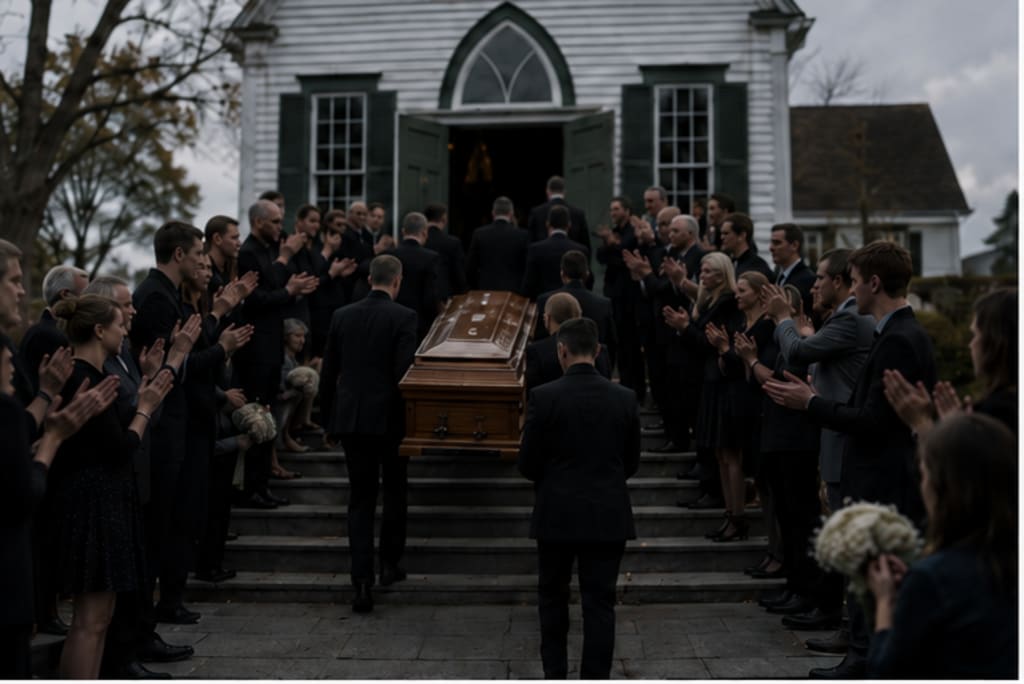
The first time Jonah heard the applause, he thought someone had won something.
It rose from the center of town just as the bus pulled away, leaving him with one suitcase, one garment bag, and the stale taste of seven hours on the road. The sound came rolling over the square in waves: hundreds of hands striking together, not politely, not briefly, but with force. With feeling.
Jonah turned toward it.
Across the street, people stood outside a white church with green shutters. Men in dark suits. Women in black dresses. Children holding flowers. A coffin rested at the top of the steps, shining beneath the afternoon sun.
The applause continued.
Jonah lowered his suitcase.
No one was smiling.
That was the first thing he noticed. Not one person looked happy, or proud, or relieved. Their faces were wet and still. A woman near the coffin clapped so hard her palms must have hurt. Beside her, a little boy clapped too, though he was crying.
The coffin disappeared through the church doors.
The applause stopped all at once.
Then everyone lowered their hands and bowed their heads.
Jonah stood at the bus stop, sweating in his interview jacket, wondering what kind of place clapped a body into the ground.
“First time in Bellwether?” someone asked.
He turned.
An old man sat on the bench beneath the bus schedule, though Jonah would have sworn the bench had been empty a moment before. The man wore a straw hat and held a paper bag against his chest.
“Yes,” Jonah said. “I’m here for the school.”
“Teaching?”
“Principal,” Jonah said, then corrected himself. “Interviewing for principal.”
The old man nodded as if that explained something unfortunate.
“You’ll want to learn when to clap,” he said.
Jonah glanced back at the church. “Is that… customary?”
“Everything is customary if it happens long enough.”
Before Jonah could ask what that meant, the old man stood and walked away down the street, one hand resting on the paper bag as gently as if it contained something alive.
Bellwether was smaller than Jonah had expected.
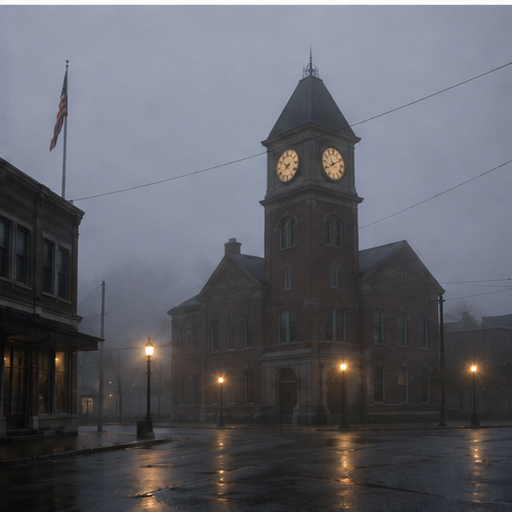
On the map, it had looked like a town. In person, it seemed more like a decision everyone had made together and then refused to revisit. A church, a school, a diner, a library, a hardware store, a barbershop with no sign, and a town hall with a clock that showed the wrong time from all four sides.
Jonah had grown up in cities. Places with noise enough to hide in. Places where people spoke to strangers only when necessary and never as if the stranger had already been discussed. Bellwether had none of that. It looked at him openly.
At the diner, three women stopped talking when he entered.
At the inn, the clerk knew his name before he gave it.
At the school, the secretary said, “You’re taller than your résumé,” and handed him a visitor badge already printed.
The superintendent was named Mrs. Vale. She had silver hair, rimless glasses, and the calm expression of someone who never needed to raise her voice because the room would quiet itself for her.
“We’ve been without a principal for almost six months,” she said, leading Jonah through the school hallway.
Children’s artwork lined the walls. Paper suns. Paper barns. Paper hands cut from colored construction paper and arranged in wreaths around classroom doors. Every hand had a name written on the palm.
“Small community,” Jonah said. “I imagine transitions are hard.”
“They can be.”
“What happened to the last principal?”
Mrs. Vale stopped beside a bulletin board covered in photographs. Field Day. Winter Concert. Harvest Pageant. In the center was a picture of a man with a round face and kind eyes, standing in front of the school sign.
“Mr. Renn,” she said.
Jonah waited.
Mrs. Vale touched the frame once. “He misunderstood something.”
The hallway seemed to hold its breath.
“I’m sorry,” Jonah said. “Did he leave?”
“Yes.”
There was clearly more. Jonah had learned, over years of interviews and administrative meetings, how to let silence invite information. But silence worked differently in Bellwether. It did not invite. It closed.
Mrs. Vale continued walking.
The interview panel had seven people: two teachers, one parent, the librarian, the town clerk, the custodian, and the old man from the bus stop.
Jonah looked at him.
The old man smiled.
No one explained why he was there.
The questions began normally enough. Budget experience. Conflict resolution. Student discipline. Staff retention. Community engagement.
Jonah did well. He knew he did well. He spoke about transparency, accountability, building trust, respecting local culture while bringing fresh ideas. The words came easily. They had served him in other rooms, with other panels, in places where people nodded at phrases like student-centered leadership and restorative practice.
Here, they listened without nodding.
Then the librarian asked, “What do you do when a child says the windows are watching?”
Jonah blinked.
“I’m sorry?”
“A child comes to your office and says the windows are watching. What do you do?”
He smiled carefully. “I would want to understand what the child means. Is this an anxiety response? A metaphor? Something they heard from another student?”
The panel was silent.
“I’d speak with the teacher,” he continued. “Possibly the counselor. I’d assess whether the child feels unsafe.”
The custodian wrote something down.
The old man asked, “Would you cover the windows?”
Jonah paused.
“If there were a reason to.”
“What reason would satisfy you?”
It was the kind of question that could make a qualified person sound foolish.
Jonah straightened. “I believe children deserve to be taken seriously. But I also believe adults have a responsibility not to reinforce irrational fears.”
Mrs. Vale looked down at her hands.
The librarian stopped writing.
Jonah knew then he had made some mistake, though he did not know which word had caused it.
After the interview, Mrs. Vale showed him to the front door.
“We’ll be in touch tomorrow,” she said.
“Thank you for your time.”
She nodded.
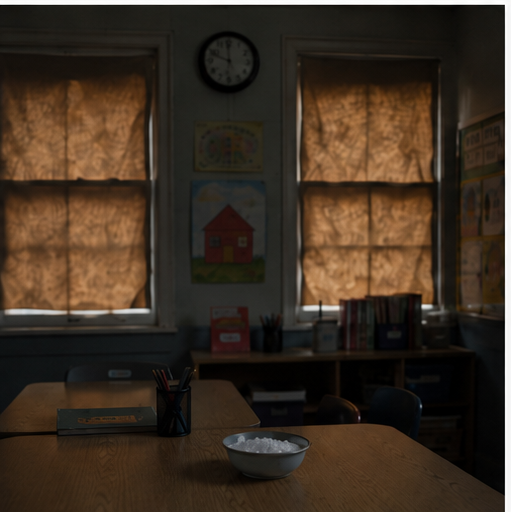
As Jonah stepped outside, every classroom window on the second floor was covered with brown paper from the inside.
That night, he ate dinner at the diner.
The waitress, a young woman with a braid down her back, brought him meatloaf without asking what he wanted.
“I didn’t order yet,” he said.
“You would have,” she replied.
He looked at the plate. “Is there a menu?”
“Not on Thursdays.”
“It’s Wednesday.”
She glanced toward the wall calendar. “Not here.”
Jonah laughed, assuming this was a joke.
No one else laughed.
A bell rang from somewhere outside.
Every person in the diner put down their forks.
The waitress turned off the radio.
Jonah looked around, waiting for someone to explain. No one did. The bell rang again. Then again. Three slow tones.
People stood.
Jonah remained seated for half a second too long, which was long enough for every face to turn toward him.
He stood.
A man by the counter closed his eyes. The cook came out from the kitchen, wiping his hands on his apron. Even the little girl in the corner booth stopped coloring and folded her hands.
The bell rang a fourth time.
Everyone sat.
Conversation resumed.
Jonah leaned toward the waitress as she passed. “What was that for?”
She studied him, not unkindly.
“Remembering.”
“Remembering what?”
“What needed remembering.”
Jonah waited for more.
She took his untouched water glass and replaced it with another.
At the inn, he found a handwritten note under his door.
Do not answer knocking after midnight.
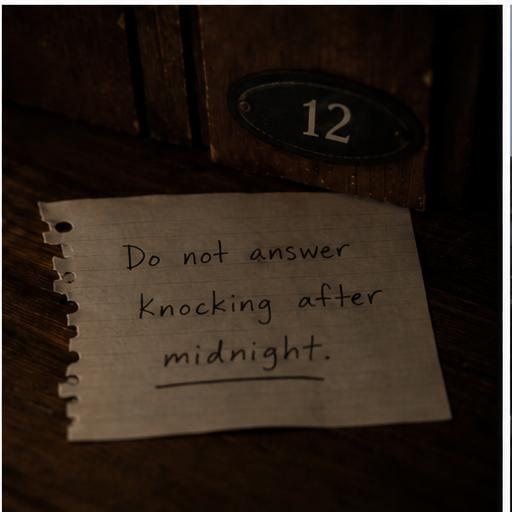
There was no signature.
Jonah stood in the narrow hallway, reading it twice.
Then he laughed.
It came out too loudly.
The innkeeper’s door opened at the end of the hall. Her face appeared in the gap.
“Something funny, Mr. Greer?”
He held up the note. “Is this part of the Bellwether welcome package?”
The innkeeper’s face tightened. “Who gave you that?”
“It was under the door.”
“Then someone is being kind.”
She closed her door.
Jonah went into his room and locked it.
The room was clean but old-fashioned. Floral wallpaper. Brass bedframe. A pitcher and basin on the dresser, though there was a bathroom down the hall. Above the bed hung a framed needlepoint:
A GUEST IS A QUESTION ASKED OF A HOUSE.
Jonah took a picture of it to send his sister, then realized he had no signal.
At 12:17, someone knocked.
Two soft taps.
Jonah opened his eyes.
For a moment, he did not remember where he was. The wallpaper moved in the dark like a garden seen underwater.
The knock came again.
Two taps.
He sat up.
The note lay on the nightstand where he had left it.
Do not answer knocking after midnight.
He stared at the door.
“Mr. Greer?” a woman whispered from the hallway.
It was Mrs. Vale.
He swung his legs out of bed.
“Mr. Greer, I need to speak with you.”
His hand was already on the knob when he stopped.
Something in the whisper was wrong. Not the voice itself. The placement. It sounded as if Mrs. Vale’s mouth were pressed directly against the keyhole.
“Please,” she said. “It’s about the position.”
Jonah did not answer.
A pause.
Then the voice changed.
“Jonah?” it whispered.
His sister.
He stepped backward.
His sister lived three states away. She had not called him Jonah since they were children.
“Open the door,” she said. “You’re being rude.”
The knob turned once.
Slowly.
Jonah grabbed his phone. Still no signal.
He looked toward the window and saw, across the street, all four faces of the town hall clock glowing in the dark.
Each showed midnight.
The knocking stopped.
In the morning, he told himself he had dreamed it.
That explanation held until breakfast, when the innkeeper poured his coffee and said, “You did well not answering.”
Jonah set down his cup.
“What is going on here?”
She continued pouring though the cup was full. Coffee spilled into the saucer.
“I asked you a question.”
“No,” she said softly. “You asked the town a question. That’s different.”
He left without eating.
At nine, Mrs. Vale offered him the job.
He should have refused.
He nearly did.
But he thought of his apartment back in the city, the rent increase, the assistant principal who had taken credit for his work, the school board member who called him “young man” though he was forty-two. He thought of Bellwether’s small class sizes, its clean hallways, its teachers who stayed for decades. He thought of how every strange thing could be translated with enough patience.
Customs. Trauma. Isolation. Local superstition.
An outsider’s arrogance often disguises itself as open-mindedness.
Jonah accepted.
For the first two weeks, he tried to observe before changing anything.
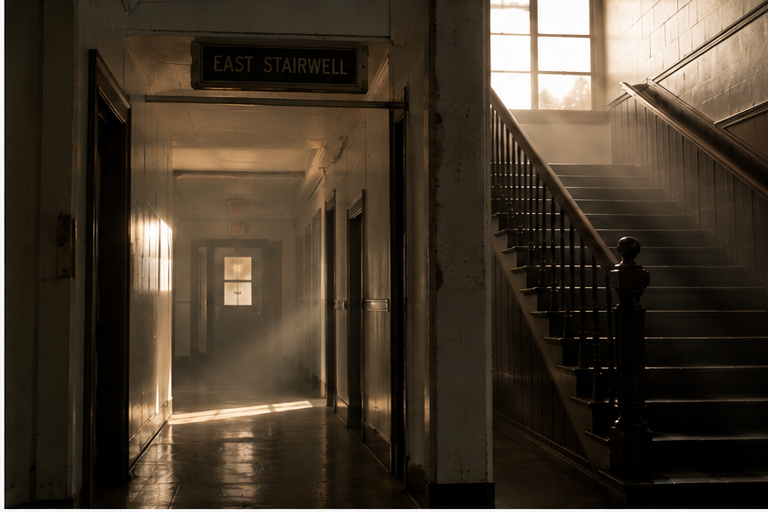
He learned that students did not enter the east stairwell alone. He learned that no one used red chalk. He learned that every classroom kept a bowl of salt near the pencil sharpener, and that on foggy mornings the first fifteen minutes of school were spent in silence, facing away from the windows.
He did not interfere.
Not immediately.
He made notes.
East stairwell — safety concern?
Red chalk — tradition? ask art teacher.
Salt bowls — sensory? pest control?
Morning silence — mindfulness practice?
The teachers were polite. The students were watchful. Mrs. Vale was available whenever he asked procedural questions and absent whenever he asked meaningful ones.
The first real conflict came in October.
A fourth grader named Elsie Price was sent to his office for refusing to draw her house.
The assignment was simple: My Home and Family. Crayons, construction paper, ten sentences. Elsie had drawn a black square in the center of the page and then scribbled over it until the paper tore.
When Jonah asked why, she said, “It was looking back.”
He recognized the shape of the interview question.
He folded his hands on the desk.
“Elsie, sometimes when we feel scared, ordinary things can seem scary.”
She looked at him with pity.
“You’re new,” she said.
“Yes. But I’m here to help.”
“That’s what Mr. Renn said.”
Jonah felt irritation rise. Not at the child, he told himself. At the adults who had taught her to fear paper and windows and doors after midnight.
He called her mother.
Mrs. Price arrived wearing a work uniform and the tense expression of someone summoned often. She listened while Jonah explained that he was concerned Bellwether’s traditions might be encouraging anxiety in vulnerable children.
Mrs. Price did not speak until he finished.
Then she said, “Did she draw the chimney?”
Jonah glanced at the paper. “No.”
Mrs. Price closed her eyes. “Thank God.”
That was when he made his decision.
The next Monday, Jonah removed the salt bowls.
He did it before students arrived, walking from room to room with a cardboard box, collecting them from shelves and windowsills and reading corners. Some bowls were glass, some plastic, some handmade clay. Each was filled with coarse white salt.
It felt, at first, like progress.
By 8:30, every teacher knew.
By 8:35, Mrs. Vale was in his office.
“Put them back,” she said.
“Good morning to you too.”
“This is not a negotiation.”
“I can’t have ritual objects in classrooms.”
“They are not ritual objects.”
“Then what are they?”
Mrs. Vale’s expression hardened. “Useful.”
“For what?”
“For keeping certain things where they belong.”
Jonah stood. “Do you hear yourself?”
“Yes,” she said. “That is one of the differences between us.”
He did not put the bowls back.
At 10:12, the east stairwell door opened by itself.
At 10:13, every student in Mrs. Hanley’s second-grade class began crying at once.
At 10:15, the windows in the art room fogged from the outside, though the day was clear and cold.
At 10:17, Elsie Price vomited black water onto her desk.
The school entered a lockdown without anyone announcing it. Teachers moved with practiced speed, covering windows, shutting lights, guiding children beneath desks. No one screamed. That made it worse.
Jonah stood in the hallway holding his radio, uselessly saying, “Can someone tell me what’s happening?”
No one answered.
At the far end of the corridor, a figure stood in the open east stairwell.
It looked like a person only because Jonah’s mind was desperate to give it mercy.
It was tall and narrow. Too narrow. Its head bent sideways beneath the ceiling. It wore what might have been clothing or might have been shadow arranged in folds. Where its face should have been, there was an opening like a keyhole.
Jonah could not move.
The thing lifted one hand.
Not toward him.
Toward the classrooms.
From behind every covered window, something knocked.
Two taps.
Two taps.
Two taps.
Jonah ran.
Not away from the thing. Toward the supply closet.
He grabbed the cardboard box of salt bowls and sprinted down the hall, scattering them outside classroom doors. Salt spilled across the floor. Bowls cracked. Teachers reached out and dragged them inside.
By the time he reached the east stairwell, only one bowl remained.
Elsie Price stood in the doorway.
Her face was gray.
Behind her, the thing leaned close, its keyhole face tilted toward her hair.
Jonah held out the bowl.
“Elsie,” he whispered.
She did not look at him.
The thing did.
Through the keyhole opening, Jonah saw a room.
Not a room he knew. A room with a bed in the center and furniture facing inward. A room where someone was waiting for him to enter and understand too late.
He threw the salt.
The hallway filled with the smell of burnt matches.
The thing folded backward into the stairwell, not retreating, exactly, but becoming farther away without moving. Elsie collapsed.
The stairwell door slammed shut.
Afterward, no one said I told you so.
That was almost worse.
Mrs. Vale sat with Jonah in his office while parents arrived. Children were picked up quietly. Teachers swept salt into careful lines across thresholds. The custodian replaced the cracked bowls with extras from a locked cabinet Jonah had never noticed.
Finally, Jonah said, “What was that?”
Mrs. Vale looked very tired.
“Something that learned we were here before we learned how to keep it out.”
“That doesn’t mean anything.”
“It means enough.”
“Why didn’t anyone tell me?”
“We did. Constantly.”
“No,” he said. “You gave me riddles. Customs. Warnings without explanations.”
“Explanations make outsiders feel entitled to judgment.”
He wanted to argue.
He could not.
He thought of the funeral applause. The bell at the diner. The paper over the windows. The note under his door. Elsie’s torn drawing. Every moment Bellwether had offered him information in a language he refused to respect because he did not yet speak it.
“What happened to Mr. Renn?” Jonah asked.
Mrs. Vale looked toward the covered window.
“He opened the east stairwell during fog.”
“Why?”
“He wanted to prove it was only stairs.”
“And?”
“It was only stairs,” she said. “At first.”
Jonah resigned before winter.
The official reason was family obligations. The town accepted this with the same solemn politeness with which it accepted most necessary lies.
On his last day, the school held an assembly.
Jonah expected a farewell card. Perhaps a brief speech. He had already packed his office into two boxes and left the new principal a long document titled Practices Requiring Continuity. It contained no explanations. Only instructions.
Keep salt bowls filled.
Cover windows during fog.
Never use red chalk.
Do not let children draw chimneys unless they choose to.
Do not open the east stairwell after the second bell.
If someone knocks after midnight, do not answer, even if the voice is familiar.
In the auditorium, the children sat cross-legged on the floor.
Mrs. Vale called him to the front.
Jonah stood awkwardly beneath the stage lights.
Then the students began to clap.
So did the teachers.
So did Mrs. Vale.
It was not cheerful. It was not gratitude. It was not forgiveness.
It was the sound he had heard on his first day, outside the church, when the coffin vanished inside.
Jonah understood then.
The applause was not celebration.
It was not mourning either.
It was recognition.
A way of saying: something has passed from one place to another, and we have seen it go.
He bowed his head.
For the first time in Bellwether, he did what everyone else was doing without needing to decide whether it made sense.
That night, the bus carried him out past the church, the diner, the library, the town hall clock with its four wrong faces.
The old man from the interview panel sat across the aisle, holding the same paper bag.
Jonah was not surprised to see him.
“Will it follow me?” Jonah asked.
The old man considered.
“Did you leave with anything that belongs to it?”
“No.”
The old man’s gaze dropped to Jonah’s suitcase.
Jonah followed it.
A thin line of white salt had leaked from the zipper onto the bus floor.
His spare suit shifted inside the bag.
Once.
Twice.
Like something knocking.
The old man sighed.
“Well,” he said, “then you’d better learn when to clap.”
About the Creator
Jason Hair-Wynn
Theatre artist, director, choreographer, and arts leader writing on accountability, equity, and culture in the performing arts, with a deep belief in storytelling, truth, and spaces rooted in care. And some travel content along the way
Enjoyed the story? Support the Creator.
Subscribe for free to receive all their stories in your feed. You could also become a paid subscriber, letting them know you appreciate their work.
Comments
There are no comments for this story
Be the first to respond and start the conversation.