
The Three-Year Password
A meticulously restrained short story that flips the marriage drama on its head—not with a fight, but with the quiet removal of a daily glass of water.
I smiled quite naturally in our marriage license photo.
She said she hadn't slept well, looked a little puffy, so we retook it three times. On the third try, she was finally satisfied. In the photo, the corners of her mouth tilt up slightly, but her eyes skip right past the lens and land on the man standing behind me, the one holding her Burberry trench. He has long fingers, fingertips resting lightly on the collar of her coat.
The way she looked at him—she used to look at me like that. When we first met. It lasted about four months.
She chose the wine for the wedding. A Provençal rosé, she said it smelled of raspberries and elderflower, the kind of wine that makes you want to kiss someone. Later, I saw in her email receipt that she'd ordered two cases. One was delivered to the reception. One to a different address. The recipient's name was her personal trainer. The note field read: For after-hours recovery.
On the wedding day, the schedule got pushed back two hours because she had a "sudden migraine." I stood at the church entrance in my suit, handing out champagne flutes, explaining, reassuring every guest. When she came back, the ends of her hair were slightly damp. She'd changed into flats. On the patch of skin just behind her ear, there was a very faint red mark. The kind of fingernail leaves behind, dragging lightly across skin.
I didn't ask. I poured the rosé into a glass decanter and watched the pale pink liquid slide down the curve of the glass, slowly, as if it were the most important thing in the world.
Under the reception lights, that red mark faded, degree by degree, back into the color of her skin.
Our wedding night. She was exhausted and went to sleep early. Her body sank into the center of our king-size bed, dressed in ivory Egyptian cotton sheets. Breathing steady. One hand resting on the pillow on what should have been my side. Fingertips slightly curled.
I slept in the guest room. Woke in the middle of the night to my phone screen glowing. A text sent to the wrong group chat: *He was fine. Not the best, not the worst. Same place tomorrow night?*
I stared at that text for maybe thirty seconds. Then I deleted the thread.
The phone screen flashed once in the dark, and the room fell back into blackness. I heard the leaves of the fiddle-leaf fig in the corner of the guest room brush against the wall in the draft from the central air, a faint rustling sound, like fabric dragging across skin.
The next day, I bought a new fiddle-leaf fig and swapped it in. The old one I left in the recycling area downstairs. Leaves still green, roots not rotted. I just didn't want to look at it anymore.
Married life settled into a rhythm, smooth as a well-oiled program.
She brought someone home roughly every other week. Sometimes the instructor from that SoulCycle she frequented. Sometimes, a man she'd met at one of her gallery openings. Sometimes, a face I'd never seen before. They usually arrived after ten at night and left around two or three in the morning. I saw the cycling instructor once. He wore an unironed linen shirt, had a mole just above his collarbone, and walked like he was perpetually reminding everyone in the room that he had an attractive pelvis.
I learned the pattern. Tuesdays and Thursdays, I'd come home late. Before heading back, I'd sit for a while in the CVS downstairs, buy a cold bottle of Smartwater, and drink it slowly. The glass door reflected my face back at me, along with the rows of Greek yogurt containers lined up neatly inside the cooler.
One night, I came home, and the entryway light was off. I stepped on something. A men's loafer, the Gucci horsebit, had dried bits of grass stuck to the sole. Maybe from a golf course. Or from one of those worn-down patches of lawn in the park.
I picked the shoe up, set it side by side with its partner, toes pointing out, lined up perfectly. Then I went to the bathroom to wash my hands. Two pumps of Aesop hand wash. Scrubbed the palms, the backs, between the fingers, under the nails. Sicilian citrus. The scent was so faint you had to concentrate to catch it.
On the sink counter sat a ring I'd never seen before. A plain platinum band. Two words engraved on the inside: *Always.*
I stepped around it. Didn't touch it.
Back in the living room, her bedroom door wasn't fully closed. Low laughter drifted out. Not her bright party laugh, the kind she used at openings. A deeper sound, rising from the back of her throat, breathy at the edges. I'd heard that laugh before. A long time ago.
I sat down on the couch. Turned the TV on. Left the sound off.
The blue light from the screen flickered across my face. On. Off. On. Off.
This went on for three years.
I think sometimes about how easy it is for people to adapt. When endurance becomes part of your daily life, it stops being endurance. It's just life. Like how, every morning while the coffee brewed, I got into the habit of setting a glass of warm water next to the coffee maker. With a slice of lemon. The first thing she did when she woke up was drink water. That first year, she drank it sometimes. Occasionally, she'd carry the glass back to bed, lean against my shoulder, finish the water, then set the glass on my nightstand and say *thank you* in a voice still rough with sleep. The second year, she seemed to have forgotten who put that glass there. The third year, she just pushed it aside. The base of the glass left a thin water trail across the wooden nightstand.
I didn't say anything. The next morning, the glass was in its usual spot. The lemon slice was freshly cut. The cut was clean. A little juice clung to my fingertip.
The change came on a very ordinary Wednesday, in the small hours of the morning.
That night I hadn't stayed out late. I sat on the living room couch, flipping through a copy of The New Yorker. The bedroom door wasn't fully closed. Low voices. Occasional laughter—that laugh, the same as before, rising from deep in the throat, edged with breath. Just a different man on the receiving end.
I turned to the cartoons section and kept reading an article about Alaskan king crab fishing boats. The article said a boat goes out to sea for three years at a time. The crew face the same weather on the Bering Sea, eat the same food, stare at the same gray sky. In three years, no one will ask them if they want to go home. I thought there was something familiar in that. But not entirely. They got to go home after three years.
My three years were up.
No big emotion. No moment of I've finally had enough. Just a timer, set long ago, quietly going off, reminding me that time was up.
I stood, walked into the guest room, and pulled a suitcase down from the top shelf of the walk-in closet. A Tumi, silver-gray, the telescopic handle a little stiff. I rubbed some olive oil on it, the one I grabbed from the kitchen. I'd bought this suitcase three years ago at Bloomingdale's. The first day I moved in. Three years it had sat empty on that top shelf, buried under two cashmere sweaters I never wore.
I opened it on the floor. There wasn't much to pack. A few Thom Browne shirts. My passport. Some documents. Nothing that needed special wrapping. Because there was nothing worth taking.
I was just zipping it shut when the bedroom door opened.
She came out, hair tangled, wearing a La Perla silk slip, deep navy, the lace trim at the neckline slightly askew. Bare feet on the oak floor. Around her ankle, an impossibly thin 14-karat gold chain with a tiny blue topaz. I'd never seen it before.
Behind her, the shape of a man. Not tall. Shoulders are a little sloped. Wearing an unironed Oxford shirt, one button done up wrong. He stood in the shadow of the hallway, like a painting that hadn't dried yet.
"What are you doing?" She frowned at the suitcase in my hand.
She didn't ask Why aren't you asleep. She didn't ask *Are you okay*. She asked *What are you doing*. This was the first time my behavior had registered, in her world, as a deviation she couldn't explain.
"Tidying up," I said.
The man behind her shifted. She didn't look at him, just waved a hand backward, like shooing a fruit fly. He stopped moving. Receded into the shadow of the room.
She stepped closer, eyes fixed on the suitcase.
"Where are you going?"
I didn't answer. I pulled the handle up. Still a little stiff. But functional.
She stepped closer still. The blue topaz on her ankle caught the floor lamp's light for a second, like a tiny eye, open and watching.
"Ethan." She said my name.
The first time in three months she'd said my name. When was the last time? Maybe last month, when she needed me to sign for a package. Or earlier. I couldn't remember.
"Look at me," she said.
I raised my head. Her gaze was different. Usually, when she talked to me, her eyes rested somewhere near my eyebrows, or slipped past my shoulder to check her phone. But now her eyes looked straight into mine. Pupils slightly dilated.
She reached out and took my hand.
Her fingers were cold. Nails freshly done, nude pink, the edges filed smooth and rounded. She didn't grab my wrist—that was how she held me when she needed me to do something. She took my palm. Palm to palm. Her fingers slid one by one through the gaps between mine and locked there. Her thumb pressed against the back of my hand. The pad of it was slightly damp.
The gesture was foreign. The last time she'd held my hand like this was probably our second month together, on Bow Bridge in Central Park. She'd stopped suddenly, grabbed my hand, laced her fingers through mine, and said it was warmer walking that way.
Her face drew closer. Her lashes were thick, with a thin coat of mascara slightly smudged onto the lower lid. She rose onto her toes. Her lips moved toward me. They were a little dry, a fine crack running across the center of her lower lip. This wasn't a kiss. It was a test. Like checking the batteries on a remote control she hadn't used in a very long time, seeing if the signal still worked.
For a second, I caught her scent. Diptyque Eau Rose, mixed with a trace of sweat, and another man's sandalwood cologne. Three smells layered together. Like a chord with one wrong note buried inside it.
Just before she reached me, I lifted my other hand.
My thumb landed at the corner of her mouth. A smudge of lipstick there. Tom Ford Spanish Pink. Smeared from earlier. I wiped it gently with the pad of my thumb. The skin beneath it was slightly warm.
The lipstick came off. My finger slipped from the corner of her mouth at the same moment my other hand pulled free from hers. Like a goodbye that didn't need saying.
Her fingers hung empty in the air for maybe three seconds. Then they slowly lowered to rest against the side seam of her slip.
"Your lipstick was smudged," I said.
She froze. Frozen on her toes, the almost-kiss still unfinished on her face. At the corner of her left eye, there was a very, very small mole. I used to see it every morning when I handed her that lemon water. Right now, that mole shifted slightly. Because the corner of her eye twitched.
"Ethan." She said my name again. Different this time. Before, it was pressing a button. Now, it was slapping the side of the machine because the button wasn't working.
I didn't stop.
"Ethan. Take one more step. I dare you."
Her voice pitched half an octave higher. Still an imperative. But there was a tremor at the end. Not a sob. More like the brief stutter of a system hitting an unknown error.
She stepped around the couch and planted herself between me and the entryway, bare feet on the cold marble tile, toes curling under. The neckline of her slip had shifted further, exposing a sliver of collarbone, and just below it, a very faint brown freckle.
"You don't love me anymore?" She tilted her head, asking this. She looked genuinely puzzled. Not sad-puzzled. Logically-puzzled. Like using the same password for three years and having it work every time, until one day someone changes the chip in the lock.
"What were these three years about?" The question came out of her mouth like an honest inquiry.
I looked at her face. The mole at the corner of her eye. The freckle below her collarbone. Details I used to see every day, until she buried them under someone else's cologne.
I let my hand fall from the door handle.
"These three years." My voice was calm. Like I was answering a question about what I had for lunch.
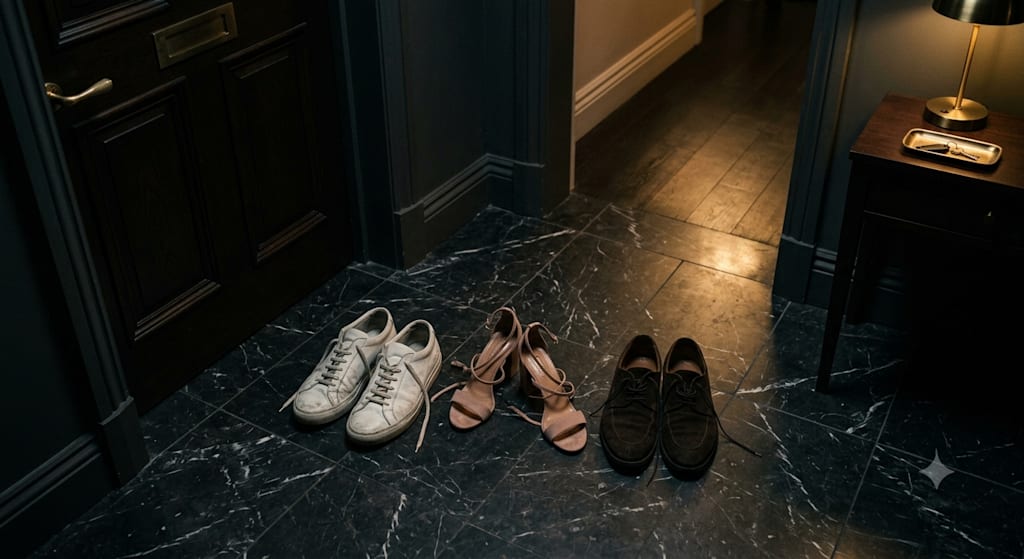
I looked down at the marble tile in the entryway. Three pairs of shoes, lined up side by side. One pair of Common Projects, white, the edges of the soles worn down to gray. One pair of Aquazzura heels, nude pink, the straps lying slack on the floor. And one pair I didn't recognize. Dark brown suede loafers. Laces undone.
I looked at those three pairs of shoes for a long moment.
Then I raised my head and gave her a small smile.
"Count them as my endurance."
I didn't wait for her reaction. I opened the door and walked out. It clicked shut behind me, soft. Like the sound of a MetroCard swiping through a turnstile.
The elevator panel counted down. PH. 7. 6. 5. 4. 3. 2. Lobby.
The elevator car was quiet. I looked down at my hand. The thumb I'd used to wipe her lipstick. The pad of it still held the ghost of her skin's warmth and the faint, greasy residue of the lipstick. I rubbed it against the seam of my trousers.
The doors opened. Night air rushed in. A little cold. Carrying the faint, damp smell of the East River.
I stood at the curb of Park Avenue, the silver-gray Tumi at my side, the suitcase that had waited three years for this moment. No traffic. The streetlamp stretched my shadow long across the pavement, all the way to the curb, like a rope someone had forgotten to coil up and put away.
And then I remembered something.
Tomorrow morning, she'll wake up. Eyes still closed, she'll reach out, out of pure habit, to that exact spot on her nightstand. Reaching for a glass of warm water with lemon.
But there won't be a glass there.
She'll stretch her arm a little further, reaching into the empty air. Her fingers will find the bare wood of the nightstand. Nothing there except a faint circular watermark, bleached a shade lighter than the rest of the wood. The ghost of a glass base, sitting in the same spot for three years. Like the pale band on a wrist after a watch is removed. Like that ring of white skin left behind when a ring is finally taken off.
She'll stare at that watermark for a while. Then maybe she'll pull her hand back, climb out of bed barefoot, and walk to the kitchen to pour her own water. She'll open the Sub-Zero refrigerator, and maybe, for a second, it'll occur to her that water was something she used to not have to pour herself.
But it won't be a big thing.
After all, life there will go on. The sheets will get changed. The scents will fade. New habits will paper over the old ones. The fiddle-leaf fig I bought from The Sill—every leaf of it will still be in its place. No one will notice which one was replaced. And no one will ever know that there was once a man who, every Tuesday and Thursday night, sat in a CVS and drank an entire bottle of ice-cold water, just to stay away two hours longer.
The sky's getting light now. The Upper East Side sky is shifting from deep gray to a washed-out pale, like a black T-shirt that's been through the laundry too many times. I pull my suitcase west. I don't look back. There's a twenty-four-hour diner a few blocks that way. I can sit down and have a cup of black coffee.
And then, probably, I'll go somewhere I've never been.
Alone.
About the Creator
Jin
Writer of reamstories
https://reamstories.com/jin
Enjoyed the story? Support the Creator.
Subscribe for free to receive all their stories in your feed. You could also become a paid subscriber, letting them know you appreciate their work.
Comments
There are no comments for this story
Be the first to respond and start the conversation.