
The Thirteenth Guest
Every Halloween, twelve people gathered for dinner. Every midnight, someone else arrived. Chapter One: The Invitation
Chapter One: The Invitation
The invitation arrived on October 13th.
It was a small black envelope, sealed with dark red wax, addressed to Eleanor Whitmore in handwriting she recognized immediately.
Her grandmother's.
But Margaret Whitmore had been dead for seventeen years.
Eleanor stood in the hallway of her apartment, turning the envelope between her fingers. There was no stamp, no return address, and no explanation for how it had appeared inside her locked mailbox.
Only a single sentence was written across the front.
You are expected at Blackwood Manor on October 31st. Midnight. Do not be late.
Beneath the words, someone had drawn thirteen tiny circles.
Eleanor felt a chill move through her.
Blackwood Manor had been empty since her grandmother's death. The enormous Victorian house stood beyond the northern edge of the village, surrounded by dead trees and iron gates that had not been opened in years.
As a child, Eleanor had spent every Halloween there.
Her grandmother had insisted on hosting a formal dinner on the night of October 31st. Twelve guests sat around a long mahogany table, dressed in their finest clothes, while candles burned in silver holders and the wind rattled the windows.
At midnight, the dinner always ended.
The guests departed without dessert, without coffee, and without saying goodbye.
Eleanor had never understood why.
She remembered asking her grandmother once.
Why do they always leave at midnight?
Margaret had stopped polishing a silver spoon.
Because, my darling, midnight is when we must make room for the thirteenth guest.
Eleanor had laughed, believing it was a joke.
Her grandmother had not laughed with her.
Three days after receiving the invitation, Eleanor booked a train ticket to the village.
She told herself she was going to discover who had sent it.
She did not tell herself the truth.
Somewhere deep inside, she already knew that Blackwood Manor was waiting for her.
And that this time, the dinner would not end the way it always had.
Chapter Two: The House That Remembered
The village looked smaller than Eleanor remembered.
The same narrow streets wound between old stone cottages. The same church tower rose above the rooftops. But the people seemed quieter, and when she mentioned Blackwood Manor to the woman running the village inn, the woman's smile disappeared.
"You're going there tonight?" she asked.
Eleanor nodded.
"Then don't stay after midnight."
"Why does everyone keep saying that?"
The woman lowered her voice.
"Because your grandmother was the last person who knew how to send him away."
"Send whom away?"
But the woman had already turned toward the kitchen.
By late afternoon, Eleanor was walking up the overgrown path to Blackwood Manor.
The iron gates stood open.
Beyond them, the house rose against the darkening sky, its tall windows reflecting the last traces of daylight. Ivy covered the stone walls, and dead roses twisted around the pillars of the entrance.
Yet when Eleanor reached the front door, she found it unlocked.
Inside, the hallway smelled of beeswax, old wood, and dried flowers.
A fire burned in the drawing room.
Fresh flowers stood in crystal vases.
The grandfather clock beneath the staircase ticked steadily, though Eleanor was certain it had stopped working years ago.
"Hello?"
Her voice disappeared into the house.
Then she heard footsteps.
An elderly man emerged from a doorway. He wore a black suit and white gloves, and his silver hair was combed neatly away from his face.
Eleanor recognized him.
"Thomas?"
The old butler bowed.
"Miss Whitmore. We have been expecting you."
"You're still here?"
"I never left."
"But the house has been empty for seventeen years."
Thomas regarded her with an expression she could not quite understand.
"Empty, Miss Whitmore, is not the same as unoccupied."
Before she could ask what he meant, he took her coat.
"Dinner will be served at eleven. Your grandmother's instructions were very precise."
Eleanor glanced toward the staircase.
"How many guests are coming?"
Thomas paused.
"Twelve, as always."
"And the thirteenth?"
For the first time, the old man's composure faltered.
"That," he whispered, "is not a question you should ask before the candles are lit."
Chapter Three: Twelve Places
At eleven o'clock, the dining room was ready.
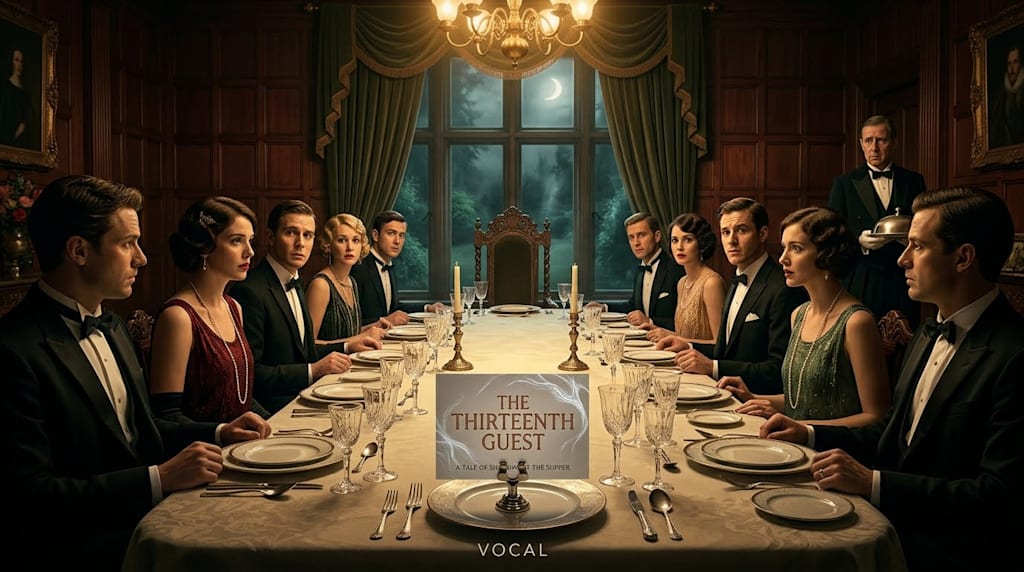
The table stretched almost the entire length of the room, covered with white linen and polished silver. Twelve candles burned in tall black holders. A bowl of dark red roses stood at the center, their petals beginning to fall.
Twelve chairs surrounded the table.
At the far end stood a thirteenth chair.
It was older than the others, carved from dark wood, with armrests shaped like twisting branches. Unlike the other places, it had no plate, no glass, and no silverware.
Eleanor stared at it.
"Why is that chair here?"
Thomas adjusted a candle.
"It has always been here."
"Who sits in it?"
"No one."
"Then why keep it?"
The butler looked toward the dark window.
"Because removing it would be an invitation."
Before Eleanor could ask another question, the doorbell rang.
The guests arrived one by one.
There was Dr. Samuel Reed, a thin man with silver spectacles who had known Eleanor's grandmother. There was Beatrice Hall, a woman dressed in dark green silk, and a pair of brothers whose faces seemed strangely familiar.
Others followed, all dressed as though attending a funeral rather than a Halloween dinner.
Eleanor counted them carefully.
Twelve.
They greeted her politely, but no one seemed surprised to see her. In fact, they behaved as though she had attended every dinner for years.
"You look just like your grandmother," Beatrice told her.
"Did you know her well?"
Beatrice's expression changed.
"Better than I would have liked."
At eleven thirty, dinner began.
The food was exquisite, but the conversation was strained. The guests spoke about the weather, the village, and the restoration of the old church. No one mentioned the empty chair.
No one mentioned the invitation.
And no one looked at the clock.
Eleanor began to suspect that they were all hiding something.
Then, at precisely eleven fifty-nine, every candle flickered.
A cold wind swept through the room.
The grandfather clock struck midnight.
Once.
Twice.
Three times.
Eleanor watched the hands move.
Four.
Five.
Six.
The guests stopped speaking.
Seven.
Eight.
Nine.
The temperature dropped so sharply that Eleanor could see her breath.
Ten.
Eleven.
And then the final chime rang through the house.
Thirteen.
The dining room door slowly opened.
No one stood outside.
Yet the thirteenth chair scraped backward across the floor.
Someone had sat down.
Chapter Four: The Man Without a Face
Eleanor could not move.
The chair at the end of the table was no longer empty.
A tall figure sat there, dressed in a black suit that looked as though it had been sewn from shadows. His hands rested on the table, pale and motionless.
Where his face should have been, there was only darkness.
The guests lowered their heads.
Every single one of them.
Thomas appeared beside the doorway, carrying a silver tray.
"Welcome," he said softly.
The figure did not answer.
Instead, he turned toward Eleanor.
She felt his attention like cold fingers against the back of her neck.
"Who is that?" she whispered.
No one replied.
The figure raised one hand.
On the table, a plate appeared before him.
Then a glass.
Then a silver knife.
The candle nearest Eleanor went out.
The figure tilted his head.
And when he finally spoke, his voice sounded like someone whispering from the bottom of a well.
"Margaret."
Eleanor's heart stopped.
That was her grandmother's name.
"I am not Margaret," she said.
The figure turned his head toward her.
"No," he replied. "You are what she left behind."
Suddenly, Eleanor remembered something.
A room at the top of the staircase.
A locked door.
A little girl standing outside it, listening to someone crying on the other side.
She had been six years old. Her grandmother had found her there and carried her downstairs without explaining what she had heard.
For years, Eleanor had believed it was a dream.
Now she could hear the crying again.
The figure extended one pale hand toward the empty place beside him.
"Come here, Eleanor."
She looked at the guests.
Their heads remained bowed.
"Why?" she demanded.
"Because it is your turn."
Chapter Five: The Family Secret
Eleanor pushed back her chair.
"I don't understand."
Dr. Reed finally raised his head.
His face was ashen.
"Your grandmother made a bargain," he said.
The faceless figure remained still.
"Seventy years ago, Margaret Whitmore was a young woman who wanted to save her family. Her father had lost everything. The house was being sold, the land was gone, and creditors were waiting outside the gates."
"What does that have to do with this?"
"She found a way to keep Blackwood Manor," Dr. Reed continued. "But the bargain required something in return."
Eleanor looked at the empty chair.
"What?"
"A place at her table. Every Halloween. Twelve living guests and one who belongs to the other side."
The figure's fingers moved against the tablecloth.
"Your grandmother invited me here for the first time when she was twenty-two," he said. "She promised that someone from her family would always welcome me."
Eleanor felt sick.
"And she kept that promise?"
"Every year."
"Until she died."
For the first time, the figure seemed almost amused.
"Death does not release a promise."
The guests began to whisper.
Dr. Reed continued.
"Your grandmother was supposed to tell you everything before she died. She wanted to find a way to end the bargain, but she never succeeded."
Eleanor stared at the thirteenth chair.
"Why am I here?"
The figure leaned forward.
"Because the house remembers its promises. And because you are the last Whitmore."
The candles flickered again.
Above them, something began to move across the ceiling.
Slow footsteps.
One after another.
Coming down the stairs.
Eleanor turned toward the door.
Thomas stood there, his white-gloved hands folded in front of him.
"Miss Whitmore," he said, his voice trembling, "there is something else you must know."
She looked at him.
"The guests at this table have been coming here for seventy years."
Eleanor swallowed.
"But some of them look exactly the same as they did when I was a child."
Thomas lowered his eyes.
"Because none of them have been alive for a very long time."
Chapter Six: The Thirteenth Place
The realization spread through Eleanor like ice.
She looked around the table.
Dr. Reed.
Beatrice Hall.
The two brothers.
Their faces began to change beneath the candlelight. Their skin grew translucent, revealing shadows beneath. Their clothes appeared older, their features less solid.
One by one, they looked toward her.
They were not guests.
They were memories.
People who had died in Blackwood Manor across generations, bound to the house by the same bargain that had preserved it.
Eleanor turned to Thomas.
"Are you dead too?"
The old butler smiled sadly.
"I have been here longer than anyone remembers."
The faceless figure rose.
The room trembled.
"Your grandmother believed she could break the bargain by refusing me a place," he said. "She was wrong. A promise can be broken only by the person who made it."
"Then how can I end it?"
"Accept your place."
Eleanor looked at the chair.
If she sat down, would she become another ghost, trapped in the house forever?
Would the guests return next Halloween, waiting for another Whitmore?
She thought of her grandmother.
Of the locked room.
Of the strange fear that had haunted her childhood.
Then she understood.
Her grandmother had never been afraid of the thirteenth guest.
She had been afraid of what would happen if the family stopped inviting him.
"What happens if I refuse?" Eleanor asked.
The figure was silent.
For the first time, the guests looked up.
Their faces were filled with terror.
Thomas stepped forward.
"The house will fall," he whispered. "Everything your family has protected will disappear."
Eleanor looked around the dining room.
The portraits on the walls.
The silver candleholders.
The old clock.
All of it had been preserved by a bargain made before she was born.
A bargain she had never agreed to.
She straightened her shoulders.
"Then let it fall."
The faceless figure became perfectly still.
Eleanor walked to the table and picked up the thirteenth chair.
It was impossibly heavy.
For a moment, the floor beneath her feet cracked, and the walls groaned as though the house itself were alive.
She dragged the chair away from the table.
"No more invitations," she said.
The figure reached toward her.
Every candle went out.
Chapter Seven: The House at Midnight
Blackwood Manor began to collapse.
The windows shattered inward. The portraits fell from the walls. The grandfather clock split down the middle, releasing a cloud of dust that swirled through the darkness.
Eleanor heard voices calling her name.
Some begged her to stop.
Others screamed.
The faceless figure stood at the far end of the room, growing taller and darker until his head nearly touched the ceiling.
"You cannot undo what your grandmother promised!"
"I am not my grandmother!"
Eleanor dragged the chair toward the open doorway.
The figure rushed forward.
For one terrible moment, she saw something beneath the darkness of his face.
A mouth.
A human mouth, stretched into a smile.
Then the house shook violently.
The thirteenth chair struck the threshold.
The wood split.
A sound like a thousand clocks breaking filled the room.
And everything disappeared.
When Eleanor opened her eyes, she was lying in the grass outside Blackwood Manor.
The sky was pale with the first light of dawn.
The house was gone.
Only the iron gates remained, twisted and rusted among the weeds.
She sat up slowly.
In her hand was a small object.
A silver pocket watch.
Its hands had stopped at midnight.
Eleanor opened it.
Inside the cover, engraved in tiny letters, were the words:
A promise is not a prison unless you choose to remain.
She closed the watch and placed it in her coat pocket.
Then she walked toward the village.
For the first time in seventy years, Blackwood Manor was silent.
And somewhere, far beyond the world of the living, a thirteenth guest was searching for another table.
Epilogue: Next Halloween
One year later, Eleanor celebrated Halloween in her small apartment.
There were candles on the windowsill, a bowl of sweets by the door, and a pot of soup warming on the stove.
For the first time, she had invited friends over without feeling that someone else had chosen the guest list.
At eleven fifty-nine, they raised their glasses.
"To new beginnings," one of them said.
They laughed.
The clock struck midnight.
Nothing happened.
Eleanor smiled and turned toward the kitchen.
Then the doorbell rang.
Everyone fell silent.
Eleanor walked to the door and looked through the peephole.
The hallway was empty.
On the floor lay a small black envelope sealed with dark red wax.
Her name was written across the front.
Her hands began to tremble.
She opened it.
Inside was a single card.
Thank you for the chair.
Beneath the words, someone had drawn thirteen tiny circles.
And from somewhere inside the apartment, a chair slowly scraped backward across the floor.
About the Creator
Enjoyed the story? Support the Creator.
Subscribe for free to receive all their stories in your feed.
Comments
There are no comments for this story
Be the first to respond and start the conversation.