
The Third Crossing
He thought it was just a rural Japanese village lagging behind modern times. He didn't know the village had left time entirely.

The train had only one car, and it smelled of wet rust and ancient cedar.
Julian checked his phone for the tenth time. Still no signal. He was a British architectural researcher, hired by a remote municipality in the mountains of western Japan to survey decaying houses. But a missed transfer and a faulty paper map had left him here, stepping onto the cracked concrete platform of an unnamed station surrounded by suffocating, dark green pine forests.
The air was dense, thick with the smell of mountain water and something metallic—like old coins left in the rain.
According to his guide, the village was supposed to be a tight-knit, aging community. But as Julian walked down the narrow asphalt road, the silence felt active. It didn’t feel like a village where people had left; it felt like a village that was hiding.
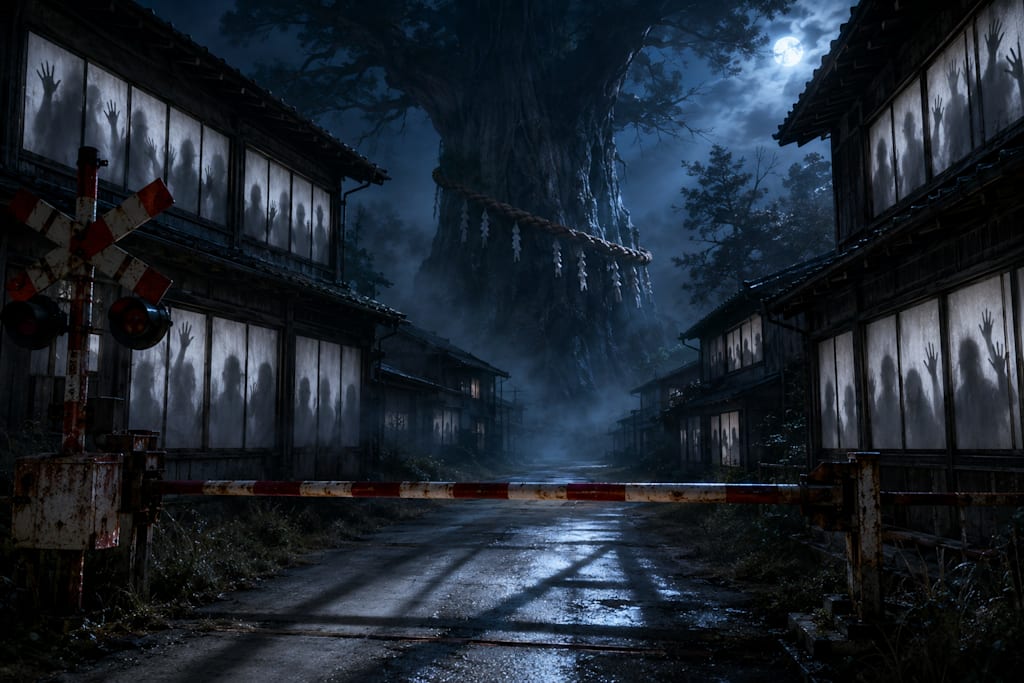
The houses (minka) were grand but suffocating. Their dark wooden frames and tiled roofs leaned over the street like silent judges. Strangely, every window was completely papered over from the outside with blank white shoji sheets. No glass. No gaps. Just smooth, blinding white.
"Hello?" Julian called out, his English voice sounding violently artificial against the mountain backdrop. "Excuse me?"
A rustle. Julian turned sharply. At the edge of a narrow drainage canal, an old woman was kneeling. She wore a faded gray kimono, her back bent into a permanent crescent. She wasn't looking at him. Instead, she was meticulously placing tiny, uncooked grains of rice into a neat, geometric circle on the mossy stone.
"Ah, Sumimasen," Julian said, shifting into his broken, polite Japanese. "I am lost. Where is the village office?"
The old woman didn't stop. Her wrinkled hand moved with mechanical precision. Then, without looking up, she spoke in a dialect so thick and rhythmic it sounded less like language and more like water hitting stone.
"The outsider walks on the second layer," she whispered, or at least, that was what Julian’s brain tried to translate. "But the train only stops at the third crossing. Do not look at the shadows on the paper."
"I’m sorry, I don't understand," Julian said, taking a step closer.
Instantly, she froze. The rice dropped from her fingers. She raised her head, but her eyes were entirely clouded with milk-white cataracts, staring right through him. She didn't look angry; she looked profoundly, deeply tired.
"You are already echoing," she said in standard Japanese, clear as a bell. Then, she pointed down the road toward a rusty red railroad crossing in the distance.
The tension in the air snapped like a tight wire. Julian felt a sudden, sickening wave of vertigo. The perspective of the street seemed to warp—the narrow road suddenly felt miles long, yet the houses felt close enough to touch his shoulders. He didn’t argue. He turned and walked rapidly toward the crossing.
As he approached, he realized the crossing made no sense. There were no tracks. Just two rusty red poles with black-and-yellow striped barriers, sitting directly across the asphalt road in the middle of the village. The alarm began to ring. Clang. Clang. Clang.
The sound was too loud, vibrating inside his teeth. But there was no train.
Suddenly, the sliding doors of the houses beside him began to shake. From behind the blank white papered windows, shadows appeared. Human silhouettes, dozens of them, pressing their faces and hands against the paper from the inside. But they weren't knocking. They were just sliding sideways, perfectly flat, mimicking the motion of a passing train.
Clang. Clang. Clang.
Julian’s breath hitched. The physical reality of the place was rejecting him. The social rules he understood—asking for directions, expecting a logical layout—were useless here. He tried to turn back, but the old woman was gone, and the road behind him was swallowed by a sudden, freezing mountain fog.
The barrier arms slowly lowered, blocking his path.
On the other side of the red poles, the road didn't continue into the forest. It opened into a vast, empty gravel space centered around a colossal, dead cedar tree. Tied around its trunk was a thick, rotting straw rope (shimenawa) dripping with black water.
Julian realized with a jolt of horror his mistake. He hadn't stumbled into an isolated rural town. He had crossed a literal border (Sakai). The village wasn’t avoiding him; it was a mechanism designed to trap something else, and he had stepped right into the gears.
The shadows on the paper windows stopped moving. In unison, the silhouettes turned their heads toward him through the paper.
Julian grabbed the rusty red barrier. The metal was ice-cold, biting into his skin. His instincts screamed at him to run, to duck under the bar, to force his way into the empty courtyard. But the air on the other side of the crossing was shimmering like heat exhaustion. He knew, with a terrifying certainty, that if his foot touched that gravel, the Julian who entered would not be the Julian who left.
He stood there, trapped between the flat shadows and the dead tree, an outsider completely illiterate in the alphabet of this land’s ghost story.
The alarm stopped. The silence returned, heavy and waiting.
And then, behind him, in the fog, he heard the distinct, rhythmic sound of wooden sandals (geta) clicking on the asphalt, walking exactly at his pace.
About the Creator
Takashi Nagaya
I want everyone to know about Japanese culture, history, food, anime, manga, etc.
Enjoyed the story? Support the Creator.
Subscribe for free to receive all their stories in your feed.
Comments
There are no comments for this story
Be the first to respond and start the conversation.