
The Thermocline Vanished in August. By September, the Lake Was Frozen.
A scientist spent six weeks proving what a ninety-three-year-old widow already knew. By then, the fish were dead, the oxygen was gone, and winter had arrived four months early.
I
Cayuga Lake in August was supposed to be warm.
Not tropical. Not the bathwater warmth of a shallow pond. This was a layered warmth: the top few meters holding summer heat at twenty-five or twenty-six degrees, so that when you jumped in, the water closed around you like a bath left sitting for an hour. Below that, the temperature dropped fast. At ten or fifteen meters, the water was seven or eight degrees, the memory of winter, locked under an invisible barrier that held it down all summer.
That barrier was the thermocline.
Dr. Miriam Osei arrived at Watkins Glen in the last week of July. She parked on the gravel driveway of the research station and looked at what she had brought: a temperature-depth probe, a dissolved oxygen meter, a water sampler, three crates of sample bottles. She carried them inside in two trips. On the third trip, sweat ran down her spine. She took off her jacket and threw it on the passenger seat.
She had run this project for eleven years. The data were almost the same every year. In May, the lake began to stratify. In June, the thermocline formed. In July and August, it held steady between twelve and fifteen meters. In September, it began to sink. In October, it disappeared. In November, the whole lake mixed. From December to March, it froze. The pattern was regular as a clock.
The first day on the boat, the heat was heavy. The dashboard thermometer read thirty-four degrees Celsius. She lowered the probe and watched the familiar curve unfold. Surface: twenty-four degrees. Five meters: twenty-three. Ten meters: twenty-one. Then a steep slope. Between twelve and eighteen meters, the temperature dropped from twenty degrees to eight. The thermocline was there, clear and sharp.
She wrote down the numbers and drove back to the dock. That night, in the motel, she organized the spreadsheet. The room next door had a television on, loud, a baseball game. She set the air conditioning to twenty-six degrees and slept.
Three days later, the wall was gone.
The curve was almost flat from surface to bottom. Surface: twenty-four. Five meters: twenty-three. Ten meters: twenty-two. Fifteen meters: twenty-one. Twenty meters: twenty. The whole lake had been stirred into a uniform, unnatural mildness.
She changed the backup probe and measured again. Same result. She drove to the middle of the lake. Same. She drove to the deepest point, forty meters. Same.
She sat at the stern. The August sun pressed against the back of her neck. She wrote in her notebook: Thermocline gone. Cause unknown. External energy input required. Order of magnitude 10^15 J.
Then she crossed out "cause unknown" and wrote: Cause impossible.
That night she emailed her department. The reply came the next day: Data received. Possible instrument malfunction or operator error. Recommend repeated measurements and equipment calibration.
She replied: Repeated. Calibrated. Not the instrument.
No reply.
II
People in town began to notice the lake was wrong in the middle of August.
First came the color. Cayuga Lake was usually clear, a deep blue-green, with visibility down to five or six meters. From the middle of August, the water grew greener and murkier. Not the normal summer algal bloom. This green rose from below, as if something on the lake bottom had been stirred up.
Then came the smell. It was not fishy. It was not the earthy smell of algae. It was deeper, older, like swamp sediment turned over. Hydrogen sulfide. Humic matter. The metabolic products of anaerobic bacteria.
Then came the fish.
On August twentieth, someone found a dead lake trout on the shore. Three kilograms. The kind of fish that grew in deep cold water. It had washed up onto the shallows, gills wide open, eyes cloudy, no visible wounds. The next day, two more. The day after that, a dozen.
By the last week of August, dead fish were floating up in sheets. Lake trout, whitefish, yellow perch, even bottom-dwelling catfish. These fish normally lived at different depths and different temperatures. Now they were all dead, floating on the same surface.
On the last day of August, Miriam made her final temperature measurement. The whole lake had dropped to eighteen degrees. Not just the surface. The whole lake. From the surface to the bottom at forty meters, the temperature was almost exactly the same. Eighteen degrees. Cayuga Lake in August, eighteen degrees throughout.
Eighteen degrees was fatal for lake trout. The fish needed water below fifteen degrees. They had spent the whole summer in the deep cold water below the thermocline, relying on that barrier to keep the warm water above them. Now the barrier was gone. There was nowhere to escape.
Miriam sat in the boat. The lake surface was calm, like gray glass. The August sun was still there, but it had lost its burning force. It had become pale, thin, as if filtered through fog.
She opened her notebook. Under "Thermocline gone," she wrote: Whole-lake temperature dropped to 18°C. Heat extraction required approx. 4×10^15 J. Cannot occur spontaneously. External mechanism required.
She drove back to the dock. An old man was fishing there, rod propped on the railing, bucket empty. Miriam glanced at the bucket. The old man glanced at her. Neither said anything.
III
The frightening part began in September.
The first week of September, the temperature was still in the twenties. Normal September. The leaves had just begun to change. School had started. The tourists were fewer, but the lakeside restaurants were still open.
Then, on the night of September seventh, the temperature plunged.
Not a normal cold front. A drop from the twenties to below zero in a single night. By morning, every thermometer in town read minus five degrees Celsius. Central New York in September, minus five.
The next morning, the lake surface had a thin layer of ice. Not the whole lake. Just the surface, a sheet less than a centimeter thick, extending a few dozen meters from the shore, shining gray-white in the morning light. When the wind blew, the ice made a fine crackling sound, like someone squeezing plastic foam in the distance.
People stood by the shore, looking at the ice. No one spoke. A man in an orange jacket crouched down and tapped the ice with his knuckle. A crack opened. He stepped back.
The day after the ice formed, Miriam took the boat out, broke through the thin ice, and lowered the probe. The whole lake had dropped to four degrees.
Four degrees. The temperature at which water is densest. In a normal lake, four-degree water sinks to the bottom because it is densest. But in a normal lake, the whole lake reaches four degrees only after a long autumn of slow cooling and mixing. That was an October or November event. Now, in early September, the whole lake was four degrees.
Miriam knew what would happen next. Four-degree water, losing more heat, would expand, become less dense, and rise to the surface. Then the surface would freeze. Once the ice cap formed, it would block the exchange of oxygen between the lake surface and the atmosphere. The dissolved oxygen at the bottom had been dropping since the day the thermocline vanished.
She had measured it. In mid-August, dissolved oxygen at the bottom was six milligrams per liter. At the end of August, four. In early September, two. Now, under the ice, dissolved oxygen at the bottom had fallen below zero point five milligrams per liter.
That was an anaerobic state. Fish could not survive in it.
The fish that had already died in August were only the first. Next would be the benthic organisms that could tolerate low oxygen for a while: snails, clams, aquatic insect larvae. Then the zooplankton. Then the base of the entire food web.
Miriam sat in the boat. The ice around her made that fine crackling sound. She pulled up the probe and looked at the nearly vertical curve. From surface to bottom, four degrees. Uniform as a glass of water left out to cool.
She wrote in her notebook: Ice cap forming. Oxygen collapse. Food web failure.
She took an energy bar from her bag, tore open the wrapper, and bit into it. Peanut butter flavor. Too sweet. She wrapped the other half and put it back in the bag.
IV
Mrs. Albright was the oldest person in town, ninety-three, living in a small white house by the lake. When she was young, she had been a student at Cornell and had taken limnology courses. Her husband had been a fisherman, working Cayuga Lake for forty years. Now she lived alone and sat on her porch every day, looking at the lake.
When Miriam went to see her, she was in the rocking chair on the porch, a blanket over her legs, eyes on the water.
"You came," Mrs. Albright said, without turning around. "Did you measure it?"
"I did," Miriam said. "The whole lake is four degrees. The ice cap has formed."
Mrs. Albright nodded, as if she had known.
"The thermocline is gone," she said. "I told you. Do you remember? I told you."
Miriam remembered. In the middle of August, when she had come into town for supplies, Mrs. Albright had stopped her and said something she had not paid attention to at the time.
"The thermocline is gone."
At the time, Miriam had thought she was confused, or just talking about the weather. Now she understood.
"How did you know?" Miriam asked.
"My husband told me," Mrs. Albright said. "Before he died. He said the wall in the lake had fallen. He said after the wall falls, the things below come up. He said after the things below come up, the things above go down. He said after the things above go down, the lake dies."
Miriam was silent for a moment. A fly landed on the wooden porch railing, stayed for a while, and flew away.
"When did he say this?"
"Last year," Mrs. Albright said. "Last winter. Before he died. He told me the wall in the lake was going to fall. He said not now, but soon. He said when the wall falls, it won't be autumn, it won't be winter, it will be summer. He said when the wall falls in summer, winter comes early."
Miriam looked at her.
"Why didn't you tell anyone sooner?"
Mrs. Albright turned her head and looked at her. Her eyes were cloudy, but her gaze was steady.
"I did," she said. "I told everyone. No one believed me. They said the old woman is confused. They said, what is the wall in the lake? They said, what is a thermocline?"
She paused.
"Do you know what a thermocline is?"
"I know," Miriam said.
"Then why didn't you come sooner?"
Miriam did not answer. She looked down at her hands. There was a line of black mud under her fingernails, from collecting instruments the day before. She put her hands in her pockets.
V
In the middle of September, the state government sent a team. Three people. Two from the Department of Environmental Conservation, one from the Geological Survey. They spent three days at the lake, taking water samples, measuring temperature, making profiles. Then they held a meeting.
At the meeting, Miriam laid out all her data. The timeline of the thermocline's disappearance. The temperature and dissolved oxygen curves. The energy estimates. And the prediction from Mrs. Albright's husband, which she called "a local resident's observation."
The man from the Department of Environmental Conservation asked, "This thermocline disappearance. Could it be instrument error?"
"I measured twelve times," Miriam said. "Three different instruments. Five different locations. The error cannot be that large."
"Could it be some natural phenomenon? An unusual storm? An earthquake?"
"Storms and earthquakes cannot mix four hundred million cubic meters of water in one night," Miriam said. "The energy required is equivalent to a nuclear power plant running for several hours."
The man from the Geological Survey had not spoken. Now he did.
"The energy you're describing. Is that the energy required to extract heat, or the energy required to mix the water?"
Miriam looked at him. It was the right question.
"Both," she said. "To turn the whole lake from a stratified state into a uniform state requires mechanical mixing energy on the order of ten to the fourteenth to fifteenth joules. To drop the whole lake from twenty-five degrees to four degrees requires heat extraction on the order of ten to the fifteenth to sixteenth joules. The two processes may be coupled, if something provided both mixing and cooling at the same time."
The geologist nodded. He took a map from his briefcase and spread it on the table. There was a line on the map, running from the east shore to the west shore, extending underground into the Finger Lakes region.
"The bottom of Cayuga Lake," he said, "has a fault."
Miriam blinked.
"What fault?"
"An east-west fault, crossing the lake bottom. It is not active. At least, we thought it was not active. But in recent years, we have recorded some microquakes in this area. Very low magnitude, usually no one notices. If fault activity increases, it could change the heat flow at the bottom of the lake."
"Heat flow?"
"Geothermal heat. There is heat flow at the bottom of the lake, coming from the mantle. Normally, this heat flow is stable and has very little effect on water temperature. But if fault activity causes the heat flow to drop, the lake bottom loses that small heat source. And for a stratified lake, the heat balance at the bottom is extremely fragile. The thermocline can exist stably because the bottom has heat flow to compensate for the heat lost slowly through the thermocline. If the heat flow stops, the bottom begins to lose heat, density increases, and the thermocline is eroded from below until it collapses."
Miriam listened, her mind moving fast.
"If the thermocline collapses," she said, "the whole lake begins to mix. Cold water from the bottom rises, warm water from the surface sinks. Then the whole lake's temperature becomes uniform. But after it becomes uniform, the whole lake continues to lose heat. Without the thermocline, the whole body of water is exposed at the surface. The rate of heat loss becomes much faster than normal."
"Correct," the geologist said. "And if you add some atmospheric anomaly, for example an increase in sulfate aerosols in the stratosphere reflecting sunlight and causing temperatures to drop, then you get a positive feedback. The lake surface cools, the lake body loses heat, the ice cap forms, albedo increases, more sunlight is reflected, and the temperature drops further."
Miriam thought of Tambora. In 1815, Mount Tambora in Indonesia erupted, the largest volcanic eruption in recorded history. It sent enormous amounts of sulfate aerosols into the stratosphere, reflecting sunlight and causing global temperatures to fall. In 1816, New England had snow in June, frost in July, crop failures. It was called the Year Without a Summer.
"You're saying," she said, "there was a Tambora-scale event, plus a local geothermal anomaly, two factors combined?"
"Not necessarily a Tambora-scale event," the geologist said. "Maybe just a moderate volcanic eruption, aerosols in the stratosphere, global cooling of a few tenths of a degree. That cooling alone would not be enough to freeze the lake in September. But if at the same time there is a geothermal anomaly, the heat source at the bottom is cut off, the thermocline collapses, and the whole lake's heat capacity is exposed, then that few tenths of a degree of cooling could be the last straw."
Miriam was silent for a moment. The air conditioner in the meeting room hummed.
"So the thermocline is not the cause," she said. "It is the result. It was the first thing to fall."
"Correct," the geologist said. "The thermocline is a diagnostic indicator. When it disappears, it means the heat balance at the bottom of the lake has already failed. After it disappears, the lake loses its protection. Then everything happens fast."
VI
By the end of September, the lake surface had frozen completely.
Not the normal winter freeze, which is slow, starting from the shore, gradually extending inward, finally closing at the center. This freeze was simultaneous across the whole lake. Overnight, the entire surface turned into a white expanse of ice. The ice was more than ten centimeters thick, thick enough to stand on.
People in town began to panic. Not because of the cold, though it was cold. The September temperature had stayed below zero, more than twenty degrees lower than normal September. People dug out winter clothes, turned on heating, canceled outdoor activities. Schools closed. Shops closed. Tourists evacuated. The whole town had been pushed into fast-forward winter, skipping autumn entirely and going straight into deep winter.
What frightened people was the lake.
The lake was the lifeblood here. In summer, tourists came to vacation, boat, fish, swim. Fishermen made their living from the lake. Restaurants attracted customers with the lake. The whole town's economy revolved around the lake. Now the lake was frozen. Frozen in September. Frozen before the tourists had all left. Frozen before the fish had all been caught.
The fish were already dead.
Before the freeze, Miriam made her last dissolved oxygen measurement. Dissolved oxygen at the bottom had dropped to zero. Dissolved oxygen throughout the lake was below two milligrams per liter. That was a concentration in which fish could not survive. The lake trout had died out long ago. Whitefish, yellow perch, even the most low-oxygen-tolerant catfish were dead. A layer of dead fish floated on the surface, frozen into the ice, like specimens preserved in amber.
She stood on the ice. Under her feet was gray-white ice. Under the ice was murky, greenish water. She could see the shadows of dead fish under the ice, motionless.
She thought of Mrs. Albright's husband's words. After the wall falls, the things below come up. After the things below come up, the things above go down. After the things above go down, the lake dies.
The wall fell. The things below came up. The things above went down. The lake died.
VII
In early October, the state government declared Cayuga Lake an ecological emergency.
More scientists came. Geologists, climatologists, limnologists, ecologists. They brought more precise instruments, drilled through the ice, took cores, measured the fault, analyzed water samples. Their conclusions were similar to Miriam's: thermocline collapse, geothermal anomaly, possibly a moderate volcanic eruption injecting aerosols into the stratosphere, several factors superimposed, causing the disaster.
No one could give a definite answer. This was not something any single mechanism could explain. It was several mechanisms occurring at the same time, amplifying each other, forming a positive feedback. Such a superimposed event was statistically extremely rare, so rare as to be almost impossible. It happened.
Miriam left Watkins Glen in the middle of October. She packed her instruments, archived her data, and wrote a preliminary report. In the last paragraph, she wrote:
The core mechanism of this event is the disappearance of the thermocline. The thermocline is the barrier of a stratified lake. It separates the warm upper water from the cold lower water and maintains the thermodynamic stability of the lake. Its existence prevents the whole lake from mixing in summer, preserves the cold water of winter at the bottom, and accumulates the heat of summer at the surface. When the thermocline collapses, the whole lake mixes, the heat capacity is exposed, and the cooling rate accelerates sharply. With the cooperation of external cooling factors, the lake surface froze in September, far earlier than in normal years.
The thermocline is not the cause of the freezing. It is the sign that the precondition for freezing has been destroyed. Its disappearance means that the thermodynamic structure of the lake has already collapsed. The subsequent freezing, oxygen collapse, and food web failure are all chain consequences of that structural collapse.
From an ecological perspective, the recovery of Cayuga Lake will be measured in years, possibly in decades. The fish community needs to be reestablished. The plankton chain needs to be restabilized. Dissolved oxygen needs to gradually recover through atmospheric exchange. Even after recovery, whether the lake's stratification pattern can return to what it was cannot currently be predicted.
She finished writing, closed her laptop, and drove away. In the rearview mirror, Cayuga Lake was a white expanse of ice, shining in the October sun. The lake surface was flat as a huge sheet of glass, quiet as something that had been dead for a long time.
She thought of Mrs. Albright. She thought of the ninety-three-year-old woman sitting on the porch, looking at the lake, saying, "The thermocline is gone." She thought of how she had not paid attention at the time. She thought of how she had spent six weeks, using temperature-depth probes, dissolved oxygen meters, energy estimates, fault analysis, only to finally understand what the old woman had said in one sentence:
The wall fell. The things below came up. The lake died.
VIII
In the first week of November, Mrs. Albright died.
She died in her sleep, quietly. People in town said she had finally gone to see her husband.
Miriam drove from Cornell to attend the funeral. The funeral was held in a small lakeside church. Not many people came. Most of the town had evacuated. Those who remained were a few dozen old people and some fishermen who refused to leave.
After the funeral, Miriam walked to the lake. The lake was still frozen. The ice was thicker than in September, covered with a thin layer of snow. On the distant shore, the trees killed by the September frost had lost all their leaves. Their bare branches stretched under the gray sky like countless dry hands.
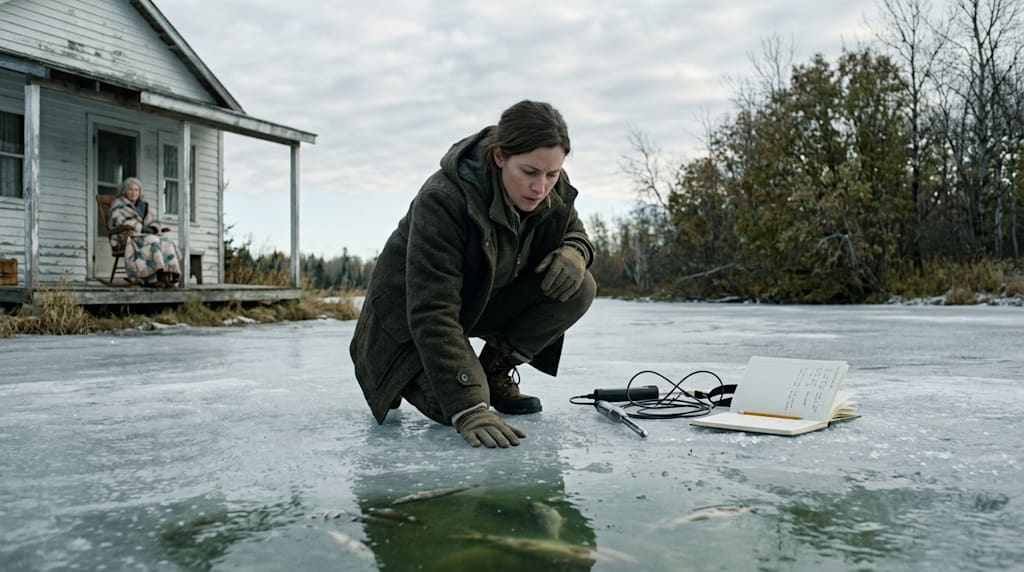
She stood on the ice. Under her feet was gray-white ice. Under the ice was murky, greenish water. She could see the shadows of dead fish under the ice, still motionless.
She thought of Mrs. Albright's husband. She thought of what the fisherman had told his wife before he died: After the wall falls, the things below come up.
She crouched down and put her hand on the ice. The ice was cold, cold enough to bite. She did not pull her hand back.
She thought of the thermocline. That invisible layer, several meters to more than ten meters deep, with the steepest temperature gradient. It separated the warm upper water from the cold lower water and maintained the stability of the lake. Its existence allowed the lake surface to be warm and the lake bottom to be cold all summer. Fish could live in their respective layers. The whole ecosystem could operate in a precise, fragile balance.
It had disappeared. Not slowly. Not through the normal autumn turnover. It had disappeared suddenly. As if someone had pulled out a wall, and then the whole house collapsed.
Miriam stood up and put her hand in her pocket. Her fingers were numb from the cold. She closed them inside the pocket, then opened them again.
She looked at the lake surface, at the white expanse of ice, at the dead fish under the ice, at the bare trees in the distance. Then she turned and walked back to the shore.
The wind blew from the lake, carrying that old smell of swamp sediment turned over. Hydrogen sulfide. Humic matter. The metabolic products of anaerobic bacteria. The smell of the lake bottom.
The wall fell. The things below came up. The things above went down. The lake died.
And all of this happened in September. In a season when the lake should have been warm. In a season when the transition should have been slow. In a year when the thermocline should have stayed steady between twelve and fifteen meters, separating warm water from cold, letting the whole lake pass safely through summer.
The day the thermocline vanished was in August. The day the lake froze was in September. At the wrong time. In the wrong place. In the wrong season. When everything should have been normal.
Miriam walked to her car, opened the door, and sat inside. The engine started. The air conditioning blew cold air at first. She waited. Warm air came. She turned the temperature up two notches, shifted into gear, released the parking brake, and drove out of the lot.
In the rearview mirror, the lake grew smaller and smaller, finally becoming a white dot that disappeared into the gray horizon. She did not look back.
About the Creator
Jin
Writer of reamstories
https://reamstories.com/jin
Enjoyed the story? Support the Creator.
Subscribe for free to receive all their stories in your feed. You could also become a paid subscriber, letting them know you appreciate their work.
Comments
There are no comments for this story
Be the first to respond and start the conversation.