
The Stuffed Cat
Short tale by Federico Berti

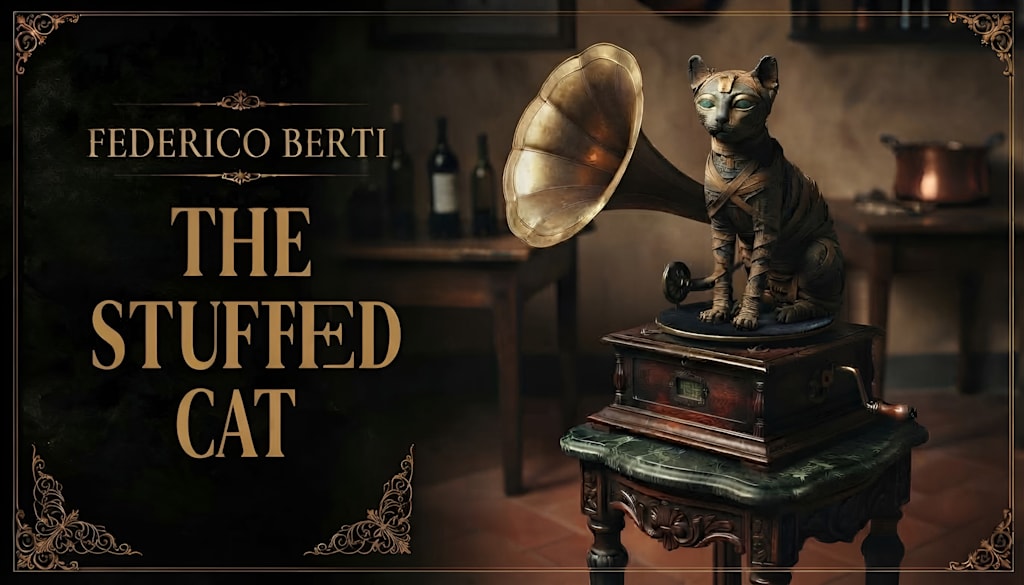
One fine spring morning, a stuffed cat standing upright on an old vinyl record player suddenly blinked, shook her head, stretched lazily, and then, after a languid yawn, climbed down from her perch, sniffing around and snooping through the hall of the Arci social club “La Bandiga”, behind Scandellara Park in Bologna. The event, took place in front of two witnesses who at first, not seeing the remains in their place, thought of a theft, or some act of spite.
“Your doing, eh,” said one.
“Ma csa dit?” answered the other.
“There’s only you and me here,” he insisted.
“What would I want with it, your little stiff?” she countered.
Him, Gavino Serra, Sardinian-speaking tavern keeper, a meter and change, full trimmed beard, broad brow and two shaggy owl’s eyebrows; her, Mariolina Brustolin, environmental warden, short curls of a chestnut going gray, chubby-cheeked, thin eyebrows. They had been a little more than friends back in the days of the squatted Lazzaretto, when Gavino slept in the van out on the farmyard and she went to the rehearsal room to play the trumpet. The day the cops came to clear them out, they had climbed onto the roof with the others and spat fire and flames from their mouths. What a wild season! Then everything had gone sour, and precisely on account of that stuffed animal.
“I’d like to see you,” Mariolina had said one day, “if they stuck you dead on a shelf in the living room, a hunting trophy for necrophiles.” She couldn’t stomach that business of the corpse on display in the tavern.
“If I’m dead, I’ll play dead,” answered Gavino, who couldn’t see the grounds for such ferocity.
She saw him changed, since he’d opened the tavern. The truth is, that stuffed cat came from an attic in San Pietro in Casale, where a friend of his, Delmo Vaccari, unable to keep her in the house on account of his wife, in whom she stirred horror and revulsion, had first had to shut her up in the attic and then give her away.
“She won’t hear of it,” he said. “She dreams the cat comes to steal her breath, wakes up in the night screaming! No, really, you hang onto her, ’cause throwing her in the trash I feel like I’d be doing her wrong.”
That animal had a story; the one who’d stuffed her was Delmo’s grandfather, a skilled hunter. It had all begun under the German occupation, when Antenore Vaccari kept two GAP partisans, city guerrillas, hidden in an underground refuge, reached by a trapdoor in the cellar, right up against a beech wood behind the farmhouse where they lived, down in the flatlands. Pretty little Dmenga would go and bring them dry bread, a bit of cheese, a few scraps, whatever she could hide in her little girl’s dress.
“Then one fine day,” Delmo recounted, “the Germans show up, set up their command in my grandfather’s house, and two of them go off to sleep right in the cellar, on that bed we’d put there to cover the trapdoor. Nothing to be done, those poor guys stayed trapped down there for months; by the grace of God the occupiers never noticed the trapdoor under the bed, or they’d have shot the whole lot. When Bologna was liberated, Grandpa had gotten it into his head that the ones in the cellar had died of hunger and hardship, and he got a lump in his throat at the thought of moving the bed to open the trapdoor.”
They hadn’t died, and they had the cat to thank, yes, that very cat: Tigrai, such was her name, spent her days in the cool underground and at night, slipping through a small grate that opened onto the outside, hunted mice, pigeons, small rodents, and carried them down to the refuge. On that modest game the poor wretches, shoving and jostling, kept going; in the cellar they had a latrine that drained into the ditch and even running water, but they had to be careful, especially at night, since at the slightest noise they’d have been discovered. When the war was over, the feline lived on a few more years, and then, having kicked the bucket, Grandfather Antenore stuffed her.
Such is the story of the stuffed cat and of how Gavino Serra came to possess her, though I fear I’ve had to simplify for brevity’s sake: the Sardinian had stood her upright on a broken record player, with the neckerchief of the ANPI, the partisans’ association, around her neck, one of the many relics of what he liked to think of as a site of memory. At the Bandiga club, behind Scandellara park, he had collected everything: pins, pennants, period photographs, military maps, canteens, books, diaries, letters. That cat, though, ended up costing him dearly! In the neighborhood a committee even formed around Mariolina to protest the indecent carcass, and the place found itself in a dismal spotlight: eggs filled with paint, graffiti on the wall, petitions, signature drives; things started to boil over when the press gave big play to the activists’ gutless stunts. Imagine the full-page headlines about the Bandiga Butcher, the Pet Cemetery Taverna, and the polished repertoire of epithets devised to feed the place to the public pillory; at a certain point Gavino had picked up the phone, call the movement’s spokeswoman, and meet her.
“Gosh! Do you really want to wreck me?” he had said to her.
“It’s you, the necrophile!.” Her, curt.
“And you’re a sanctimonious, goddamn Judas, Just like I’d killed that cat with my own hands: you know how many times I’ve sat down at a table with a customer to tell him that story? It’s a bit as if the animal came back to life, with everything she drags along behind her.”
“What story? It’s just a fetish!” Her, curt.
In short, what with all the back and forth, the poor little beast had ended up truly coming back to life. It was precisely while the two were arguing heatedly, that serene April morning, that the remarkable event I mentioned took place: the feline jumped first onto the chairs, then on the tall stools, paced up and down the bar, licked the tap spout two or three times, crossed the place lengthwise, crosswise, from bottom to top and back again, until she saw fit to go out through the crack of an open window.
The two hapless souls, sensing in their hearts that the cat showed, all in all, no sign of hostility, followed after her, looking around to figure out where the heck she was going, and wondering how such an absurd thing could have happened. The cat, for her part, paid no mind to the barriers that block a human being’s path: she stalked insects and butterflies, went up and down the trees of the little orchard behind the club, scrambled over gates, planters, balconies, stairs, railings; at first she stayed around the inner courtyard, then little by little widened the circle, then made for the Asse Attrezzato, and at that point following her got harder and harder. I wish I could linger on every detail of what happened that April 24th, describe the cat’s long circuit and how she almost seemed to want to keep herself in sight: just when she seemed to have vanished behind a low wall, in the tall grass, or on the roof of some little groundscraper, there she was all of a sudden at the end of an alley, a boulevard, a garden. She waited for them, then set off again.
Tigrai roamed all morning with no apparent logic, dragging her astonished pursuers behind; she crossed Bologna in a half loop, passing first through Scandellara Park, then the university district, then Montagnola, the Station, Lazzaretto, Porta Lame, Malpighi; then she took the arcades toward Piazza Maggiore, always with the two on her heels, and her outpacing them, but never by much. Gavino and Mariolina, for their part, would have followed her to the ends of the earth, dazed by an event of which “unusual” was putting it mildly; along the way they came upon a picket organized by some thirty citizens over the felling of an elm, and a signature drive against the potted saplings in the courtyard of City Hall, Palazzo d’Accursio. A few hours later the cat slipped into via Tagliapietre and, leaping onto a ground-floor windowsill, vanished inside. The two looked at each other, dumbfounded. It was the monastery of Saint Catherine of Bologna.
They went into the little church of Corpus Domini, dedicated to the famous poet, painter, musician and mystic whom the Bolognese revere as the city’s co-patron saint. Woman, intellectual and artist; you could tell the church had been damaged by the war, though legend has it that during the occupation a bomb flat-out refused to go off there. The interior of the temple was a spectacular homage to the Muses, a riot of terracottas, frescoes, illuminated books, gold and silver plate. All around could be heard a women’s chant, accompanied by a psaltery and an ancient little viol, whose sublime notes spread through the air.
“There she is!” Gavino pointed. “Down there, on the high altar!” Tigrai sat crouched on her hind legs, looking as if she were reading the great open missal; she still wore the partisans neckerchief around her neck, the one Gavino had put on her at the Bandiga Club. The two looked each other in the eye, then with a nod of complicity split up and ventured closer; the revenant hissed a couple of times, raising her spotted little paw, and with a leap vanished behind the choir, popped out on the other side and moved off. She reappeared a little further on, through a round window, richly figured and protected by iron bars, that opened onto an inner chapel. She slipped through the grille.
Gavino and Mariolina leaned in, peering into a finely decorated crypt; at the center of the room another set of remains, human this time, brown-faced, in the dark habit of the Poor Clares, enveloped in an apotheosis of beauty, sat placidly on a gilded throne, behind a glass case. The cat first circled all around the glass, trying to get near the saint’s incorrupt body, but finding no opening she kept looking about, sniffing the air all the while, into which a pleasant perfume of aromatic balm was drifting. The Sardinian couldn’t hold back; turning to his companion he smiled at her, needling her with an apostrophe:
“What where we talkin about? Maybe some stiffs under a glas bell?”
Mariolina stayed silent for a while, savoring all that overabundance of beauty, with no sensible reply coming to mind. Then, without taking her eyes off the enthroned popess, she put in, wrinkling her nose:
“Let’s get out of here, or the cat one’s not coming out.”
She took the tavern keeper by the hand, inviting him to step away from the porthole, and smiled at him, her index finger running down the line of her nose; they went and hid in the confessional nearby, forgetting her for some interminable quarter of an hour; they came out disheveled and rumpled around noon, to go back, each to their own. Thus ended the pursuit of the spirit, or whatever it was.
A few weeks later, Radio Fujiko aired an interview with a guard at the Civic Archaeological Museum, who reported a strange night visit: a gray-and-white tabby with a spotted little paw and the partisans neckerchief around her neck had been caught on the security cameras, standing in a solemn pose before the mummified cat on display in the museum. By the time the museum reopened the next morning, nobody had seen her again.
Since then, Gavino Serra enjoys telling this story to every customer of the tavern who asks him what became of the stuffed cat on the record player, of which nothing remains but a photograph hanging on the wall of the Bandiga. Mariolina and the twelve apostles of the collective deny his version of events, claiming instead that the wine seller, tired of the protests, made up his mind to haul off the stuffed carcass, and invented the rest. I fear we shall never know the truth, and yet ever since Tigrai’s body disappeared, someone swears they’ve recognized the shadows of Gavino and Mariolina, behind the half-lit windows, dancing the tango late into the night, after closing time, at the Bandiga club behind Scandellara park.
About the Creator
Federico Berti
Writer, composer, actor. Internationally known as a performer, one‑man band, and audiobook narrator. Expert in the art of memory.
Enjoyed the story? Support the Creator.
Subscribe for free to receive all their stories in your feed.
Comments
There are no comments for this story
Be the first to respond and start the conversation.