
THE SOVEREIGN ROUTE
Infrastructure of Refusal

PART ONE: ROUTINE MAINTENANCE
The access road had been erased from municipal records in 2041, the year the grid went live. Kael Voss remembered because he'd been the one to file the decommissioning paperwork, back when he still wore the logistics corps insignia and believed infrastructure served people rather than controlled them.
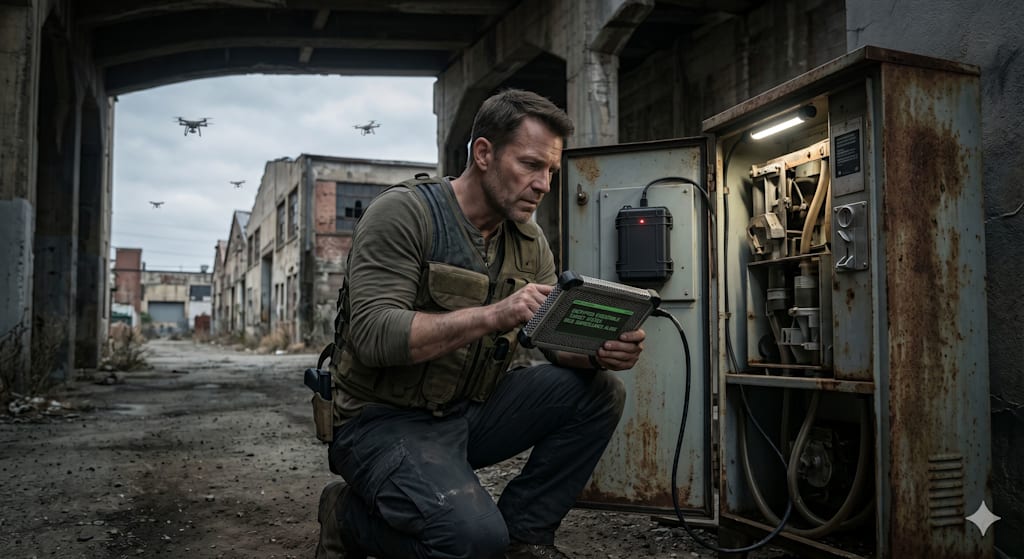
Now, seventeen years later, he navigated the forgotten route by muscle memory and dead reckoning. His transport—a diesel relic that predated mandatory telemetry—growled through the industrial wasteland where the city's expansion had stalled and retreated. Crumbling warehouses stood like tombstones. Overhead, the surveillance drones traced their geometric patterns across the morning sky, but down here, in the infrastructure gaps, their algorithms saw only static and disinterest.
Kael checked his chronometer. Four hours until the next grid census sweep. Plenty of time.
The dispenser sat in the shadow of a collapsed overpass, camouflaged by rust and deliberate neglect. To anyone scanning from above, it looked like another piece of abandoned municipal equipment—a water reclamation unit, maybe, or a derelict charging station from the brief electric vehicle era. Only the faint scuff marks in the dust betrayed regular use, and only if you knew where to look.
Kael killed the engine and sat in silence, listening. This was the discipline that had kept him alive through the resource wars and invisible through the surveillance age: patience, observation, the tactical pause before commitment. The wind carried nothing but urban decay. The drones maintained their distant patrol patterns. He was alone.
He approached the dispenser with his tool case, running through the maintenance checklist that had become liturgy. External integrity first: the armored housing showed no signs of tampering, no plasma torch marks or pry attempts. The token slot was clean, the dispensing tray clear. He keyed in his master access code—a twenty-digit sequence he'd never written down—and the panel slid open with a pneumatic hiss.
The interior was a marvel of analog engineering, a deliberate rejection of networked convenience. Physical token counters, mechanical sorting mechanisms, gravity-fed dispensing channels. Everything designed to operate without a single networked component, without leaving a single digital trace. Water purification chips in the left column, un-networked communication devices in the center, analog currency wafers in the right. The lifeblood of the off-grid economy, the infrastructure of autonomy.
Kael checked the token count first. Seventy-three transactions since his last service run, two weeks ago. Higher than usual. The authority's latest grid update—mandatory biometric authentication for all purchases over five calories—had driven more people to seek alternatives. He made a note to increase the next supply drop.
He moved through the checklist with practiced efficiency. Lubricating the mechanical sorters. Checking the physical locks. Testing the dispensing mechanisms. Replacing the air filters that kept dust from fouling the delicate machinery. This was honest work, he told himself. Infrastructure that served rather than surveilled. A gift to those the grid had marginalized or marked.
The token reservoir was running low. He refilled it from his case, the physical coins clinking with a sound that belonged to an earlier century. Each token was hand-stamped with a unique pattern, impossible to counterfeit without the original dies he'd commissioned from a machinist who'd died three years ago. The tokens were currency, yes, but more than that—they were proof that transactions could exist outside the grid's omniscient ledger.
He was closing the reservoir panel when he noticed it.
An anomaly in the weight distribution. The dispenser's center of gravity was off, shifted slightly forward. Years of handling heavy equipment had given Kael an instinct for these things, a tactile sense of how machines should feel. This one felt wrong.
He opened the central maintenance panel, the one that accessed the dispenser's core mechanisms. Everything appeared normal at first—the sorting drums, the dispensing channels, the token validation system. But there, secured to the back of the validation housing with professional-grade mounting brackets, was something that didn't belong.
A drive case. Military-grade, judging by the hardened casing and thermal shielding. Roughly the size of his palm, matte black, with a single interface port and a small LED that pulsed with a slow, steady rhythm.
Kael's hand froze halfway to the device. His tactical training screamed warnings, but curiosity and something deeper—hope, maybe, or the ghost of idealism—pulled him forward.
He examined the mounting without touching the drive itself. The installation was professional, precise. Whoever had placed it here had known exactly what they were doing, had accessed the dispenser with tools and knowledge that matched his own. The brackets were secured with tamper-evident fasteners that showed no signs of forced entry.
Which meant someone had his access codes. Or had manufactured their own.
Kael's mind raced through possibilities. The resistance had cells throughout the city, networks within networks. He'd always maintained operational distance—he provided infrastructure, they provided distribution—but perhaps they'd decided to use his dispensers for more than transactions. Perhaps they'd found a way to crack his security, to repurpose his machines for their own operations.
He should walk away. Leave the drive untouched, close the panel, complete his route and pretend he'd never seen it. That was the smart play, the tactical choice. Don't touch unknown hardware. Don't compromise operational security.
But the LED pulsed, steady and patient, and Kael found himself reaching for his diagnostic tablet—an offline device, naturally, with no wireless capability and a hardened case that could survive a drone strike.
He connected a shielded cable to the drive's interface port and ran a passive scan. No active transmission detected. No network handshake attempts. The drive was inert, waiting.
The scan results made his breath catch.
The drive contained a single executable file, heavily encrypted but with metadata that made its purpose clear. A virus. Not some crude malware or ransomware, but a sophisticated algorithmic weapon designed to target a very specific system: the authority's surveillance grid.
Kael read the technical specifications twice, then a third time, his hands beginning to shake. If the metadata was accurate—and the encryption suggested it was genuine—this virus could permanently blind the grid's facial recognition algorithms, corrupt the transaction tracking databases, introduce cascading errors into the movement monitoring systems. It was a liberation code, a digital weapon that could actually give the resistance a fighting chance.
His first thought was wonder. His second was tactical calculation. His third was a creeping unease he couldn't quite name.
Someone had placed this drive in his most secluded dispenser, his most secure location. Someone had trusted him—or his infrastructure—with a weapon that could change everything. The resistance must have finally decided to move from passive survival to active resistance. They'd found a way to strike at the grid itself, and they'd chosen his network as the staging ground.
It made sense. His dispensers were offline, untraceable, distributed throughout the city. They were the perfect dead drops for coordinating a distributed attack. Load the virus onto the drive, place it in a secure location, let resistance cells access it through the physical dispensers, copy it to their own devices, and deploy it simultaneously across the city. The authority would never see it coming because the entire operation would happen outside their surveillance envelope.
Kael disconnected the diagnostic cable and sat back, his mind working through the implications. This changed everything. His network had always been defensive, a way to provide autonomy without directly challenging the authority. But this—this was offensive capability. This was revolution.
He should feel elated. Vindicated. This was what he'd been building toward, wasn't it? Infrastructure for freedom, tools for resistance. The drive represented everything he'd hoped for when he'd started building the network.
So why did his tactical instincts scream warnings?
Kael forced himself to think methodically, to analyze rather than react. He examined the mounting brackets again, the professional installation, the clean access. Whoever had placed the drive had skills that matched his own, resources that matched his own.
How many people in the resistance had that level of capability?
How many people in the resistance even knew this dispenser existed?
He'd always maintained strict operational security. The resistance knew the dispensers existed, knew how to use them, but they didn't know the locations until they needed them. Information was compartmentalized, distributed through trusted intermediaries, never centralized. It was the only way to keep the network secure.
So how had someone found this location, accessed this specific dispenser, and installed military-grade hardware without his knowledge?
The unease crystallized into something sharper. Kael pulled out his maintenance log—a physical notebook, naturally—and checked his records. Last service: fourteen days ago. Token count then: forty-one. Token count now: seventy-three. Thirty-two transactions in two weeks.
He did the math. Average transaction time: three minutes. Total transaction time: ninety-six minutes. Call it two hours of total dispenser access over fourteen days.
How long would it take to install the drive? With the right tools and knowledge, maybe fifteen minutes. Twenty at most. Easily hidden within the normal transaction window.
But that assumed the installer had his access codes. Had the master sequence that opened the maintenance panels. Had knowledge of the dispenser's internal layout.
Kael felt cold certainty settling into his chest.
There were exactly three people in the world who had that information. Himself. The machinist who'd built the dispensers, dead three years. And the logistics corps officer who'd approved the original decommissioning paperwork, the one who'd helped him identify the forgotten routes in the first place.
The officer who now worked in the authority's infrastructure security division.
Kael stood abruptly, his hand instinctively moving to the plasma cutter on his belt. He scanned the area with fresh eyes, looking for surveillance he'd missed, for drones that had deviated from their patterns, for any sign that he'd walked into a trap.
Nothing. The wasteland remained empty. The drones maintained their distant patrol. He was alone.
But the drive pulsed its steady rhythm, patient and waiting, and Kael realized with growing horror that he might not be investigating a resistance operation.
He might be investigating bait.
PART TWO: DANGEROUS QUESTIONS
Kael didn't touch the drive again. He closed the maintenance panel, secured the dispenser, and drove back to his workshop with the careful paranoia of a man who'd just glimpsed the edge of a trap.
The workshop occupied the basement of a derelict factory in the industrial zone, another forgotten space that existed in the gaps of the grid's attention. Kael had chosen it for the same reasons he'd chosen all his locations: no network coverage, no surveillance overlap, no reason for the authority to care. The building's official status was "pending demolition," a bureaucratic limbo that had lasted seven years and would likely last seven more.
He parked the transport in the loading bay and sealed the entrance behind him. The workshop was spartan—workbenches, tool racks, supply crates, a cot in the corner for the nights when he couldn't risk traveling. No computers, no network devices, nothing that could betray his location or operations. The only concession to modern technology was his diagnostic tablet, and that stayed in a Faraday cage when not in use.
Kael sat at his workbench and forced himself to think systematically. He'd survived the resource wars by staying three steps ahead of the enemy, by anticipating moves before they were made. He'd stayed invisible to the authority by thinking like them, by understanding their systems and exploiting their blind spots.
Now he needed to think like them again.
He pulled out his notebook and began mapping the problem. Start with facts, not assumptions. Build the picture from evidence, not fear.
Fact one: Someone had installed a military-grade drive in his most secure dispenser.
Fact two: The installation required his access codes and knowledge of the dispenser's internal layout.
Fact three: The drive contained a virus designed to attack the authority's surveillance grid.
Fact four: The installation was professional, precise, and left no evidence of forced entry.
Kael stared at the facts, forcing himself to consider possibilities he didn't want to face.
Possibility one: The resistance had somehow acquired his access codes and decided to use his network for offensive operations without consulting him.
He tested this possibility against what he knew. The resistance was compartmentalized, cautious, paranoid about infiltration. They wouldn't risk compromising his entire network by accessing a dispenser without authorization. They'd contact him first, negotiate, coordinate. That was basic operational security.
Unless they didn't trust him anymore. Unless they'd decided he was a liability, too cautious, too defensive. Unless they'd decided to take control of the infrastructure he'd built.
But that didn't explain the drive itself. Where would the resistance get military-grade hardware? Where would they get a virus sophisticated enough to attack the grid's core algorithms? The resistance was resourceful, but they weren't miracle workers. They operated on salvaged equipment and improvised solutions, not cutting-edge cyber weapons.
Possibility two: A third party had compromised his network and was using it for their own purposes.
Corporate sabotage, maybe. Or a foreign intelligence operation. The grid had enemies beyond the domestic resistance. But again, the access problem remained. How would a third party get his codes? How would they even know the dispensers existed?
Possibility three: The authority had known about his network all along and had decided to weaponize it.
Kael's hand stopped moving. He stared at the words he'd just written, feeling the logic click into place with terrible clarity.
The authority had the resources. They had the capability. They had access to his old logistics corps files, his service records, his psychological profile. They knew how he thought, how he operated. They'd known about the forgotten routes because he'd been the one to decommission them.
And they had motive.
Kael stood and began pacing, his mind racing. Think it through. The authority didn't just want to stop the resistance—they wanted to identify them, map them, eliminate them completely. But the resistance was distributed, compartmentalized, invisible. How do you find people who've learned to live outside your surveillance envelope?
You give them a reason to reveal themselves.
You offer them hope. You offer them a weapon. You offer them exactly what they've been dreaming of: a way to strike back at the grid itself.
And then you watch who reaches for it.
Kael felt sick. He returned to his workbench and continued writing, following the logic to its conclusion.
If the authority planted the drive, they'd need a way to track who accessed it. But the dispensers were offline, untraceable by design. There was no network connection to monitor, no digital trail to follow.
Unless the drive itself was the tracking mechanism.
Kael grabbed his diagnostic tablet and pulled up the scan results he'd saved. He'd run a passive scan, checking for active transmissions. But what if the drive wasn't designed to transmit? What if it was designed to tag?
He examined the technical specifications more carefully, looking past the virus payload to the underlying architecture. The drive had a small power cell, enough to maintain the LED and basic functions. It had the interface port he'd connected to. And it had—
There.
A secondary chipset, separate from the main storage. Too small to hold data, too simple to run complex operations. But perfectly sized for a single function: proximity logging.
Kael's hands shook as he traced the implications. The drive wasn't just storage. It was a sensor. Every time someone accessed it, every time someone connected a device to that interface port, the secondary chipset would log the event. Not transmit it—that would require network capability the drive didn't have. Just log it. Store it. Wait.
And then, when the drive was eventually recovered—when the authority came to collect their bait—they'd have a complete record of every device that had accessed it, every person who'd reached for the liberation code.
But that still left a problem. How would the authority know when someone had accessed the drive? How would they know when to move in for arrests?
Kael thought about the dispensers, about their design and function. They were offline, yes. Untraceable, yes. But they weren't invisible. They existed in physical space, in locations the authority could monitor if they chose to. Locations he'd selected because they were in the grid's blind spots, but blind spots could be watched if you knew where to look.
What if the dispensers themselves had been compromised?
Kael felt his stomach drop. He'd built the dispensers himself, assembled them from components he'd sourced carefully, tested them exhaustively. But the components had to come from somewhere. The hardened cases, the mechanical sorters, the token validators—he'd purchased them through intermediaries, through supply chains he'd thought were secure.
But if the authority had known about his network all along, if they'd been watching and waiting, they could have compromised the supply chain. They could have installed tracking hardware in the components themselves, hidden so deep in the machinery that even his careful inspections wouldn't find it.
He thought about the dispenser's weight distribution, the anomaly that had led him to discover the drive. What if that wasn't just the drive's weight? What if there was other hardware hidden in the machine, hardware he'd never thought to look for because he'd trusted his own construction?
Kael grabbed his tool case and headed for the door. He needed to check, needed to know. But as his hand touched the handle, he stopped.
If he was right—if the dispensers were compromised, if the drive was bait, if the authority was watching—then going back to the dispenser was exactly what they'd expect. They'd be waiting for him to investigate, to try to remove the drive, to warn the resistance.
They'd be waiting for him to lead them to the rest of the network.
Kael stepped back from the door, his tactical training overriding his panic. Think. Analyze. What would the authority's operational plan look like?
They'd plant the drive and wait. They'd monitor the dispenser remotely, watching for access attempts. When someone tried to copy the virus—when some desperate resistance member connected their device to that interface port—the drive would log the event and the hidden tracking hardware would transmit an alert.
Then the enforcement drones would move in. Fast, coordinated, overwhelming. They'd tag the user, track their movements, follow them back to their cell. And they'd do it quietly, without fanfare, so the rest of the resistance wouldn't know the network had been compromised.
One by one, they'd roll up the entire resistance network. All because people reached for hope.
Kael sat down heavily on his cot. The elegance of it was almost beautiful, in a horrifying way. The authority hadn't just set a trap—they'd weaponized the very concept of liberation. They'd turned hope itself into a tracking mechanism.
And he'd built the infrastructure that made it possible.
His dispensers, his network, his life's work—all of it had been allowed to exist because it served the authority's purposes. They'd let him build a pressure valve for the resistance, a way for dissidents to survive without directly challenging the grid. And now they'd turned that pressure valve into a killing floor.
How long had they known? How long had they been watching? Kael thought back over the years, over every dispenser installation, every supply run, every maintenance visit. Had they been tracking him the entire time? Had they been mapping his network, identifying his users, building their target list?
He thought about the sovereign citizens who relied on his dispensers. The off-grid workers who needed water purification chips. The families who used analog currency to buy food without the grid tracking their calorie intake. The dissidents who used un-networked comms to coordinate their quiet resistance.
All of them were in the database now. All of them were marked. And the moment any of them reached for the liberation code, the moment any of them tried to access that drive, they'd be tagged for enforcement.
Kael looked at his hands, at the calluses from years of working with machinery, at the scars from the resource wars. He'd built the network to help people, to give them a shred of autonomy in a world that demanded total submission. He'd thought he was building infrastructure for freedom.
Instead, he'd built a distributed execution apparatus.
The question now was what to do about it.
PART THREE: THE TRAP REVEALED
Kael didn't sleep. He sat at his workbench through the night, mapping the network in his mind, calculating timelines and probabilities.
Seventeen dispensers distributed throughout the city. Seventeen potential trap sites. Seventeen locations where sovereign citizens might walk blindly into the authority's snare.
He'd installed the first dispenser nine years ago, in the early days after the grid went live. Back then, it had been a simple idea: provide an alternative for people who couldn't or wouldn't submit to total surveillance. A way to buy necessities without the grid tracking every transaction, every calorie, every movement.
The network had grown slowly, carefully. One dispenser at a time, each location chosen for its position in the grid's blind spots, each installation executed with meticulous security. He'd never advertised, never recruited. Word had spread organically through the underground, through whispered recommendations and careful trust.
By the authority's standards, it was a small operation. Maybe a few thousand users across the city, people who valued autonomy enough to seek out physical locations and use analog currency. Not a threat to the grid's dominance, just a minor inefficiency, a rounding error in the surveillance state's total information awareness.
Except it wasn't an inefficiency. It was a feature.
Kael understood that now. The authority had let his network exist because it served their purposes. It identified dissidents, concentrated them in known locations, gave them a false sense of security. And when the time came to eliminate the resistance, the network would provide a perfect targeting mechanism.
The drive was just the trigger. The bait that would make people reveal themselves, that would separate the merely cautious from the actively resistant. Anyone who tried to access the liberation code was someone who wanted to strike back at the grid, someone who posed a real threat.
And the dispensers would mark them for elimination.
Kael pulled out his maintenance logs and began cross-referencing dates. When had the drive been installed? He'd last serviced the secluded dispenser fourteen days ago. The drive hadn't been there then—he would have noticed the weight distribution anomaly. So the installation had happened sometime in the past two weeks.
What else had happened in the past two weeks?
He flipped back through his logs, through news clippings he'd collected, through the fragments of information that filtered down to the off-grid world. Two weeks ago, the authority had announced a major grid update, mandatory biometric authentication for all purchases over five calories. The update had driven a surge in dispenser usage—he'd seen it in the token counts, in the increased traffic at his locations.
The timing wasn't coincidental. The authority had pushed people toward the dispensers with the grid update, had created pressure and desperation. And then they'd planted the drive, the promise of liberation, the hope that resistance might actually be possible.
It was psychological warfare, executed with surgical precision.
Kael stood and walked to his supply crates. He needed to verify his theory, needed to confirm that the dispensers themselves were compromised. But he couldn't go back to the secluded location—that would be expected, monitored. He needed a different approach.
He selected a dispenser at random from his mental map. The one in the old transit station, abandoned since the grid had made public transportation obsolete. It was a mid-tier location, not as secure as the secluded dispenser but not as exposed as some of the others. If the authority had compromised his supply chain, if they'd installed tracking hardware in the components, it would be in all the dispensers, not just one.
Kael loaded his tools and headed out in the pre-dawn darkness. The transit station was a forty-minute drive through forgotten routes, through the city's discarded spaces. He arrived as the sun broke over the eastern towers, painting the ruins in shades of amber and rust.
The dispenser sat in what had once been a ticket hall, camouflaged behind a collapsed vending machine. Kael approached carefully, scanning for surveillance, for any sign that the location was being actively monitored. Nothing obvious. The drones maintained their distant patterns. The grid's attention was elsewhere.
He opened the maintenance panel and began a systematic inspection, looking for hardware that didn't belong. The token validator, the sorting mechanisms, the dispensing channels—all standard, all as he'd built them.
Then he removed the back panel, the one that accessed the dispenser's core housing, and found what he was looking for.
A small module, no larger than his thumb, secured to the interior frame with industrial adhesive. It had a miniature antenna, a power cell, and a single LED that pulsed with a slow, steady rhythm.
A transmitter.
Kael's hands were steady as he examined it, but his mind was screaming. The module was sophisticated, military-grade, designed to operate on minimal power for extended periods. It wasn't transmitting constantly—that would drain the battery and risk detection. Instead, it was listening, waiting for a trigger signal.
He traced the module's connections and found the trigger mechanism: a current sensor attached to the dispenser's interface port. The same port he'd used to scan the drive. The same port anyone would use to access the drive's contents.
The logic was elegant and damning. When someone connected a device to the interface port, the current sensor would detect the power draw and activate the transmitter. The transmitter would send a burst signal—probably encrypted, probably on a frequency the grid reserved for enforcement operations—containing the dispenser's location and a timestamp.
And then the drones would come.
Kael sat back, feeling the full weight of the trap settle over him. It wasn't just the drive. It wasn't just one location. Every dispenser in his network had been compromised, turned into a distributed sensor array. The authority had been patient, had let him build the network, had waited for the perfect moment to weaponize it.
How long had the transmitters been there? He thought about his supply chain, about the components he'd sourced. The hardened cases had come from a military surplus dealer, a contact he'd trusted. The mechanical sorters had been custom-fabricated by a machinist in the industrial zone. The token validators had been salvaged from old parking meters, refurbished and modified.
Any of those sources could have been compromised. All of them, probably. The authority had resources he couldn't match, reach he couldn't escape. They'd infiltrated his supply chain, installed their hardware, and waited.
For nine years, they'd waited.
Kael thought about all the people who'd used his dispensers in that time. Thousands of transactions, thousands of sovereign citizens seeking autonomy. Had the authority been tracking them all along? Had every token exchange, every water purification chip, every analog currency wafer been logged and analyzed?
Or had they only activated the transmitters recently, when they'd decided it was time to spring the trap?
He examined the module more closely and found a date code stamped into the casing. Three months old. The transmitters had been installed recently, probably during a supply run when he'd restocked the dispensers with new components. He'd been so careful about security, about checking for network capability, but he'd never thought to scan for dormant hardware.
Three months. The authority had been planning this operation for at least three months, probably longer. They'd compromised his supply chain, manufactured the transmitter modules, installed them in components they knew he'd use. And then they'd waited for the right moment to plant the drive, to offer the bait.
Kael closed the maintenance panel and stood. He needed to think, needed to plan. But as he turned to leave, he heard it: the distant whine of drone rotors, growing closer.
He froze, his tactical instincts screaming. Had he triggered something? Had the transmitter activated when he'd opened the maintenance panel? Or was this just a routine patrol, a coincidence?
The whine grew louder. Multiple drones, moving in formation. Not a patrol pattern. A response pattern.
Kael ran.
He made it to his transport as the first drone crested the transit station's roof. It was an enforcement model, matte black, bristling with sensors and weapons. It didn't fire—not yet. It was tracking, identifying, confirming.
Kael gunned the engine and tore out of the station, heading for the nearest forgotten route. The drone followed, maintaining distance, and he realized with cold certainty what was happening.
They weren't trying to capture him. They were tracking him. Following him back to his workshop, to his other locations, mapping the full extent of his network.
He'd walked into the trap after all.
Kael took a hard turn into a collapsed underpass, killing his lights and engine. The drone overshot, circling back to search. He had maybe thirty seconds before it reacquired him.
He couldn't go back to the workshop. He couldn't go to any of his known locations. The moment he did, he'd compromise everything.
But he couldn't run, either. Because running meant abandoning the network, meant leaving the trap active, meant letting sovereign citizens walk blindly into the authority's snare.
The drone's searchlight swept over the underpass entrance. Kael made his decision.
He couldn't save the network. But he could destroy it.
He could dismantle the trap before anyone else triggered it.
PART FOUR: THE IMPOSSIBLE DECISION
Kael waited in the darkness of the collapsed underpass, listening to the drone's rotors fade into the distance. They'd lost him, for now. But they'd be back, and they'd bring more resources, more surveillance, more coordination.
He had hours, maybe less.
The transport's engine ticked as it cooled. Kael sat in the driver's seat, his hands on the wheel, his mind working through the impossible mathematics of what came next.
Seventeen dispensers. Seventeen trap sites. Seventeen locations where people seeking freedom would instead find enforcement drones and arrest—or worse.
He could walk away. Disappear into the forgotten routes, abandon the network, save himself. The authority would spring their trap, roll up the resistance, eliminate the dissidents. But he'd survive. He'd done it before, during the resource wars, when survival meant making hard choices and living with the consequences.
But the resource wars had been different. Then, he'd been fighting for himself, for his unit, for abstract concepts like territory and supply lines. The people who died had been soldiers, combatants, people who'd chosen the fight.
The people who'd die now were different. They were families buying food without the grid tracking their calorie intake. Workers seeking water purification chips because the municipal supply was contaminated. Dissidents coordinating quiet resistance through un-networked comms. People who'd trusted his infrastructure, who'd believed his dispensers offered genuine autonomy.
People he'd promised to help.
Kael thought about the secluded dispenser, about the drive pulsing its patient rhythm. How long before someone found it? How long before word spread through the underground that a liberation code existed, that freedom was finally within reach?
Days, probably. Maybe hours. The resistance had networks within networks, communication channels he didn't fully understand. Someone would hear about the drive. Someone would make the pilgrimage to the secluded location. Someone would connect their device to that interface port, seeking hope.
And the transmitter would activate. The drones would come. Another dissident would disappear into the authority's detention system, or worse.
Unless Kael stopped it.
He started the engine and pulled out of the underpass, heading not for safety but deeper into the city, toward the network he'd built. He had a new route to run now, a final maintenance cycle. Not to service the dispensers but to destroy them.
The logic was brutal but clear. He had to physically dismantle every dispenser, execute hard resets on the hardware, sever the transmitters' power supplies. He had to destroy the trap before anyone else triggered it.
It would mean the end of the network. The end of the infrastructure he'd spent nine years building. The end of the autonomy he'd provided to thousands of sovereign citizens.
But it would save lives.
Kael drove through the pre-dawn streets, mapping the route in his mind. Seventeen dispensers, distributed across the city. If he moved fast, if he didn't stop, if he executed the dismantling with the same precision he'd used for installation, he could hit them all before the authority mobilized a full response.
But there was a problem. The moment he started dismantling dispensers, the moment he opened maintenance panels and cut power to transmitters, the authority would know. They'd see their trap being destroyed. They'd send enforcement drones to stop him.
Every dispenser he dismantled would be a breadcrumb leading them to the next location. Every hard reset would narrow their search pattern. By the time he reached the final dispensers, they'd be waiting for him.
Kael accepted this. He'd survived the resource wars by staying ahead of the enemy, but he'd also learned when to make a stand. This was that moment. Not a fight he could win, but a fight that mattered.
He thought about the sovereign citizens who'd relied on his network. He couldn't save the infrastructure, but he could save them from the trap. He could give them one final gift: the knowledge that the dispensers were compromised, that the liberation code was bait, that the authority had been watching all along.
But how? He had no way to contact them, no communication channel that wasn't monitored. The whole point of the network had been operational security, compartmentalization, anonymity. He didn't know who his users were. He'd never wanted to know.
The answer came to him as he approached the first dispenser on his route. He couldn't warn them directly. But he could leave a message they'd understand.
He could destroy the dispensers in a way that made the trap obvious.
Kael parked near the first location—a dispenser hidden in an abandoned parking structure. He approached with his tool case, moving quickly now, no longer worried about stealth. Speed was everything.
He opened the maintenance panel and went straight for the transmitter module. He didn't try to remove it carefully or preserve evidence. He smashed it with a hammer, destroying the antenna and power cell, making sure it could never transmit again.
Then he moved to the dispenser's core systems. He pulled the token validator, the sorting mechanisms, the dispensing channels. He piled them on the ground in front of the dispenser, a clear message: this machine has been compromised, this location is not safe, do not trust this infrastructure.
Finally, he used his plasma cutter to burn a message into the dispenser's armored housing, large enough to be read from a distance:
TRAP. AUTHORITY KNOWS. NETWORK COMPROMISED. STAY AWAY.
It took him twelve minutes. Too long. He needed to move faster.
Kael drove to the second location, then the third, executing the same brutal dismantling at each site. Smash the transmitter. Gut the dispenser. Leave the message. Move.
By the fourth location, he'd refined the process to eight minutes. By the sixth, he was down to six.
And by the eighth, the drones had found him.
PART FIVE: CASCADE DESTRUCTION
The first drone appeared as Kael was finishing the dispenser in the old industrial park. He heard the rotors before he saw it—a high-pitched whine cutting through the morning air. He looked up to see the enforcement model hovering above the tree line, its sensors locked on his position.
Kael didn't run. Not yet. He had thirty seconds before the drone could coordinate with others, before it could establish a perimeter. He used those seconds to finish burning his message into the dispenser's housing, making sure the warning was clear.
Then he ran.
The transport was fifty meters away, parked behind a collapsed warehouse. Kael sprinted across open ground, his tool case banging against his leg, the drone tracking his movement. He heard the whine of its rotors intensify as it descended, moving to intercept.
He made it to the transport with seconds to spare. The drone was twenty meters away when he gunned the engine, tires screaming as he accelerated into a forgotten access road. The drone followed, maintaining pursuit distance, and Kael realized it was doing exactly what the first drone had done: tracking, not capturing.
They wanted to see where he'd go next. They wanted him to lead them to the remaining dispensers.
Kael took a hard turn into a service tunnel, one of the old maintenance corridors that ran beneath the city. The tunnel was too narrow for the drone to follow. It would have to circle around, try to reacquire him at the other end.
He had maybe three minutes.
The ninth dispenser was two kilometers away, hidden in a derelict water treatment plant. Kael pushed the transport to its limits, the engine roaring in the confined space of the tunnel. He emerged into daylight near the plant's perimeter and immediately spotted two more drones converging on his position.
They were coordinating now. Learning his patterns. Anticipating his route.
Kael abandoned stealth entirely. He drove straight to the dispenser, parked in plain sight, and began the dismantling process. Smash the transmitter. Gut the machine. Burn the message.
The drones circled overhead, maintaining distance. They weren't trying to stop him. They were documenting. Recording. Building their case.
Or waiting for backup.
Kael finished the ninth dispenser in four minutes and moved to the tenth. This one was in an abandoned subway station, accessible only through a maintenance shaft. The drones couldn't follow him underground, but they'd be waiting when he emerged.
He worked in the darkness of the station, his headlamp illuminating the dispenser. Smash. Gut. Burn. The routine had become automatic, muscle memory taking over while his mind calculated routes and timelines.
Eight dispensers left. Maybe two hours before the authority mobilized a full enforcement response. Maybe less.
Kael climbed back up the maintenance shaft and found four drones waiting. They'd established a perimeter, boxing him in. But they still weren't attacking. Still just watching.
Why?
The answer hit him as he drove toward the eleventh dispenser. They weren't trying to stop him from dismantling the network. They were trying to stop him from warning people. As long as he was destroying dispensers, he was doing their work for them—eliminating the infrastructure, removing the evidence of their trap.
But the messages he was leaving, the warnings burned into the housing—those were a problem. Those could spread through the underground, could alert the resistance that the network had been compromised.
The drones weren't waiting for backup. They were waiting for orders. Someone in the authority's command structure was deciding whether to let him continue or shut him down.
Kael reached the eleventh dispenser—a unit hidden in a collapsed shopping complex—and found his answer. As he approached with his plasma cutter, one of the drones broke formation and descended, positioning itself between him and the dispenser.
A warning. No more messages.
Kael ignored it. He moved toward the dispenser, plasma cutter raised. The drone's weapons systems activated, targeting lasers painting his chest.
He kept moving.
The drone fired a warning shot, a plasma bolt that scorched the ground at his feet. Kael stopped, his tactical training screaming at him to retreat, to survive. But he thought about the sovereign citizens who'd relied on his network, about the people who'd walk into the trap if he didn't warn them.
He took another step forward.
The drone adjusted its aim, targeting his center mass. Kael could see the weapons charging, could calculate the probability of survival. Near zero.
He took another step.
The drone held position for three seconds. Then, abruptly, it rose back to perimeter height. Someone had overridden the engagement order. Someone had decided to let him continue.
Kael didn't waste time questioning it. He dismantled the eleventh dispenser, burned his warning, and moved to the twelfth.
The pattern continued. The drones followed but didn't engage. They documented but didn't interfere. Kael worked through the thirteenth, fourteenth, and fifteenth dispensers, each dismantling faster than the last, each warning burned deeper into the metal.
By the sixteenth dispenser, he'd been working for three hours straight. His hands were blistered from the plasma cutter, his muscles screaming from the repetitive motion. The drones had multiplied—he counted eight now, maintaining a loose perimeter around his position.
One dispenser left. The secluded unit where this had all started, where the drive still pulsed its patient rhythm.
Kael drove toward it through the forgotten routes, the drones following in formation. The sun was high now, the city fully awake. Somewhere in the authority's command center, people were watching his progress, making decisions about his fate.
He didn't care. He had one more dispenser to dismantle, one more warning to leave. After that, whatever happened would happen.
The secluded dispenser sat in the shadow of the collapsed overpass, exactly as he'd left it yesterday. Had it only been yesterday? It felt like years.
Kael parked and approached the dispenser, his tool case heavy in his hand. The drones maintained their perimeter, but he could sense a change in their formation. They were tightening, preparing for something.
He opened the maintenance panel and reached for the transmitter module. His hand was steady despite the exhaustion, despite the knowledge of what was coming.
Then he heard it: more rotors. Not the high-pitched whine of surveillance drones, but the deeper thunder of heavy enforcement units. Gunships, probably. The kind that didn't just track and document. The kind that eliminated threats.
Kael looked up and saw them approaching from the east, six heavy drones in attack formation. The authority had made their decision.
He had maybe two minutes.
PART SIX: THE LAST MACHINE
Kael's hands moved with practiced efficiency, no wasted motion, no hesitation. He smashed the transmitter module first, destroying its ability to call for help. Then he moved to the drive, the liberation code that had started everything.
He could leave it. Let the authority recover their bait, let them wonder if anyone had accessed it. But that felt like surrender, like accepting their narrative.
Instead, he pulled the drive from its mounting brackets and placed it on the ground. Then he brought his boot down hard, crushing the hardened case, shattering the internal components. The LED flickered once and died.
The heavy drones were a kilometer away now, closing fast. Kael could see their weapons systems, could identify the plasma cannons and kinetic launchers. They weren't coming to arrest him. They were coming to eliminate a threat.
He moved to the dispenser's core systems, pulling the token validator, the sorting mechanisms, the dispensing channels. He piled them in front of the machine, creating a monument to infrastructure that had tried to serve rather than control.
Thirty seconds.
Kael grabbed his plasma cutter and began burning his final message into the dispenser's housing. His hands were steady, his mind clear. This was the message that mattered, the warning that had to survive.
TRAP. AUTHORITY PLANTED LIBERATION CODE. ALL DISPENSERS COMPROMISED. NETWORK WAS HONEYPOT FROM THE START. TRUST NOTHING. BUILD NOTHING THEY CAN WEAPONIZE. TRUE FREEDOM REQUIRES—
The heavy drones opened fire.
Kael dove behind the dispenser as plasma bolts tore through the air where he'd been standing. The armored housing absorbed the first volley, metal screaming as it superheated. He had seconds before they adjusted their aim, before they brought enough firepower to punch through the armor.
He looked at his unfinished message, at the words he'd never complete. True freedom requires what? What wisdom could he offer? What lesson could justify the nine years he'd spent building a trap?
The answer came to him with perfect clarity: True freedom requires accepting that some infrastructure cannot be built. Some systems cannot be trusted. Some gifts become weapons in the wrong hands.
But he'd never finish burning those words. The drones were repositioning, coordinating their fire. The next volley would be the last.
Kael made his choice. He stood, stepping out from behind the dispenser, making himself visible. If they were going to eliminate him, they'd do it on his terms, not cowering behind the machine he'd built.
The drones locked on. Weapons charged. Kael raised his hands, not in surrender but in acknowledgment. He'd done what he came to do. Sixteen dispensers dismantled. Sixteen warnings left. The network was destroyed, the trap was broken.
The sovereign citizens would find his messages. They'd understand what had happened. They'd learn the lesson he'd learned too late: that infrastructure built in the shadow of a surveillance state would always be compromised, always be weaponized, always serve the authority's purposes in the end.
The drones fired.
But the plasma bolts didn't hit Kael. They hit the dispenser behind him, the armored housing, the pile of components he'd gutted from the machine. The authority wasn't trying to kill him. They were destroying evidence.
Kael understood. They couldn't let the dispenser survive, couldn't let anyone examine the transmitter modules or trace the supply chain. They had to eliminate the physical proof that they'd weaponized his network.
Which meant they needed him alive. Needed him to testify, to confess, to provide the narrative they wanted. The rogue operator who'd built an illegal network. The dissident who'd endangered sovereign citizens. The criminal who'd forced the authority to intervene.
They'd rewrite the story, make themselves the heroes, make him the villain.
Kael ran.
He made it to his transport as the heavy drones finished destroying the dispenser. They didn't pursue immediately—they were thorough, making sure every component was slag, every piece of evidence was eliminated.
He had maybe thirty seconds.
Kael gunned the engine and headed for the forgotten routes, the paths he knew better than anyone. The drones followed, but they were heavy, slow, designed for firepower rather than pursuit. He could lose them in the infrastructure gaps, in the spaces the grid didn't care about.
But he couldn't run forever. Eventually, they'd coordinate, they'd establish perimeters, they'd bring resources he couldn't match. Eventually, they'd find him.
Unless he disappeared completely. Unless he became a ghost, even more invisible than before.
Kael drove through the morning light, through the city he'd tried to serve, and began planning his vanishing. He had contacts in the underground, people who owed him favors, people who could provide new identities and safe passage. He had resources cached in locations the authority didn't know about.
He could survive. He could disappear. He could live to fight another day.
But as he drove, he thought about the messages he'd left, about the warnings burned into sixteen dispensers. Would they be enough? Would the sovereign citizens understand? Would they learn the lesson, or would they just find new infrastructure to trust, new systems to rely on?
He didn't know. He'd done what he could. The rest was up to them.
The drones fell behind, losing him in the forgotten routes. Kael drove until he reached the city's edge, where the surveillance grid thinned and the forgotten spaces grew larger. He abandoned the transport and continued on foot, carrying only his tool case and the knowledge of what he'd built and destroyed.
Behind him, the city hummed with the grid's omniscient attention. Ahead, the wasteland stretched empty and free.
Kael walked into it, leaving no footprints, casting no shadow, becoming the ghost he'd always claimed to be.
PART SEVEN: AFTERMATH
Three days later, a sovereign citizen named Maya Chen approached the dispenser in the old transit station. She'd heard rumors through the underground, whispers of a liberation code that could blind the grid's surveillance algorithms. She'd made the pilgrimage carefully, using forgotten routes, avoiding surveillance.
She found the dispenser gutted, its components piled on the ground like a mechanical autopsy. And burned into the armored housing, she found the message:
TRAP. AUTHORITY KNOWS. NETWORK COMPROMISED. STAY AWAY.
Maya stood in the ruined ticket hall, reading the words again and again. She thought about the other dispensers she'd used over the years, about the water purification chips and analog currency that had given her family a shred of autonomy. She thought about the infrastructure she'd trusted, the system she'd believed in.
All of it had been a trap. All of it had been watched.
She pulled out her un-networked comm device—purchased from this very dispenser six months ago—and began spreading the word. Not through the grid, not through channels the authority could monitor, but through the old ways. Face-to-face meetings. Whispered conversations. Physical messages passed hand to hand.
The network was compromised. The dispensers were traps. The liberation code was bait.
Trust nothing. Build nothing they can weaponize.
The message spread through the underground like a virus, faster than the authority could contain it. Within a week, every sovereign citizen in the city knew. The dispensers were abandoned, left to rust in their forgotten locations. The analog economy collapsed, forcing people back onto the grid or into deeper hiding.
The authority declared victory. They'd eliminated a criminal network, they said. They'd protected citizens from a dangerous dissident. They'd maintained order and security.
But they'd lost something too. The pressure valve was gone. The system that had identified and concentrated dissidents no longer existed. The resistance, warned and wary, scattered into the infrastructure gaps, becoming harder to track, harder to predict.
And somewhere in the wasteland beyond the city, a ghost named Kael Voss built a new workshop in a space the grid would never find. He didn't build dispensers anymore. He didn't build infrastructure. He'd learned that lesson.
Instead, he built something smaller, something that couldn't be weaponized: knowledge. He documented what he'd learned, wrote it down in physical notebooks, created a manual for resistance in a surveillance state.
The manual had one central thesis: True freedom requires accepting that some infrastructure cannot be built. Some systems cannot be trusted. In a world where the authority controls the supply chains, monitors the networks, and weaponizes hope itself, the only safe infrastructure is no infrastructure at all.
Autonomy, the manual argued, couldn't be provided. It had to be taken, individually, through a thousand small acts of resistance that left no pattern, no network, no system to compromise.
It was a harder path. A lonelier path. But it was the only path that couldn't be turned into a trap.
Kael finished the manual on a cold morning three months after the network's destruction. He made copies—physical copies, printed on salvaged paper—and began distributing them through the underground. Not through dispensers or centralized distribution, but through random drops in forgotten spaces, left for whoever might find them.
Some copies were found by sovereign citizens. Some by resistance members. Some by people who'd never heard of the network, who were just beginning to question the grid's total control.
And slowly, quietly, a new kind of resistance began to emerge. Not organized, not networked, not reliant on infrastructure. Just individuals making choices, taking risks, finding freedom in the spaces between the grid's attention.
It wasn't the revolution Kael had imagined when he'd built his first dispenser. It wasn't the systematic alternative he'd tried to create. But it was something the authority couldn't weaponize, couldn't compromise, couldn't turn into a trap.
It was the only kind of freedom that could survive in a surveillance state: the freedom that refused to be infrastructure, that refused to be systematized, that existed only in the moment of choice.
Kael stood in his workshop, looking at the manual he'd written, and wondered if it was enough. He'd destroyed his life's work to save lives. He'd learned the hardest lesson: that gifts become weapons, that infrastructure serves power, that true autonomy cannot be provided.
But he'd also learned something else: that resistance doesn't require infrastructure. It requires only the choice to resist, made again and again, by individuals who refuse to submit.
The grid hummed in the distance, omniscient and patient. The authority watched and waited, confident in their control.
And in the forgotten spaces, in the infrastructure gaps, in the moments between surveillance, people made choices. Small choices. Invisible choices. Choices that added up to something the grid couldn't measure or control.
Freedom.
Not the freedom Kael had tried to build. Not the freedom of infrastructure and systems. But the freedom of refusal, of resistance, of individuals who chose autonomy even when it cost everything.
It was enough. It had to be enough.
Because it was all they had left.
________________________________________
In the authority's command center, analysts reviewed the data from the dispenser network operation. Seventeen locations compromised. Zero arrests made. The target—the rogue operator who'd built the network—had vanished completely.
The operation was classified as a partial success. The network had been eliminated, the infrastructure destroyed. But the primary objective—rolling up the resistance through coordinated arrests—had failed.
Worse, the operation had been exposed. The sovereign citizens knew about the trap, knew about the transmitters, knew that the liberation code had been bait. The authority's credibility in the underground was damaged, perhaps permanently.
The analysts wrote their reports, made their recommendations, filed their assessments. They suggested new approaches, new strategies, new ways to identify and eliminate dissidents.
But in the quiet moments, when the reports were filed and the meetings were over, some of them wondered: Had they won or lost?
They'd destroyed a network. But they'd also created a martyr, a story, a lesson that would spread through the underground for years to come.
They'd eliminated infrastructure. But they'd also taught the resistance that infrastructure was a weakness, that systems could be weaponized, that true resistance required something they couldn't track or control.
They'd maintained order. But they'd also revealed the extent of their surveillance, the depth of their infiltration, the lengths they'd go to maintain control.
And in doing so, they'd made the resistance stronger. Not more organized, not more networked, but more resilient. More distributed. More impossible to eliminate.
The analysts didn't include these thoughts in their reports. They wrote what was expected, what the command structure wanted to hear. But they knew the truth:
The authority had won the battle. But the war—the endless, grinding war between control and autonomy—continued.
And in the forgotten spaces, in the infrastructure gaps, in the moments between surveillance, people made choices.
The grid hummed. The drones patrolled. The surveillance algorithms processed their endless data streams.
And somewhere in the wasteland, a ghost named Kael Voss wrote his manual and waited for the next chapter of resistance to begin.
The sovereign route was closed. But there were other routes, other paths, other ways to find freedom in a world that demanded submission.
The journey continued.
It always continued.
About the Creator
Charles V Sasser Jr
Retired U.S. Army CSM, SOFREP defense analyst, and author of the thriller Led by Love of Country. I translate military doctrine into strategic insights on global conflicts, defense technology, and executive leadership.
Enjoyed the story? Support the Creator.
Subscribe for free to receive all their stories in your feed. You could also become a paid subscriber, letting them know you appreciate their work.
Comments
There are no comments for this story
Be the first to respond and start the conversation.