
The Sound Beneath the House
At midnight, the dead make one final last call.

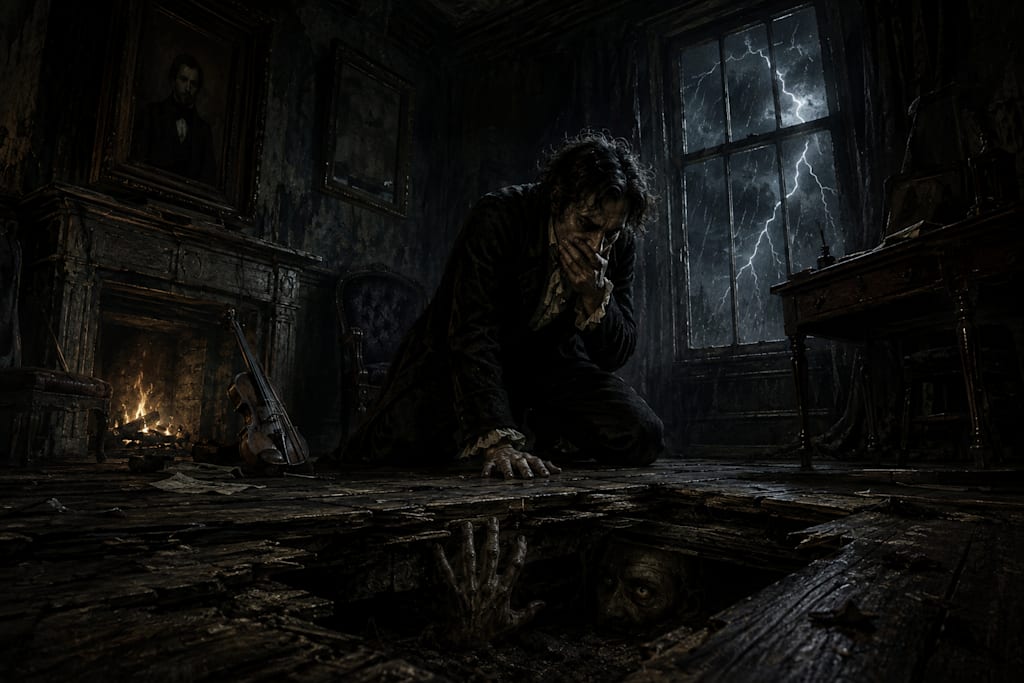
There are sounds which a man may hear and forget, and there are others which enter the mind with such dreadful force that they become a permanent portion of it. I had always possessed an unfortunate sensitivity to sound. The smallest disturbance could command my attention for hours, and the faintest movement beyond a wall could keep me awake long after the rest of the household had surrendered to sleep. I had spent much of my life regarding this affliction as a weakness that could be mastered through reason. On the night of the storm, however, reason proved a frail defense against what came from beneath my chamber.
I had taken refuge in an abandoned mansion upon a lonely hill three days before the storm began. The house had belonged to a physician whose portrait remained suspended in the entrance hall, his narrow face possessing an expression of such severe intelligence that I disliked looking upon it. The villagers below spoke of the mansion with reluctance and avoided the road leading toward it after sunset. Their superstition amused me when I first heard it. I considered the house an excellent retreat for my studies precisely because no curious visitor would disturb me. By the third night, I had begun to understand why the villagers preferred distance.
Shortly after eleven o'clock, I heard the first sound.
It was a faint metallic clicking beneath the boards of my chamber, followed by a slow scraping noise. The interval between the two sounds was nearly identical each time, creating a rhythm so precise that I soon found myself counting the seconds between them. At first, I attributed it to some mechanism concealed beneath the room, perhaps an old pipe contracting beneath the violence of the storm. Rain struck the roof with such fury that the entire mansion seemed to tremble beneath it. Yet the sound possessed a quality that separated it from every other disturbance. The storm was chaotic.
Tick.
Scrape.
Pause.
Tick.
Scrape.
I attempted to ignore it. I returned to my desk, opened a volume of verse, and forced myself to read aloud. My voice seemed absurdly weak against the weather, while that dreadful rhythm continued beneath me with unwavering patience. I read faster. The sound continued. I raised my voice until I was nearly shouting, hoping to bury the noise beneath my own words, yet each time I paused for breath, the ticking remained there, waiting.
At last, I took up the violin that had been left in the room and began to play. I had little concern for beauty. I wanted volume. I dragged the bow across the strings with increasing violence until the notes became shrill and painful. My intention was to drown the sound beneath the music, yet the opposite occurred. The ticking seemed to enter the music itself. Each stroke of the bow appeared to summon another scrape from beneath the boards.
I threw the violin aside and dropped to my knees.
The instant my ear touched the floor, the sound became immense.
It was no longer beneath me. It seemed to occupy the entire world.
The clicking came from directly below my head, followed by the slow metallic scrape. Then came three distinct knocks.
I recoiled so violently that I struck the side of the bed.
Three knocks.
A pause.
Three more.
I stared at the boards. The storm continued outside, yet I heard nothing except those measured blows. Some portion of my intellect insisted that the sound had a rational explanation. Some broken pipe. Some animal trapped beneath the room. Some mechanism concealed by the age of the house. I seized the iron poker from the fireplace and struck the boards.
The first blow splintered the wood.
The second widened the opening.
The third silenced everything.
I remained motionless, staring into the darkness beneath the chamber.
Then came a single knock.
I felt every muscle in my body tighten.
Another followed.
Then another.
The sound had become a clock.
I began counting backward, though I could offer no reason for the impulse. Twenty-seven. Twenty-six. Twenty-five. Each number seemed connected to the diminishing interval between the knocks. I became convinced that midnight would bring an end to whatever had begun beneath me, though whether that end would deliver relief or terror, I could scarcely imagine.
At eleven fifty-five, I barricaded the door.
At eleven fifty-six, I began reciting poetry.
At eleven fifty-seven, the voice came.
It spoke from beneath the boards.
The voice was mine.
“Please.”
I stopped reciting.
Again came the word, faintly at first, then with greater clarity.
“Please.”
A memory rose within me that I had spent years burying beneath books, study, travel, and silence.
There had been another man.
His name was Oscar Crane.
He had come to the mansion with me years before, when I still possessed the confidence of youth and believed myself capable of escaping the consequences of any deed through sufficient intelligence. Oscar had discovered a secret I had guarded with increasing desperation. We argued in this very chamber during another violent storm. His anger frightened me. His threats frightened me more.
I struck him.
He fell.
I remember the sound of his body against the boards. I remember kneeling beside him. I remember seeing his eyes open.
He was alive.
That fact had haunted me more than the act itself.
I carried him beneath the chamber and concealed him inside a cavity beneath the boards. He begged me to stop. He promised silence. He promised anything I wanted. I heard every word.
Then I closed the opening.
I left him there.
For years I had told myself that memory had become confused with nightmare. I had persuaded myself that Oscar died immediately. I had constructed explanation after explanation until I could almost believe my own inventions.
The sound beneath the chamber destroyed them all.
Tick.
Scrape.
Tick.
Scrape.
At eleven fifty-eight, I began tearing apart the boards with the poker.
At eleven fifty-nine, I reached the cavity.
The darkness beneath the room seemed deeper than any natural hollow could have been. I struck another board aside and saw what remained of Oscar. His clothing had decayed almost entirely. His skull rested among pieces of timber, and beside him lay the iron instrument with which I had struck him.
I dropped the poker.
For several seconds there was complete silence.
Then the ticking began again.
Only now it came from inside me.
I pressed both hands over my ears. It made no difference. The sound continued inside my skull with increasing force. My own heart seemed to follow its rhythm. My thoughts began breaking apart beneath the relentless repetition.
Tick.
Scrape.
Tick.
Scrape.
Midnight approached.
I understood then what the sound had been telling me.
It had never been a warning from some spirit trapped beneath the mansion.
It had been my own memory calling me toward the truth.
The final knock came at midnight.
The boards beneath me burst upward.
I saw Oscar standing in the darkness.
His face bore the terrible marks of his imprisonment, yet his expression contained something far worse than anger. It contained patience.
He raised his arm toward me.
“You left me here,” he said.
I tried to answer, though my voice had become useless.
He stepped closer.
“Last call.”
The room vanished.
When the villagers entered the mansion the following morning, they found the chamber door barricaded from inside. They found the broken boards and the remains beneath them. They found the ruined violin beside the fireplace.
They also found me seated against the wall, alive, though I had ceased speaking.
For several hours I remained perfectly still.
Then, shortly before noon, I began counting.
The villagers say I have continued ever since.
Twenty-seven.
Twenty-six.
Twenty-five.
And beneath the mansion, from somewhere deep beneath the chamber, another voice patiently counts with me.
About the Creator
Tim Carmichael
Let your becoming be louder than your fear, and your smallest steps become the road you once thought impossible to walk. An Appalachian poet and cookbook author my book Beautiful and Brutal Things is on Amazon, Link 👇
Enjoyed the story? Support the Creator.
Subscribe for free to receive all their stories in your feed. You could also become a paid subscriber, letting them know you appreciate their work.
Comments
There are no comments for this story
Be the first to respond and start the conversation.