
The Shadow and the Ring: A Lord of the Rings Fan Fiction — Where Courage Was Born in the Dark
A Lord of the Rings

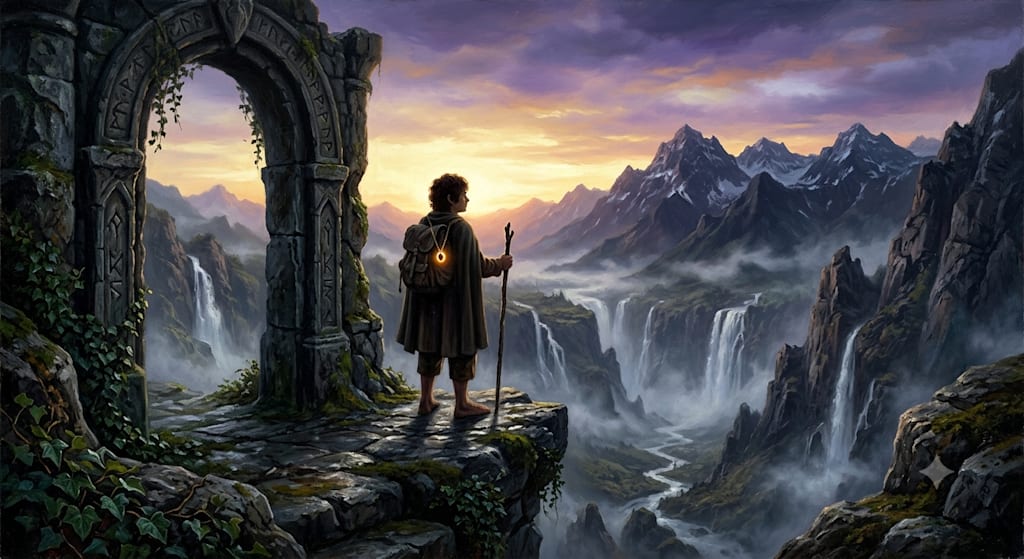
A Journey Into the Heart of Middle-Earth
There are stories that live not just on pages but inside the bones of those who read them. Lord of the Rings is one such story. Written by J.R.R. Tolkien and beloved by millions across generations, this legendary tale has shaped the very way we understand fantasy, heroism, and the cost of goodness. Today, we step into that world — not as distant observers, but as companions on a quest that will remind you why some stories never truly end.
This fan fiction story explores an untold corner of Middle-earth — a night before the Fellowship departs from Rivendell — a moment Tolkien only hinted at, yet one that burns with everything that makes Lord of the Rings extraordinary: loyalty tested before battle, the weight of impossible choices, and the quiet heroism that no song ever captures.
Part I — The Last Fire Before the Dark (Lord of the Rings Fan Fiction)
Rivendell, the Eve of the Fellowship's Departure
The last fire in the Last Homely House burned low that night, casting long amber shadows across the courtyard where the nine companions sat in silence. Frodo Baggins pressed his small, rough hands together and stared into the embers. Beside him, Samwise Gamgee — loyal as stone, warm as bread — had not spoken in nearly an hour. That alone told Frodo everything he needed to know about how frightened they both were.
"You should rest, Mr. Frodo," Sam finally said, his voice careful as a man carrying something fragile. "Tomorrow's a long road."
"All the roads ahead are long," Frodo replied softly. He reached up and touched the chain at his neck — felt the faint, terrible warmth of the One Ring pulsing against his chest like a second heartbeat, darker than his own. He had not told Sam how it whispered to him in the quiet hours. He was not sure Sam could carry that knowledge and still smile the way he smiled.
Across the courtyard, Gandalf the Grey sat alone on a stone bench, pipe unlit, grey eyes fixed on the stars above the Misty Mountains. He looked old tonight — not the theatrical old of a wizard who makes smoke-rings at birthday parties, but ancient, like a mountain that has watched rivers dry up and seas change their names. Frodo watched him and felt an odd pang of something close to grief.
Part II — What Aragorn Carried in the Dark
The Heir of Isildur and the Weight of a Name
Aragorn, son of Arathorn, sat apart from the rest — not from coldness, but from habit. The habit of a man who had spent decades being no one, calling himself Strider, shrinking himself into the shape of the world expected of a ranger and nothing more. Even now, with the truth of his lineage acknowledged in the halls of Rivendell, he found the name Aragorn sat strangely in his mouth, like a word in a language he had once known as a child.
He was sharpening his blade — the reforged sword Andúril, flame of the West — when Boromir came to sit beside him. The man of Gondor had said little since the Council. He had argued for the Ring to be used as a weapon against Sauron, and he had lost the argument cleanly, but losing arguments rarely cured a man of the belief that drove him to make them.
"You are quiet," Boromir said. It was not quite an accusation.
"So are you," Aragorn replied.
Boromir looked at the sword in Aragorn's hands. "My father would have called you a king tonight. In the hall, with Elrond's blessing and the sword whole again. He would have bent his knee." He paused. "But my father is not here."
"Neither is Gondor's need, not yet," said Aragorn quietly. He set the sword across his knees and looked at Boromir directly. "I do not ask for your faith tonight. I only ask that you keep your sword sharp and your heart clear. What lies ahead will demand both."
Boromir studied him for a long moment — that measuring look soldiers give to commanders before deciding whether to follow them into the dark. Then, slowly, he nodded. It was not trust. Not yet. But it was a door, left open.
Part III — Legolas, Gimli, and the Strangeness of Alliance
An Elf and a Dwarf Begin the Unlikeliest of Friendships
Of all the strange things the One Ring had done to the world, perhaps the strangest was this: it had put an Elf and a Dwarf within speaking distance and required them both to stay there.
Legolas of Mirkwood stood at the edge of the terrace, his silver eyes tracking the movement of stars with the easy familiarity of someone who had watched them for centuries. Gimli son of Glóin sat on a low wall nearby, eating his third supper and studiously not looking at the Elf.
"The stars are different here," Legolas said, not addressing anyone in particular.
"Stars are stars," Gimli grunted. "Round. Bright. Far away. Same as everywhere."
"That is exactly what a Dwarf would say."
"And that is exactly what an Elf would say about what a Dwarf would say."
A pause. Then, to the considerable surprise of both of them, they each made a sound that might have been the beginning of a laugh. Legolas turned to look at Gimli, and Gimli looked back at Legolas, and the ancient enmity between their peoples lay between them for a moment like a sword — and then, quietly, like a sword being set aside, it rested.
"I have never traveled with an Elf," Gimli admitted.
"I have never traveled with a Dwarf," said Legolas. "I am told you are stubborn, loud, and impossible to lose."
"All virtues," said Gimli, and this time there was no mistaking the laugh.
Part IV — Gandalf Speaks to the Fire (Lord of the Rings Wisdom)
The Wizard's Counsel on Courage, Fear, and What Lies Ahead
Frodo approached Gandalf near midnight, when the rest of the Fellowship had finally gone inside. The wizard did not look up but shifted slightly on the bench — enough to say: sit, without saying anything.
Frodo sat. "Gandalf," he said, "are we going to fail?"
The wizard was quiet for so long that Frodo began to wonder if he had heard. Then: "I do not know. I have never known. That is the thing about quests, Frodo — they do not come with maps to the ending. Only maps to the next step."
"That is not very comforting."
"No," Gandalf agreed. "But it is true, and truth is better than comfort when you are walking into darkness." He finally looked at Frodo, and his eyes were very kind and very old and very, very awake. "What I do know, with everything I am: you are the right person to carry it. Not because you are the strongest or the cleverest or the bravest. But because you already know the Ring's weight and you have not yet let it change who you are. That matters more than strength."
Frodo touched the Ring through his shirt. "What if I cannot hold on to who I am?"
"Then you let Sam hold on to it for you," said Gandalf simply. "That is why we do not walk alone."
Part V — The Dawn, and the Setting Out
When the Fellowship of the Ring Stepped Into the Unknown
They left at dawn, when the light was still pale and cold and the valley of Rivendell lay wrapped in silver mist. Elrond stood at the gate and watched them go, and his face — that ageless, careful face — held something that might have been grief and might have been pride and was probably both at once.
Nine of them. Nine against the dark. It seemed absurd and it seemed exactly right.
Frodo walked in the middle of the company, which put him between Gandalf ahead and Sam behind, with Aragorn to his left and Boromir to his right. He was so small among them — a hobbit among warriors and wizards — and yet the weight on his chest was heavier than any sword any of them carried.
Sam came up beside him as the gates of Rivendell disappeared behind a bend in the road. "All right, Mr. Frodo?"
"Not yet," said Frodo honestly. "But I think I will be."
Sam nodded, settled his pack more firmly on his shoulders, and matched Frodo's pace exactly — as he always had, and as he would, across all the miles and all the dark that lay ahead.
The Lord of the Rings had begun. Not in a council chamber, not in a king's hall, not with trumpets. It had begun the way all the truest things begin — in the quiet space between one step and the next, where fear and love walk together, and love, somehow, keeps moving.
Frequently Asked Questions About Lord of the Rings
Q1: What makes Lord of the Rings different from other fantasy stories?
Lord of the Rings stands apart because Tolkien built an entire world — languages, histories, mythologies — before writing a single chapter of narrative. The story feels lived-in because, in a very real sense, it was. Tolkien spent decades in Middle-earth before inviting readers in. That depth shows on every page and makes the emotional weight of the quest feel genuinely earned.
Q2: Why is Frodo chosen to carry the One Ring?
Frodo is chosen not because he is the most powerful or the most skilled, but because his innocence and humility make him less susceptible to the Ring's corruption — at least initially. The Ring seeks power; it has less grip on someone who does not crave it. This is the central paradox of Lord of the Rings: the smallest and the gentlest is the one who must carry the greatest burden.
Q3: Is Lord of the Rings appropriate for younger readers?
The Lord of the Rings is generally considered suitable for readers aged 12 and above, though motivated younger readers often enjoy it with guidance. It contains themes of war, sacrifice, grief, and moral corruption, but these are handled with depth and care rather than gratuitous darkness. It remains one of the most rewarding books a young person can read, offering lessons about courage and friendship that last a lifetime.
Q4: What are the best Lord of the Rings books to read first?
Begin with The Hobbit, which is shorter and lighter in tone — it introduces Middle-earth gently. Then move to The Fellowship of the Ring, The Two Towers, and The Return of the King. For deeper Tolkien lore after the main trilogy, The Silmarillion is magnificent but more demanding. The Lord of the Rings series rewards re-reading at every stage of life.
Q5: How long does it take to read the Lord of the Rings trilogy?
At an average adult reading pace of 250-300 words per minute, the full Lord of the Rings trilogy (approximately 481,000 words) takes roughly 30 to 40 hours. Most readers spread this across 4 to 8 weeks. Many find the pacing slower in places — Tolkien is generous with landscape and history — but devoted readers consistently call it time well spent.
Conclusion — Why Lord of the Rings Still Matters
The Lord of the Rings is not a story about a ring. It is a story about the kind of courage that doesn't announce itself — the courage of small people carrying impossible weights through frightening dark because someone has to, and they happen to be there. It is a story about friendship as the only armor that truly holds. It is a story that knows evil is real and exhausting and sometimes wins the day, and that love keeps going anyway.
Tolkien wrote it during and after the Second World War, and the shadow of that experience — loss, senseless destruction, the cost of ordinary people caught in vast darkness — is present on every page without being explicit. That is what gives Lord of the Rings its unusual resonance across generations: it is myth made from lived grief, and readers feel that truth even when they cannot name it.
Whether you are returning to Middle-earth for the fifth time or stepping through the gates of Rivendell for the first, the story gives you something new. Because you are different each time you read it. And the Lord of the Rings — patient, generous, timeless — is always waiting.
About the Creator
saif ullah
Content writer on different niches, specially on finance.
Enjoyed the story? Support the Creator.
Subscribe for free to receive all their stories in your feed.
Comments
There are no comments for this story
Be the first to respond and start the conversation.