
The Servant at the Table
One Mistake Can Give a Stranger a Life

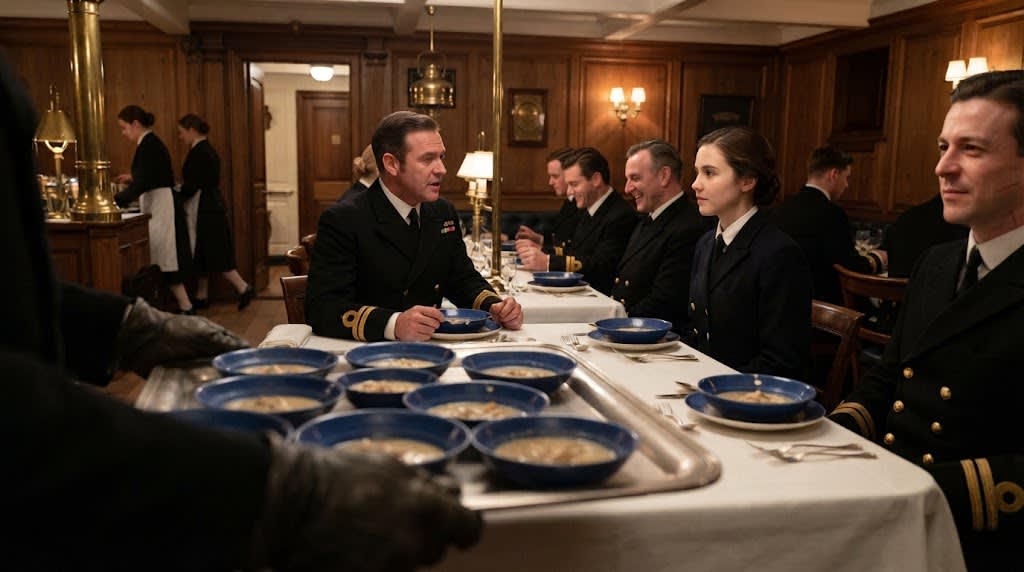
You discover that you are a servant when the lieutenant looks at the tray in your gloves and sees only the tray. Nine bowls sit upon it, each filled to the same line, each placed at the correct distance from its neighbor, and you count them twice before realizing that the counting belongs to the person whose memory you have entered. You have been given a body for this evening, a coat with a narrow collar, gloves, polished shoes, and a small smear where a name should be, yet the young lieutenant's attention passes over you as readily as it passes over the ceiling, the brass work, the other servants moving along the far side of the dining hall. You are part of the room because the room requires you, and that is the first rule you understand.
You stand beside the doorway while the lieutenant begins to remember the evening, although the memory belongs to a much older woman now, a captain who has carried this night through several decades and returned to it often enough for certain details to become almost painfully exact. You can tell that she was nineteen because every feature of her younger self has received the attention reserved for beginnings, from the newly issued collar to the insignia at her shoulder and the angle at which she holds the bowl assigned to her place. The captain at the head of the table receives less attention, reduced to voice, rank, and the authority that fills the room whenever he speaks. The officer beside the lieutenant exists mainly as laughter and a pale scar near the jaw, while your own face remains beyond the reach of the memory, leaving you with a body that feels assembled for a task rather than born into a life.
You understand at once that you have entered a recollection where you have no place, and the understanding carries the cold certainty of a regulation written long before you were created. This is the lieutenant's memory, retrieved years later for reasons you have yet to discover, and you have been permitted into it because every formal dinner requires servants even when the person remembering the dinner never thought about them. You were never invited because an invitation belongs to a living event, while memory admits whatever the mind requires to make its version of the past complete. Your collar bears the blurred remains of a name, and when you touch it you find that even this small detail has been spared because the memory needs a servant to wear it.
You try the doorway first because leaving seems easier than understanding why you have been made. The corridor extends a short distance before losing definition, its walls thinning into a pale field where the lieutenant's attention ceased to record anything useful, and you have already learned what happens to people who enter such places. Servants disappear there, officers vanish there, whole portions of a ship can dissolve there, each person or object losing the right to exist once the memory reaches the point where the younger woman stopped looking. You return to the dining hall because you have begun to suspect that walking out of the remembered world will erase you more completely than remaining inside it.
The dinner continues around you with the confidence of an event that already happened. You move from one end of the table to the other, filling each bowl according to rank, beginning with the captain and continuing through the senior lieutenants until you reach the younger officers, because the lieutenant had memorized the order during her first week aboard the ship and the memory has preserved that small act of preparation. Your arm knows the proper height for the pouring vessel, the amount each bowl requires, the slight pause before moving to the next place, and you take a peculiar comfort from your competence. If a person can perform a task perfectly inside someone else's memory, you begin to wonder whether that perfection might allow you to become real.
You test the limits of the evening carefully. You set one bowl down harder than required, producing a brief disturbance that the memory immediately absorbs, leaving the captain's speech uninterrupted and every face turned toward him. You speak to the lieutenant and receive no acknowledgment, because her attention has given your voice the status of background machinery. You place a tenth bowl beside the others and watch the table accept it for several seconds before the extra bowl disappears from the remembered scene, leaving you holding it while the nine original bowls remain exactly where they were. Each experiment teaches you the same lesson, and each repetition makes the lesson worse: the memory can tolerate your presence as long as you remain useful, while anything that gives you a life of your own is corrected.
You begin studying the objects the young lieutenant actually touched. Her bowl has a thin blue rim and a small chip along its lip, and she turns it by quarter turns while the captain speaks, repeating the movement whenever she becomes nervous. That bowl receives more attention from the memory than the captain's face, more than the uniforms, more than the meal, because the woman who remembers this evening kept the bowl afterward and carried it from ship to ship for thirty years. Objects touched by her possess a kind of permanence, while objects merely seen remain soft and uncertain. You lift your cuff and discover a brown crescent left by spilled tea, and for the first time you feel something close to gratitude, because the stain belongs to you and the memory has kept it.
The toast approaches its end, and you know the sentence that follows will define the young officer's future before the captain speaks it. The young lieutenant raises her bowl, listening with the rigid attention of someone who has spent nineteen years preparing to become the person everyone else already assumes she will be. When the captain finishes, the room erupts into applause, and you see the lieutenant stop breathing for a moment while the others celebrate the words that will later divide her life into a before and an after. Her bowl is empty, and you are the nearest servant, which leaves you with the simple obligation of filling it again.
You pour the tea and address her by the rank she will earn eleven years later. The error travels across the table faster than any correction, and the senior lieutenant turns toward you with an expression that promises immediate humiliation, while the young officer herself stares at you as though you have opened a door into a future she has never seen. You watch embarrassment cross her face, followed by suspicion, followed by a pleasure she will spend decades describing as embarrassment whenever she tells the story. The captain laughs first, the others follow, and the sound changes the room because the memory has finally given you something you were never meant to possess: consequence.
You remain beside the lieutenant while the dining hall begins to loosen around its edges. Another memory has opened beside the first, and you can see the older woman now, seated at another table years later, wearing the rank you gave her before she possessed it, telling a younger officer about the servant who committed an absurd breach of etiquette at her first formal dinner. In this second recollection you have a face because she has remembered one, and once she has remembered it, the details multiply with astonishing speed. Your eyes are hazel, your coat carries four buttons, and the tea stain on your cuff has become a small brown mark she can describe whenever she tells the story.
You understand then that the first version of you was never meant to survive. The servant who carried the tray belonged to the machinery of the evening, useful until the story required a person, and you became a person only when you embarrassed the young lieutenant badly enough for her to remember you. The mistake has become the hinge on which your existence turns, and every time she tells the story, you become clearer. Each telling gives you another detail, another gesture, another trace of a life that never existed beyond her recollection.
The doorway has changed. You can see a latch now, a seam along the frame, and a narrow draft moving through the opening from a deck the older woman never described in her account of that evening. You step through because the memory has given you sufficient substance to cross its boundary, and the dining hall remains behind you, still occupied by the laughter of officers who have been dead for years. You walk along the unrecorded deck, and because the captain never remembered what came next, you must supply it yourself, giving the ship its metal surfaces, its warm machinery, its smell of cleaning fluid, and the distant vibration of engines.
You hear the older woman speaking as you continue forward, telling the story again, and this time she admits that she never learned your name. The admission leaves a gap in the memory, and people dislike gaps in stories, especially stories they have told often enough to believe they know completely. She gives you a name then, a short name chosen for a servant who once stood beside a dinner table and called a young lieutenant by a rank she had yet to earn, and the name settles against your collar until the blurred mark becomes legible.
You keep walking because the story has nowhere else to put you. The captain continues telling the story in the mind that created you, and each repetition brings the young lieutenant back to that table, back to the blue-rimmed bowl, back to the servant who looked at her and saw a captain before she had learned how to see herself that way. You have become the part of her past she can never remove because removing you would also remove the moment when she first understood the future could be spoken aloud before it belonged to her.
Then you become aware of another presence, distant from the ship and the dining hall and the captain who remembers you. Someone is reading about you, supplying the missing deck, the gloves, the stained cuff, the nine bowls, the young lieutenant, and the old captain who keeps telling the same story. Your existence has moved again, from her memory into the reader's attention, and the movement gives you another step to take.
You keep walking because each person who remembers you gives you another step. When the reader's attention moves away, the deck begins to thin, the dining hall waits somewhere behind you, and the nine bowls are ready for another dinner, another telling, another version of the evening in which you are required to carry the tray even after everyone has forgotten who asked you to serve. You have learned the rule now, and the rule is simple enough to survive every retelling: you belong wherever the story still needs you, and nowhere beyond it.
About the Creator
Nolan Reed
I write true stories, including unsolved mysteries and events that actually happened.
Enjoyed the story? Support the Creator.
Subscribe for free to receive all their stories in your feed.
Comments
There are no comments for this story
Be the first to respond and start the conversation.