
The Safe Room
There was no place in Dark City to hide from the Reality Police

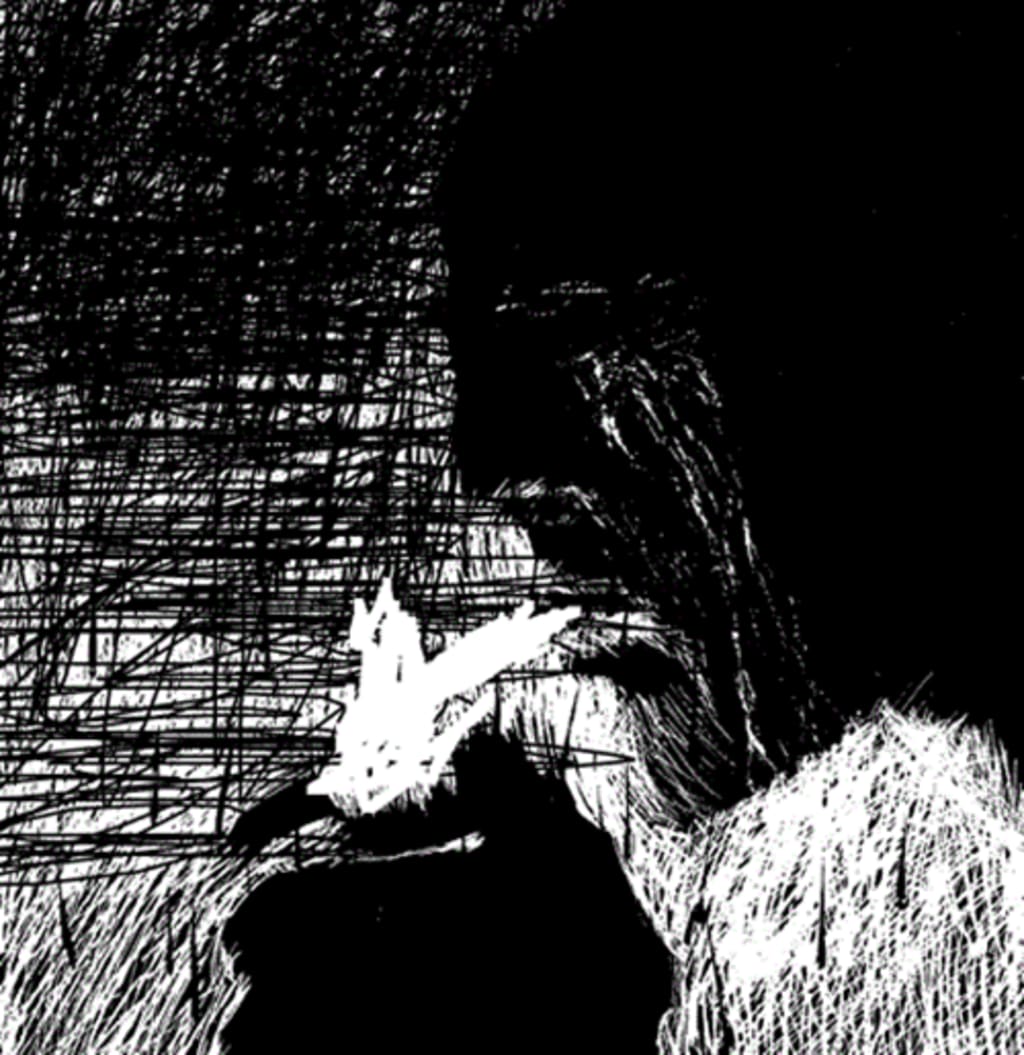
Two eyelids suddenly flicked open.
In the green-painted dark corners of the ceiling, spider web residue still there for over the existence of the cheap apartment room had a permanent existence.
Hardigan woke up at four in the morning. He woke up in his cold bed, sheets coiled like snakes. He went into the bathroom. Shaving, he saw the bright red color of blood spreading in the white porcelain sink. Something you usually didn’t see in everyday life because all bright colors were forbidden. He was fascinated by the bright red color. He had been dreaming but didn’t know what it was. He didn’t know for sure anymore whether or not he was lucid yet. In the city, the colors were muted. Psychologists say that we dream in muted colors. But Hardigan had the thought that the full-color experience was a visual hallucination and that the muddy muted tones were the reality of the world, not the bright shiny colors that hypnotized people to their own surroundings. He left the decrepit apartment and went to his slightly less decrepit office.
He left the room, taking his hat from the tall stand in the corner of the room. He smoothed his trench coat and left. The sound of the door re-echoed in Hardigan’s mind as he stared blankly back at the exit at the room.
The stairs spiraled like a snake. He tossed number ten onto the pavement and crushed it reflexively under his shoe. A middle-class woman walked by and gave him a look of disapproval. Hardigan ignored it and moved out and into the world to find something that was hidden to him in the normal existence of a quietly screaming city in the day and then nocturnally dazed, muted, and blunted in the night. Then he found himself inside another dead-end bar with the other dead-enders. A working man with a slight build, in his work clothes fidgeting some papers in front of him. It looked like some bills that he would not be able to pay again. And he would need some way of trying to get the cash that he didn’t have.
Hardigan left the bar.
A gauntlet of five dead-bolts clanked. One-two-three-four-five clanks. He was in a hall outside his office door. He pushed open the door and his muscle-memories took over. His hand reached out toward the rocker-switch for the electric lights and flicked them on. He saw a cockroach sitting silently on the floor, facing him. He went into the room and got the canister of bug spray and stood above the cockroach with the bug spray in his hand. He looked at it. He wondered what it would be like to one day wake up as a bug.
He sprayed it. Then he swept the dead bug into the trashcan and shut the lid on top of it. Then he dragged on his cigarette and exhaled a gray poison cloud.
He looked around himself at the burning reds, number twenty-two still smoldering in the ashtray. Then at the bottles of whiskey in the trash and some remnants of Soylent burgers. The aroma of food wafted through the window. Hardigan tried to ignore it. He continued calling around for work.
“Found any work for me?”
“No. Got no work for you, chum. Nothing on the ups. What about your contact on the inside?”
“Haven’t heard from him since the last job. Before the war. He saved me last time.”
Noon.
Once in a while, the dark clouds would unexpectedly dissipate, and the sun would come out as if you were dreaming a beautiful dream while still inside of a nightmare that you were still having. This happened just frequently enough to deepen the horror of their existence. Then, just as suddenly as it happened, it would turn dark again as the clouds rolled back and thickened as to be almost completely impenetrable to light and returned the people back to reality. For one infinitely sweet but fleeing moment, the world would suddenly be radiantly beautiful, light, and idyllic. But then it all would just seem like a dream inside of a nightmare.
Then, night. Now seated, he could feel the pressured air from the ceiling fans spinning the air downwards against his face and eyeballs.
Hardigan hadn’t had a case in weeks. He was nervously staring at the blank calendar. “Duesday.” All he had in his pockets was a sweaty, crumpled portrait of Andrew Jackson with crinkles across his neutralic face. He was deep in thought. He ran his fingers through his hair. His hair was narrow near the peak of his forehead, forming a widows’ peak. He wondered how the widow’s peak got its name. He only needed about a hundred more Andrew Jacksons then he could leave after paying the landlord.
Sitting under the artificial, flickering lighting, he looked pale, unhealthy, sick. He felt stressed. Post-cigarette high fading, he was certain he needed a break and got up. He then walked to the refrigerator, opened it, and stared at the plastic-bag encased piece of mystery-meat. He had trouble remembering what it was. He had a flashback: When an especially hungry dog, the neighborhood feral dog, stole one of his steaks from the store one day, he almost shot it. But then he felt a sudden compassion for the starving creature and pitied it as he watched it eating the steak eagerly, as the dog stared at him. Later in the week, he was still starving when he found the dog again. He shot the dog. Hardigan had no regrets. Ring ring — Ring ring.
He re-entered his office and scrambled around his desk, searching for his phone. He wondered if it was a client. He suddenly felt a little bit flattered and anxious at the same time. Someone trying to call him. He felt like he existed in some way and he felt validated. He picked up his phone and pressed a button on the side of the phone. The black-plastic phone cover slid off the keypad with a low snick. An antenna projected out of the top of the phone. He pressed the phone to his ear and answered: “Hello?” All he heard was hiss.
Then he heard a voice in his mind. “There’s a patrol car coming right now to your location. You’re getting raided, meet me at the usual room.”
It was the Lieutenant. He made a gap through the horizontal slats of the blinds with his whitened shaky hands and looked out the window at the fog, but he couldn’t tell for sure who was out there because the fog made everything difficult to see.
Through the streets, long black-and-white city patrol cars came rolling out of the night-fog to the front of Hardigan’s apartment building, driving past boulevards where sex workers were walking up and down the sidewalk. The sidewalk was cracked. Everything in the city looked rundown and unrepaired, even though there was constantly repair work, nothing ever seemed to get fixed or stayed fixed for long. The tires crushed the small pieces of the road pavement that were broken off from the broken pavement surface and ejected them in different directions into the night-fog. There were police sirens, like the howling of wolves, in the distance. The flashing rooftop lights were retina-burning red and green. The ambient light made the blue light look grayish-green. The sirens dopplered at a pain-inducing decibel through the street, penetrating even the multi-layered nuclear-blast proof windows. The patrol cars stopped below Hardigan’s window as the sirens ceased and the megadecibel sirens calmed down. Police stepped out of the black-and-white autos from both sides of them carrying batons and guns on their sides.
Hardigan should’ve left the city when he realized how bad it was, but he didn’t have the money. Eventually, everyone would end up as a victim, he thought to himself. Who would be the next victim of the city? Time to move again before the cops move in looking for non-existent money to loot. If they found only the crinkled Andrew Jackson — and no Benjamin Franklins — they wouldn’t spare him any wrath from batons. Everything good he’d ever heard about the city before moving here was a lie, he thought. His face and guts contorted in psychic pain, as if trying to close up the conduit to some room where the pain was coming from. Outside his window, there was the noise of some sirens. Hardigan peeked out the blinds for some visual details, but he couldn’t see much. It was too dark and foggy. The street lights were busted and hadn’t been fixed for a month. But then a blue and red siren and lights blaring came through the street. The lights appeared green and red and Hardigan’s retina burned with a painful sensation as his ears were ringing from the obnoxiously high decibel sirens. The sirens were like a conduit for pain that opened into his inner ear. He shut the window.
Seated at his desk, he pulled open the top right drawer and pulled out something black and shiny. A gun. It reminded him of himself in the days when he was not broken. His cognitive dissonance over the situation of the world he lived in was too great. He could never get over the strangeness of this sick, disappointing world. Maybe he should’ve never left his home of Lake View Hill. Home, not going through the same routines everyday like a recurring dream. He set the pistol (not “gun,” he told himself) on his desk and fingered it, feeling the intricate molded texture on the curved pistol grip. He couldn’t remember the last time he had fired it. He thought he could almost smell burnt cordite residue still on the gun. There was something romantic about the aroma of the burnt cordite, which stimulated some emotion within him, which reminded him of being in a different room in his mind, a room where he didn’t feel like a prisoner of the city and the bureaucracy that kept it running, which robbed people of dignity, turning them into conduits for profit and power for the people who had muscled their way to the top of the bureaucracy and needed a constant fresh supply of proletariat to keep the bureaucracy running. He needed to find a way of coping with the intense loneliness that he felt all the time, which was crippling him.
He tucked the pistol into his waist band and closed up his coat. He had sold his holster to the pawn shop for a few bucks. If this wasn’t good gun safety, he didn’t care anymore.
The double doors to the lobby of Hardigan’s apartment building swung open followed by black-uniformed and helmeted police.
They climbed the stairs to Hardigan’s floor. The cops stepped onto the dark path towards the front door of one of the apartments. Heavy black boots crossed the creaky wooden-slatted floor. When they reached the lighted area in the front entrance in the hallway, there were four of them.
A gleaming black polished jackboot kicked the door open with heavy force.
The heavy wooden door was unlocked, and it swung open without resistance. Gun muzzles pushed into the black room. A figure was in the room, silhouetted within the green-glowing rectangular window frame. They lit up the room, strobing it with light. The walls were stippled with a few dozen uniformly circular holes.
Then the strobe lights ceased. Oily burnt cordite smoke wafted across the green beams of light streaming through the uncovered window.
The figure was gone.
Inside, the room was black. The light of the cloud-shaded moon showed that the room was empty.
“Hologram.”
Above the darkened city, the sky was ever-clouded, like an immense, slow-moving gray river. Like an upside-down world.
In the city, you had to keep moving to stay alive. And since nobody could be sure of what reality was, there was no sense in keeping your thoughts trapped by any narrow opinion of what the world and what reality really was. On the train, he watched the panoramic view of the city’s silhouette against the dull red sky. The hills and valleys of the black silhouettes of the towers of the city, flechette like and needle like points. With cables crisscrossing across the narrow valleys of the city, transmitting data and information to the different parts of the city. Like vines crisscrossing the dense trees of a dark jungle. The speed of information was the speed of the economy. Hardigan exited the train into the rain.
He heard the loud yell of a train as it came down some train tracks a few blocks away. He was in a bad part of the city.
The street was empty except for a few dark-coated men with their hands in their coat pockets, as if concealing guns in their coats. They gave Hardigan sideways glances as he passed on the other side of the street. Hardigan tried to ignore their furtive glances. He focused on the feeling of his hand holding onto the pistol grip of the gun in his waistband and mentally prepared himself in case violence struck out of nowhere.
He walked through the scene toward a hidden location, the safe room.
He reached the location and waited. He had arrived at the safe room, a room where the police surveillance cameras couldn’t see, cleverly hidden in a walled-off district.
He reached into his outer coat pocket and pulled out a lighter. A sharp snick came out of it. The sphere of orange-yellow light emanating from the lighter flame cast the texture of his face into a dark relief of abstract patterns of dark and light that revealed an image of a deeply hardened and experienced face. The face the light revealed was cruel, harsh, ragged, similar in texture to the brick wall next to him. The blood-traced protruding eyes hovering in a black shadow had a glare that could melt glass. Then Hardigan lit a cigarette. A skeletal hand brought the cigarette to his lips. The city was silent as the night was returning. The low-rumbling sound of traffic on the streets carrying workers to pitch-darkened homes only brought attention to the stretches of silence.
Then, the shadow behind him moved. He reached inside his coat pocket and felt the gun in his waistband through a hole he made in the coat pocket. He was afraid it was a creep and pulled out his pistol.
It was the Lieutenant, and they went inside the safe room.
The Lieutenant offered him a cigarette. “Want a smoke?”
“I smoked forty cigarettes today. Yes, I counted.”
“Won’t find reds for under ten. Got any Soylent?”
“No. All I have is an Andrew Jackson.”
“If that’s all you have, why’d you leave the Department? Detectives don’t make money.”
“Why do you call me? We can’t be seen together. Supposed to be a war. Left when I had the feeling I was going to be transferred to another district imminently. My gut told me it was to the graveyard district.”
“Remember the old days, chum?”
“Like a brother to me. Thanks for the last job. Saved me. Do you have a job for me?” The winds blew dust and trash around. It was moaning through the streets right now.
“No. We were like brothers, but two or more people can’t be together without contradictions. Even friends. Come back to our side.”
“Got ransacked. We keep a safe distance apart for reasons like this.”
“But, you could use a rest. Why don’t you go to the sensory deprivation tanks afterwards? I’m going there later. I’ve got an appointment for a couple hours.”
“I intend to keep wired. Better this way. Bad weather. Clear up and pass?”
“No. Something wrong?” The Lieutenant stopped and looked at Hardigan curiously with a questioning glance.
“It’s been this way exactly for years, day after day. I’ve been keeping track. There is something wrong with the sky. Something is wrong with reality.”
“Well, I think you’re right.” The Lieutenant began chuckling.
“Exactly. I can’t even remember the last time I saw the sun.”
“How do you know the sun exists? How do you know that? It’s all a lie.”
The Lieutenant pulled out a gun fast. But Hardigan was faster. He struck the Lieutenant’s inner arm with his fist and knocked the gun out of it. He pulled his own gun out and fired two shots straight through the Lieutenant’s chest.
The Lieutenant’s body slumped to the black ground. Hardigan stood staring at the body for a while, bright blood on his hands, the color bright against the dark and muted tones of the setting. Hardigan had no regrets.
He left the Lieutenant behind in the so-called nameless district.
There are no such things as safe rooms in the city, he thought to himself.
His only friend was dead, and Hardigan had no home to go to. You didn’t live long in the city. You had to be stone cold hard, like a diamond bullet, and keep death inside of you, locked in a dark and secret room deep inside your soul, hidden, like the dark side of the moon. Show only your beautiful side, like the moon. Then let death explode instantly and with extreme prejudice.
The full moon was like a woman’s breast. It was raining incessantly. The moon-touched clouds covered up the crimson moon. He turned and faded to black.
About the Creator
Vuthy Huot
Award-winning and card-carrying writer. BA in Philosophy. Hospital volunteer. I believe writing serves an existential purpose. Working on my first novel. If you like what you read, feel free to leave a tip. I would love some feedback.
Enjoyed the story? Support the Creator.
Subscribe for free to receive all their stories in your feed. You could also become a paid subscriber, letting them know you appreciate their work.
Comments
There are no comments for this story
Be the first to respond and start the conversation.