
The Room That Has Your Name
You were never meant to find it

You take the wrong staircase because the elevator is broken.
That is all.
No decision worth regretting. No warning ignored. No locked door forced open.
Just a staircase.
The museum closes at six, and at 5:42 you are still on the third floor, moving too slowly through an exhibition you have already stayed too long to see properly.
A guard has passed twice.
The second time, the smile was thinner.
You understand the message.
Time to leave.
You follow the EXIT sign through a narrow doorway and descend one flight.
Then another.
The stairs should return you to the lobby.
They do not.
At the bottom is a corridor.
No windows.
No signs.
Only gray walls and a strip of fluorescent light humming overhead.
You stop.
Behind you, the staircase rises into darkness.
Ahead, the corridor bends left.
You should go back.
That thought arrives immediately.
You ignore it because going back means three flights of stairs and because the corridor surely connects with the lobby somewhere.
Buildings have service corridors.
Museums have staff areas.
Nothing strange about that.
You walk.
The first door says STORAGE.
The second says CONSERVATION.
The third has no label.
All three are locked.
At the corner, the fluorescent lighting changes.
Warmer.
Older.
The walls change too.
Gray paint becomes cream.
Modern fire doors become dark wood.
The floor beneath your shoes is no longer vinyl.
It is parquet.
You look back.
The corridor behind you appears longer than it was.
You keep walking.
There is no reason not to.
That is what you tell yourself.
Then you see the rope barrier.
A brass post on either side.
A red cord.
Beyond it, another hallway.
Someone has placed a small sign at waist height.
AUTHORIZED PERSONNEL ONLY.
You stop.
You could turn around now.
Instead, you notice the door at the far end.
It is open.
Only slightly.
Light escapes through the gap.
You hear something inside.
Paper moving.
Not footsteps.
Not voices.
Paper.
A page turning.
You step over the rope.
That is the first thing you do knowingly.
The hallway beyond feels colder.
The doors along it have brass numbers.
You notice the missing even numbers.
You notice because there is nothing else to look at.
At the end waits 219.
The open door.
You push it.
The room beyond looks nothing like a museum office.
It resembles a reading room.
One table.
One chair.
One green-shaded lamp.
Shelves cover every wall.
No paintings.
No artifacts.
Only boxes.
Hundreds of them.
Each box carries a white label.
A name.
You read the nearest.
MARGARET HALL.
Another.
DAVID RENNER.
Another.
ELAINE MORRIS.
Ordinary names.
You do not recognize them.
You enter.
The page-turning sound stops.
You freeze.
Nothing moves.
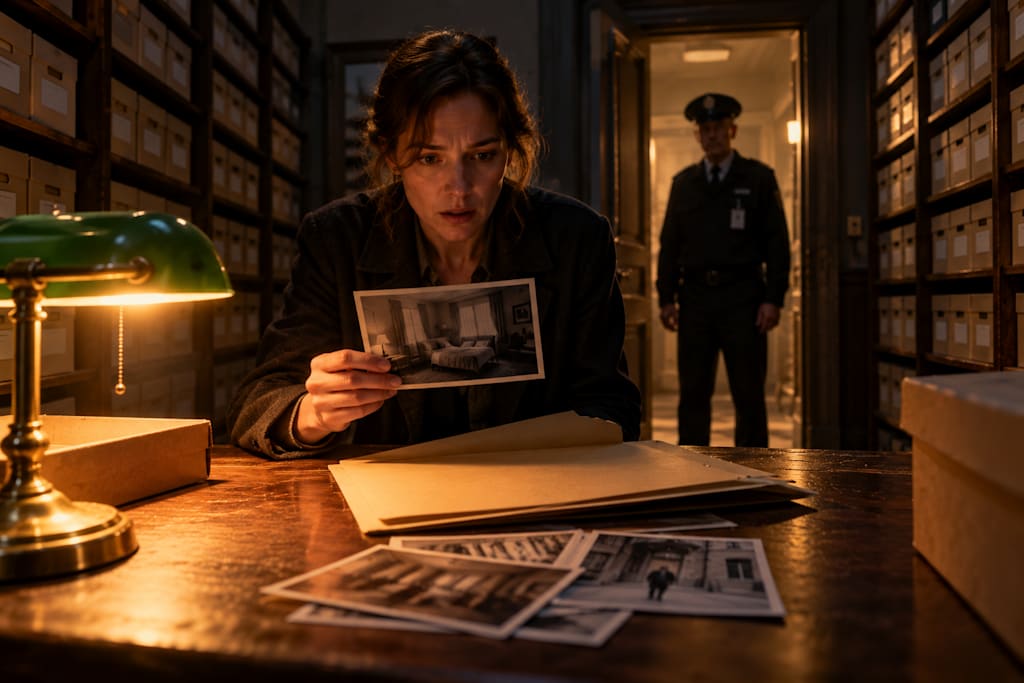
The table is empty except for a folder.
Closed.
Cream-colored.
Placed exactly beneath the lamp.
You take one more step.
There is a name written on the folder.
Yours.
Not a similar name.
Not your surname only.
Your full name.
Middle name included.
Spelled correctly.
You do not touch it.
For several seconds, you simply stand there while your body decides what your mind refuses to.
Your mouth dries.
Your heartbeat becomes something separate from you.
You look toward the door.
Still open.
You should leave.
You know that.
Instead, you reach for the folder.
Of course you do.
Inside is a photograph.
You recognize it immediately.
Your bedroom.
Taken from the doorway.
The bed unmade.
Curtains half open.
The shirt you wore yesterday lying on the chair.
You turn the photograph over.
Nothing written.
The next image shows your kitchen.
This morning.
A mug beside the sink.
Keys on the counter.
You remember leaving them there.
The third photograph shows you entering the museum.
Taken from across the street.
5:03 p.m.
You drop it.
The photograph lands face up.
You are looking toward the museum entrance.
Behind you stands a person you did not notice.
Too far away for the face to be clear.
Close enough to know the person is watching you.
You close the folder.
That should be enough.
It is more than enough.
You turn toward the door.
Closed.
You never heard it move.
You cross the room quickly and grab the handle.
Locked.
You pull again.
Nothing.
You knock.
Once.
Then harder.
No response.
You call out.
Your voice sounds wrong in the room.
Too flat.
The shelves seem to absorb it.
You take out your phone.
No signal.
Battery: 61%.
Then 60%.
Then 59%.
You stare.
58%.
57%.
The numbers fall every few seconds.
You switch the phone off.
The lamp flickers.
Behind you, paper moves.
You turn.
The folder is open again.
A new page lies inside.
You approach because distance no longer feels safer.
The page contains a typed sentence.
YOU ENTERED AT 5:47 P.M.
Below it:
YOU OPENED THE FILE AT 5:51 P.M.
Another line appears as you watch.
Not printed.
Appearing.
YOU TRIED THE DOOR AT 5:53 P.M.
You step back.
The next sentence forms.
YOU WILL CHECK THE SHELVES.
You do not.
You refuse.
You stand perfectly still.
The page waits.
Nothing happens.
Then the line disappears.
A new one replaces it.
YOU WILL CHECK THE SHELVES AFTER THE LIGHT GOES OUT.
The lamp goes dark.
You move immediately.
Your hands find the shelves.
You hate that.
You hate it more than the darkness.
Your phone comes back on when you press the button.
12%.
You use the flashlight.
Rows of boxes.
Names.
Dates now visible beneath them.
Some dates have two numbers.
Birth.
Death.
Some have only one.
The nearest box reads:
MARGARET HALL
1962-2024
Next:
DAVID RENNER
1981-2025
Next:
ELAINE MORRIS
1975-2026
You move faster.
The boxes appear chronological.
The years increase.
You stop.
There is another box.
Your name.
Your birth year.
A dash.
Nothing after it.
Your breath catches.
Beside your box is an empty space.
Not accidental.
Exactly the width of another box.
Your phone battery shows 4%.
A sound comes from the corridor.
Footsteps.
Slow.
Measured.
Approaching.
You turn off the flashlight.
Darkness.
The footsteps stop outside the door.
A key enters the lock.
You back away.
The door opens.
Light from the corridor cuts across the floor.
Someone enters.
A museum guard.
The same guard who passed you upstairs.
You almost laugh from relief.
The guard does not look surprised.
That removes the relief immediately.
You try to explain.
Wrong staircase.
Locked door.
Your name.
The photographs.
The guard raises one hand.
Not threatening.
Tired.
You stop talking.
The guard walks to the table.
Closes the folder.
Turns on the lamp.
Then looks at you.
"You aren't supposed to be here."
The sentence should comfort you.
It does not.
You nod.
You apologize.
You ask for the way out.
The guard looks toward the shelves.
Then toward your box.
Then back to you.
"You weren't supposed to be here yet."
Your body goes cold.
You ask what that means.
The guard sighs.
You are given no answer.
Instead, the guard crosses to your box and pulls it from the shelf.
It is heavier than it should be.
The lid comes off.
Inside are photographs.
Hundreds.
You as a child.
You at school.
You in places you barely remember.
You asleep.
You crying.
You laughing beside people whose faces have been cut away.
You living moments no camera was present to record.
The guard removes the final photograph.
You standing in this room.
Right now.
The picture shows the guard facing you.
Behind the guard, the door is open.
Behind you, something stands near the shelves.
You do not turn around.
The guard looks at the photograph.
Then at the space behind you.
Something changes in the guard's face.
Not surprise.
Recognition.
You whisper a question.
The guard does not answer.
The lamp flickers once.
The guard places the photograph back into the box.
Then says:
"You need to leave before it decides you're early."
You do not ask what "it" means.
You run.
Past the guard.
Through the door.
Down the hallway.
Over the red rope.
Around the corner.
The cream walls become gray.
Parquet becomes vinyl.
The fluorescent lights return.
You reach the staircase.
You climb.
One flight.
Two.
Three.
The lobby doors are still open.
Visitors are leaving.
A woman checks her coat.
A child complains about being hungry.
A guard near the entrance glances at you without interest.
Normal life.
Ordinary sound.
You push through the glass doors into evening air.
Your phone reconnects.
5:58 p.m.
Eleven minutes.
That is all.
You stand on the pavement, breathing.
Then your phone vibrates.
A notification.
No sender.
No number.
Just an image attachment.
You open it.
The photograph shows the museum from across the street.
You are standing outside exactly where you are now.
The image has been taken from behind you.
You do not turn around.
At the bottom of the photograph, beneath your name, a second date has appeared.
Today.
You keep staring at the screen.
Behind you, the museum doors close for the night.
About the Creator
Alain SUPPINI
I’m Alain — a French critical care anesthesiologist who writes to keep memory alive. Between past and present, medicine and words, I search for what endures.
Enjoyed the story? Support the Creator.
Subscribe for free to receive all their stories in your feed. You could also become a paid subscriber, letting them know you appreciate their work.
Comments
There are no comments for this story
Be the first to respond and start the conversation.