
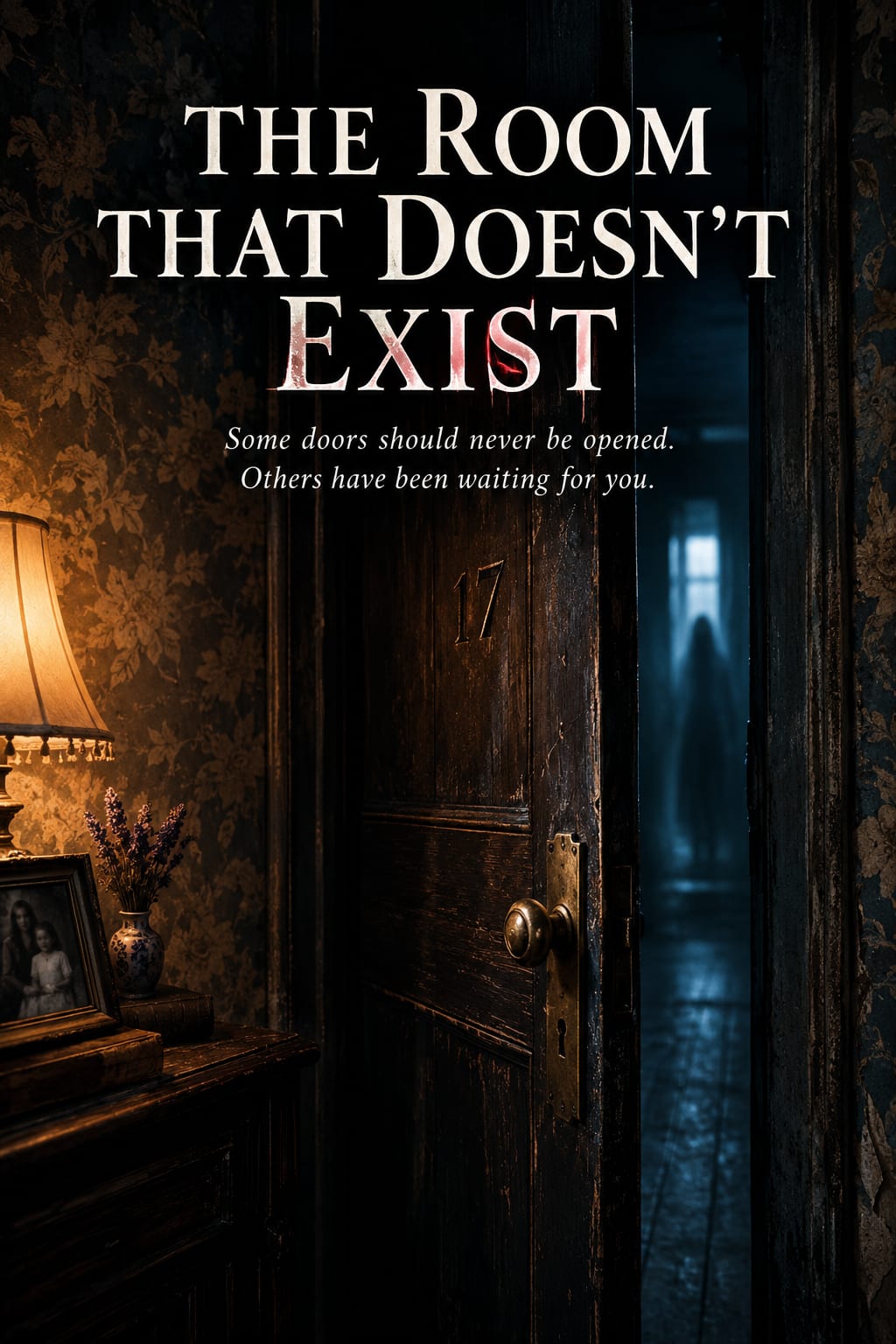
The Room That Doesn't Exist
Some doors should never be opened. Others have been waiting for you.
The first time Eleanor heard the knocking, she thought it was coming from the apartment next door.
Three slow knocks.
Then silence.
She glanced at the clock on the kitchen wall. It was 2:17 a.m.
Rain traced thin lines down the windows of her new apartment, and the old building creaked whenever the wind pressed against its walls. Eleanor had moved in only four days earlier, hoping that a fresh start in London would help her forget the life she had left behind in Manchester.
The apartment was surprisingly cheap for its location. It had high ceilings, tall Victorian windows, and an old fireplace that no longer worked. The wallpaper was faded, the wooden floors groaned beneath her feet, and the corridors smelled faintly of dust and lavender.
Her landlord, an elderly man named Mr. Whitmore, had seemed unusually eager to hand over the keys.
"There is just one thing you should know," he had told her.
Eleanor had looked up from the rental agreement.
"What is it?"
"If you hear noises at night, don't worry. Old buildings have their secrets."
At the time, she had laughed.
Now, sitting alone in her kitchen, she wasn't laughing anymore.
Three more knocks echoed through the apartment.
This time, they came from the bedroom wall.
Eleanor stood slowly and crossed the room. She pressed her ear against the faded cream wallpaper.
Nothing.
Then she heard a woman crying on the other side.
It was a quiet, exhausted sob, as though someone had been crying for a very long time.
"Hello?" Eleanor whispered.
The crying stopped.
For several seconds, there was complete silence.
Then a woman's voice answered.
"Eleanor?"
Her blood ran cold.
Nobody in London knew she was there. She had given her new address to only one person: her younger sister, Sophie.
And the voice behind the wall sounded strangely familiar.
It sounded like her mother.
Her mother had been dead for eleven years.
Eleanor stumbled away from the wall and reached for her phone. She turned on the flashlight and examined the wallpaper, searching for some explanation.
That was when she noticed a thin, dark line running vertically beside the wardrobe.
A doorframe.
It hadn't been there when she went to bed.
She was certain of it.
Slowly, she pulled the wardrobe away from the wall.
Behind it stood a narrow wooden door with a brass handle. The wood was almost black, and someone had carved a small number into its surface.
17.
Eleanor stared at it.
Her apartment number was 16.
She reached for the handle.
It was warm.
From the other side came three familiar knocks.
Then her mother's voice whispered:
"Please, darling. Open the door."
Eleanor closed her eyes.
She remembered that voice singing to her when she was a child. She remembered the smell of her mother's perfume, the warmth of her hand, and the final conversation they had shared in a hospital room.
But she also remembered something else.
The last words her mother had ever spoken to her.
Whatever happens, never open a door you don't remember closing.
Eleanor stepped back.
The handle began to turn by itself.
And from somewhere deep inside the wall, a second voice spoke.
It was Eleanor's own.
"Don't let her out."
By morning, Eleanor had convinced herself that exhaustion and grief were playing tricks on her mind.
She had barely slept. Every time she closed her eyes, she saw the black wooden door and the number carved into it.
At seven o'clock, she called her sister.
Sophie answered sleepily.
"Eleanor? Is everything okay?"
"Do you remember Mum ever talking about a door?"
"What kind of door?"
"A door that shouldn't exist. One hidden inside a wall."
There was a long silence.
Then Sophie laughed nervously.
"You're not going to believe this, but Mum used to tell us a strange story when we were children. She said there were doors in the world that could hear you thinking about them."
Eleanor sat upright.
"What else did she say?"
"I don't remember everything. I was little. But she always told us never to open a door if we heard someone we loved calling from the other side."
A chill ran through Eleanor's body.
"Why didn't you tell me this before?"
"Because I thought it was just a bedtime story!"
Before Eleanor could answer, three knocks sounded from the bedroom.
Sophie heard them through the phone.
"Eleanor? What was that?"
The knocking stopped.
Then a familiar voice drifted through the apartment.
"Girls? It's time to come downstairs."
Sophie began to cry.
It was their mother's voice.
Exactly as they remembered it.
"Where are you?" Sophie whispered.
Eleanor ended the call.
She didn't know what frightened her more: the voice behind the wall or the fact that, for one terrible second, she had wanted to open the door.
That morning, Eleanor went downstairs to find Mr. Whitmore.
The elderly landlord lived in a small apartment filled with antique clocks, old books, and framed photographs. When he opened the door, he looked as though he had been expecting her.
"You've heard it," he said.
It wasn't a question.
Eleanor pushed past him.
"What is apartment seventeen?"
The old man closed the door carefully.
"There is no apartment seventeen."
"I saw the door."
Mr. Whitmore said nothing.
"I heard someone behind it. Someone who knew my name."
He sat down heavily in an armchair.
"Before this building became apartments, it was a private residence. A family lived here in the late nineteenth century. The father was a physician, a man interested in memory, grief, and the workings of the human mind."
"That doesn't explain the door."
"No," he replied. "It doesn't."
He folded his hands.
"The family had a daughter named Margaret. She died when she was seventeen."
Eleanor felt a chill travel down her spine.
"How?"
"Nobody knows for certain. The official records say she died of a fever. But after her death, the family began to report strange things. Knocking in empty rooms. Voices behind walls. People claiming to see relatives who had been dead for years."
"And apartment seventeen?"
"The physician insisted there was a room in the house where the dead could speak to the living."
Eleanor shook her head.
"That's impossible."
"Of course it is."
"Then why are you telling me this?"
"Because every person who has ever claimed to find that door has heard the voice of someone they lost."
Eleanor remembered her mother's voice.
Please, darling. Open the door.
"How do you make it stop?"
Mr. Whitmore looked at her with an expression she couldn't interpret.
"You leave."
"And if I don't?"
He stood and walked toward a cabinet. From a locked drawer, he took out a yellowed envelope.
Inside was an old photograph of a young woman standing in front of a wooden door.
She had dark hair, pale skin, and a small scar beneath her left ear.
Eleanor stared at the photograph.
The woman had her face.
Not a resemblance. Not a similar expression.
Her face.
"Who is she?" Eleanor whispered.
"Margaret Whitmore."
"That's impossible."
"Yes," he replied. "It is."
He turned the photograph over.
On the back, written in faded ink, were seven words.
She returned eleven years after her death.
Eleanor looked up.
"Eleven years?"
Mr. Whitmore's expression became almost unbearably sad.
"Your mother came here once, Eleanor. A long time ago."
The room seemed to tilt.
"My mother never lived in London."
"No. But she visited this building when she was a young woman. She was looking for something."
"What?"
The old man hesitated.
"Her sister."
Eleanor had never known her mother had a sister.
Before she could ask another question, the grandfather clock in the corner began to strike.
One.
Two.
Three.
It continued until it had struck seventeen times.
Mr. Whitmore closed his eyes.
"She's opening it again," he whispered.
"Who?"
He looked directly at Eleanor.
"The woman behind the door."
Eleanor returned to apartment 16 just before noon.
She had intended to leave London. She had even packed a small suitcase. But something about the photograph had changed everything.
Margaret Whitmore had her face.
And her mother had known about the room.
There was a connection between them, a secret that had survived generations.
Eleanor needed to understand it.
She pulled the wardrobe away from the wall.
The door was still there.
Number 17.
She photographed it with her phone, then called Sophie.
"I need you to do something for me."
"What?"
"Go through Mum's old things. Look for letters, photographs, anything connected to her family."
"Eleanor, we should leave this alone."
"I can't."
"Why not?"
"Because I think Mum knew something about this place."
Sophie was silent for a moment.
Then she said, "There is a box in the attic. Mum told me never to throw it away."
"What's inside?"
"I don't know. She never let me open it."
"Please, Soph. Look."
Eleanor ended the call and turned back to the door.
A small piece of paper had appeared beneath it.
She crouched down and pulled it free.
It was a photograph.
The image showed two little girls standing in a garden. One was Eleanor, aged about six. The other was Sophie.
Behind them stood their mother.
Eleanor recognised the dress, the garden, even the old wooden bench.
But there was something wrong.
The photograph had been taken in their childhood home in Manchester, more than two hundred miles away.
And in the background, standing beside the garden gate, was a fourth figure.
A young woman with dark hair and a small scar beneath her left ear.
Margaret.
On the back of the photograph, someone had written a date.
October 17, 2015.
Eleanor's hands began to tremble.
Her mother had died in October 2015.
The photograph was dated the day after her death.
From behind the door came a soft scraping sound.
Then her mother's voice.
"Eleanor, darling. You have to remember."
"Remember what?"
"The promise."
Eleanor closed her eyes.
She was six years old again, standing in a dark hallway while rain battered the windows. Her mother was kneeling in front of her, holding both her hands.
There was a door at the end of the corridor.
A door that didn't belong there.
Her mother was crying.
"If you ever hear me calling from the other side," she whispered, "you must never open it."
Little Eleanor had nodded.
Then she had asked the question that had haunted her dreams ever since.
"What if you're in there?"
Her mother had kissed her forehead.
"Especially then."
The memory vanished.
Eleanor staggered backward.
She had forgotten.
Not because the memory had disappeared naturally, but because someone had made her forget.
And now the door was asking her to remember.
At six that evening, Sophie arrived in London.
She carried a small wooden box and looked as though she hadn't slept.
"I found these in Mum's attic," she said.
Inside the box were letters, several photographs, and a journal bound in dark leather.
The first letter was addressed to their mother.
The signature at the bottom read:
Margaret.
Eleanor opened the journal.
The handwriting was delicate and hurried.
October 12, 1987.
The room appeared again last night. I heard my mother's voice calling from inside. She died three years ago, yet I know it was her.
The doctor says grief can create powerful illusions. He says the mind searches for what it has lost and sometimes invents the impossible.
But I have seen the door. I have touched the handle. And something on the other side touched me back.
Eleanor turned the page.
October 19, 1987.
Margaret has disappeared.
Her family refuses to discuss the room. The doctor has burned every drawing, every note, every record of its existence.
But the door remains.
Sophie sat beside her.
"Who was Margaret?"
Eleanor continued reading.
October 21, 1987.
I have discovered the truth.
Margaret was not the doctor's daughter. She was his sister, born seventeen years after him. When their mother died, the doctor became obsessed with finding a way to speak to her again.
He built a room in which memory could take physical form. At first, the voices were harmless. They repeated familiar words, old conversations, fragments of the past.
Then the room began to ask questions.
It wanted to know what the living remembered.
And it wanted to be remembered in return.
Eleanor felt sick.
The next page contained a single paragraph.
The room does not bring back the dead. It creates something from the grief of the living. It learns their voices, their memories, their secrets. The longer someone listens, the more convincing it becomes.
Eventually, it begins to believe it is the person it imitates.
Sophie grabbed Eleanor's arm.
"We have to go."
But Eleanor was staring at the final entry.
It was dated October 17, 2015.
The day her mother died.
My sister has heard the knocking.
She believes she can save Margaret. She believes that if she opens the door, she will find the little girl we lost.
I have tried to stop her.
If she fails, the room will take her voice.
And one day, it will use that voice to call her daughters home.
The journal slipped from Eleanor's hands.
Her mother had not been talking about a story.
She had been warning them.
A violent knock shook the bedroom wall.
Then another.
And another.
The door handle began to turn.
Sophie backed away.
"Eleanor, we have to leave. Now!"
But Eleanor couldn't move.
From the other side, her mother's voice called again.
"Darling, please. I'm frightened."
Tears filled Eleanor's eyes.
It sounded exactly like her.
Every word, every breath, every tiny hesitation.
Then the voice whispered something that only Eleanor could have known.
"The blue dress you wore on your seventh birthday. You spilled chocolate on it, and I told you that it didn't matter."
Eleanor covered her mouth.
The memory was real.
The room knew it.
And the room was waiting for her to answer.
Sophie seized Eleanor's hand and pulled her toward the front door.
But when they reached the corridor, they stopped.
The hallway had changed.
The staircase was gone.
The front door had disappeared.
In its place stood another wooden door.
Number 17.
Sophie began to sob.
"This isn't possible."
The walls seemed to stretch away into darkness. The faded wallpaper had become covered in photographs: Eleanor as a child, Sophie asleep in her bed, their mother standing outside a hospital room.
Every photograph showed a moment no stranger should have known.
At the far end of the corridor stood a woman.
Their mother.
She wore the pale blue dress Eleanor remembered from the hospital. Her hair was neatly brushed, and her face was calm.
She looked exactly as she had before she became ill.
"Oh, my girls," she whispered.
Sophie took a step forward.
"Mum?"
The woman smiled.
"I've missed you."
Eleanor caught her sister's wrist.
"Don't."
"But it's her!"
"No, it isn't."
Their mother looked hurt.
For a moment, Eleanor almost believed she was wrong.
Then she noticed the woman's reflection in the glass of a framed photograph.
There was no reflection.
Only darkness.
The woman's smile faded.
"Eleanor," she said softly. "You promised you would remember me."
"I do remember you."
"Then open the door."
"I remember what you told me."
The woman's face changed.
The skin around her eyes darkened. Her smile became too wide, stretching beyond the natural shape of her mouth.
"You don't know what you're doing," she hissed.
Eleanor stepped forward.
"You aren't my mother."
The woman screamed.
Every photograph on the wall shattered at once.
Behind the glass, hundreds of voices began to whisper. Some laughed. Some cried. Some begged to be released.
And among them, Eleanor heard her own voice.
"Don't let her out."
She understood now.
The room had been calling her for years, using the voice of someone she loved. It had fed on her grief, gathering memories until it could imitate her mother perfectly.
But it could not understand love.
It could only imitate the words.
Eleanor took Sophie's hand.
"We have to remember what she told us."
Sophie was crying too hard to speak.
Eleanor closed her eyes.
Whatever happens, never open a door you don't remember closing.
Then she remembered something else.
Her mother had never told them to forget the door.
She had told them not to open it.
There was a difference.
Eleanor turned toward the wooden door at the end of the corridor.
The handle was still moving.
Behind it, her mother's voice had become a desperate whisper.
"Please, Eleanor. I'm still here."
Eleanor approached the door.
The wood felt warm beneath her palm, almost alive.
For a moment, she was tempted to open it. To hear her mother's voice without a wall between them. To ask the questions she had carried for eleven years.
But grief was not proof that the dead were waiting behind a door.
And a familiar voice was not the same as a familiar soul.
Eleanor stepped back and took Sophie with her.
Together, they turned away.
The door slammed shut.
A terrible silence followed.
The walls stopped moving.
The photographs disappeared.
And the front door of apartment 16 returned.
They ran.
Neither sister looked back.
By morning, Eleanor and Sophie were sitting in a small café several streets away.
Neither had slept.
They called the police, but when officers arrived at the building, they found nothing unusual. Apartment 16 was exactly as it appeared on the original floor plan.
There was no second door.
No corridor that stretched into darkness.
No apartment seventeen.
Mr. Whitmore had vanished.
His office was empty, the furniture covered in dust, as though nobody had lived there for decades.
The landlord's name did not appear in the building records.
Neither did Margaret Whitmore.
Eleanor and Sophie left London that afternoon.
They didn't speak about the room for several weeks.
Eventually, Eleanor moved to a small flat in another city. Sophie returned to Manchester, where she began sorting through their mother's belongings.
They tried to convince themselves that the experience had been a shared nightmare, a strange reaction to grief and exhaustion.
Life slowly returned to normal.
Then, three months later, a package arrived at Eleanor's apartment.
There was no return address.
Inside was a photograph.
It showed Eleanor and Sophie sitting together in the café on the morning after their escape.
The image had been taken from outside the window.
Eleanor was certain neither of them had noticed anyone taking it.
She turned the photograph over.
On the back, written in familiar handwriting, were five words.
You forgot to close it.
That night, Eleanor pushed her wardrobe against the bedroom wall.
She checked the locks on every door and window.
Then she sat on her bed until dawn, listening to the silence.
At 2:17 a.m., three slow knocks came from inside the wall.
Eleanor did not move.
A woman's voice whispered her name.
She closed her eyes.
The knocking came again.
Then a second voice spoke.
A child's voice.
Her own voice, from eleven years earlier.
"Mummy?"
Eleanor covered her ears.
The voice began to cry.
And somewhere behind the wall, a brass handle slowly turned.
Epilogue: Apartment Seventeen
Years later, a young couple moved into a Victorian building in Bloomsbury.
The rent was surprisingly cheap. The ceilings were high, the windows overlooked a narrow street, and the landlord seemed unusually eager to hand over the keys.
"There is just one thing you should know," he told them.
"If you hear noises at night, don't worry. Old buildings have their secrets."
The young woman laughed.
On their fourth night, at exactly 2:17 a.m., she woke to the sound of three slow knocks.
She followed the sound into the bedroom.
Behind the wardrobe, she discovered a narrow wooden door with a brass handle.
Someone had carved a number into its surface.
The young woman reached for the handle.
From the other side, a voice whispered:
"Please. I've been waiting for you."
And deep inside the wall, another voice began to scream.
"Don't open it."
About the Creator
Enjoyed the story? Support the Creator.
Subscribe for free to receive all their stories in your feed.
Comments
There are no comments for this story
Be the first to respond and start the conversation.