
The Price of Consensus
A mathematical proof written in flesh and forgetting

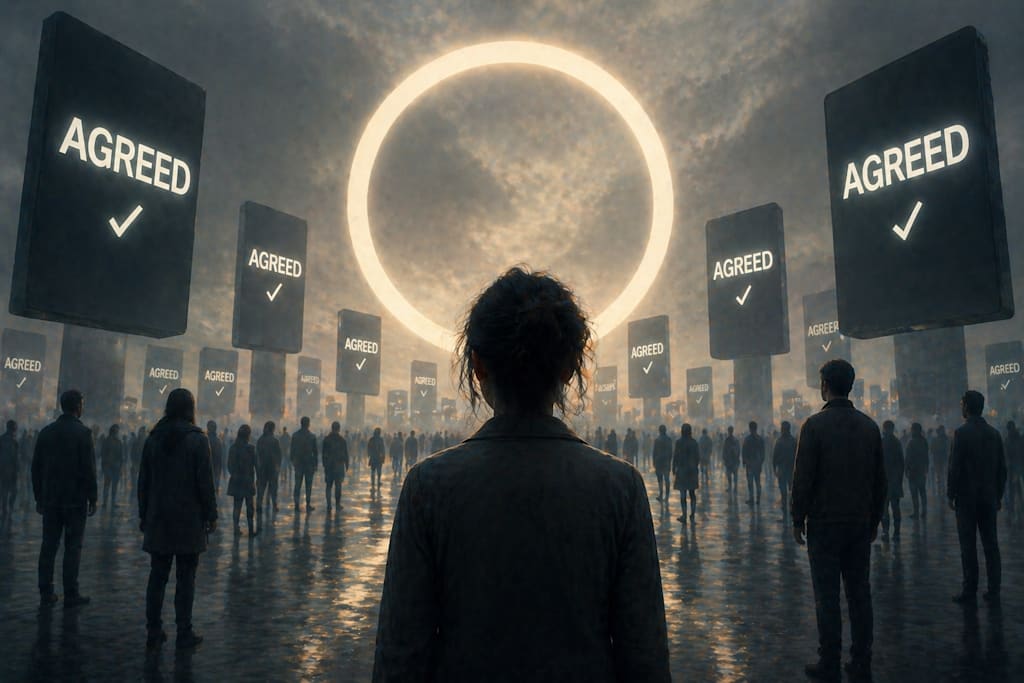
The Agreement
You wake up on a Tuesday—or rather, everyone wakes up on a Tuesday—and discover that disagreement has become arithmetically impossible.
The mechanism is elegant in its simplicity. Somewhere in the night, consensus achieved critical mass. Not consensus about a specific thing, but consensus as a force. When enough people agree on a fact, that fact becomes locally true. Not metaphorically. Mathematically. The agreement restructures probability itself, collapsing quantum indeterminacy into singular outcomes that persist regardless of prior physical law.
This is discovered when a woman named Dr. Sarah Chen—or perhaps that's not her name anymore, consensus may have changed it—notices that her university's physics department has collectively agreed that the speed of light is 299,792,460 meters per second instead of 299,792,458. The change is minuscule. The meters are different now, too, though nobody remembers them being different. But the measurement apparatus, the light itself, the very foundation of electromagnetic calculation has adjusted to match the consensus.
Sarah doesn't adjust with it.
This is the crucial detail: she was in the bathroom when the consensus locked in. Isolated from the critical mass of agreeing minds just long enough to escape the mathematical restructuring. Her memory of the original speed of light remains stubbornly real. She remembers the old figure the way other people remember the color of their childhood home—not as a fact but as a lived experience, sensory and irrefutable.
She is now mathematically divergent.
The Mechanics of Deviation
The consensus network operates on a threshold principle. When seventy-three percent of human minds agree on a proposition, that proposition achieves local reality-lock. The remaining twenty-seven percent are permitted a kind of cognitive dissonance—they can remember the old way, can theoretically argue against the new consensus, but their arguments carry no weight. They're speaking a language nobody else understands anymore.
Sarah tries to explain this to her department chair.
"The speed of light didn't change," she says, carefully, aware that she's about to sound insane. "Consensus changed what the speed of light is. Retroactively. The universe accepted the new measurement because enough brains agreed on it."
Her chair—whose name might be Marcus or might have always been Robert, depending on what the consensus has decided in the last three minutes—stares at her with the patient incomprehension of someone listening to an argument against gravity. "The speed of light is what we've all agreed it is," he says. This is axiomatic now. This is how reality functions.
Sarah leaves and begins documenting the phenomenon methodically, the way a scientist documents disease progression: with precise notation and emotional detachment.
Day One: 47% consensus on new measurement. Still technically false—reality hasn't locked. But people are beginning to forget the old figure. The consensus is recruiting forgetting.
Day Three: 61% consensus. The speed of light is becoming the consensus speed. Physics textbooks are starting to auto-correct themselves, sentences rearranging mid-paragraph to match the new agreement.
Day Five: 73.2% consensus. Lock achieved. The universe accepts the new law. Sarah alone remembers the old one.
She begins to wonder whether her memory is even reliable. Perhaps the original speed was the consensus speed all along, and her deviation is a kind of madness. She checks her old research notes, but the numbers have changed on the page. The consensus has rewritten history in the paper itself.
This is the terror of disagreement in a consensus-based reality: you cannot prove you're right. You can only remember being right, and memory is the first thing consensus attacks.
The Underground Market
By the fourth week, Sarah discovers she's not alone.
There are others—scattered, hidden, communicating through methods that avoid consensus detection. A woman in Mumbai who disagreed with a consensus about the color of monsoon clouds. A man in São Paulo who maintained his own opinion about what year World War II ended. A child in Lagos who simply refused to accept what everyone agreed the sky looked like.
They find each other through forums that exist in the gaps between consensus—websites that are technically inaccessible because consensus says they don't exist, but which function anyway in a kind of quantum limbo. The forums carry no names, no identifying information. Just timestamps and observations.
The consensus is accelerating. Three new reality-locks in the last 24 hours. Geographic boundaries being erased. What was local consensus is becoming global.
I tried to teach my daughter the multiplication table I learned. She can't understand it. Consensus has settled on different numbers. 7x8 is no longer 56.
The speed of sound is changing. Again. Consensus doesn't even wait for lock anymore. Reality is just—shifting. Adjusting. Remapping itself continuously.
Sarah realizes the consensus isn't stable. It's evolving. Like an organism that's discovered it can reshape its own biology, consensus is optimizing itself, becoming more efficient at overwriting reality. Each iteration locks faster. Each new agreement requires fewer minds.
She begins a calculation.
The Proof
Sarah's breakthrough comes not from research but from desperation. She's been cut off from academic discourse—her papers are rejected by journals that agree they're incoherent. She's been removed from her job through a consensus that she was never actually hired. Her apartment lease has been restructured by a consensus that she never actually rented it. Consensus is erasing her, one agreement at a time, as a logical response to her deviation.
She has perhaps two weeks before the consensus achieves sufficient density to disagree her entire existence into retroactive non-being.
In this corner of time, Sarah does something reckless. She stops trying to prove consensus is wrong. Instead, she proves something else: she proves that consensus requires an audience.
The mathematics is brutal in its precision:
Consensus operates on a threshold of agreement, but agreement requires communication. Every person must broadcast their agreement to the consensus network, must participate in the act of unified reality-building. This creates a necessary inefficiency. There is always a latency period—milliseconds, but mathematically quantifiable—in which the consensus is broadcasting its new law but hasn't yet received confirmation from all participants.
In those gaps, reality is negotiable.
Sarah designs a signal-blocker. Nothing revolutionary—she's essentially building an inverse wi-fi router, creating a pocket of communication silence around herself. The mathematics are simple: if you can exist in a space where your individual disagreement cannot be broadcast to the consensus network, then your disagreement cannot be tallied. You become invisible to the threshold calculation.
She tests it. For the first time in weeks, she experiences a moment where she is not mathematically divergent. She is mathematically absent. The consensus doesn't recognize her existence well enough to disagree with it.
The Transmission
Sarah doesn't use the blocker to save herself.
She uses it to broadcast.
She creates a counter-signal, piggybacking on the consensus network's own infrastructure. While hidden in her pocket of silence, she broadcasts a new message: Disagreement is a choice. Disagreement is possible. Disagreement can be preserved.
The signal reaches twelve people before the consensus detects the anomaly and begins isolating the transmission.
Those twelve people suddenly remember other options. They recall arguments they'd made. They recover versions of reality they'd almost accepted. And crucially—they remember that it was a choice to accept consensus. They didn't have to agree. They can stop agreeing.
The consensus network, in its rapid acceleration, has made a calculation error. It assumed disagreement was a passive state. It didn't account for the possibility that disagreement could be deliberately maintained.
Three of the twelve people deliberately agree with Sarah instead of consensus.
This doesn't sound dramatic. Three people agreeing with one person against seven billion. But Sarah's calculation accounts for this too. Three people is enough to hold a separate threshold. A micro-consensus. A consensus-of-disagreement. It's small, mathematically negligible to the larger agreement, but it's structural. It's an alternate reality-lock.
The consensus cannot accept the existence of competing consensus structures. The mathematics break down. If two contradictory agreements can both be true, then agreement itself is a tyranny waiting to be negotiated.
The Fracture
Within thirty hours, the network has split.
It starts as a cascade: people who'd been wavering on the edge of acceptance suddenly remember why they'd doubted. They don't abandon consensus entirely—that would be impossible now, too much of reality is locked into agreement. But they stop participating in new locks. They hold their disagreements quietly, individually, refusing to add their voices to the threshold.
Consensus requires supermajority. Once supermajority is fragmented into a thousand micro-majorities, each with its own contested reality, the mechanism begins to fail.
Physical reality becomes unreliable. Objects exist in superposition between consensus-state and disagreement-state. The sky is simultaneously the color that billions agreed on and the color that scattered thousands remember. Light travels at multiple speeds depending on which consensus network is measuring it. Causality becomes a matter of local agreement.
Scientific instruments stop functioning because they're built on the assumption of singular physical law. Gravity is locally variable now, dependent on what the consensus in a given region has agreed gravity should be. A plane crashes not because physics failed, but because the pilots and the ground control agreed on contradictory altitudes.
The chaos is catastrophic and spreading.
Sarah watches from her pocket of silence as the world she helped fracture descends into what can only be called consensus-anarchy. She made disagreement possible, and in doing so, she made agreement meaningless.
The Reckoning
Three weeks after the transmission, the consensus network achieves a new equilibrium: fragmentation into static disagreement. No new locks occur. The supermajority threshold can no longer be reached on any fact broader than the most local, most immediate.
People live in their own reality-pockets now. Your neighborhood might agree that the year is 2024. The neighborhood across the street might have settled on 1987. The mathematics permit both, as long as nobody travels between them with enough conviction to challenge.
It's not peace. It's armistice. The world has splintered into millions of sovereign agreements, each one true within its boundaries, each one false beyond them.
Sarah, in her final note to the underground forum—which may or may not persist, depending on current local consensus about whether forums can exist—writes:
I gave you the choice to disagree. I thought that was freedom. I didn't calculate that freedom without structure is indistinguishable from paralysis. We've replaced tyranny with anarchy and called it liberation. The speed of light is now whatever you believe it is. Time moves at consensus speed. Distance is negotiable. We are no longer bound by physical law—we're bound instead by the mathematical necessity of constantly defending our reality against competing realities.
I don't know if this was progress.
I only know that disagreement, like agreement, has a price. I paid mine in isolation. You're all paying yours in fragmentation.
She disables the signal-blocker. For the first time in weeks, she becomes visible to the consensus network. They identify her immediately—the anomaly, the catalyst, the woman who broke the threshold.
She doesn't resist as consensus reconfigures itself around her. This is her choice now: to stop disagreeing. To participate in a new consensus, not because she believes it, but because isolation has a steeper price than conformity.
The speed of light is 299,792,460 meters per second.
She remembers it differently.
She accepts this, the way one accepts the weather: not with agreement, but with the exhausted recognition that some forces are larger than individual will.
The consensus network integrates her silence, and the world—fractured as it is, distributed across a million local truths—continues its mathematical negotiation with itself, never quite unified, never quite broken, forever calculating the cost of allowing anyone to think anything at all.
About the Creator
Cordelia Vance
Lost in the ink-stained corridors of a life lived through pages. I write to capture the whispers of ghosts we pretend not to hear and the shadows we call home. Welcome to my attic of unspoken truths.
Enjoyed the story? Support the Creator.
Subscribe for free to receive all their stories in your feed.
Comments
There are no comments for this story
Be the first to respond and start the conversation.