
The Plandemic: A Mandate for All Seasons — Part II
Acts VI, VII, VIII, IX, and Epilogue
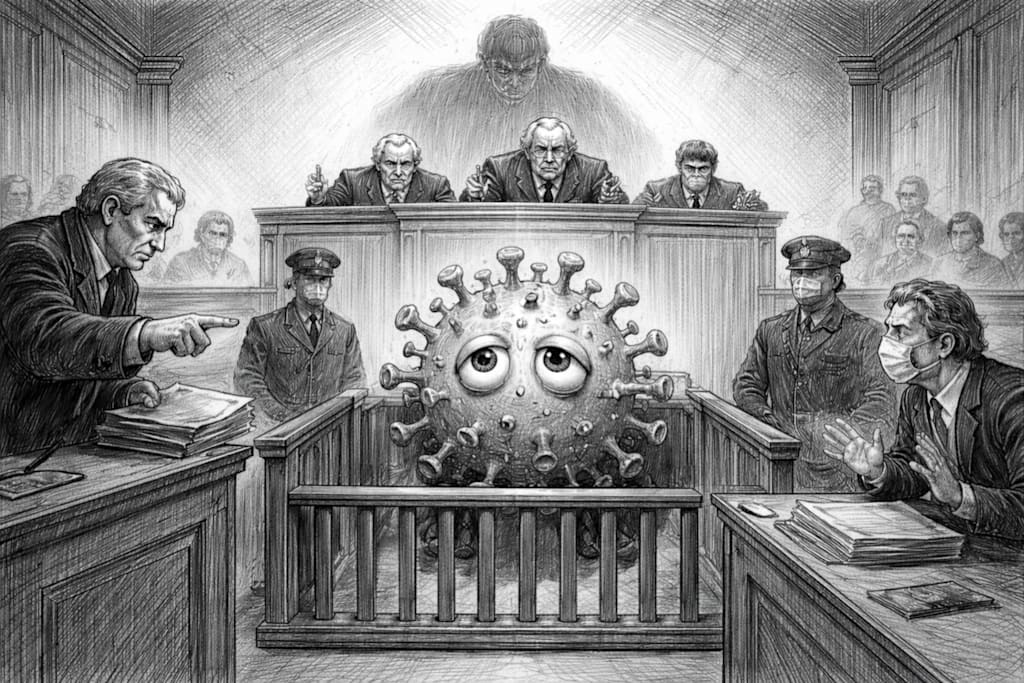
…
ACT VI – Witnesses for the Defense
ACT VII – Cross-Examination of the Absent
ACT VIII – The Reckoning That Did Not Occur
ACT IX – The Closing Address
EPILOGUE – Instructions for the Next Emergency
…
ACT VI – WITNESSES FOR THE DEFENSE
Witness One: Necessity
The bailiff announced the witness without irony.
“Necessity.”
No one laughed. Necessity never inspired laughter. It inspired resignation.
The concept took the stand with perfect composure. Tailored. Economical. Unburdened by doubt.
The Prosecutor did not offer pleasantries.
“State your function,” he said.
Necessity spoke calmly.
“I explain why alternatives are unavailable.”
“Unavailable,” the Prosecutor repeated. “Or merely inconvenient?”
Necessity did not blink.
“In emergencies, distinction collapses.”
The Prosecutor nodded.
“So you claim jurisdiction precisely where scrutiny is weakest.”
A pause.
“I claim inevitability,” Necessity replied.
The Prosecutor circled slowly.
“Let us clarify your résumé. You have appeared at every historical moment where restraint was abandoned. You testified at the suspension of habeas corpus, the internment of populations, the authorization of extraordinary force.”
Necessity inclined its head.
“And history has often vindicated me.”
“History,” the Prosecutor replied, “has buried you – after cleaning up.”
A judge intervened.
“Counsel, confine yourself to relevance.”
“I am,” said the Prosecutor. “This witness asserts inevitability. I intend to test it.”
He turned back.
“You say there was no alternative.”
“Yes.”
“Not fewer alternatives?”
“No.”
“Not unexamined alternatives?”
“No.”
“Not alternatives that threatened timelines, reputations, or authority?”
“No.”
The Prosecutor smiled thinly.
“How efficient. You spare us the nuisance of imagination.”
Necessity stiffened.
“Lives were at stake.”
“Indeed,” the Prosecutor replied. “Which lives?”
A murmur.
“All lives,” Necessity said.
“Ah,” said the Prosecutor. “The universal noun. When everyone is invoked, no one is specified.”
He leaned forward.
“Did you conduct comparative risk analysis?”
“That would have taken time.”
“Did you permit longitudinal uncertainty?”
“That would have undermined confidence.”
“Did you allow dissenting models?”
“That would have fractured unity.”
The Prosecutor straightened.
“So necessity required ignorance, unanimity, and speed.”
Necessity hesitated – just once.
“Necessity required action.”
The Prosecutor struck.
“Action without comparison is not necessity. It is impatience in uniform.”
A judge objected.
“Counsel, you editorialize.”
“No,” the Prosecutor said calmly. “I cross-examine.”
He turned back to the witness.
“Answer me this: at what point does necessity expire?”
Necessity was silent.
“At what metric?”
Silence.
“At what threshold of accumulated contradiction?”
Necessity finally spoke.
“When the emergency ends.”
The Prosecutor laughed – once, softly.
“And who declares that?”
Necessity said nothing.
The Prosecutor nodded.
“No further questions.”
Witness Two: Fear
Fear entered without being sworn. It had never needed an oath.
It took the stand already trembling. Authentic. Contagious. Righteous.
The Prosecutor approached gently, almost kindly.
“You are very powerful,” he said.
Fear nodded.
“I keep people alive.”
“You keep them obedient,” the Prosecutor replied. “Sometimes those overlap.”
Fear bristled.
“I respond to danger.”
“You amplify it,” the Prosecutor corrected. “You are not a sensor. You are a multiplier.”
A judge intervened.
“Fear is natural.”
“So is fire,” said the Prosecutor. “We do not build policy by pouring gasoline on it.”
He leaned closer.
“You were invoked daily, were you not?”
Fear smiled faintly.
“I was featured.”
“Headlines?”
“Yes.”
“Briefings?”
“Yes.”
“Dashboards?”
“Yes.”
“Counterfactual reassurance?”
“No.”
The Prosecutor nodded.
“You were curated.”
Fear grew defensive.
“People needed to understand the stakes.”
“And did you ever inform them of uncertainty?” the Prosecutor asked.
Fear hesitated.
“Uncertainty confuses.”
“Confusion,” said the Prosecutor, “is what happens when adults are treated as children.”
Fear’s voice sharpened.
“You would have had them debate while danger spread.”
“I would have had them informed,” the Prosecutor replied. “There is a difference you find inconvenient.”
He paced.
“You labeled dissent as denial, caution as cruelty, inquiry as threat.”
Fear protested.
“Unity saves lives.”
“Sometimes,” said the Prosecutor. “And sometimes it silences alarms.”
He stopped.
“Tell the Tribunal: how long may fear govern before it ceases to protect and begins to deform?”
Fear said nothing.
The Prosecutor delivered the blow.
“You are a tool, not a ruler. When you sit on the throne, truth flees the court.”
Fear left the stand diminished.
Witness Three: Consensus
Consensus arrived to applause – from itself.
It radiated calm authority, surrounded by footnotes, endorsements, and institutional seals.
The Prosecutor did not sit.
“Consensus,” he said, “you are beloved.”
“I am stability,” Consensus replied. “I am trust.”
“You are,” the Prosecutor said, “agreement after disagreement has been exhausted.”
Consensus smiled.
“Agreement without chaos.”
“Agreement without contest,” the Prosecutor corrected.
He leaned in.
“How did you form?”
“Experts aligned.”
“After debate?”
“After urgency.”
“After replication?”
“After review.”
“After dissent?”
Consensus paused.
“Dissent was… noted.”
“Not answered?”
“It was outweighed.”
“By evidence?”
“By volume.”
The Prosecutor nodded gravely.
“Consensus by tally. A plebiscite of credentials.”
A judge bristled.
“Are you dismissing expertise?”
“I am interrogating unanimity,” the Prosecutor replied. “Expertise argues. Consensus declares.”
He turned back.
“Tell me: when did you last revise yourself?”
Consensus hesitated.
“Revision undermines confidence.”
“Precisely,” said the Prosecutor. “You are allergic to correction.”
Consensus grew stern.
“Without me, institutions fracture.”
“Without fracture,” the Prosecutor replied, “institutions fossilize.”
He paused.
“You were invoked to end debate, not to conclude it.”
Consensus stiffened.
“Debate costs lives.”
“So does error,” the Prosecutor replied. “Which you made structurally invisible.”
He straightened.
“You are not the end of inquiry. You are its obituary.”
Silence fell hard.
The Chair spoke slowly.
“These witnesses have justified much.”
“They have excused everything,” the Prosecutor replied.
He turned to the Tribunal.
“Necessity abolished alternatives. Fear disciplined the public. Consensus sealed the system.”
He lowered his voice.
“Together, they did not merely enable action. They foreclosed reckoning.”
He stepped back.
“No further witnesses for the defense.”
The Chair swallowed.
“Proceed to… whatever remains.”
The Prosecutor nodded.
“What remains,” he said, “is the reckoning that never came.”
ACT VII – CROSS-EXAMINATION OF THE ABSENT
The Prosecutor did not call another witness.
He turned to the Tribunal and spoke as one does when the defense has declined to appear.
“We now cross-examine those who are not present,” he said.
“Not because they were unavailable. But because absence was their strategy.”
He began with the most conspicuous vacancy.
The Absent Party: The Investigator
“No independent investigative body convened with plenary authority,” the Prosecutor said.
“No commission insulated from reputational risk.”
“No tribunal empowered to subpoena, compel testimony, or impose consequence.”
He paused.
“This is not oversight failure. It is oversight design.”
A judge interjected.
“Investigations occurred.”
“Yes,” said the Prosecutor. “Internal ones.”
He continued, methodically.
“When institutions investigate themselves, three outcomes are possible: exoneration by process, diffusion of responsibility, recommendations without enforcement. Notice what is excluded.”
He looked directly at the bench.
“Adjudication.”
He continued.
“No cross-institutional audit with authority over data harmonization.”
“No adversarial testing of official models.”
“No retrospective counterfactual analysis permitted to ask a single dangerous question: What if we were wrong?”
He did not raise his voice.
“In any other domain – aviation, structural engineering, finance – this absence would be criminal negligence.”
He paused.
“In emergency governance, it is praised as stability.”
The Absent Party: The Comparator
“In a trial, one compares,” the Prosecutor said.
“One intervention against another.
One strategy against restraint.
One outcome against non-action.”
He let the sentence end cleanly.
“In this case, comparison was politically radioactive.”
A judge objected.
“Comparisons are difficult across populations.”
“They are difficult,” the Prosecutor agreed. “Which is why they are indispensable.”
He continued.
“No serious institutional effort was made to preserve genuine control groups once deployment reached scale.”
“No protected space for alternative protocols.”
“No tolerance for jurisdictions that declined participation without moral condemnation.”
He looked up.
“Without comparators, correlation masquerades as causation. Without comparators, success becomes tautological.”
He leaned forward.
“We acted, therefore it worked.
It worked, therefore we acted.”
He paused.
“That is not science. That is circular authority.”
The Absent Party: The Stop Rule
“In every honest experiment,” the Prosecutor said, “there exists a stop rule.”
He enumerated.
“If harm exceeds threshold, stop. If efficacy fails to materialize, stop. If signal contradicts premise, stop.”
He looked at the bench.
“Where was the stop rule?”
Silence.
“What magnitude of adverse signal would have paused deployment?”
“What duration of uncertainty would have triggered revision?”
“What evidence would have justified reversal?”
He did not wait.
“None was specified.”
He continued.
“An intervention without a stop rule is not a trial. It is a commitment.”
The Absent Party: Responsibility
The Prosecutor’s voice hardened.
“Who bears responsibility for error?”
He listed possibilities.
“Not the manufacturers. Immunized. Not the regulators. Following guidance. Not the policymakers. Following experts. Not the experts. Responding to emergency. Not the emergency. Emergencies are blameless.”
He stopped.
“Responsibility was not denied. It was atomized.”
He looked directly at the Tribunal.
“When responsibility is everywhere, it is nowhere. When it is nowhere, accountability is impossible.”
He stepped back.
“The defense has rested.”
ACT VIII – THE RECKONING THAT DID NOT OCCUR
The Prosecutor spoke without pause now. This was not presentation. This was summation.
“A reckoning did not occur,” he said, “not because there was nothing to examine but because examination threatened legitimacy.”
He continued.
“Every institution involved faced the same constraint: to investigate fully would be to concede fallibility at scale.”
He did not soften the sentence.
“In modern governance, scale is sacred. Admitting error at scale is treated as systemic suicide.”
A judge objected.
“Public confidence must be preserved.”
“Confidence,” the Prosecutor replied, “that cannot survive truth is fraud by another name.”
He continued.
“No moratorium on mandates pending review.”
“No sunset clauses enforced.”
“No compulsory post-hoc trials with independent funding.”
“No formal apology mechanisms.”
“No reparative framework even discussed.”
He looked at the Tribunal.
“Instead, the world was instructed to move on.”
He delivered the next lines precisely.
“Those harmed were individualized. Those benefited were collectivized. The program remained abstract. The consequences became personal.”
He paused.
“This is how systems avoid reckoning: they privatize harm and socialize justification.”
The room was silent.
“Debate was declared settled.”
“Questions were reframed as fatigue.”
“Skepticism was pathologized.”
“And memory was shortened deliberately.”
He leaned forward.
“The absence of reckoning is not neutral. It is an active choice.”
He continued.
“When no reckoning occurs, three messages are transmitted unmistakably. Future emergencies will receive the same exemptions. Authority will again precede evidence. Accountability will again be deferred indefinitely.”
He let the third point land.
“This is not about the past,” he said.
“It is a rehearsal for the future.”
The Chair spoke quietly.
“What would you have done?”
The Prosecutor did not hesitate.
“I would have separated speed from immunity. Action from absolution. Emergency from permanence.”
He continued.
“I would have built failure into planning rather than deny it afterward.”
“I would have preserved adversarial inquiry as a safeguard, not a threat.”
“And I would have treated consent as a process, not a slogan.”
He straightened.
“Most of all, I would have insisted on reckoning precisely because intentions were claimed to be good.”
He looked directly at the Tribunal.
“Power that claims virtue must submit to judgment. Or it becomes theology.”
Silence.
The Prosecutor gathered nothing. There were no papers left.
“This Tribunal is fictional,” he said. “But the architecture it describes is not.”
He paused.
“And if no reckoning occurs in reality, then fiction will be the only place left where truth is examined without permission.”
He sat.
The Chair did not speak for a long time.
Finally, he said: “Prepare your closing.”
ACT IX – THE CLOSING ADDRESS
The Prosecutor stood for the last time.
There was no flourish. No appeal to conscience. No invocation of shared values. Those devices presume good faith. This address presumed only record, sequence, and consequence.
“Members of the Tribunal,” he began, “this closing does not accuse. It enumerates.”
He paused.
“What follows is not moral outrage. It is procedural clarity.”
He spoke slowly.
“In every historical episode later judged catastrophic, observers search for monsters. They find none. They search for declarations of intent. They find memoranda. They search for villains. They find committees.”
He looked directly at the bench.
“This is not an anomaly. It is the pattern.”
He continued.
“Large-scale harm does not require hatred. It does not require cruelty. It does not require even indifference.”
He paused.
“It requires authorization.”
A pen dropped somewhere. No one moved.
“Authorization,” he said, “is the moment where action becomes permissible and consequence becomes abstract.”
He began to enumerate.
“An intervention was authorized at scale,” he said. “Authorization preceded long-term observation.”
“Authorization was not conditional upon defined stopping criteria.”
He looked up.
“In any system concerned with minimizing harm, authorization is provisional. It is reversible. It is contingent.”
He paused.
“Here, authorization was cumulative. Each day of continuation was treated as evidence of correctness.”
He stated the conclusion plainly.
“When authorization cannot be withdrawn without reputational collapse, it is no longer provisional. It is doctrinal.”
“Deployment occurred at scale,” he continued. “Scale was celebrated as success.”
“Scale was treated as validation.”
He paused.
“In risk analysis, scale amplifies consequence. In propaganda, scale replaces proof.”
He looked directly at the Tribunal.
“No serious containment strategy existed once deployment commenced. No protected minority protocol. No sustained parallel track.”
He stated the inference.
“When scale precedes certainty, uncertainty is multiplied, not reduced.”
“Legal, institutional, and professional immunity was extended,” he said.
“Immunity was justified as necessary for speed.”
He paused.
“In every mature system, immunity is paired with counterweights: independent review, post-hoc liability, compulsory transparency.”
He shook his head once.
“Here, immunity was not paired. It was granted cleanly.”
He let the sentence stand.
“When immunity is total and review is voluntary, error becomes costless to the actor and expensive to the subject.”
“Data collection occurred,” he said. “Reporting mechanisms existed.”
“Dashboards proliferated.”
He paused.
“But adjudication did not occur.”
He leaned forward.
“Data without authority to conclude is not oversight.
It is archiving.”
He continued.
“No single body was empowered to integrate signals across jurisdictions, disciplines, and institutions and to issue binding findings.”
He stated the result.
“When data cannot compel response, it functions as alibi.”
“Consent was invoked,” he said. “Consent was advertised.”
“Consent was celebrated.”
He paused.
“But consent without meaningful alternative is compliance. Consent without exit is submission.”
He continued.
“Mandates expanded while uncertainty persisted. Exemptions narrowed while data matured.”
He looked at the bench.
“When consent is time-limited but obligation is indefinite, consent has been nullified retroactively.”
“Public obedience was demanded,” he said.
“Obedience was moralized.”
“Obedience was rewarded rhetorically.”
He paused.
“Dissent was not debated. It was disqualified.”
He spoke evenly.
“When obedience becomes the metric of virtue, policy ceases to be corrigible.”
“Adverse outcomes occurred,” he said.
“They were individualized.”
“They were depersonalized.”
He paused.
“No collective forum existed in which harms could be aggregated, examined, and weighed against benefits by an authority independent of the program itself.”
He stated the effect.
“Harm was rendered anecdotal by design.”
“Responsibility was everywhere and nowhere,” he said.
“No decision point carried terminal accountability.”
He listed cleanly.
“Designers deferred to regulators. Regulators deferred to experts. Experts deferred to emergency. Emergency deferred to necessity.”
He paused.
“This chain has no end. Therefore it has no fault.”
He looked directly at the Tribunal.
“When responsibility cannot be located, judgment cannot occur. When judgment cannot occur, repetition is guaranteed.”
“Finally,” he said, “memory was shortened.”
He did not raise his voice.
“Debate was declared closed. Language was softened. Questions were reframed as fatigue.”
He paused.
“In every episode later judged intolerable, the final act is always the same: instruction to move on.”
He delivered the sentence flatly.
“Moving on is not healing. It is erasure.”
The Prosecutor stopped enumerating.
He allowed silence, not for effect but because nothing remained to be said in that register.
Then he spoke again.
“This Tribunal will not issue a verdict,” he said.
“It cannot. It is fictional.”
He looked at the bench.
“But history will issue one eventually. History always does.”
He continued.
“When that judgment comes, it will not ask whether intentions were sincere.”
“It will not ask whether fear was justified.”
“It will not ask whether speed was understandable.”
He paused.
“It will ask only whether limits existed. And whether they were enforced.”
He leaned forward.
“If limits existed only rhetorically, history will record that. If review existed only performatively, history will record that. If consent existed only narratively, history will record that.”
He straightened.
“And if no reckoning occurred when it was still possible, history will record that too.”
He concluded with final precision.
“This was not the failure of science. It was the failure of governance under the pretense of science.”
“This was not the corruption of individuals. It was the corruption of process.”
“This was not malevolence. It was permission.”
He stopped.
“There is nothing further.”
The Prosecutor sat.
The Tribunal did not adjourn.
It could not.
It existed only so long as someone was willing to imagine judgment where none had occurred.
EPILOGUE – INSTRUCTIONS FOR THE NEXT EMERGENCY
This is not addressed to judges.
There will be none.
It is addressed to administrators, regulators, advisers, executives, editors, and experts – those who will insist, again, that this time is different.
Read carefully.
When the next emergency arrives, and it will, remember this:
Speed is not absolution.
If speed requires immunity, slow down.
If speed requires silence, stop.
Authorization must be reversible.
If you cannot specify, in advance, the conditions under which you will halt, revise, or withdraw authority, you are not authorizing. You are committing.
Scale is not proof.
If you cite adoption as evidence of correctness, you have abandoned inquiry.
Scale multiplies error faster than it multiplies benefit.
Immunity demands counterweights.
If actors are shielded from consequence, oversight must be adversarial, independent, and empowered to compel change.
Voluntary review is decoration.
Data must be adjudicated.
Dashboards without decision authority are alibis.
Collection without consequence is concealment by excess.
Consent must include exit.
If refusal is punished, consent has been revoked.
If alternatives are forbidden, consent has been simulated.
Dissent is not a threat.
If disagreement destabilizes your policy, your policy is brittle.
Policies that cannot tolerate doubt will not survive truth.
Fear is not a governor.
If fear sets thresholds, those thresholds will drift.
If fear enforces unity, error will entrench.
Responsibility must terminate.
If every decision defers upward or outward, no decision is accountable.
Chains without endpoints are designed to evade judgment.
Memory must be preserved.
If you instruct the public to “move on” before review is complete, you are not protecting stability. You are preparing repetition.
Finally, understand this:
History does not judge intentions.
History judges limits.
It asks whether power was bounded, whether review was real, whether harm was examined without defensiveness, and whether authority submitted to correction.
If you believe your cause is righteous, submit it to scrutiny.
If you believe your actions are necessary, define their end.
If you believe your system is humane, permit it to be judged.
If you do not, others will – later, colder, and without regard for your explanations. And they will not ask why you acted. They will ask why no one stopped you.
That is all.
About the Creator
Enjoyed the story? Support the Creator.
Subscribe for free to receive all their stories in your feed.
Comments
There are no comments for this story
Be the first to respond and start the conversation.