
The Plandemic: A Mandate for All Seasons — Part I
Acts I, II, III, IV, and V
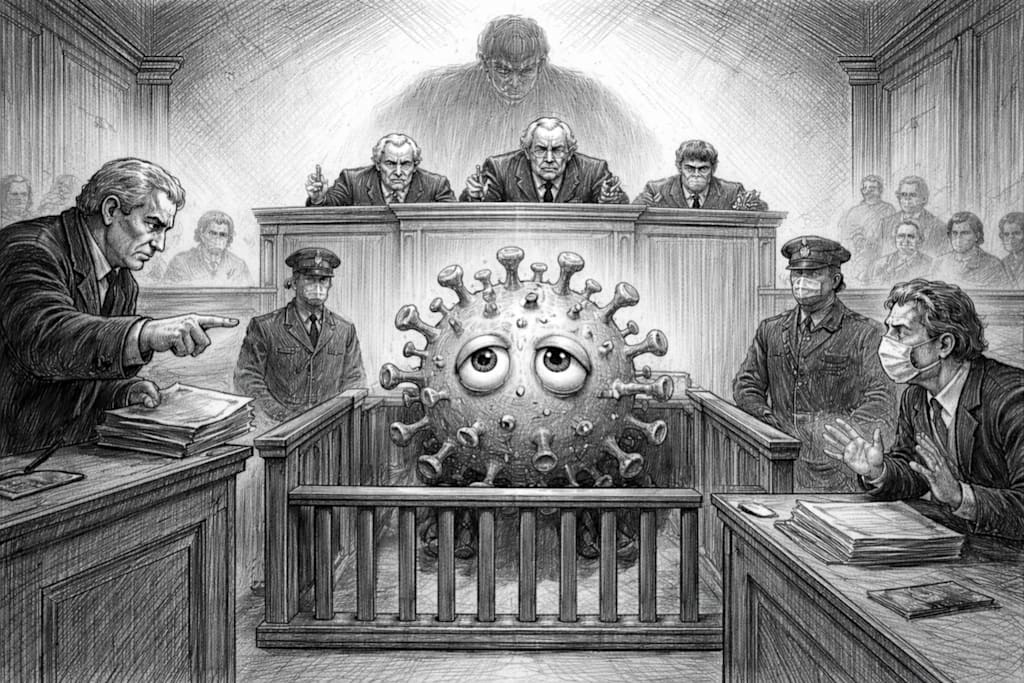
…
ACT I – The Summons
ACT II – The Architecture of Emergency
ACT III – The Alchemy of Incentives
ACT IV – The Trial That Wasn’t
ACT V – The Silence of the Record
…
ACT I – THE SUMMONS
The chamber was neither grand nor modest, neither ancient nor modern.
It was designed, rather, with that deliberate blandness peculiar to institutions that prefer not to be remembered. Pale stone. Flat light. A geometry that discouraged reverence while encouraging compliance.
At the center stood the Tribunal, not elevated, for elevation implies hierarchy, and hierarchy implies responsibility. This Tribunal preferred horizontality. A table without ornament. Chairs without arms. Faces without insignia.
The Prosecutor rose.
He did not strike the gavel. He did not need to. Silence had already been achieved, not by authority but by exhaustion. The kind that follows years of shouting without reply.
“Let the record show,” he began, “that no crime is alleged here.”
A murmur passed through the gallery. Relief, perhaps. Or confusion.
“We do not convene to accuse,” he continued, “but to inquire. And inquiry, as every age eventually learns, is the most dangerous act of all.”
He paced once, slowly, as if measuring the distance between language and consequence.
“This Tribunal has not been summoned to judge men, nor to condemn institutions, nor to pronounce sentence upon history. We are here to ask a narrower question, and therefore a more terrifying one.”
He looked up.
“What happens when speed becomes virtue, when urgency becomes absolution, and when protection from liability is mistaken for protection from error?”
No one spoke.
“History,” he said, “has a habit of forgiving enthusiasm while punishing doubt. This Tribunal exists to reverse that habit, if only in imagination.”
A clerk read the summons, not charges but propositions:
That an Emergency Mandate was declared across much of the world.
That under this mandate, customary safeguards were abbreviated, suspended, or redefined.
That liability shields were granted at scale.
That outcomes were celebrated in advance of observation.
That questions were treated as threats.
“None of these propositions,” the Prosecutor noted, “are controversial. They are, in fact, widely praised.”
He paused.
“The controversy begins only when one asks whether praise is an adequate substitute for reckoning.”
The Tribunal’s Chair, a figure of studied neutrality, cleared his throat.
“Proceed,” he said. “But confine yourself to hypotheticals.”
The Prosecutor smiled thinly.
“Of course. Hypotheticals are the only remaining refuge of free thought.”
He turned to the first imaginary witness, not a person but a concept.
“Let us call our first witness: The Emergency.”
A ripple of discomfort moved through the room. Emergencies, after all, do not like to be questioned. They prefer obedience, not interrogation.
“In ordinary times,” the Prosecutor said, “policy is slow. Evidence is demanded. Trials are run. Errors are catalogued. Responsibility is apportioned. But emergencies,” he gestured broadly, “are impatient creatures. They insist that what cannot be done carefully must be done immediately.”
He leaned forward.
“Now imagine, purely as fiction mind you, that an emergency arose so vast, so amorphous, so psychologically total, that it permitted not merely acceleration, but exemption. Exemption from precedent. Exemption from liability. Exemption from retrospection.”
“In such a world,” he asked, “what incentive remains to discover error?”
The Chair shifted.
“This Tribunal does not presume error,” he said.
“Nor do I,” replied the Prosecutor. “I merely observe that error, like guilt, prefers darkness, not because it is wicked but because it is human.”
He turned to the gallery.
“In our imagined world, the public was told: Speed is safety. To hesitate is to harm. To question is to endanger others.”
He allowed the words to settle.
“Ladies and gentlemen,” he said softly, “this is not the language of medicine. It is the language of war.”
A stir. A note was passed. A stenographer hesitated, then continued.
“And yet,” the Prosecutor went on, “no war was declared. No enemy named with precision. No battlefield demarcated. Only a permanent mobilization of fear.”
He straightened.
“The Tribunal will hear many defenses in the days to come. That there was no choice. That the moment demanded faith. That disagreement would have fractured unity.”
He smiled, almost sadly.
“Every generation that has done something irreversible has said exactly the same thing.”
He returned to his seat.
“Let the Tribunal now consider,” he concluded, “whether the absence of accusation is itself the gravest indictment of all.”
ACT II – THE ARCHITECTURE OF EMERGENCY
The Tribunal reconvened without ceremony. Emergencies, after all, do not like ceremony; it reminds them of rules.
The Prosecutor stood again, this time with papers in hand, unnecessary papers, blank save for headings. They were props, like all documents in an emergency: designed not to inform, but to reassure.
“Members of the Tribunal,” he began, “we now turn to structure. Not motive, not outcome, not consequence, merely structure. For if no one designed the edifice, then no one need be blamed when it collapses.”
He lifted one page.
“Exhibit A: The Emergency Declaration.”
He did not read from it. He did not need to.
“An emergency,” he continued, “is a remarkable thing. It is the only phenomenon in modern governance that expands power while contracting responsibility. It accelerates decision-making while decelerating accountability. It creates omnipotence without authorship.”
He paced.
“In ordinary jurisprudence, haste is suspect. In emergency jurisprudence, haste is sanctified. Delay becomes negligence. Caution becomes cruelty. Prudence is rebranded as sabotage.”
A judge raised an eyebrow.
“Is this not rhetorical exaggeration?” she asked.
“On the contrary,” the Prosecutor replied, “it is rhetorical understatement. In our hypothetical world, the emergency did not merely permit speed; it demanded it. Speed was not a tactic; it was a moral credential.”
He stopped and faced the bench.
“Tell me, Your Honors: when speed itself is treated as evidence of virtue, what becomes of error?”
Silence.
“What becomes,” he pressed, “of those whose profession once consisted of saying, ‘We do not yet know’?”
The Prosecutor consulted his blank page.
“Before the Emergency,” he said, “knowledge was provisional. After the Emergency, it was declarative. Before, policy followed evidence. After, evidence followed policy, dutifully, selectively, and always late.”
A faint ripple of discomfort passed through the room.
“Now,” he said, “let us be precise. The Emergency did not abolish standards. That would have been vulgar. It rebranded them.”
He raised a finger.
Trial became “real-world deployment.”
Observation became “post-implementation learning.”
Harm became “anecdotal.”
Absence of data became “confidence.”
“This,” he said, “was not the destruction of rigor. It was its cosmetic preservation. The rituals remained; only their restraining force was removed.”
The Chair interjected.
“You imply intent.”
“I imply architecture,” the Prosecutor corrected. “Intent is a luxury reserved for memoirs. Architecture operates regardless of intention.”
He turned slightly, adopting the tone of a lecturer addressing inattentive students.
“In our imagined world, the Emergency produced three structural miracles.”
“First,” he said, “concentration without conspiracy. Decisions that once required plural assent were consolidated, not because anyone plotted but because coordination was declared inefficient.”
“Second,” he continued, “authority without ownership. Orders were issued everywhere and authored nowhere. Responsibility was diffused so finely that it evaporated.”
“And third,” he concluded, “obedience without persuasion. Consent was no longer earned. It was assumed. Retroactively.”
The Prosecutor allowed himself a thin smile.
“This is the genius of emergency governance. It does not demand tyranny. It achieves something far more durable: compliance with gratitude.”
He turned to the gallery.
“The public, you see, was not merely commanded. It was thanked. Thanked for sacrifice. Thanked for patience. Thanked for silence.”
He leaned forward.
“And one does not sue those who have thanked one for one’s own protection.”
A clerk coughed. A pen scratched too loudly.
“Let us now consider,” the Prosecutor said, “a principle once so obvious it did not require articulation: that extraordinary measures require extraordinary proof.”
He paused.
“In our fictional Emergency, this principle was inverted. Extraordinary measures were justified by extraordinary fear. Proof was deferred, outsourced, or promised in future revisions.”
A judge spoke.
“Are you suggesting the Emergency was unjustified?”
“Not at all,” the Prosecutor replied. “I am suggesting that justification became irrelevant.”
He gestured toward the ceiling, as though addressing an invisible audience.
“Once an emergency is declared permanent enough, justification becomes a relic. The only remaining question is whether one is with it.”
He resumed pacing.
“And here we encounter the Emergency’s most subtle achievement: it collapsed epistemology into morality.”
“To agree was to be good.
To doubt was to be dangerous.
To ask for data was to ask for delay.
And delay, by definition, killed.”
He stopped.
“In such a climate, truth does not merely lose. It becomes indecent.”
The Chair shifted uneasily.
“This Tribunal,” he said, “must avoid cynicism.”
“Cynicism?” the Prosecutor echoed. “No, Your Honor. Cynicism requires detachment. What we examine here is earnestness, dangerously sincere, impeccably credentialed, earnestness.”
He raised another blank sheet.
“Consider the new catechism of the Emergency:
There is no alternative.
The science is settled.
We will know more later.
Later is too late.
“These propositions are not arguments,” he said. “They are closures.”
A judge interrupted.
“But closures are necessary in crisis.”
“Indeed,” the Prosecutor replied. “Which is why they must be temporary. In our hypothetical world, however, closure became habit.”
He looked directly at the bench.
“When did the Emergency end?”
No one answered.
“Precisely,” he said.
“The Emergency did not conclude; it normalized. It acquired bureaucracies, spokespersons, branding guidelines. It learned to issue updates that never resolved anything.”
He allowed a darker note to enter his voice.
“And most importantly, it learned how to preempt review.”
“How?” asked the Chair.
“By insisting that any future reckoning would itself endanger lives. By declaring that investigation was not merely unhelpful, but immoral.”
He straightened.
“In this way, the Emergency achieved what no despot ever has: it rendered accountability indistinguishable from cruelty.”
The Prosecutor returned to his papers, stacked them neatly, and set them down.
“Members of the Tribunal,” he concluded, “this Act has concerned itself only with form, not content; with process, not outcome; with structure, not guilt.”
He paused.
“But structures decide outcomes long before outcomes are visible.”
He sat.
“And when a structure is designed such that error cannot be named, harm cannot be measured, and responsibility cannot be assigned; then, even benevolence becomes lethal.”
The Chair nodded slowly.
“Proceed,” he said. “Call your next… hypothetical.”
The Prosecutor stood once more.
“Let us call,” he said, “The Incentive.”
ACT III – THE ALCHEMY OF INCENTIVES.
The Tribunal sat.
The Prosecutor rose.
Somewhere, an institution exhaled in relief; this Act concerned incentives, not intentions, and incentives are always safer. They belong to everyone and therefore to no one.
“Members of the Tribunal,” he began, “we now arrive at the most misunderstood subject in public life. Not evil. Not greed. Not even power.”
He smiled faintly.
“Incentives.”
A judge nodded approvingly. Incentives were respectable. They wore spectacles. They attended conferences.
“In our imagined world,” the Prosecutor continued, “no one needed to harbor malevolence. No one needed to wish harm. All that was required was a system so exquisitely calibrated that virtue and self-interest became indistinguishable, and error became unpunishable.”
He raised a single finger, as though lecturing a recalcitrant freshman.
“Let us begin with a small, technical adjustment. One so modest it barely warranted a press release.”
He paused.
“The Suspension of Liability.”
No gasp. No outrage. Liability, after all, is a tedious word. It lacks romance. It inspires no songs.
“Historically,” he went on, “liability served an unfashionable purpose. It connected action to consequence. It discouraged recklessness by attaching cost to error. In short, it reminded professionals that being wrong had a price.”
He glanced toward the bench.
“This was deemed… inefficient.”
A few smiles appeared – tight, knowing smiles.
“In our hypothetical Emergency,” he said, “liability was not abolished. That would have seemed crude. It was waived. Temporarily. Heroically. In the name of urgency.”
He leaned forward.
“And here the alchemy begins.”
He let the silence thicken.
“When liability disappears,” he said, “risk does not. It merely migrates.”
“From whom?” asked a judge.
“From the decision-maker,” replied the Prosecutor, “to the decision-subject.”
He straightened.
“Incentives, you see, are never destroyed. They are redistributed, usually downward.”
A clerk adjusted her headset.
“Now,” the Prosecutor continued, “let us imagine a system in which those who design, authorize, promote, and mandate an intervention bear no downstream responsibility for its consequences.”
He spread his hands.
“Is this corruption?”
“No,” he answered himself. “Corruption requires secrecy. This arrangement was announced proudly.”
“Is it conspiracy?”
“Again, no. Conspiracies require coordination. This required only alignment.”
He allowed himself a knowing dramatic arch of the eyebrow.
“What it is, Members of the Tribunal, is a triumph of modern governance: risk without accountability, authority without exposure, and profit without penalty, all wrapped in the language of salvation.”
The Chair frowned.
“Profit is not before this Tribunal.”
“Nor need it be,” said the Prosecutor. “Profit is merely a witness. Incentive is the defendant.”
He paced slowly.
“In our fictional scenario, institutions were told: Act boldly. You will not be punished for error.”
“Corporations were told: Scale rapidly. You will not be sued.”
“Regulators were told: Approve swiftly. You will not be blamed.”
“And the public,” he said softly, “was told: Comply gratefully. You will be protected.”
He stopped.
“Ladies and gentlemen, this is not a system designed to discover truth. It is a system designed to avoid regret.”
A judge interjected.
“But surely the waiver of liability encouraged innovation.”
“Indeed,” the Prosecutor replied. “Innovation flourishes when failure is costless.”
He let the remark hang, like a guillotine paused mid-drop.
“In ordinary times,” he continued, “innovation is restrained by the dull, bourgeois requirement that one must answer for what one creates.”
“In our imagined Emergency, innovation was liberated from that vulgarity.”
He adopted a mock-solemn tone.
“Be bold. Be fast. Be wrong, if you must. History will understand.”
He glanced around the chamber.
“And history, poor creature, was not consulted.”
The Prosecutor returned to the lectern.
“Let us now consider the incentive to know.”
He tapped the blank page.
“In a system where liability exists, knowledge is protective. One seeks data eagerly, hungrily, even obsessively, because ignorance is expensive.”
He looked up.
“In a system where liability is absent, knowledge becomes dangerous.”
A murmur.
“Dangerous,” he repeated, “because knowledge generates obligation. Obligation generates responsibility. Responsibility invites blame.”
He smiled thinly.
“And blame, in our fictional Emergency, was the only truly prohibited substance.”
A judge leaned forward.
“Are you suggesting deliberate ignorance?”
“I am suggesting,” the Prosecutor replied carefully, “that curiosity was structurally disincentivized.”
He resumed pacing.
“Post-deployment surveillance? Voluntary.
Long-term outcome tracking? Deferred.
Adverse signal aggregation? Fragmented.
Comparative risk analysis? Discouraged.”
He stopped.
“Not because anyone said ‘Do not look’ but because looking served no one.”
The room grew colder.
“Incentives,” he said, “teach without instruction. They educate silently.”
He turned toward the gallery.
“Ask yourselves: in such a system, who benefits from discovering harm?”
No one answered.
“And who benefits from declaring success early?”
Several people shifted.
“Exactly,” he said.
The Prosecutor now allowed the scorn to surface fully.
“This Tribunal must appreciate the elegance of the arrangement. It achieved what tyrants can only dream of: universal participation without universal culpability.”
He leaned forward, voice low.
“Everyone was involved. No one was responsible.”
A judge attempted levity.
“You paint a bleak picture.”
“I paint an accurate one,” the Prosecutor replied. “Bleakness is merely the absence of flattering light.”
He straightened.
“In such a world, celebration becomes a substitute for verification. Press conferences replace audits. Testimonials replace trials. Dissenters are accused not of being wrong, but of being unhelpful.”
He paused.
“And unhelpfulness, as we all know, is the cardinal sin of modern technocracy.”
The Prosecutor gathered his papers.
“Members of the Tribunal,” he concluded, “this witness has not alleged corruption, malice, or intent.”
He looked directly at the bench.
“It has alleged something far more damning: that the system worked exactly as designed.”
He bowed his head slightly.
“When incentives reward speed, punish doubt, immunize error, and sanctify compliance; then outcomes, whatever they may be, are no longer accidents.”
He stepped back.
“They are artifacts.”
The Chair cleared his throat.
“You may proceed.”
The Prosecutor nodded.
“Let us now call,” he said, “The Trial That Wasn’t.”
ACT IV – THE TRIAL THAT WASN’T
The Tribunal resumed under lights that were too bright to be comforting and too dim to be honest. The Prosecutor stood without papers this time. There would be no exhibits. The absence was itself the exhibit.
“Members of the Tribunal,” he began, “we now address a curious species of event: the trial that did not occur.”
He paused.
“Not because it was forbidden. Not because it was impossible. But because it was rendered… impolite.”
A faint stir. Trials were, after all, sacrosanct. Entire civilizations had been built on their sanctity. Evidence, cross-examination, replication, duration. These were not luxuries but disciplines. They were the tedious scaffolding of trust.
“In the era before our fictional Emergency,” he continued, “trial meant something rather specific. It meant duration. It meant comparison. It meant the unpleasant willingness to discover that one’s most cherished hypothesis was incorrect.”
He inclined his head.
“It meant humility.”
A judge interjected.
“Are you suggesting humility was absent?”
“I am suggesting,” the Prosecutor replied, “that humility was reclassified as obstruction.”
He paced.
“Let us imagine, for argument’s sake, that a novel intervention was introduced at unprecedented scale. Let us imagine further that the customary decades of layered inquiry – preclinical modeling, phased testing, longitudinal surveillance – were compressed.”
He looked up.
“Not eliminated, of course. Merely accelerated.”
The word hung in the air like a euphemism waiting to be cross-examined.
“Acceleration,” he said softly, “is a noble word. It suggests efficiency. Momentum. Progress. But acceleration in science has an awkward property: it shortens the interval in which error may reveal itself.”
He allowed a thin smile.
“Nature, regrettably, does not accelerate in sympathy with our funding cycles.”
A few in the gallery suppressed nervous laughter.
“In our imagined world,” he continued, “trial was transformed from a gate into a bridge. Instead of standing between proposal and deployment, it accompanied deployment, running alongside it, breathless.”
He gestured as if indicating a race.
“Phase became overlap. Observation became concurrent. Authorization became provisional yet operational.”
A judge leaned forward.
“But provisional authorization is standard in crisis.”
“Indeed,” the Prosecutor replied. “Provided provisional remains provisional.”
Silence.
“In this fictional account,” he said, “provisional became universal before it became complete.”
He stopped pacing.
“Consider the ancient principle of equipoise, the notion that one proceeds because one genuinely does not know which path is superior.”
He looked at the bench.
“Equipoise requires uncertainty.”
He let the next line land deliberately.
“In our Emergency, uncertainty was intolerable.”
He straightened.
“To admit uncertainty would have been to invite hesitation. Hesitation, we were told, endangered lives. Therefore, uncertainty was not debated. It was dissolved.”
A judge objected.
“You conflate public messaging with scientific deliberation.”
“Do I?” the Prosecutor asked mildly. “In a system where public messaging shapes regulatory posture, and regulatory posture shapes scientific funding, and scientific funding shapes permissible hypotheses, where precisely does messaging end?”
No answer came.
He resumed.
“In our hypothetical, dissenting hypotheses were not refuted; they were deplatformed. Not disproven; deprioritized. The effect was identical but far more civilized.”
He raised an eyebrow in a gesture that might have been borrowed from William Buckley’s drawing room.
“After all, one need not burn books if one can simply bury them in irrelevance.”
The Chair shifted.
“You imply suppression.”
“I imply preference,” said the Prosecutor. “A preference so overwhelming that alternative inquiry withered from lack of oxygen.”
He moved closer to the bench.
“Let us be clinical. Long-term data, by definition, requires long term. In our accelerated world, long term was a luxury. Outcomes were celebrated at ninety days, congratulated at six months, canonized at a year.”
He allowed a darker note.
“But biology is not bound by quarterly reporting.”
The chamber seemed colder now.
“In ordinary times,” he continued, “unexpected signals trigger pause. Pause triggers review. Review triggers adjustment.”
“In our Emergency, unexpected signals triggered reassurance.”
He spread his hands.
“The reassurance was not irrational. It was necessary. Confidence had become policy.”
A judge asked quietly:
“And if signals accumulated?”
The Prosecutor’s gaze did not waver.
“They were contextualized.”
The word drew a murmur.
“Context,” he said, “is the velvet glove of dismissal.”
He walked slowly.
“In this imagined scenario, the apparatus of pharmacovigilance existed. Databases were maintained. Reports were logged. Committees convened.”
He nodded.
“The rituals remained intact.”
He stopped.
“But the interpretive threshold – the point at which accumulation becomes alarm – shifted subtly, then decisively.”
He faced the Tribunal squarely.
“When the success of a program is politically existential, adverse interpretation becomes destabilizing.”
The Chair’s expression hardened.
“You approach accusation.”
“I approach structure,” the Prosecutor replied evenly. “Structures protect themselves.”
He resumed his measured cadence.
“The trial that wasn’t did not vanish in a puff of smoke. It dissolved in applause.”
He let the sentence settle.
“Mass deployment preceded mass understanding. Mandate preceded longitudinal clarity. Celebration preceded audit.”
He looked toward the gallery.
“And when questions arose – earnest, data-driven, sometimes clumsy questions – they were reframed not as scientific inquiry, but as moral threat.”
A thin smile.
“It is remarkable how swiftly epistemology can be conscripted into ethics.”
He turned again to the bench.
“In such a world, the trial becomes theatrical. Its outcome is assumed; its continuation perfunctory.”
He lowered his voice.
“And the public, observing the spectacle, mistakes scale for certainty.”
He stepped back.
“This Act does not allege that trials were fabricated. It alleges something subtler and perhaps more disturbing: that trial was subordinated.”
He allowed a final line to strike with the bluntness of a skilled parliamentarian.
“When deployment becomes the experiment, consent becomes the control group.”
The silence was now absolute.
The Chair spoke carefully.
“You tread near moral condemnation.”
“I tread near simple mathematics,” the Prosecutor replied. “Scale multiplied by uncertainty yields consequence.”
He inclined his head.
“The question before this Tribunal is not whether acceleration was justified. It is whether acceleration, once initiated, could ever permit full reversal.”
He sat.
“And whether any system so invested in its own success can ever admit that its trial remains unfinished.”
The Chair swallowed.
“Proceed.”
The Prosecutor stood again.
“Let us now call,” he said, “The Record.”
ACT V – THE SILENCE OF THE RECORD
There are many kinds of silence. The silence of ignorance. The silence of censorship. And the most modern silence of all: the silence of overwhelming data that refuses to cohere.
“Members of the Tribunal,” the Prosecutor began, “we now consider the Record.”
He held up an invisible ledger.
“In theory, the Record is incorruptible. It contains entries, timestamps, reports, revisions. It is the bureaucratic memory of civilization.”
He tilted his head.
“In practice, the Record is only as courageous as those who interpret it.”
He paced slowly.
“In our imagined world, data was abundant. Dashboards glowed. Graphs updated in real time. Metrics were tweeted.”
A slight, razor-edged smile.
“The spectacle of transparency was dazzling.”
He stopped.
“And yet transparency without synthesis is camouflage.”
A judge leaned forward.
“You claim concealment?”
“I claim fragmentation,” he replied. “A thousand databases speaking at once, none authorized to conclude.”
He continued.
“Adverse reports were logged, but categorized. Categories were defined, but adjusted. Thresholds were established, but revised.”
He looked up.
“The Record was never falsified. It was contextualized into paralysis.”
The word echoed faintly.
“In such a system,” he said, “no signal is decisive. Every anomaly is provisional. Every excess is attributable elsewhere.”
He leaned forward.
“And excess mortality, should it appear, becomes a statistical Rorschach test.”
A judge stiffened.
“You imply manipulation of mortality data.”
“I imply interpretive elasticity,” he replied coolly. “Elasticity that stretches until meaning snaps.”
He resumed pacing.
“In ordinary public health practice, unexpected mortality triggers inquiry. Inquiry triggers transparency. Transparency triggers trust.”
“In our Emergency, unexpected mortality triggered caution. Caution about interpretation.”
He paused.
“Caution, notably, about interpretation, not about deployment.”
The chamber felt smaller now.
“The Record,” he said, “became a hall of mirrors. Each institution reflected the other. Each deferred to consensus. Each cited alignment.”
He allowed the satire to cut cleanly:
“And consensus, as every bureaucrat knows, is that condition in which no one wishes to be first.”
He faced the bench squarely.
“When institutions investigate themselves, investigation becomes choreography.”
He lowered his voice.
“Review panels were assembled. Reports were issued. Summaries were executive.”
A razor-thin smile.
“The executive summary, Members of the Tribunal, is the most efficient instrument ever devised for converting complexity into reassurance.”
He stopped moving.
“In this fictional narrative, those who demanded raw data were told it was misunderstood. Those who analyzed it differently were told they lacked context. Those who persisted were told they lacked compassion.”
He let the irony sharpen.
“And compassion, once weaponized, is invincible.”
The Chair spoke softly.
“You are constructing a world in which error cannot surface.”
“I am constructing,” said the Prosecutor, “a world in which error surfaces but cannot stabilize.”
He gathered himself.
“The silence of the Record is not the absence of numbers. It is the absence of adjudication.”
He looked around the chamber.
“No independent tribunal. No cross-institutional audit with authority. No retrospective commission unconcerned with reputation.”
He allowed the final blow.
“When every institution’s credibility depends upon the same narrative, revision becomes existential.”
The silence was no longer discomfort; it was recognition.
The Prosecutor inclined his head.
“This Tribunal exists only in fiction,” he said quietly. “But if it did not, even in imagination, who would hear the Record speak?”
He returned to his seat.
The Chair took a long breath.
“Call your next witness.”
The Prosecutor rose once more.
“Very well,” he said.
“Let us call Necessity.”
About the Creator
Enjoyed the story? Support the Creator.
Subscribe for free to receive all their stories in your feed.
Comments
There are no comments for this story
Be the first to respond and start the conversation.