
The Place You Were Never Supposed to Be
Some places leave before you do

“This is not where you are supposed to be.”
But you are already here.
You are almost eight.
It is summer.
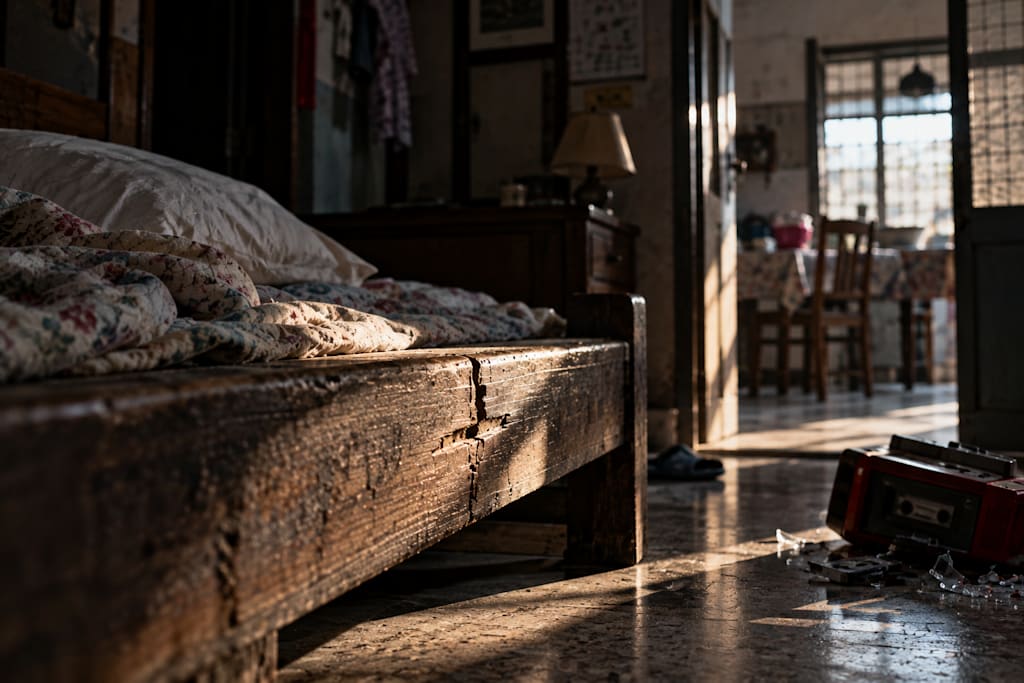
You are sleeping on the large wooden bed you share with your grandmother in a military dependents’ village when a sudden shout wakes you.
Fear is not unfamiliar to you.
What frightens you most is that you are already used to it.
You have heard arguments before.
You already know how to keep yourself still when voices begin to sound dangerous.
Then you hear the words:
“I’ll kill you first, then myself!”
Your grandfather drives a kitchen knife into the wooden bedframe.
Fifteen centimeters from where you are lying.
You open your eyes wide.
Your face stays calm.
But inside, panic is already spreading.
You watch your grandmother run through the door.
The door of the place everyone calls home.
Outside, the entire neighborhood is buried beneath the summer heat.
Strangely quiet.
Everyone knows what has happened.
No one comes inside.
You tell yourself it was only a dream.
Children do that when the truth is too large.
You tell yourself that once you wake up, everything will be fine.
You don't know how much time passes.
Then the day begins to look normal again.
Your grandfather comes home from the market.
Your grandmother stands in the kitchen preparing dinner.
Everything looks ordinary.
But one question keeps circling inside you:
What happened a few hours ago?
You cannot answer.
The fear is still there.
Then another voice reaches your ears.
“You can't do anything.”
You stand against the wall, trying not to cry.
Your grandmother's hand is still bleeding.
Your aunt is holding her.
The words came from your grandmother.
You stare at what is happening.
As if you are watching a television drama.
As if you are looking at a slideshow about domestic violence.
Anything is easier than admitting that this is your home.
Then another scene returns.
The first slide.
It is after dinner.
Night has already settled over the house.
Your grandmother and your father are arguing through a wall.
You hear hurried footsteps coming from the other room.
Your father appears in the living room.
A red cassette recorder is in his hand.
Then everything happens too quickly.
He throws the red cassette recorder at your grandmother.
The sound of breaking plastic replaces the sound you cannot make.
Your aunt rushes between them.
Your father leaves the room in anger.
Your aunt holds your grandmother.
Her hand is bleeding.
Her tears do not stop.
And you stand there.
Small enough to disappear.
Yet old enough to remember all of it.
You do not understand the conflict.
You only know that you are being forced to choose a side.
And everyone is your family.
That is what makes this place dangerous.
You cannot escape.
Whichever side you leave, you feel as though you have betrayed someone.
You grow up in a place where refusing to choose a side becomes another reason to blame you.
When someone needs you, they call you family.
When they no longer need you, they forget you.
Later, the past is brought back to you like evidence.
Every mistake becomes a record.
Every silence becomes a weapon.
Every attempt to protect yourself becomes selfishness.
And somewhere inside all of this, everyone forgets the simplest thing.
You are a child.
A child who lost a mother at five.
A child with no one standing between you and the adults who were supposed to protect you.
A child who learns too early that the word family does not always mean safety.
But you are also a person.
You look around at the familiar faces.
The familiar names.
The familiar titles.
Grandfather.
Grandmother.
Father.
Aunt.
Words that are supposed to tell you where you belong.
But you no longer know what they mean.
You know every corner of the house.
The wooden bed.
The walls.
The doorway.
The kitchen.
The place where the red cassette recorder broke.
You know where the arguments begin.
You know where the footsteps stop.
You know where your grandmother runs.
You know where you stand.
Against the wall.
Always against the wall.
Then you understand something.
You have been standing there for years.
Not inside that house.
Not exactly.
Somewhere inside yourself.
You are still eight.
Still waiting for someone to tell you that none of this was your fault.
Still waiting for someone to tell you that you did not have to choose.
Still waiting for someone to remember—
a child should never have to understand an adult's violence.
You look at the wooden bed.
The mark from the knife is still there.
You reach toward it.
Your fingers stop before touching the wood.
Fifteen centimeters.
That is all.
You hear the shouting again.
You close your eyes.
For a moment, you think you are back there.
But you are not going back.
You never left.
The house is gone.
The summer is long over.
But the child standing against the wall is still there.
You look at him.
He looks back at you.
You want to tell him:
This is not your fault.
You do not have to choose.
You were only a child.
But he does not answer.
He simply stays against the wall.
So you stay too.
For the first time,
someone stays with him.
You look once more at the mark on the bedframe.
And finally, you understand—
you were never supposed to be there.
Never.
You were only a child.
And you,
were also a person.
About the Creator
Alix
Featured Author at Spillwords Press | Literary storyteller exploring memory, silence, and the spaces between people.
Enjoyed the story? Support the Creator.
Subscribe for free to receive all their stories in your feed.
Comments
There are no comments for this story
Be the first to respond and start the conversation.