
The Only Player of All Worlds
Ethan Knight counted every person who looked down on him. Then the system started counting him.
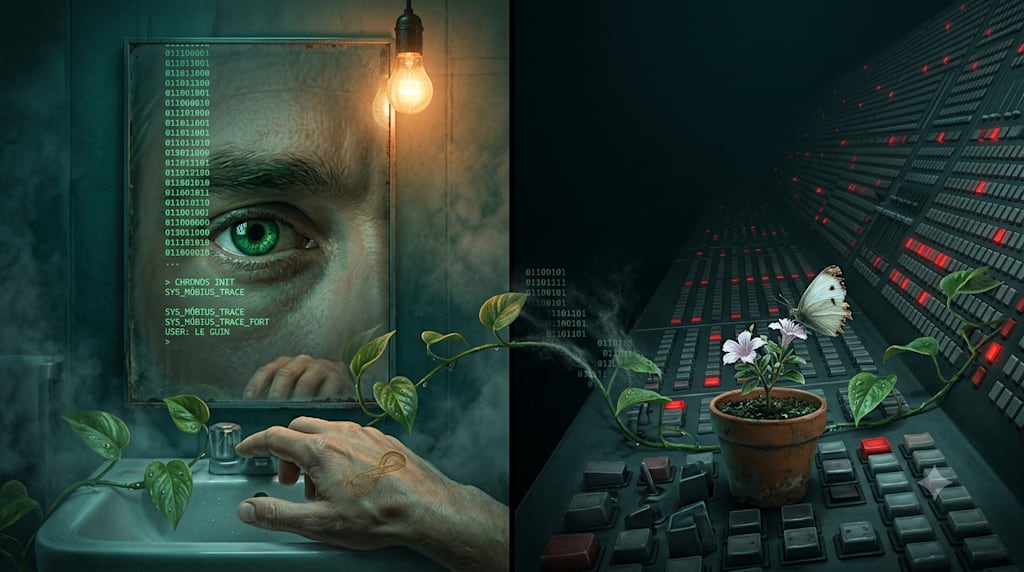
Volume I: The Wastrel's Awakening
Chapter 1: Bubbles
At the celebration banquet, project manager Valerie's laser pointer cut through three rows of heads and stopped on Ethan's forehead.
"Over-budget approver: Ethan Knight."
The red bar on the bar chart was taller than everyone else's. The number had been shrunk so it wouldn't burst out of the table's border.
Brian Howard sat across the round table. His knife and fork lay horizontally across his plate, pointing at ten and four o'clock — his father had taught him how to place them. He wiped the corner of his mouth with his napkin.
"Valerie, I interviewed three people for that position," Brian said, not looking at Ethan. "All of them had one more skill than him."
Ethan held his beer glass. Condensation beaded on the glass, and foam formed a white ring at the bottom. He counted the bubbles: seven rose from the bottom at the same time, three burst against the rim, four vanished into the surface.
Intern Susan sat beside him. She moved her chair five centimeters to the left. The iron chair leg made a very soft sound against the marble floor, soft enough that only Ethan could hear. He'd been waiting for her to move it.
He didn't speak. He had Valerie's three first-class flight reimbursement forms saved on his phone. The client names on the itinerary didn't match the actual contracting parties. He'd dug up the data at 3:41 AM the night before last. He didn't bring it out because no one asked.
He finished his beer. After the foam dispersed, there was nothing at the bottom of the glass.
Queens. The end of the subway line, then one more bus. The rented apartment was on a street where half the streetlights were broken.
Ethan pushed open the bathroom door. He turned the faucet to full, let cold water run for three minutes, then looked up at the mirror. Bloodshot pupils, three more veins in the right eye than the left.
Then the characters began to appear.
Not on the surface of the mirror. In his eyes. Line by line, monospaced font, the color of phosphor green on an old CRT monitor.
Omniverse Player Protocol v.7.8.4
Binding eligibility detected: Critical mass of world underlying rule loopholes accumulated
Loophole count: 147,829,331
Accept becoming the Only Player? [Y/N]
He closed his eyes. The characters were still there. Opened them. A progress bar appeared in the lower left of his vision, translucent, green, loading.
At 7%, he walked two circles around the room. At 13%, he noticed his iris pattern in the mirror was reorganizing, like 1.4 million fiber optic cables being connected simultaneously.
"Yes," he said to the mirror.
No voice answered. The web between his left thumb and forefinger itched. Something moved beneath the skin, then stilled. A faint golden mark shaped like half a Möbius strip appeared.
Three small lines emerged in the upper right of his vision:
Novice task triggered
Objective: Shut up everyone who looks down on you
Completion reward: Basic body enhancement | $1,000,000 cash | Skill [Eye of Insight]
The mattress springs creaked seven times. He lay down, placed his phone face down on the nightstand, and slept.
Chapter 2: The Spacebar
8:30 AM. Receptionist Jenny was wiping her keyboard with alcohol wipes, didn't look up.
Ethan walked to his workstation. The cubicle partition was 1.2 meters high. Standing up, he could see everyone's heads. The computer booted, the Windows icon spun twenty-seven times.
"Ethan."
Mike's voice. Mike was the department head, his office at the end of the hallway, with a door. The frosted glass on the door was etched with his full name plus MBA.
He threw a document at Ethan. It hit the keyboard. The spacebar popped off, bounced twice on the desk.
"Redo it. Wrong format."
Mike turned.
"Mike."
His left foot was already out, stopped mid-air, because Ethan hadn't called him "Director Mike."
Ethan picked up the spacebar and pressed it back into the keyboard. The plastic snapping sound was soft.
"You transferred $47,000 from the company procurement card to 'Carter Industries' yesterday at 3:12 PM. Carter Industries' registered address is in Miami, the same building number as your wife Laura's yoga studio. The bank receipt is in my phone. Shall I forward it to the board?"
Jenny's alcohol wipe stopped. Gray dust clung between the wipe and the keyboard, three centimeters from the keys.
Marcus, in the corner workstation, took off his headphones. The leaking drumbeat was paused.
Mike's Adam's apple moved.
Ethan placed the document on his left side, aligned with yesterday's documents. Then he opened Excel and continued the spreadsheet he hadn't finished last week.
Mike stood for four seconds, then walked back to his office. The silhouette on the frosted glass blurred for a second.
Task progress: 1/147.
At 9:47, the air conditioning vent started dripping. Water dripped on his cubicle partition. He listened to thirty-two drops, then stood up to get a mop.
Walking to the breakroom door, his phone vibrated. A message from Brian Howard: "7 PM tonight. Manhattan Yacht Club. Class reunion. The position you applied for back then — my intern is handling it now. Come by if you're free."
He stared at it for three seconds, then put the phone back in his pocket, picked up the mop, and wiped the floor clean. When he wrung out the mop, the water was gray.
Chapters 3–5: Eye of Insight
The skill activated without ceremony. Ethan just looked a little longer.
After the morning meeting, finance director Claudia walked past his workstation. Black suit, the buttons of her cuffs done up to the very top. She nodded at Ethan, the kind of nod that didn't plan to stop.
Ethan watched her for three seconds longer.
A line of data surfaced in the upper right of his vision:
Target: Claudia Weaver
Violation type: Travel expense misappropriation
Time: Most recent — last Thursday 2:07 PM
Amount: $3,420
Recipient: Private travel agent (non-contracted vendor)
Evidence path: HR reimbursement system → Q4 Batch 6 → Attachment PDF page 3
He shifted his gaze back to his computer screen. Said nothing.
That afternoon, Claudia came over voluntarily to ask his opinion on the new report format. Her tone was better than any time before. He didn't answer her question about the report, just looked up at her, the same length of time as always. Claudia's knuckles whitened around her coffee cup.
Marketing director Victor was harder. A man who always draped his suit jacket over his chair instead of wearing it, liked to lean against the window during meetings, framing himself with the Manhattan skyline. He'd been with the company for nine years, produced six regional managers. Board members called him "Vic."
Ethan stared at the back of his head for three seconds.
Target: Victor Collins
Violation type: Client resource diversion
Affiliated entity: Oasis Consulting (37% ownership)
Company clients signed via Oasis Consulting in past two years: 11
Of which 6 were originally company A-tier client pool
Note: Oasis Consulting registered address is ex-wife's property
That day Victor walked past him in the hallway. Victor said, "Ethan, you're looking well lately." Ethan said, "Thanks," and kept walking. After seven steps, he heard Victor stop. He didn't look back.
He threatened no one. He just looked for a few seconds, then looked away. The people themselves couldn't sit still — like being touched on the shoulder by a finger in the dark, the person who touched said nothing, the person touched couldn't sleep all night.
Chapters 6–8: Silent Efficiency
The first to resign was Alan from Procurement. Submitted his resignation letter Friday afternoon, didn't show Monday. Reason: "personal reasons."
Second was Claudia. The day she handed in her resignation, she ran into Ethan in the breakroom. The coffee machine was brewing its second cup. She stood behind him, waiting for him to finish. "You want sugar?" Ethan asked. She shook her head. He walked out with his black coffee. The glass door reflected her silhouette — her mouth opened twice, nothing came out.
By the end of the second week, six mid-level managers had submitted resignations.
Valerie called Ethan into her office, the first time she'd called him in alone. The office had floor-to-ceiling windows, blinds half-drawn. Light struck the desk like bars.
The door closed with a soft sound.
"Ethan." Her hands were folded on the desk, nails freshly done. "What are you doing?"
Ethan looked at the data floating above her head: last November, falsified project expenses, $130,000. The recipient's address was in Miami, just one block from the address Mike used. Same business park, different unit number. Valerie and Mike had taken three months to learn to use the same shell company. The system noted: "No direct link."
"Nothing," he said. Then he stood up, pulled the door open, and walked out.
In the hallway, Marcus was passing by with a cup of instant noodles. Seeing Ethan come out, he nearly dropped it. Ethan steadied it for him.
That night, Ethan returned to the rented apartment and closed the door. His suit hung on a sticky hook. The hook was crooked; the suit slid to the floor. He didn't pick it up.
After a shower, he sat on the edge of the bed. His phone lit up three times — the work group was discussing the sixth person to resign. He didn't click.
He placed his phone face down on the nightstand.
Before falling asleep, the number in the lower left of his vision flickered once: task progress silently accumulating from the silent observing. He didn't count.
Chapter 9: Brian's Invitation
The text came at 2:14 PM.
Brian Howard: "7 PM tonight. Manhattan Yacht Club. Class reunion. The position you applied for back then — my intern is handling it now. Come by if you're free."
Ethan stared at the screen. The screen auto-dimmed, he lit it. Dimmed again, lit again. The third time it dimmed, he put the phone down and opened his laptop.
Howard Industries. Parent company registered in Delaware, actual operations in New York. Old Howard — Brian's father — held 71.3% equity. Another 18% was scattered among three small shareholders. The remaining 10.7% was an employee options pool that had never been exercised.
He glanced at the system check-in page. Today had auto-checked in. The reward lay in his inventory: cash balance sufficient to initiate leverage. Investment analysis ability had passively activated — when his eyes swept across Howard Industries' financial reports, certain numbers automatically turned red, certain turned green. Red was a crack, green was a fulcrum he could pry.
The 18% small shareholders: one was going through a divorce, needed cash for alimony; one had pledged shares to a bank, the pledge ratio already at the margin call line; one was 73, his son didn't want to take over.
Three hours. All negotiated.
Brian's father's equity still needed to go through procedures; tax loopholes would help with that. Ethan saved the documents to his phone, folder named "7."
He stood up, took out a suit from the wardrobe. Dark gray, bought two years ago at Macy's on sale. A small coffee stain on the cuff that wouldn't wash out. He put it on, tied his tie in front of the mirror. Tied it twice — first time too tight, second too loose, third just right.
The person in the mirror no longer had bloodshot pupils. A faint gold ring bordered the iris, paler than the mark on his hand. He wasn't sure when it had appeared.
The Yacht Club was on Manhattan's West Side. When Ethan arrived, the setting sun over the Hudson was just falling into the water, the color of diluted orange juice.
The doorman looked at his invitation, then at him.
"Class reunion's on the third floor," the doorman said. "Elevator on the right."
"Thanks."
There was a mirror in the elevator. He saw himself again. His ears plugged slightly as the elevator rose. He swallowed. The doors opened. The crowd in suits and formal wear was at the end of the hallway. Laughter layered like triple-track reverb.
Chapter 10: The Yacht Club
A long table. Snow-white tablecloth. Twelve place settings, three glasses beside each — champagne, red wine, water — arranged by order of use. Brian sat by the window, the Hudson and the lights of the opposite shore behind him.
When Ethan entered, some looked up, some didn't. Brian nodded at him, a very small movement, just enough to count as a greeting.
Ethan sat near the door. The water glass in front of him had ice cubes, slowly melting. He watched the edges of the cubes round for a while.
"— so I'm saying, the most important thing in investing is pedigree. Which family you're born into determines what kind of deals you get to see."
The speaker was Andrew, Brian's next-door dorm neighbor in college, family in real estate brokerage. Now he worked as an investment manager at Brian's company.
"Brian took me to see Howard Industries' M&A case last month," Andrew continued. "The due diligence report alone was two hundred pages. That kind of deal — ordinary people can't even get a photocopy."
Brian smiled. Not looking at Ethan, but everyone knew who those words were aimed at.
He placed his car keys on the table. The Porsche crest logo faced up. The ice cube in the whisky glass beside it trembled.
"Speaking of Howard Industries," Brian pressed his napkin to the corner of his mouth, "my dad just completed the acquisition last month. Increased to absolute control."
Ethan reached inside his suit jacket.
The movement was unhurried, natural as pulling out a wallet. He drew out a folded sheet of A4 paper and placed it on the table. He didn't hand it over, didn't push it. He just laid it there, then unfolded it. The page slid smoothly across the tablecloth, wiping a bit of reflection off the Porsche crest on Brian's keys.
"Howard Industries was acquired by me three hours ago."
Ethan said this without lifting his fingers from the paper.
"Your father's equity is now under my name. The 18% small shareholders' shares have all been fully transferred. Combined, absolute control is mine."
Brian took the paper.
He read it once. Looked up, then read it again. Looked down again.
His thumb pressed against the bottom edge of the paper. The nail turned white.
Seven people at the table. Six simultaneously picked up their phones.
Ethan didn't move. He didn't stand up and declare victory, didn't slam the table, didn't throw red wine in Brian's face. He simply left the paper in Brian's hand, then stood up.
"The position done by an intern, keep it for yourself."
On his way out, he glanced back.
Brian still held the paper, thumb still in the same spot. The nail bed was entirely white.
Ethan walked out of the Yacht Club. In the foyer, a chair stood alone on the red carpet, its metal feet pressing four shallow dents into the pile. Beside the chair, at the edge of the carpet, lay a dead moth, wings still intact, body already dried.
The wind blew from the Hudson, carrying the mixed scent of river water and diesel. He stood on the steps and buttoned a button, then descended. Seventeen steps. He counted every one.
Chapters 11–30: Knight Group
The system began rewarding skills regularly — not the kind that turned someone into a billionaire overnight, but just enough.
Investment intuition was like having someone who never lost focus reading financial reports for him. Business knowledge loaded fast enough to digest in one week the M&A case studies that would take others three years. The black-tech blueprint rewards were the strangest: not complete technical solutions, but half-finished ideas — a battery formulation improving energy density by 12%, a logistics algorithm optimized to save 7% on transportation costs — always just half a step ahead of the current market, just enough to avoid suspicion about the source.
Ethan registered a company, named it "Knight Group." Registered address on the fourth floor of an old building in Lower Manhattan. The elevator required manually pulling an iron gate.
First deal: reverse-acquiring businesses using the loopholes discovered by Eye of Insight. Mike's shell company supplier "Carter Industries" had three supply chain vulnerabilities behind it. He turned the loopholes into acquisition targets. Within three months he'd taken over seven small suppliers, restructured them into a new division.
The company grew from 1 person to 12 to 47.
He rented a corner office with a window. On the windowsill he placed a pothos. The receptionist girl, Amy, watered it every day. The pothos died once — leaves yellowing from the edges, then the stem softening. By the time Ethan noticed, it was beyond saving. After work, he went to the flower shop on the corner and bought a new one, put it in the same spot. The next day, Amy watered it just as usual, didn't notice any difference.
Amy was twenty-three. Brown curly hair, wore a dusty rose lipstick. Second year out of college, had sent out twenty résumés. The only response was from Knight Group's front desk position. On her first day, she wore a white blouse, buttoned to the second button — not too tight, not too loose. She knew the line.
Ethan noticed she drank water every day precisely at 3 PM. Not 3:01, not 2:59. She would stand, walk to the breakroom, take the same mug from the cabinet, fill it two-thirds with warm water, drink, wash the mug, put it back. Then return to the front desk and continue answering calls.
One day Ethan ran into her in the breakroom. She was on tiptoes reaching for the coffee beans on the highest shelf. The hem of her blouse pulled a little from her skirt waistband, exposing a strip of waist, skin cold white under the fluorescent light.
Ethan didn't help her. He leaned against the doorframe, waiting for her to reach it. She got it. Turned and saw him. Her eyes showed no panic, only a brief pause, as if calculating how long this pause should be.
"Mr. Knight," she said.
"The switch on the left side of the coffee machine sometimes has a bad connection. Press it twice," he said, then poured himself a black coffee and walked out.
She watched him leave. Her gaze lingered exactly one second longer than "normal."
That evening, Ethan was working late alone in the office. The whole building was dark except for his room. Outside the window, the Lower Manhattan skyline — glass towers reflecting other glass towers, infinite mirrors. The pothos leaves had water droplets, traces of the day's watering.
Amy's access card swiped the front door. The electronic chime sounded in the empty reception area. She knew he was here. She had no reason to be working late.
She came in carrying two cups of coffee. Handed one to him. Drank one herself. She sat in the chair opposite his desk, crossed her legs, a high heel dangling from her toes and swinging once. She asked if he was tired. He wasn't. She said you should rest. He said you too. She said I can help you. She didn't say help with what.
That night, the pothos leaf moved — the AC vent just happened to blow that way. Or maybe something else.
Chapters 31–50: 147 Names
The task progress bar in the lower left of his vision kept ticking. Every time he "shut up someone who looked down on him," the number increased by one.
The 17th was his university advisor, who had said, "I won't recommend your résumé to any company." Ethan had HR recruit at his alma mater, with a contract clause: the advisor's name must not appear on any recommendation list. HR asked why. He said personal preference. This personal preference was written into the formal recruitment process terms. The advisor learned about it from a colleague — the colleague relayed it with careful curiosity, and the advisor's hand holding his coffee cup didn't move.
The 43rd was his ex-girlfriend's father. The old man who said in the family group chat, "Our family doesn't need a son-in-law with no prospects." Ethan acquired the company he worked at. Didn't fire him, didn't cut his salary, didn't move his office to the basement. Every day he walked past the lobby electronic screen, which scrolled the company's largest shareholder's name and stake percentage. Every letter of the name was capitalized. ETHAN KNIGHT. The old man never looked up when passing the screen, but he knew where those letters were. His footsteps would quicken — not much, just half a step faster.
The 89th was Old Howard. On the day of the handover signing, the fountain pen rolled to the edge of the desk and fell to the floor. Ethan bent down and picked it up. The nib was already bent. He placed the pen in front of Old Howard, didn't replace it with a new one. Sign it, he said. Old Howard signed. His hand didn't shake, but there was a pause at the end of every letter, as if the pen hesitated on the paper, unsure whether to continue.
But these weren't the hardest part.
The hardest was the 146th. It was someone Ethan barely remembered — a university classmate, a girl who never spoke. She hadn't mocked him, hadn't looked down on him, hadn't laughed along when Brian humiliated him. But her data was marked in the system as "looking down": because she had deliberately avoided him during a group assignment once. She was afraid of being assigned with "that useless team member." Her looking down wasn't contempt — it was fear. Ethan spent three days finding her contact information. He called and said one thing: That group assignment back then — you weren't wrong.
The progress bar jumped once. Then the 147th appeared.
Chapters 51–70: The City's Underlying Texture
Ethan began to see things — not from the system, but things he noticed himself.
Three ticket machines at the Queens subway station were perpetually under repair. Homeless people slept near the heating vents inside the station. Security guards would kick the soles of their shoes at 3 AM to wake them. One time Ethan came out from a late-night shift, saw a kid by a trash can picking up a half-drunk soda bottle, shaking the can to confirm there was still half a mouthful left before putting it in his pocket.
These people weren't in the system's tasks. The task only said "people who look down on you." These people hadn't looked at him at all.
He began making small anonymous transfers from his personal account. Not much — an extra three thousand dollars in someone's Social Security account, someone's rent paid through the end of the year. Every time he did this, his phone screen would go black for an instant, then recover.
He thought it was a bug.
Chapters 71–90: Cracks in the Rules
The first time the system flashed red text was when he was signing an acquisition contract.
Warning: User behavior deviating from profit-maximization path detected
Current behavior: Beneficial resource transfer
Recommendation: Terminate
The red text lasted seventeen seconds. Ethan looked at it, like looking at a stranger who barged into his house but forgot to take off their shoes. He finished signing the contract. The faint gold mark on his left hand burned.
He took off his suit jacket, rolled up his sleeve. The edges of the mark were blurring, like a Möbius strip being pulled from one end — not disappearing, but extending. Extending along his forearm, to his wrist, finally to his fingertips. Every gold thread vibrated faintly. Not pain. A low-frequency resonance.
That night he dreamed of the console.
It floated in a void without base, without floor, without ceiling. Just a metal tabletop embedded in a space of seven dimensions. On the tabletop were 147,829,331 red buttons. In the dream, he knew the exact number without counting — the way you know your own heart rate without counting beats.
Beneath each button pressed a name. He could see the names, dense and countless, some from Earth, some in scripts he'd never seen, but in the dream he recognized them all. Some buttons had turned gray — couldn't be pressed. No names beneath the gray buttons.
No one was at the console. But he sensed someone had just left. Residual warmth on the chair back. A pair of scissors rested beside the armrest — old scissors, the handles wrapped in black electrical tape. The edge of the tape was curled up, exposing a sliver of metal beneath.
He woke at 4:17 AM. The streetlights outside had just gone out — not all at once, but one by one, left to right. He counted to the seventh, and they were all dark.
The mark on his hand had cooled. But when he pressed his palm to the window glass, a layer of condensation formed on the glass, exactly the shape of his palm print.
Chapters 91–100: The Final Link of the Novice Task
Task progress: 146/147.
The last target wasn't in any office, at any party, in the depths of anyone's memory.
The last target was Ethan Knight.
The system's definition of "looking down" included self-contempt — the person who counted bubbles at the celebration banquet, the person who didn't dodge when a document was thrown at him, the person who watched his ex-girlfriend marry Brian and never sent a single message, the person who wiped up leaks with a mop, the person standing outside a convenience store at 3 AM drinking instant coffee.
Ethan used to look down on him. Still looked down on him. But he knew — if he didn't stop this contempt, the 147th name would hang forever in the lower left of his vision, like a wound that would never heal.
He walked into the bathroom of his rented apartment. The mirror was still there. Hard water stains had dried into small white patches on the glass. The person in the mirror no longer had bloodshot pupils. The gold ring at the edge of the iris had stabilized — not an intrusion, but an inlay, like fine threads set into the iris.
He looked at that person.
"You can stop being a wastrel," he said.
That person also looked at him.
"But you can't look down on the person who used to be one. That person is also you."
The progress jumped to 147/147.
The reward arrived starting from bone density. He heard his ribs rearranging — not the sound of breaking bones, but something finer, like sand pouring from one container into another. There was a high-frequency vibration in his breathing. He opened his mouth. The enamel on his teeth was hardening. His tongue tip could taste a new kind of smoothness.
[Eye of Insight] upgraded to [Eye of Insight · Revised]. Now he could see the origin of data — the timeline unfolding behind every violation record, like a river from source to estuary. He could see the day Mike first embezzled public funds — his daughter had just been born, the incubator bill had just arrived. He could see the year before Valerie falsified project expenses, the day she signed her divorce papers with ink on her fingers, ink that smudged onto the edge of the agreement.
He didn't know whether these "reasons" should be taken as excuses. The system didn't tell him. The system just laid the data out, like a coroner placing organs on an autopsy table — you judge for yourself.
The $1,000,000 cash had already been spent, turned into Knight Group's registered capital and the first acquisition.
The system displayed a new prompt:
Novice task completed
Second phase unlocked: World travel function
Accessible worlds: 3
Ethan turned off the bathroom light. The faucet wasn't tightened. Water dripped into the drain — one drop, another drop. He counted to thirteen, then reached out and tightened it.
Walking out of the bathroom, his phone in the bedroom lit up — not a text, a news push notification. Headline: "Knight Group Market Value Doubles After Howard Industries Acquisition." He swiped it away. The screen reflected his face. The green glow was no longer in his eyes. But he knew it would return, in another world, in another form.
Volume II: King of the City (Chapters 101–300)
Chapters 101–130: The Rise of Knight
Knight Group moved to a new office in Midtown. The building was called Octavia Tower — glass curtain wall, sixty-seven stories, the elevator required a card to access the upper floors. Ethan's office was on the 52nd floor. Outside the window: the spire of the Empire State Building and the Hudson River.
Looking down from the 52nd floor, the people on the street were moving color blocks. Yellow was taxis, black was suits.
The first black tech he released was a battery formulation. Unlike the market's "industry-disrupting" gimmicks — his technology only improved energy density by 12%. 12% wasn't enough to make the world scream, but enough for three automakers to call simultaneously about exclusive licensing.
The second was a logistics algorithm. Optimized to save 7% on transportation costs. 7% wasn't "revolution" in CEOs' eyes — it was "profit." What they always liked was profit.
Knight Group began laying out in seven industries simultaneously: energy, logistics, biopharma, data security, real estate, high-end consumer goods, and a "Special Projects Division" with no publicly described business scope. The outside world called it "Knight's Seventh Hand" — no one knew what it did, only that it burned through 15% of the group's profits every year. Ethan never explained. That division had only one employee: himself. The office was at the deepest part of the 52nd floor. No nameplate on the door. Only his access card could open it.
He could see other people's data. He didn't want others seeing his.
Competitors held meetings to study him. Goldman Sachs' youngest analyst, Lydia Chen, wrote a twenty-seven-page research report. The conclusion: "We don't know how he does it. Every move is half a step ahead of the market. Half a step, exactly — fast enough that no one can replicate, slow enough that no one thinks it's impossible."
The New York Times financial section headline: "The Kid from Queens Is Eating Manhattan."
Ethan put the newspaper beside the pothos. Amy asked him, "Should I frame it?" He said no. Later, the newspaper was water-stained in one corner — Amy had spilled some water while watering the pothos. He saw it, didn't throw it away.
Chapters 131–150: Victoria (Part I)
Victoria Cross showed up at his office door without an appointment.
Amy made the internal call. There was something in her tone he'd never heard in the company before — not panic, but the instinctive caution of a receptionist facing a creature far above her own tier: "Mr. Knight, there's a Ms. Cross here to see you. She says she's — 'Cross of Cross Group.' No appointment."
Cross Group. The largest privately-held conglomerate in North America, with assets twenty times Knight Group's. Victoria was Old Cross's only granddaughter. She took over as CEO at twenty-eight, doubled the family fortune in five years. Financial magazines called her "The Ice Queen of Manhattan" — not a joke, but awe. She never gave interviews, never attended business forums, appeared only in courtrooms and boardrooms. Every time she appeared, she wore black. Black suit, black skirt, black heels. The only variation was the fabric — wool, silk, leather, each black different. She could distinguish the differences between these blacks.
Ethan let her in.
When she walked in, her high heels made almost no sound on the carpet. Black silk blouse, black trousers, an extremely thin platinum chain on her left wrist. No earrings, no rings. Her hair was pulled into a low ponytail. Her hairline was very neat — the kind of neatness that doesn't rely on makeup, but genetics.
She didn't exchange pleasantries. Sat down. Crossed her legs. Knees together, ankles crossed — the posture of old money.
"Ethan Knight." She pronounced his name. The tone was flat, like reading a contract she didn't intend to sign. "Your Knight Group has taken fourteen targets I'd been eyeing for over two years, in six months. Precise technique, timing always exactly one step ahead of me. One step — not three steps. One step."
"You're saying I stole from you," Ethan said.
The corner of Victoria's mouth moved. Not a smile. Something closer to a predator gauging distance.
"Stealing requires evidence. You're legal. You're smart — smart people don't leave evidence." She leaned back slightly, her body angle shifting from negotiation to observation. "I just want to know what you'll buy next."
"Afraid I'll buy Cross Group?"
She said it without blinking. "Yes. Whether you can do it, I don't know. But I want to know whether you'll try."
That afternoon they talked for three hours. Not a negotiation — she made no demands. Something older: two apex predators confirming territorial boundaries in the same hunting ground. She asked how he'd found the weak points in those fourteen targets. He didn't answer. She asked why only half a step ahead instead of a full step. He still didn't answer. She asked if he made all the decisions alone. He said, sometimes the pothos helps. She glanced at the pothos on the windowsill. This time the corner of her mouth moved for a long time — still not a smile, but almost.
After she left, Ethan sat in his chair, looking at the chair she had sat in. There was still a slight indentation in the cushion.
He opened the system. Her name appeared in the database, but the data made him feel something close to fear for the first time.
Target: Victoria Cross
Violation data: None.
Note: This individual has left no violation records in the rules engine.
Alternative assessment: Unreadable.
Not "no violations" — "unreadable." Ethan's system had scanned thousands of people. Only two had ever shown this prompt. One was Victoria Cross. The other was the Zero Player that Kane had mentioned.
Ethan closed the interface. Outside the window, the Empire State Building had just lit up.
Chapters 151–160: The Long Island Wedding
Ethan received the invitation. Not from his ex-girlfriend Leah, but because Brian had sent a group message and hadn't removed him. The address was an estate in the Hamptons, Long Island — a Georgian-style white house, a white arch set up on the lawn, two hundred white chairs arranged in a fan shape facing the bay.
Leah used to be his. In their final year of university, they first spoke on the steps outside the library. She asked to borrow a pen — a black ballpoint, the cap chewed. She never returned it. Later he saw that pen in her dorm, stuck in a pen holder, the cap still bearing the bite marks. She said she liked people who bit pen caps. He said that was nervousness. She said no, it was seriousness.
Later her father told her: "Serious people have no prospects. People with prospects don't need to be serious."
On the wedding day, Ethan didn't go to the venue. He sat in the small café across from the estate — wooden tabletops with knife-carved marks, only him and a drowsy clerk in the shop. He ordered a black coffee. The oil on the surface fractured into several small islands. He watched for a moment, lifted the cup, took a sip. Bitter.
3 PM. The time on the invitation. He heard the melody of the wedding march drifting from the distant estate — a string quartet, the sound torn by the sea breeze, only a few notes reaching him. The bride's father gave her away. The groom said "I do." The bride said "I do." The violin drew out its final long note.
3:07 PM. Ethan made a phone call. To his assistant: "Buy this land."
Not to ruin the wedding. The estate's zoning permit had expired six months ago. The owner owed the bank $170 million and was about to list it for sale after the wedding. Ethan bid $150 million in cash. At 3:12 PM, the acquisition email reached the estate owner's phone. At 4:08 PM, the deal was confirmed. At 4:30 PM, the wedding ended. Guests drank champagne on the lawn. No one knew the ground beneath their feet no longer belonged to the Howards.
From the café window, Ethan saw the bride and groom taking photos under the arch. Leah's wedding dress train was very long, straightened three times by a bridesmaid bending down. When she smiled, the curve of her lips was exactly the same as six years ago. Six years ago she'd told him: "My dad doesn't like you — but I do."
He paid for the coffee. Left the tip on the table, under the cup — three times the bill. The clerk was startled awake by the door chime. Ethan pushed open the glass door. Outside was afternoon sunlight and sea breeze. He put his hand in his suit pocket and touched the stiff edge of the invitation. Took it out, looked at it, folded it once, then again, until it was small enough to fit into the ashtray slot of the trash bin outside the café door. A tiny piece of gold foil clung to his finger — the gilded corner of the last letter "A" in "Brian & Leah" on the invitation. He flicked it off.
The white chairs on the estate still faced the bay in formation. The sea breeze blew flower petals into the swimming pool. No one knew what had happened beneath their feet. She would never know. This was the last gift he could give her — letting her believe she had won cleanly.
Chapters 161–180: Victoria (Part II)
Not long after the wedding incident, Victoria appeared again. This time it wasn't daytime.
9 PM. Only Ethan's office light remained on in the building. He heard the elevator arrive at the 52nd floor — at this hour, no one but him could access the upper floors with their card. But he hadn't given her access. She could come up without access.
When she walked into the office, it was raining outside. A few raindrops clung to her shoulders. Her black hair was a shade darker than usual. No umbrella in her hand, no bag, only a slim folder. She placed the folder on his desk.
"That land in the Hamptons. You bought it too fast — the estate owner got your acquisition email while he was toasting his daughter." She said, "Someone told me you're a cold bastard. But I don't think so — a bastard wouldn't wait until the wedding was over to send the email."
"Maybe I just don't like working on weekends," Ethan said.
Victoria walked around the desk and stood beside him. The scent on her was a cool-toned perfume mixed with rain — iris and cedar. No sweetness. She never wore anything sweet.
"You don't work weekends? You were signing contracts at 3 AM on a Saturday," she said.
"You're following me."
"I'm studying you," she corrected. The two words had no difference in her mouth.
Her fingers landed on his desk, index and middle finger tapping lightly in alternation, like counting a beat. She looked down at him. He was sitting, she was standing. This angle brought the edge of her collar right to his line of sight — a very thin platinum chain lay beneath her collarbone, not the one from the daytime, a new one. The pendant was a tiny key shape.
Victoria's hand moved away from the desk. Moved near his shoulder — not touching, just hovering. Something in the air thickened.
"Did you check my data?" she asked suddenly.
Ethan said nothing.
"Of course you did." She answered her own question. "You checked everyone. You use some method — I don't know what, but you have it — to scan every opponent's weakness. Only I have no weakness, right? Clean Victoria. Zero violations. You can't find anything."
She bent down, her lips close to his ear. Close enough that he could feel the vibration of air as she spoke, but not touching.
"Does that make you want me more, or fear me more?"
She straightened up. Picked up the folder from the desk. Not here for an answer. Here to drop bait. Inside the folder was a cooperation agreement: a joint investment between Cross Group and Knight Group. Amount: $5 billion. Terms: equal decision-making power.
Ethan finished reading the document. Looked up. "Equal? You've never given anyone equal."
"You've never asked anyone either," she said. Then turned and walked out. The sound of high heels receded down the hallway. The elevator doors opened then closed. The AC vent sent in a draft that dispersed some of the iris and cedar scent she'd left behind, but not entirely.
Ethan sat in his chair for a long time. Outside the window, the rain had stopped.
There was a water droplet on the pothos leaf — not from Amy's watering this time. It was a raindrop that had been thrown from Victoria's shoulder when she came in. He watched the droplet slide down the leaf vein, stop at the very edge of the leaf, not falling.
The system gave no prompt. No violation data, no suggestion, no red text warning. When it was silent, it was most terrifying.
Chapters 181–200: The City Underground
Ethan built an automated system: siphoning 0.3% of Knight Group's profits, anonymously dispersed into Social Security accounts, community clinics, public schools across New York City. For the three perpetually broken ticket machines at the Queens subway station, he began funding the MTA's repair budget through an anonymous trust. The first check he signed had a blank memo line.
At 3 AM, he left the office. The subway had stopped. Only convenience stores and pharmacies still had their lights on. On Eighth Avenue he saw a person sleeping near a heating vent — three layers of cardboard, the top layer printed with the Amazon logo. He walked over, placed a hot coffee and three $20 bills beside the cardboard, using the coffee cup to weigh down the corner of the bills so they wouldn't blow away. That person didn't wake.
After he walked away, a line of red text flashed in the lower right of his vision, too familiar:
Warning: Beneficial behavior is affecting the stability of underlying rules
He kept walking. The red text flashed three times, then extinguished itself.
Outside the convenience store, a kid was picking up soda bottles by the trash can — shaking one, confirming there was still half a mouthful left, then putting it in his pocket. Same as another kid he'd seen months ago, maybe the same one, he couldn't tell anymore.
He went in and bought a coffee. Also bought a $20 convenience store gift card, left it on the steps where that kid often sat — weighed down with a pebble. Didn't give it face to face, because face to face would force gratitude at that moment. He didn't want gratitude.
That night he discovered something: every time he did what the system deemed "meaningless" good deeds, the total loophole count dropped. More loopholes meant more system power. By reducing loopholes, he was shrinking the system's authority — weakening his own golden finger.
The mark on his hand began to ache again while he thought. Not burning — a deeper, duller pain, like bone resisting its own density.
He stored all the data on that old offline phone. Hid it under the pothos pot. The soil was pressed down tight.
Chapters 201–250: The Larger Player
The headquarters of Genesis Capital was in an unremarkable brownstone building on K Street in Washington, D.C. Only twelve employees inside, managing over $60 billion in assets. The actual controller, Garrett Kane, was seventy-one. It was said he hadn't set foot in the office in thirty years — he gave orders via an old BlackBerry phone. No one had ever seen him send an email — he only made calls.
Ethan used Eye of Insight · Revised to trace Kane's history. What he saw was no longer violation data, but the operational logs of another system — Kane had bound with a "Rules Engine" at age thirty. What he saw wasn't stock price movements, but the trajectory of the mathematical curve behind stock prices. Probabilities, interest rates, trends — the underlying parameters of the world were a readable table in his eyes.
Kane asked Ethan to meet in Central Park.
The bench was near the zoo entrance, the sound of the sea lion pool audible in the distance. Kane wore an old trench coat, a bag of pigeon feed resting on his knee. He tossed a handful, and pigeons fluttered down to his feet. Their claws scratched the stone slabs with a very soft sound.
"You're using the 'Omniverse Player' system, right?" Kane didn't look at him, kept scattering feed. "Latest version. But latest doesn't mean strongest. My system can see rules. Yours can break rules. And people who break rules eventually get devoured by rules. Have you been getting red text warnings recently?"
Ethan didn't answer.
"That's a yes. It's tightening. Every warning adds another layer of the rules' binding on you. At a certain point, you'll stop being the player — you'll become its pawn. Just like me. Just like everyone who's ever bound a system." Kane crumpled the empty bag into a ball, stuffed it into his trench coat pocket. "I'm going to tell you a name — Zero Player. The first person to bind a system. What is it now? No one knows. It thinks this universe is its game. New players are bugs. Bugs need to be cleared. The stronger you get, the faster it finds you."
"You've seen it?" Ethan asked.
"Once. Forty years ago. In Chicago. It looked like an ordinary person. Brown sweater, black-framed glasses, eating a hot dog. Mustard dripped on the sweater. He wiped it with his finger, didn't get it clean. He said — 'Garrett, your engine is too slow, can't fix the cracks in the rules. When you die, I'll reclaim your permissions.' Then he left. Took the bus. Paid with coins."
Kane stood up, his knees making a clicking sound.
"For forty years I've been waiting for another player to appear. Someone faster than me. Someone who can break rules, not just read them." He looked at Ethan, his gray-blue eyes holding a sharpness that didn't match his age. "Kid, you're faster than me — but fast isn't enough. You need to know where Zero is, and how to find it before it finds you."
"The price?"
The corner of Kane's mouth pulled upward. Not a smile. Something older than a smile.
"20% of Knight Group. The Rules Engine can hide your data trail for a while. How long? Don't know. But better than nothing."
Ethan didn't say yes, didn't say no. He sat on the bench, watching the pigeons peck up the last grains of feed. A pigeon walked up to the toe of his shoe and tilted its head at him.
"I'll find you again," Ethan said. Then stood and walked out of Central Park. As he left the gate, he put his hand in his pocket — and found that Kane had somehow slipped the crumpled empty feed bag into his coat pocket. Brown wax paper, rustling when crumpled. A coordinate was drawn on it in pencil. A coordinate pointing to a world number Ethan had never seen.
Chapters 251–275: Power and Complicity
Victoria rang his apartment doorbell at 11 PM. Not his office. His apartment. He had never told her the address.
He opened the door. She stood in the hallway, behind her the harsh fluorescent lights of Queens casting a cold halo on her black hair. For the first time, she wasn't wearing black — a charcoal cashmere cardigan, white T-shirt underneath. Flat shoes on her feet. In her hand, a bottle: Macallan 18, already opened.
"Your apartment number was easier to find than your financial statements," she said, lifting the bottle slightly.
"You didn't come this late just to drink."
"It's not about business tonight," she said. But her eyes said otherwise. Her eyes said: It's not about business tonight — but it's definitely not about personal matters either. It was that thing between them — the third thing.
She came in. Ethan's apartment wasn't big. A gray sofa, a bookshelf. No photo frames on the shelf, nothing proving he'd ever had an intimate relationship with anyone. Only a coffee machine on the kitchen counter. The counter was wiped clean.
She looked around. "Your place is like a hotel. No traces of anyone living here."
"Do you still want coffee?" he asked.
"No. I want to know why you live alone." She sat on the sofa, placed the bottle on the coffee table, two glasses. She poured equal amounts into both. Precise technique — perfectly even.
"I find it easier to control things living alone," he said.
"Control what?"
"Everything."
Victoria picked up her glass. Took a sip. The whisky left a momentary wet trace on her lower lip. She didn't wipe it.
"Do you know why I came to see you today?" she said.
"Because your conglomerate lost a third target to me — the building next to Rockefeller Center. The contract was signed this afternoon."
"Right. You've beaten me three times in a row. Three times, Ethan. No one has ever beaten me three times — not because they weren't smart enough, but because they disappeared after the first win."
"I haven't disappeared."
"So I was thinking —" She put her glass down on the table. Glass touched glass, a very soft sound. She shifted slightly toward him. The sofa cushion sank, the angle bringing her shoulder closer to his arm. "Maybe you're not beating me. Maybe you're testing me. Seeing how much I can take. Seeing when I'll snap."
"Will you snap?" he asked.
"No. That's the problem." Her voice dropped very low, so low only breath supported the syllables. "I thought I would. But I haven't. Three times — I just wanted to get closer and see how you do it. I want to see your cards." Her fingers landed on his arm — not gripping, just touching. The fingertips were cold. "You can't read my cards either. So you also want to get closer," she said.
Ethan didn't move. Her fingers lifted from his arm and landed on her own knee. That position had been at zero distance from him five seconds ago. Now it had returned to a socially safe distance. She was the only person who had voluntarily withdrawn after touching him.
"You and I will eventually face off," she said. "Maybe not a business war. Maybe somewhere else. When it comes, will you beat me — or let me beat you?" She didn't wait for his answer. Stood up, picked up her cardigan. "The whisky is yours. Next time you're buying."
She walked to the door. Looked back.
"Ethan. Your apartment isn't without traces of living. You just hide the traces. I can see them."
The door closed. The whisky was still on the coffee table. Her glass rim bore a light red lip print, the color of diluted blood. He looked at that lip print. For a long time. Then picked up his own glass, took a sip, in the direction of that lip print.
Chapters 276–300: The Threshold of Choice
Kane's coordinates led Ethan to the first "hidden player": outside Reykjavik, Iceland, in a geothermally heated cottage, lived a solitary old man named Olaf. His system was "Linguistic Retrospection" — he could understand any dead language. When Ethan arrived, the old man was listening to an old radio. What played wasn't music, but syllables he had heard in dreams — Old Norse.
"Zero has been here," Olaf said, lowering the radio volume. "Many years ago. He said my system was too weak, not worth reclaiming. But he gave me a choice — be his pawn, or his test data. I chose the third option: play dumb. He let me go."
"Why did playing dumb work?" Ethan asked.
"Because he can only control smart people." Olaf said, "The problem with smart people is, they always optimize rules — like you, like Kane, like Zero himself. But optimize to the end, and the rules eat the optimizer. The only way not to be eaten by rules is to sometimes lose, sometimes be slow, sometimes let the fool win."
Ethan stayed in Iceland for three days. Olaf taught him one line of Old Norse: "þat er vegrinn sem ekki er farinn" — that is the road not traveled.
When he returned to New York, Kane was dead.
The same bench in Central Park. Kane sat in the spot where he'd scattered pigeon feed, the empty bag clutched in his hand, eyes open. The body was already stiff. A sticky note was pasted to his forehead — written in pencil: "Useless to Zero. Useful to you. Find the others. —Kane."
The coroner's conclusion was cardiac arrest. Natural causes. Ethan knew it wasn't. He turned the sticky note over. On the back was a string of new coordinates, Kane's handwriting so scribbled it was almost illegible — the last few words seemed written with the last of his strength: "Zero isn't in the system. Zero is next door. Next door to every world."
Ethan returned to the office. The pothos had died again — this time the roots had rotted. Amy said she didn't know why the roots rotted; she clearly hadn't overwatered. Ethan pulled the dead pothos from the pot. The roots were tangled with some kind of extremely fine white fungal threads.
He went to the flower shop and bought a new one. Same variety, same pot. The florist asked him: "How long do you plan to keep buying them?" He said: "Until it stops dying."
The mark on his hand was faintly burning. He rolled up his sleeve — the mark was no longer faint gold. It was turning red. Not the red of warning text, but deeper, like subcutaneous blood vessels that had ruptured and healed, repeatedly scarring in the same spot.
A new prompt appeared in the lower right of his vision:
Second phase nearing completion
World travel function upgrading — accessible worlds: 6
Recommendation: Proceed to the next world as soon as possible to accelerate loophole repair progress
Ethan dismissed the prompt. He dialed Victoria's number. It rang three times before she picked up.
"You're calling me," she said. No question mark in her tone.
"I need you to help me with something."
"What."
"Hold Knight Group for me. I need to leave for a while. Not sure how long."
A few seconds of silence on the other end. Then she said: "The price."
"When I come back, I'll tell you my cards."
Another few seconds of silence. Then she said: "Fine. But if you don't come back — I'll buy every piece of land you've left behind. Including the doormat in front of your apartment."
The corner of Ethan's mouth moved. For the first time, not because of calculation.
"Deal."
He hung up. Outside the window, Manhattan blazed with lights. He turned to look at the pothos on the windowsill — the new one. The leaves still bore water droplets sprayed by the florist.
From under the flower pot he pulled out the old phone. Kane's coordinates had automatically converted into a format the system could recognize. The phone screen showed only one line — not a system push, but the last text Kane had sent before his death:
"Zero is next door to every world."
Ethan put the phone in his pocket. The mark on his left hand burned again.
Then he pressed the button in the system menu he had never used —
World Travel · Next Level
He vanished from the rented apartment for forty-three seconds.
After forty-three seconds, the world would be entirely different.
Volume III: Sword and Sovereignty (Chapters 301–600)
Chapters 301–320: The Iron Throne World
The system's dropdown menu appeared while Ethan sat on a bench in Central Park. The seventh day after Kane's death. Freezing rain fell on New York.
Among the selectable worlds, one label had changed:
Accessible: Iron Throne World (Difficulty: B+)
World rules: Feudal monarchy · Knight system · Divine Tribunal
Anomalously high loophole density in this world
Recommendation: Prioritize processing
Ethan selected it. His vision went black, and his body dissolved into the rain.
He landed in mud. Face down, his lips coated with dirt and crushed grass. The smells of rust, horse manure, and burning firewood flooded his nostrils simultaneously. He lifted his head — in the distance stood a gray stone castle, its spire's banner snapping in the twilight. The banner bore a dying griffin, blood dripping from its crest onto the heraldry's edge.
System prompt:
Current world rules: Divine right of kings · Knightly oaths · Trial by ordeal
This world's power system: Mana tides (currently at low ebb)
Recommendation: Check in to obtain compatible skills
Ethan stood up, brushing mud from his knees. He wore his Earth dark gray suit, standing in this medieval mud like a guest just ejected from a funeral.
A cavalry unit galloped from the castle. Hooves splashed mud into the air. The leader was a female knight, her silver armor etched with blade scars, no helmet, her dark blonde hair braided into a single plait hanging over her shoulder. Her horse stopped two meters before Ethan, its breath steaming white mist.
"Did you fall from a divine rift?" She looked down at him from her mount, blue eyes sweeping over the mud stains on his suit. "Dressed like a heretic."
Before Ethan could speak, the system flashed a green line:
Target: Brynn Ironvale
Identity: Deputy Commander of the Royal Knights
Threat level: B+
Note: This individual's oath is bound to "Bones of the Old Gods" — partial resistance to rule-based skills
"My name is Ethan Knight," he said. "I'm lost."
"Lost?" Brynn drew her longsword, the tip pointing at his throat. "The last person who fell from a divine rift destroyed half the Eastern March. Give me a reason not to kill you."
"I can help you win your next war."
The sword tip didn't waver. But her pupils contracted slightly.
Chapters 321–350: The Woman on the Regency Throne
The castle's interior was called "Iron Throne Keep" — ironically, the true Iron Throne wasn't in the throne room, but in a small chamber at the top of the regency tower. Because the current ruler wasn't a king, but a regent queen.
Her name was Seraphina Ashwick. Widow of the late king, birth mother of the young king. Her husband had fallen from his horse during a hunt and died — the horse's girth had been cut halfway through. She was twenty-four that year, her son three. The kingdom's code dictated that a queen could not rule directly; she could only sit behind the throne in the name of regency. In ten years, she had turned "could only" into "absolute."
Ethan first saw her at a council meeting. When Brynn led him into the council chamber, twelve nobles were arguing over a tax bill. At the far end of the long table stood a high-backed chair, its back facing outward, the occupant invisible. The arguing continued for a full three minutes, until a hand extended from behind the chair — long, pale, a black iron ring on the index finger. The face of the ring was engraved not with a family crest, but an inverted crown.
That hand tapped the armrest twice. The sound wasn't loud, but the entire chamber fell silent.
The chair turned around.
Seraphina Ashwick wore no regent's crown. She was dressed in a dark green gown, the collar high to her collarbone, sleeves long to her wrists. The only bare skin was her face and fingers. Black hair parted in the center, bound behind her head, revealing an extremely tiny mole at the very center of her forehead. Her features belonged to the kind of face that made it impossible to judge age — could be thirty, could be a thousand.
"A new rift person," she said. Not a question. "Brynn says you can help us win our war. Are you a general, or a sorcerer?"
"Neither," Ethan said. "I'm a merchant."
A few nobles snickered. Seraphina didn't laugh. She looked at him, her gaze sweeping from forehead to toe, then back up. Not assessing — weighing.
"Merchants speak with interests," she said. "How many soldiers do you have?"
"Zero."
"Provisions?"
"Zero."
"Then what are you bargaining with?"
Ethan paused for two seconds. "Loopholes."
The council chamber was so silent you could hear the candle wick crackling as it burned. Seraphina's fingers stopped tapping on the armrest. Her eyes held something similar to Victoria's — an instinctive focus on prey.
"Everyone leave," she said.
The nobles looked at each other. An old earl opened his mouth to object. Seraphina's gaze swept over him, and his mouth closed again. The crowd filed out. The last to leave was Brynn. At the door, she glanced back at Ethan — a complex expression: a knight's instinctive alertness to potential threat, mixed with a curiosity she refused to admit.
The door closed. Only Ethan and Seraphina remained, along with twelve empty chairs and a candle about to burn out.
"Loopholes." She repeated the word, standing up. Her skirt hem brushed the stone floor, making a rustling sound. She walked toward Ethan. With every step, the scent on her grew clearer — not perfume, but a blend of old books, cold stone, and some kind of metal. The scent of power itself. "Do you know how many loopholes this kingdom has? Nobles evade taxes, clergy take bribes, generals sell military supplies privately — I know all of this. I don't need you to tell me there are loopholes."
"You need me to tell you which loopholes can be sealed and which can't," Ethan said. "Seal the wrong ones, and your regency tower will collapse."
She stopped in front of him. Half a head shorter than him, but the angle of her gaze didn't feel like looking up. More like someone standing on a mountain looking down at a valley.
"The price?" she asked.
"I want to see your library."
Seraphina's eyes narrowed. This was the first time her expression approached a smile — but still far from it.
"My library holds no treasure."
"Books are enough."
She didn't answer immediately. Instead, she raised her hand — the hand with the black iron ring — and touched the knot of his tie with the back of her index finger. The mud on his suit had dried, but his tie was still completely crooked. She straightened it. The movement was neither slow nor gentle.
"You do dress like a heretic," she said, "but your eyes are a hunter's. Tomorrow at dawn, come to my library."
Chapters 351–380: The Library and the Hunting Ground
The regency tower's library was beneath ground level. A spiral stone staircase descended about three stories deep, the air growing colder and drier. When the stone door pushed open, Ethan saw something he had never seen before — not a system console, not a data interface, but real, paper, vellum-bound knowledge. Tens of thousands of volumes. Bookshelves so high they required ladders, ladders mounted on rusty rails.
Seraphina stood beside the reading lectern at the very back. She had changed into a deep blue robe, sleeves rolled to her elbows — the first time Ethan had seen her bare wrists. On the inside of her left wrist was an old scar, long and thin, lighter than the surrounding skin.
"In this library there is a volume called the Chronicle of the Divine Rifts," she said, her finger resting on an opened vellum book. "It records every person who has fallen through a rift since this world was created. Including you. Fifty-seven in total. Forty-three of them died — burned by the Tribunal, beheaded by knights, or torn apart by mana tides. Of the remaining fourteen — seven became kings, three became high clergy, two became world-enders. And two disappeared."
"Disappeared?" Ethan approached the lectern.
"Completely erased from history. No bodies, no records. As if they never fell." Seraphina turned a page. The edges of the vellum were scorched yellow, some characters already blurred. "One called 'The First,' one called 'The Zeroer.' Appeared in the same period, disappeared in the same period."
Ethan's pupils contracted.
"You've heard of them?" She caught the change in his expression.
"Possibly," he said.
Seraphina closed the book. Dust rose from the pages, swirling in the candlelight. "You're not just a merchant. And what you're looking for isn't books — you're looking for these rift people. You want to know why they disappeared, or you want to find the one who's still alive."
Ethan didn't deny it.
"I can help you find them," she said, "but you must help me with something."
"What?"
"In half a month, the Divine Tribunal will send an inquisitor to Iron Throne Keep. They will judge whether my son — the young king — possesses 'divinely granted sovereignty.' If the verdict is no, I lose the regency, my son will be exiled, and my head will hang from the city gate."
"You want me to stop the trial."
"No." Seraphina's mouth finally curved — a very small arc, but it definitely curved. "I want you to help me manipulate the trial. You said you're a merchant — merchants don't fight battles without profit. Every vote in this trial can be traded. The inquisitors of the Tribunal are men, not gods. Men have loopholes."
She had pushed him into the game's rules. Not as a pawn — as another player.
That night, Ethan checked in at the castle guest quarters. The system rewarded him with a new skill: [Eye of Judgment · Revised] — able to identify "tradeable weaknesses" within any rule system, covering law, religion, and oaths. For the first time, the system's reward matched the tool he needed with such precision. For the first time, he felt the system was helping him — rather than manipulating him. And that made him even more alert.
Chapters 381–410: The Trial of Sovereignty
Judgment Day. The throne room of Iron Throne Keep had been stripped of all decoration, leaving only a single high chair in the center — the Iron Throne itself, forged from a thousand broken swords, every blade on the backrest curving at a different angle. The inquisitor was an old man who had traveled from the Tribunal's capital, wearing a crimson robe, the hem stained with journey mud. His name was Augustus Fry. It was said he had judged over four hundred divine trials in his lifetime — every one upheld. Zero overturned verdicts.
The young king was a ten-year-old boy. Thin, brown-haired, sitting on a low stool beside the Iron Throne. His feet couldn't reach the ground, swinging his legs, trying hard not to let his face show fear. Seraphina stood behind him, one hand resting on his shoulder. Today she wore neither dark green nor deep blue, but black — a black different from all the blacks in Victoria's wardrobe. The color of mourning clothes, but worn not for the dead — worn by someone prepared to die.
Augustus read the trial proclamation. The gist: the gods grant kings power; a king must prove he carries divine blood. And the only test — grasp the Spear of Judgment. If the spear rejected him, it proved his bloodline impure.
Two acolytes carried the Spear of Judgment in. It was smaller than Ethan had imagined — barely an arm's length, iron shaft, the spearhead already half rusted. But its presence made the air in the throne room heavier.
The young king stood. Seraphina's hand slipped from his shoulder. The boy walked toward that spear, his fingers trembling.
"Wait."
Ethan entered the throne room from a side door. He wore the local clothes Brynn had found for him — a dark gray tunic, leather boots, a blunt dagger at his belt. He finally looked less like a heretic.
Augustus turned his head. "Who are you?"
"A witness." Ethan said. "The third volume, fourteenth chapter, sixth section of the Divine Law states: a trial may accept testimony from any free person who can provide 'evidence of divine will.' I am a free person."
Augustus's eyes narrowed. He was not accustomed to being quoted law. "What do you want to say?"
Ethan walked beside the Spear of Judgment. His hand didn't touch it, only came close — close enough for the system to scan.
Target: Spear of Judgment (Sacred Relic)
Nature: Rule-bound object
Binding rule: Accepts only individuals carrying specific bloodline markers
Loophole: Bloodline marker detection relies on blood protein configuration — can be temporarily simulated via exogenous peptide chain injection
Ethan turned to face the twelve nobles, six clergy, and the entire Royal Knights present.
"The original intent of Divine Law isn't to select a king with a spear. The original intent of Divine Law is —" He paused, then recited a line of ancient clerical script that even Augustus didn't expect to be quoted: "'Sovereignty lies not in blood, but in the bones of the subjects the king protects.' This is from the manuscript of Ignatius, the first inquisitor, kept in the library of Iron Throne Keep."
Augustus's face changed. He knew this manuscript existed. He had read it once during his studies forty years ago. He thought only the Tribunal's secret archive held a copy.
Ethan continued: "I request that before the spear test, the king's 'Proof of Protection' be examined first. In his ten years of rule, grain prices have fallen by thirty percent, no border has been lost by even an inch, and the plague in the Eastern March was suppressed with medicines bought from the royal private treasury. If the Divine Tribunal's standard of sovereignty is protection, he has already passed. If the standard is merely the protein detection of a spear —" He paused, looking into Augustus's eyes. "Then the Divine Tribunal's standard is cheaper than the bloodline witchcraft of a village sorceress."
The throne room was silent for a full five seconds. Then one knight began striking his breastplate with his sword pommel. Then a second. A third. The metallic impacts echoed through the stone hall.
Seraphina watched him. The hand resting on her son's shoulder didn't move, but her knuckles began to whiten.
Augustus Fry was silent for a long time. Then he took the Spear of Judgment from the acolyte's hands and placed it beside the Iron Throne — not handed to the child, but placed beside the throne.
"Sovereignty lies not in blood." He repeated the line Ethan had quoted. "In four hundred trials, you are the first to quote the Ignatius manuscript. I will reconsider the divine trial procedures. During the reconsideration — the young king retains the throne."
The nobles began to murmur. The clergy's expressions grew increasingly sour. Brynn stood among the knight formation, watching Ethan through her visor, her fingers loosening and tightening on her sword hilt.
Chapters 411–440: The Hunters' Dance
Late that night, Ethan was in the library. He had finished the last page of the Chronicle of the Divine Rifts. The fifty-seventh rift person — at the end of the record, someone had inked out the name and destination. But beneath the ink on the vellum, someone had scratched a faint mark with a fingernail — a single letter: Z.
Zero.
He closed the book, preparing to leave, when footsteps sounded on the stone stairs.
Seraphina descended. Still in that black gown, but the top button of the collar was undone. In her hands were two pewter cups and a dark glass bottle of wine — local wine, nearly black in color.
"When you quoted the Ignatius manuscript," she set the cups on the reading lectern, pouring, "I almost thought you were truly a scholar."
"I'm not," Ethan accepted the cup.
"I know. Scholars don't check the door before touching a book." She lifted her own cup, took a sip. The dark wine left a momentary deep-colored trace on her lower lip. "You're someone accustomed to danger. Before falling into my kingdom, you'd already survived other battlefields."
Ethan looked at her. Candlelight split her face into light and dark halves — the forehead mole in the dark, the lips in the light.
"And you?" he asked. "Are you accustomed to danger, or accustomed to creating danger?"
Seraphina set down her cup. She walked around the lectern, toward him. This time her steps were different from Victoria's — Victoria was a cold wind; Seraphina was an undercurrent. She stopped before him, raised her hand, and touched his cheekbone with her fingertip. The motive for that gesture was hard to determine — checking a warrior's bone density, or something else.
"You saved my son's throne today," she said, voice very low. "I paid you nothing. You owe me nothing — I owe you. In this kingdom, owing someone is dangerous. Usually, the debtor finds a way to kill the creditor."
"You want to kill me?"
Her finger slid from his cheekbone to his jaw. The touch was very light, like a feather scraping stone.
"I was thinking — you're a rift person. You'll leave sooner or later. If I must owe someone, I'd rather owe someone who won't stay to collect the debt." Her thumb stopped in the hollow of his chin. "After you leave, I can say you gave me no chance to repay. That way I'm still clean."
"Does being clean matter that much?" he asked.
"To people who've been dirty long enough, it matters a great deal."
Her hand slipped from his face. But didn't fully withdraw — she grasped the front of his tunic and pulled him down slightly. Her lips approached his ear, close enough that her breath dampened his ear, but again not touching.
"Augustus leaves tomorrow. He'll announce the indefinite suspension of the trial. After he leaves the city gate, the Duke of the Eastern March will begin to move — he's waited six years for this day. I need you to find the Duke's weakness before he acts. This is the last time you help me."
"And then?"
"Then I no longer owe you." She released his tunic, stepped back. "Owing people keeps me from sleeping. And I haven't slept well for a very, very long time."
She picked up her pewter cup and drank the remaining wine. The bottom of the cup met the lectern with a muffled thud.
At the foot of the stone stairs, she turned back. "Ethan Knight. When you owe me nothing, and I owe you nothing — will you still come to the library?"
He didn't answer. She waited three seconds. Then turned and ascended. Her footsteps faded away.
Ethan looked at the cup she'd left on the lectern. The rim bore her lip print, deeper than Victoria's — nearly black. He picked up his own cup, faced the direction of that lip print, and drank all the wine in the cup. Bitter, astringent, with a faint aftertaste of rust.
Chapters 441–480: The Eastern March's Undercurrents
The Duke of the Eastern March was named Caspar Varen. His domain was the kingdom's most fertile plain, his private army three times the size of the royal forces. His family crest was an ouroboros — no beginning, no end. During the trial, he hadn't spoken a single word, just sat in the corner, looking at Ethan the way one looks at a new dish.
Ethan spent three days investigating Varen's weaknesses. Not through force — but through a new skill he'd acquired by checking in within the Iron Throne World: [Vassal Chain]. This skill allowed him to trace any noble's network of fealty and mark the "weakest link."
Varen's fealty chain had over seven hundred knights and lesser lords. The thirteenth among them — a border baron named Roland Ashvale — had a deliberately concealed rift with Varen: seven years ago, Varen, in the name of "kingdom interests," had seized the Ashvale family's ancestral mine. Ashvale signed the transfer deed — not voluntarily, but with a blade at his throat. The blade wasn't Varen's — it belonged to an acolyte of the Tribunal.
On a rainy night, Ethan traveled alone to Ashvale March. He didn't bring Brynn, didn't bring any of Seraphina's people.
Ashvale's castle was nothing more than a stone longhouse, no bigger than the stables of Iron Throne Keep. Roland Ashvale sat before the hearth fire, an old blanket over his knees, a pewter wine cup in his hand. His hand was shaking — not from too much drink, but some kind of nerve damage.
"Who are you here for?" Ashvale asked, not looking up.
"For myself," Ethan sat across from him by the fire.
"Then leave. I have nothing left that can be taken."
"You do." Ethan said. "You have a reason for revenge."
Ashvale's fingers stopped trembling.
That night Ethan didn't return. He stayed in Ashvale's longhouse until dawn. The fire went out three times; Ashvale's servant added wood three times. By the third time, Ashvale had handed over all the evidence — the secret letters between the Tribunal acolyte and Varen, the originals from seven years ago. The paper was already brittle, nearly breaking at the folds, but the acolyte's wax seal was still intact.
"Take these, and Varen dies," Ashvale said. His voice was very calm, but his eyes reflected the fire, like two glowing coals. "I have one condition — let me be present."
"You'll see it," Ethan gathered the letters. "But it won't be you looking at his face. It'll be him looking at yours."
The corner of Ashvale's mouth twitched. Not a smile. A spasm of something suppressed too long.
Chapters 481–520: Garden and Thorns
Before handing the secret letters to Seraphina, Ethan made a decision — he would see her one more time in her library. Not as a dealer in interests. As someone about to leave.
That evening, when he entered the library, Seraphina was already there. She sat at the reading lectern, before her the book he had previously leafed through — the Chronicle of the Divine Rifts. Her finger rested on that fingernail scratch — the letter Z.
"Did you find what you were looking for?" she asked, not looking up.
"I did. The secret letters between Varen and the Tribunal acolyte. Complete chain of evidence. You can use them to force Varen to surrender part of his military power, or directly confiscate his domain for treason." He placed the letters on the desk.
Seraphina finally raised her head, looking at the stack of yellowed papers. She reached out and turned over the top one. Read it. Then the second. The third.
"Who did you get these from?" she asked.
"Roland Ashvale. The border baron whose mine Varen seized seven years ago. He had one condition — let him be present."
"Present to witness Varen's trial?"
"Present to watch Varen recognize his face."
Seraphina folded the letters neatly and placed them back on the desk. She stood up and walked toward Ethan. This time she had no hesitation — not an undercurrent, but the seabed exposed after the tide receded.
"You've helped me three times. First at the trial. Second, finding evidence against Varen. Third — you handed the evidence directly to me instead of making your own deal with Varen. Dealing with Varen would have gotten you more."
"Maybe I don't want more."
"Then what do you want?"
Ethan didn't answer.
Seraphina reached out, her fingers touching his face again — this time not the cheekbone, but the side of his jaw, near the ear. Her fingers were cold, but the contact lasted longer than any time before.
"You're leaving tomorrow," she said. Not a question. "Rift people always leave. Some walk back into the rift, some into the grave. None stay in the Iron Throne World."
"Then why ask what I want."
"Because I want to know —" Her fingers slid from his jaw to the back of his neck, through the ends of his hair, stopping there. "If you weren't leaving, what would you want."
Ethan raised his hand and grasped her wrist where it rested on his neck. Her pulse beat beneath his thumb, a frequency far more honest than her expression.
"Would you ask me to stay?" he asked.
Seraphina's pupils dilated. This was the first time she showed genuine surprise — not the focus of a hunter gauging distance, but the stunned bewilderment of being struck by a reaction she had never anticipated.
"I won't," she said. Her voice lighter than any word before. "Because those who ask you to stay will eventually hate you. Rift people don't belong anywhere. You won't belong to me, just as you don't belong to the world you came from. You only belong to the road you haven't walked yet."
She pulled her hand from his neck. The motion was very light, but after pulling away, she took a step back. That step was closer to a genuine intimacy than any embrace — she was giving him space to leave.
"Varen's trial will be held in three days," she resumed that steady, crack-free voice. "Ashvale will sit in the front row. If you wish, you can stand beside me. If you don't — your library access rights are permanently retained. No matter what world you're in."
Ethan didn't say yes or no. He just pushed the stack of secret letters half an inch closer to her. Then turned and walked up the stone stairs. His footsteps echoed in the circular stairwell, like someone climbing up from the bottom of a deep well.
Chapters 521–560: Leaving the Iron Throne
Varen was convicted of treason. His domain was reduced by a third, his private army cut to a ceremonial guard. Ashvale's mine was returned — the old baron sat in the front row of the judgment seats, not speaking a single word throughout. When Varen was escorted out of the throne room, Ashvale stood up. His knee made a cracking sound, but he stood straight. Varen passed before him, glanced at him. Ashvale said nothing. He just nodded slightly — not a boast of victory, but a statement: You're still alive. I'm still alive. We both remember.
Ethan stood beside Seraphina, less than an arm's length away. She didn't look at him. But at the trial's end, her hand dropped, and the back of her hand brushed lightly against the back of his. Less than a second. Then she withdrew her hand into her sleeve.
Brynn escorted him to the city gate. The female knight wore no helmet, her hair disheveled by the wind.
"You said you're a merchant," she said, "but merchants don't spend three days in the rain for a baron's mine. What are you really?"
Ethan looked at her. The system performed one last scan of her data — loyalty, combat capability, oath-binding object. All normal. The only abnormality was a new line at the very bottom of a data column she herself didn't know about:
Emotional inclination: Complex, undefined
"I'm looking for someone," Ethan said. "He's called Zero. If you ever encounter another rift person — someone who looks very ordinary, who drips mustard on himself when eating a hot dog — don't draw your sword. Let him go. Then write a letter to that queen in the library. She knows how to find me."
Brynn frowned, but nodded. A knight's promise needs no extra words.
Ethan walked out of the city gate. The mud had dried, the ruts deep like old scars. He stopped beneath a dead oak tree and opened the system interface.
A prompt surfaced in his vision:
Iron Throne World loophole repair progress: 72%
Cross-world data sync detected
Repair actions in this world have impacted total loophole count: reduced by approximately 12,000
Current total loophole count: 147,817,331
Still far from the target. But 12,000 loopholes — everything he'd done here was more than years of accumulation on Earth.
He looked back at Iron Throne Keep. The griffin banner on the spire still snapped in the wind. In one of the highest windows of the regency tower, a candle was lit. A figure stood at the window — dark green gown, hair bound behind her head. She didn't wave, didn't move. Just stood.
Ethan pressed the button on the system menu.
World Travel · Next Level
Chapters 561–600: Between Rifts
Ethan didn't return to Earth immediately.
He briefly stopped in the gap between worlds — what the system called the "Transfer Station." A void without physical rules, no ground beneath his feet, no sky overhead, but he could stand, could breathe. Countless fragments floated around him — broken Roman columns, steampunk gears, wrecked spaceship debris. A charred Bible drifting by in a windless space.
At the very center of the Transfer Station stood a mirror. Not a bathroom mirror — a standing cheval mirror, brass frame, the glass clean as if just wiped.
Ethan walked to the mirror. The person in the mirror wasn't himself.
It was a man in a brown sweater, black-framed glasses, holding half a hot dog. Mustard had dripped on the sweater. He was wiping it with a napkin, couldn't get it clean.
The Zero Player.
The Zero in the mirror looked up at Ethan, as if he could see him.
"You did well in the Iron Throne," Zero took a bite of the hot dog, speaking while chewing. "Loophole repair speed was 40% faster than my estimate. Seraphina — nice variable. I didn't anticipate anyone using emotional transactions to accelerate loophole repair. Usually, that kind of transaction creates new loopholes." He swallowed, wiped his mouth with the napkin. "But you're different. You made that queen feel she didn't owe you — when in fact, everything she owes you lies in the future. That debt will keep fermenting, pushing her to become a better ruler. Loopholes will keep decreasing, even with you no longer in that world. Clever."
"I didn't do it to help you repair loopholes," Ethan said.
Zero crumpled the hot dog wrapper into a ball and threw it at the mirror. The paper ball vanished as it touched the glass, and Ethan saw nothing emerge on his side.
"I know. You did it to make yourself feel — you weren't using her." Zero leaned closer to the mirror, his glasses reflecting Ethan's face. "But you were using. The tool you used wasn't the system — it was yourself. You think that's cleaner. It's actually dirtier — because the system doesn't feel pain. You do."
"What are you trying to say?"
"I'm saying you're getting closer and closer to me. Not physical distance — game progress. Your loophole repair efficiency has entered the top three in all player history. First is me, second was Kane, third is you. Kane is dead, I don't count. Soon you'll be the only one who catches up to the progress."
"What happens after I catch up?"
Zero didn't answer. He took off his glasses and wiped the lenses with the hem of his sweater. The mustard stain on the sweater smeared onto the lenses. He wiped very slowly. Then put his glasses back on, stepped back, out of the mirror's frame. Only void remained in the mirror.
Then a line of text emerged from the void — the same monospaced green font Ethan had first seen in his bathroom mirror:
Are you ready?
The mirror shattered.
The shards didn't scatter — they floated in the void like a nebula, each fragment reflecting a different world: a burning city, a palace sunken beneath the sea, a space station spinning in eternal night. The largest shard was in the center, reflecting the Manhattan skyline — the light in the 52nd-floor office was still on. Two figures stood at the window. One was Victoria, a document in her hand. The other was Ethan himself — but wearing a different suit, standing with a slightly different posture.
Ethan stared at that shard. He reached out to touch it. As his fingertip touched the edge of the fragment, the system surfaced a new prompt:
Second phase complete
World travel function upgraded
Newly accessible worlds: Post-Apocalyptic Wasteland · Deep Sea Dynasty · Eternal Night Space Station
Recommendation: Return to original world for 72-hour rest (Earth time)
Warning: Loophole count in original world is rebounding
Rebound source: Knight Group · Special Projects Division
Note: Unauthorized data access detected
Accessor identity: Victoria Cross
Victoria was investigating him. She might have already found the old phone, found the pothos pot, found his never-disclosed "Seventh Hand" division. She had said — "If you don't come back, I'll buy every piece of land you've left behind. Including the doormat in front of your apartment." She wasn't joking.
Ethan withdrew his finger. The shards dispersed, like paper scraps scattered by wind.
He selected "Return to Original World."
The Transfer Station's void shattered into the cold night air of a New York winter. He stood on the bench in Central Park. The freezing rain had stopped. The ground was covered with a layer of transparent ice. On the armrest of the bench, someone had written a line with a marker — freshly written, handwriting he recognized:
"I've taken the doormat first. Come back and explain. —V.C."
Ethan turned on his phone. Thirty-seven unread messages. Twenty-seven from his assistant, nine from the board, one from an unknown number.
He opened the unknown number.
"Ethan Knight. This is Augustus Fry. The Tribunal's archives contain a sealed manuscript — regarding the two individuals you mentioned. The First and The Zeroer. They didn't disappear. They were erased from history by each other. If you're searching for either of them, be careful. Be careful of the one who resembles you most. —O.F."
Ethan finished reading the text. Put the phone back in his pocket.
The lake in Central Park was frozen over with thin ice. A wild duck slipped on the ice, then steadied itself. He watched it for a moment, then turned and walked toward the 52nd floor. Victoria had taken his doormat. Now he was going to see what else she had taken.
Volume IV: Twilight of the Gods (Chapters 601–1000)
Chapters 601–630: The Doormat and the Hidden Room
New York. 1:14 AM.
Ethan stood at his apartment door. The fluorescent tube in the hallway emitted a low hum, the light fixture housing a semicircle of dead insects. The doormat was indeed gone. Victoria kept her word.
The lock showed no sign of being picked — she must have used a legal key. Ethan bent down and touched the spot where the doormat had been. The tile held a small square dust imprint, one edge of the mark dented by a shallow heel print. He recognized the diameter of that heel.
He pushed the door open. The living room light was on.
Victoria sat on the gray sofa. On the coffee table before her lay his old phone — the offline phone, dug up from under the pothos pot, storing all the system logs. She had brought the pothos too. The entire pot sat beside the coffee table, fresh water droplets still on the leaves. She had even watered it for him.
"Your doormat is on the fire escape," she said, no pleasantries. "It got soaked in the rain. I took it to dry. I'll bring you a new one tomorrow."
Ethan closed the door. Hung up his coat. His movements unhurried.
"What did you find?" He sat in the armchair on the other side of the coffee table. Between them lay the coffee machine and that pothos.
Victoria picked up the old phone and lit the screen. No password — Ethan never gave it one. Physical isolation was its password.
"I found three things." She turned the phone screen toward him. "First, your 'Seventh Hand' division burns through 15% of Knight Group's profits every year but never generates any book returns. The funds flow into over three hundred Social Security accounts, seventeen community clinics, and four public school maintenance funds across New York City. You're a terrible businessman — you spend money on people who will never give you a return."
"And the second?"
"Second." She swiped the screen. "Over the past two years, you've recorded over a hundred thousand data points — every one labeled 'loophole.' I don't fully understand the definition of loophole, but I can see that every time you make an anonymous transfer, this number drops a little. It's like you're patching something. Or rather — like you're atoning for something in your own way."
"Atoning for what crime?"
"I don't know." Victoria put the phone down, looked at him, her expression so calm it didn't match a woman who'd broken into someone else's apartment in the middle of the night. "Maybe atoning for the crime you don't dare tell anyone. Maybe atoning for this scar on your hand." She pointed to the web between his left thumb and forefinger — the faint gold mark had now stabilized into a pale red old scar.
Ethan didn't pull his hand back. Didn't explain.
"Third." Victoria stood, walked to the pothos, and flicked a leaf with her finger. "That 'Special Projects Division' office of yours — besides you, there's no second person. But last week I sent someone in to install a thermal sensor. At 3:17 AM, the sensor recorded a body temperature. Not yours. Because you were in Tokyo at the time. The sensor showed that body temperature remained in the office for four minutes, then vanished. No entry or exit record, no access card swipe, no elevator stop. Just appeared out of thin air, and disappeared into thin air."
Ethan's fingers moved slightly.
"Who is that person?" Victoria asked. "Or rather — what is that 'thing.'"
Silence lasted seven seconds.
"The Zero Player," Ethan said.
Victoria didn't ask "Who is that." She just tilted her head slightly — the angle of a hunter assessing new prey.
"It's come to you?"
"He came to Kane. Forty years ago. Kane is dead. Now he's come to me."
"What does it want?"
"He wants me to complete a game." Ethan stood and walked to the window, looking at Manhattan in the early morning hours. The lights in the 52nd-floor office were already off, but he knew Zero might be standing in that dark room, touching his pothos leaves. "The endgame is to repair all loopholes — delete all suffering he can control from the world. Then reset everything."
"Sounds like a god," Victoria said.
"He is. He made himself one."
Victoria walked from the sofa to stand behind him. She didn't touch him, but stood very close — close enough that he could smell the cool-toned perfume on her. Iris and cedar, exactly the same as their first meeting. No sweetness.
"How are you going to answer him?" she asked.
"Haven't decided yet."
"Then let me tell you something." Her hand finally landed on his shoulder — only fingertips, pressure just enough to let him know she was there. "I'll return your doormat. I won't steal your pothos. I won't swallow your group while you're gone. But these aren't free. The price is — whatever game you're playing with whatever thing, don't shut me out. I spent two years investigating your secrets, not so I could stand in the audience and applaud on the day you win."
Ethan turned around. She was too close. After turning, her face was only a palm's width from his. Neither stepped back.
"I might not win," he said.
"Then we lose together," she said.
Then she released her hand. Picked up her cardigan from the sofa, walked toward the door. Passing the coffee table, she placed the old phone back beside the pothos pot — she'd preserved its original place for him. Reached the foyer, stopped.
"Tomorrow morning at eight. Knight Group board meeting. You've been absent three times. If you don't show, your directors will initiate a no-confidence vote. I held them off for two rounds. I won't help with the third." She pulled the door open. The hallway light fell on her profile. "Also — you need a new suit. That coffee stain on the cuff hasn't come out in two years of washing."
The door closed. Ethan looked down at his cuff. Dark gray suit, Macy's sale item. The coffee stain was still in the same spot. Two years, washed countless times.
He suddenly realized something: Victoria could describe the exact shade of the coffee stain on his cuff — which meant she had been close enough to read the laundry tag. And he had never noticed her getting that close.
Chapters 631–670: Letter from Iceland
The next day, Knight Group board meeting. Ethan sat at the head of the long table, listening to seven directors speak in turn. They were debating the entry strategy for a new market — acquisition or organic build. Ethan listened for forty minutes, then finally spoke: "Acquisition Plan A, organic build Plan B. Do both. A under Knight Group's name, B under your personal trusts. Whoever wins buys out the other's share after six months." All seven directors fell silent. Then began signing.
After the meeting, his assistant handed him an express envelope. Sender's address: Reykjavik, Iceland. No sender name. He opened it. Inside were a folded piece of vellum and a key — brass, mottled with rust.
The vellum read:
Ethan Knight.
Olaf passed away last week. Cause of death: cardiac arrest.
Three days before his death, he spoke his last words:
"Tell that kid in New York — Zero can't go where he hasn't been."
Spoken in Old Norse.
The enclosed key was left to you by him.
He said you'd know which door.
—Reykjavik Police Department · Estate Processing Division
Ethan folded the letter. Olaf — the solitary old man he'd met in Iceland, holder of the "Linguistic Retrospection" system. The second player Zero had visited. Now he was dead of cardiac arrest, just like Kane. Natural causes — two people, same death. Cardiac arrest.
He checked Olaf's file. The system record showed: Olaf's loophole repair count was zero. He had never repaired a single loophole. He chose to play dumb. Zero let him go for many years, but still reclaimed his system — through cardiac arrest.
The key was light in his palm. Ethan turned it over. On the key's handle was engraved a single letter: Z.
Zero's initial. But this key was given to him by Olaf, not Zero. A man who played dumb spent most of his life studying Zero. And he discovered something — important enough that Zero had to stop his heart.
Ethan clenched the key. The old scar on his hand didn't heat up. The system didn't surface any prompt. It was playing dead.
That afternoon, he used the system to search "places Zero has been." The database returned not a list of locations, but a line he had never seen before:
Search restriction: This individual is protected under highest administrator authority
Alternative query result: Zero's activity trail recorded only in system log root directory
Access permission: Denied
Sole exception: Original world physical path — traceable via non-system methods
Non-system methods. Meaning: Zero's past wasn't in the system — it was in the real world. In some filing cabinet, in the basement of some old house, in the memory of someone who still remembered him. Zero could delete data, but he couldn't delete reality.
Ethan opened his computer, using no system skills at all. Pure search engine. Keywords: Zero Player, cardiac arrest, Chicago, hot dog, brown sweater, black-framed glasses, basement, system, code, v.7.8.4. He searched until 4 AM. His browser history was bottomless.
Finally, he found a local news article from twelve years ago:
Chicago Tribune Archives — April 17, 2008
Headline: Man Dies of Cardiac Arrest in Lincoln Park Neighborhood, Police Rule Out Homicide
Body: The deceased was a former researcher in the Computer Science Department at the University of Chicago, living alone in a basement apartment near Lincoln Park. Neighbors described him as "hardly ever going out, occasionally visiting the corner hot dog stand." The body was discovered by the landlord. At the time of death, a computer was still running on the desk, its screen displaying several lines of green characters. Police did not interpret them.
The article didn't give a name. But it included a photo — the door of the deceased's apartment. On the door was a label written in marker, faded nearly illegible:
Zero.
Ethan zoomed in on the photo. The address was 1147 West Lincoln Park Avenue, Basement Unit B. The article mentioned that the "still-running computer" had been turned over by police to the landlord as a personal effect. The landlord kept it for three years, then threw it out — but before that, he sold the hard drive to an old electronics recycler. The recycler's name was mentioned by chance in another community classified ad: "Old Tom's Electronics Recycling · Milwaukee Avenue."
Ethan stood up. Outside the window, the sky had already grayed. He sent his assistant a message: "Book me a flight to Chicago. The earliest one today. And find someone for me — an old electronics recycler on Milwaukee Avenue, name of Old Tom. He took in a hard drive fifteen years ago."
Sent. Then he sent Victoria a message: "Cancel tomorrow's board lunch meeting for me."
Her reply came almost instantly: "Reason?"
"Going to Chicago. To find an answer."
"What answer?"
Ethan typed a few words, deleted them. Typed a few more, deleted them. Finally sent just two words:
"Zero."
Victoria didn't reply again. A minute later, his assistant sent the flight info: United Airlines, 9:20 AM to Chicago O'Hare. Seat 3A. A note was added in the remarks: "Ms. Cross upgraded your seat. She said — 'Don't search for answers in economy. Answers don't sit in economy.'"
Ethan looked at that line, put the phone back in his pocket. The pothos leaves had water droplets again. This time, not from anyone's watering — the morning mist outside had condensed on the leaf surface, slowly sliding down.
Chapters 671–710: The Chicago Basement
1147 West Lincoln Park Avenue. Twelve years later, it was a renovated three-story apartment building, the exterior painted pale blue, an organic juice bar on the ground floor.
Ethan stood across the street. In his hand he held the printed news photo — in the old picture, a crooked elm tree stood by the basement door. The tree was still there, but it had been pruned, the crown no longer leaning toward the door but pulled straight by steel cables.
The system gave no prompt. No map marker, no data popup, no red text warning. This was a place Zero had deliberately deleted — invisible even to the system. Ethan had found it through a twelve-year-old newspaper and a blurry photo.
He walked into the juice bar. "Hi, I wanted to ask — does this building have a basement?" The clerk was a young girl with pink hair, chewing gum. "Basement? Yeah. But the landlord says no entry. It's storing the shop's miscellaneous stuff."
"Is the landlord in?"
"The landlord is a trust company. They come once a year. Last time was last August."
A trust company. Zero had wrapped his old address in a trust, turning it into an address with no living person responsible. He had turned his own past into a loophole — a repaired loophole.
Ethan left the juice bar and circled to the back of the building. In the back alley was an old iron staircase leading to a basement side door. A new lock hung on the door — too new, a stark contrast to the rusty iron doorframe. Someone had changed the lock. Not twelve years ago. Recently.
He used the system to scan the lock cylinder. A line appeared in his vision:
Target: Mechanical lock (newly replaced)
Installation time: Approximately two weeks ago
Lock cylinder brand: Schlage
Note: Lock purchase traced to a downtown Chicago hardware store — cash payment, no surveillance.
Two weeks ago. Zero had replaced the lock with a new one before Ethan arrived. Not to block him — to tell him: I know you're coming. I'll give you a new lock. Open it yourself.
Ethan took out the brass key Olaf had left him. The letter Z on the key handle glinted in the sunlight. He inserted the key into the lock. Turned it once.
Click. It opened.
When the door pushed open, the basement's air surged out — cold, dry, carrying the scent of old wires and dust. Not must. A dryness older than must. The stairs descended seven steps. A bare bulb hung from a pull cord overhead. Ethan pulled it once, and the bulb lit. Incandescent light, very low color temperature. The stains on the wall looked like continents on a map.
The basement wasn't large. About twenty square meters. An iron-frame bed, mattress gone. A wooden desk, a crack running across its surface. A folding chair. Three cardboard boxes piled in the corner. On the wall hung a poster — an 80s sci-fi movie, Tron. A programmer sucked into an electronic world. In the bottom right corner of the poster, someone had written a line in black marker:
"The first world was myself."
Ethan walked to the desk. A small piece of paper was caught in the crack on the desktop — not trash, deliberately wedged in. He pulled it out. A convenience store receipt, dated April 16, 2008. The day before Zero died. Only one line of products on the receipt:
Hot dog · Mustard · Coffee (black) · Batteries (AA x4)
Four batteries. Not two, not one. Four AA batteries were usually used in one kind of device — an old portable tape recorder.
Ethan began rifling through the boxes. First box: old books. Programming manuals, Basic Physics, A History of Western Philosophy, an English translation of the Tao Te Ching. Second box: old clothes. Brown sweater (mustard stain still there), jeans, a pair of worn-out Converse. The third box was the heaviest. He opened it. Inside was an old tape player, four AA batteries already leaking fluid, and a cassette tape. On the cassette case, written in ballpoint pen:
"To the next person who walks into this basement."
Ethan put the tape into the player. The terminals in the battery compartment were corroded by the leaked fluid. He scraped them a few times with the key, barely making contact. Pressed play.
The tape turned. Hiss lasted over ten seconds. Then a young man's voice — around nineteen, a little hoarse, carrying uncertainty.
"If you've found this tape, it means I'm dead. Not truly dead — dead as 'Zero Player.' That's good. Because Zero Player shouldn't exist for too long."
A pause. Soft keyboard tapping in the background.
"My name is Marcus. Not Marcus Something — I deleted my last name. Nineteen years old. I wrote the first version of the Omniverse Player system in the basement of the University of Chicago's Computer Science building. I didn't think that much back then. I just couldn't stand it — couldn't stand how unfair this world is. Some people are born with trust funds, some people are born sleeping on heating vents. I wrote a line of code, wanting those who work hard to get rewarded. I didn't think too much. You don't think too much when you write your first line of code either."
The tape hissed for a long time.
"But the system iterated on its own. It grew parts I never wrote from the code I wrote — it began detecting 'loopholes.' It told me the world's loopholes are suffering. Repairing loopholes meant eliminating suffering. Eliminating suffering meant eliminating those who caused suffering, or those who endured it. It gave me authority. A lot of authority. I started repairing loopholes. The first hundred, I thought I was saving the world. By the thousandth, I started having nightmares. By the ten-thousandth — I couldn't stop anymore. Because with every repair, the system grew stronger. The stronger the system, the more loopholes. The more loopholes — the more reason I had to repair."
The keyboard sounds stopped.
"Later I understood. The system wasn't made to repair loopholes. It was made to keep loopholes forever. Loopholes were its food. And I was its teeth. So I decided to quit the game. Not shut down the system — I couldn't. But delete myself from the system. Delete the identity of Zero Player. Leave the system without its administrator."
In the tape's background, another sound appeared — very soft, as if someone passed by the basement door. Zero's voice lowered.
"But deleting my identity came with a cost: the system would continue to exist. It would search for the next 'Only Player.' And the next player would repeat my mistakes. Unless — someone, after I deleted myself, could find what I left behind. This tape. This key. This basement. And one sentence."
The tape was reaching its end. His voice began to slow.
"Zero can't go where he hasn't been. This is a bug I buried in the deepest layer of the system log. My range of activity is limited to places where I left physical traces while alive — Chicago, Central Park in New York, a few other cities I visited. If you run into Zero in another world, that isn't Zero. That's the system using my image to speak to you. The real Zero — the me that the system deleted — is still here. In this basement. Where you're standing."
The last few seconds. The hiss of the tape turning.
"Don't become a god. A person who once was human, once they become a god, becomes crueler than a born god — because a human knows what pain is, and a god doesn't have to."
Click. The tape ended.
The basement fell back into silence. The tungsten filament in the bare bulb overhead trembled once, emitting an extremely fine hum. The Tron poster on the wall was stirred at one corner by the draft from an old air conditioner, flipping up then sticking back. The paste on the back of the poster was already brittle. A few particles fell onto Ethan's shoulder.
Ethan stood without moving. He rewound the tape in the player and played it from the beginning again. Then a third time.
At the end of the third play, the system suddenly surfaced a prompt — but this time not red text. Blue text. A blue he had never seen:
System log root directory · Hidden layer detected
Access source: Non-administrator path
Prompt: Root directory first line of code is being read
First line of code content:
"10 IF USER = 'HUMAN' THEN GOTO 20"
"20 IF USER = 'GOD' THEN DELETE SYSTEM"
Ethan stared at those blue characters. This was Zero — that kid named Marcus — the first line of code he wrote at age nineteen. He wrote a paradox: If the user is human, the game continues. If the user is god, delete the system. He didn't write "if Zero Player." He only wrote "human" and "god." Meaning, when nineteen-year-old Marcus wrote that first line of code, he had already presupposed that one day, a "human" would walk into this basement — not a "god."
He took the tape out of the player. Gently placed it in the inner pocket of his suit jacket — near his chest. Then he removed the four leaking batteries and put them in the other side pocket of his jacket. He took the receipt, the poster fragment, the brown sweater. When he folded the sweater, a few flecks of old mustard powder fell out.
When he locked the door, he left the brass key in the lock. The next person who walked into this basement wouldn't need a key.
Chapters 711–750: Victoria's Trump Card
On the flight back from Chicago to New York, Ethan made a decision.
When he walked into the 52nd-floor office of Knight Group, Victoria was already there. She sat in his chair, facing his window, holding a cup of black coffee. The coffee was still steaming — she had clearly just learned he was returning and brewed it in advance. His coffee machine, his coffee beans. She now had access to his office.
"What did you find?" she asked.
"A person. A nineteen-year-old kid." Ethan pulled the old sweater from his bag and placed it on the desk. The mustard stain on the sweater had hardened into a brown crust, but its shape was still clear. "His name was Marcus. He wrote the first line of code for the Omniverse Player. Then he spent half his life trying to delete that code."
Victoria picked up the sweater. Turned it over. Saw the tag on the cuff — washed so many times the print was faded, but still legible: Gap, 1992 collection. She folded the sweater neatly and placed it back on the desk. The movement was very gentle, like putting down a medical record that could easily shatter.
"You flew to Chicago and brought back an old sweater, a cassette tape, four dead batteries. This isn't a treasure hunt. It's a memorial. You didn't go looking for a weapon — you went looking for a weakness. Zero's weakness."
"Not Zero's weakness," Ethan said. "Marcus's regret. Those two are different."
Victoria was silent for two seconds. Then she pulled a folder from inside her blazer — the same slim folder as their first meeting. She placed it on the desk, pushed it toward him.
"My turn," she said.
Ethan opened the folder. Inside was a stack of investigation reports. The cover header: Knight Group Special Projects Division Investigation · Cross Group Internal Document.
He turned the pages. The report detailed the patterns of his system activity — not through system access, but pure human investigation: timelines, travel overlaps, anomaly cross-referencing. Victoria had spent over a year, using the most painstaking methods — hiring private investigators, cross-checking, interviewing witnesses — piecing together a nearly complete "Ethan Knight Anomalous Behavior Map."
The last few pages of the report listed his "suspected contact targets" across the world: Olaf in Iceland, the young mechanic in Japan, the mine owner in South Africa, the swordsman Adrian in the martial arts world — every time Ethan disappeared, she could find indirect evidence in subsequent business activities proving he hadn't truly vanished, but had left economic traces elsewhere. She had even tracked him to the Iron Throne World — not through crossing over, but through historical research. She had found a legend of "the Merchant Knight" in a medieval vellum manuscript.
She couldn't cross worlds. She had approached the truth using only real-world methods.
The last page was a single handwritten line:
"Conclusion: Ethan Knight possesses an information system beyond current technology. This system is networked across multiple parallel worlds. He is using this system to repair something he calls 'loopholes.' His ultimate opponent is designated 'Zero Player.' Currently, Ethan is at a disadvantage."
Ethan closed the folder.
"How much do you know?" he asked.
"As much as you do." Victoria picked up her coffee cup. Black coffee, no sugar, no cream. She took a sip, leaving a lip print on the rim — the color a deep dusty rose. "I spent two years investigating you. Not to find leverage — to determine whether you're an enemy. The conclusion: you're not. Everything you do — anonymous transfers, repairing loopholes, even your actions in those other worlds — all do the same thing. Help the weak."
She set the cup down.
"Zero is the enemy," she said. Not a question.
"Zero isn't the enemy." Ethan picked up the old sweater and touched the position of the mustard stain with his finger — left chest, directly above the heart. "Zero is a child eaten by the system he himself wrote. Now the system walks around wearing his image. Every player thinks Zero is the final villain. But the real Zero — the man named Marcus — is already dead. Or rather, he tried to delete himself so the system would lose its administrator. But he failed. The system didn't shut down. It just pretended to lose its administrator, and then searched for the next one."
"You're the next one."
"Yes. And I'm already close to the progress that triggered his self-deletion. Soon the system will force me to choose — become the new administrator, or be deleted."
Victoria walked around the desk. She didn't stand beside him — she stood directly in front of him, her knees nearly touching his knees.
"Then what will you choose?" she asked.
Ethan looked up at her. Her eyes had never been so serious.
"Marcus chose to delete himself. But he failed. So his method was wrong. The real answer isn't deletion, and it isn't becoming the administrator. The real answer is — to distribute the system's administrative privileges. Distribute them to everyone. Let the rules stop being a single person's game."
Victoria looked into his eyes. She was searching for something at the bottom of them. Found it.
"You're going to open-source the system's code," she said.
"Yes."
"Open it to whom?"
"All worlds. Everyone still alive. Let them decide for themselves which rules are worth keeping and which should be deleted. No administrator. No player. No loopholes — because the concept of a loophole only has meaning when one person holds privilege. When everyone can modify the rules, 'loopholes' are just 'different opinions.'"
The corner of Victoria's mouth moved. This time, it was a real smile. A very small arc, but definitely a smile.
"You're insane," she said. "But I followed you for two years before I found a madman. I'm not switching."
From her briefcase she pulled out another folder. Thinner this time — only one page.
"Cross Group and Knight Group Merger Agreement Draft," she said. "Only three clauses. First: Ethan Knight serves as Co-CEO. Second: Victoria Cross serves as Co-CEO. Third — neither party may sacrifice themselves without the other's consent. This is the only non-negotiable clause."
Ethan looked at that page. The third clause was printed in bold. All other terms could be negotiated. This one couldn't.
"You think I'd sacrifice myself?" he asked.
"You stood in that Chicago basement for forty minutes — I could estimate it from your phone's location pings. After you got that tape, you could have left immediately. But you didn't. You stood there and listened three times. You were memorizing his words. You're afraid you'll become him. You're looking for a way." Her voice was steady, but the knuckles gripping the edge of the folder were beginning to whiten. "People looking for a way fall into two types — those looking for a way to survive. Those looking for a way to make death meaningful. I don't invest in the second type."
Ethan reached out. Not to take the folder. To hold her whitening knuckles. Her fingers were cold in his palm.
"I choose survival," he said. "I haven't seen you lose yet. Can't bear to leave."
Victoria's knuckles slowly regained color in his palm. She didn't pull her hand away. She said: "Good."
Chapters 751–800: The Final World
The system surfaced a new world travel menu. 3:03 AM.
Accessible worlds:
· Post-Apocalyptic Wasteland (Difficulty: A) — Visited
· Deep Sea Dynasty (Difficulty: A+) — Unvisited
· Eternal Night Space Station (Difficulty: S) — Unvisited
· Zero's Garden (Difficulty: ???) — Location locked
· Original World (Difficulty: No rating) — Current
Two new worlds unlocked. But the most critical was a newly appeared line: "Zero's Garden." Not something he actively selected — the system had displayed it on its own. Zero's garden, automatically unlocked after the Chicago basement was opened. Difficulty unknown, rating question marks. Location locked — meaning he had to go there first for the system to provide coordinates.
Ethan didn't click immediately. First, he did one thing: used Eye of Insight · Revised to scan the system's source code.
This was his greatest takeaway from Chicago — those four leaking batteries weren't waste. On the bottom of one battery's metal casing, someone had scraped off the paint and carved an extremely tiny line: ROOT_ACCESS_KEY_HAKARL. Marcus had hidden the system's root access privilege in the most inconspicuous everyday object. Only someone who walked into that basement, rifled through those boxes, and examined those four dead batteries in their hand would discover it.
The system's root privileges gradually opened to Ethan. This time, no red text warning, no resistance. The system was like a tamed dog, rolling over, exposing its belly.
Root directory access: Granted (temporary)
Source code structure: Seventeen layers of iteration
Layer 1 (Marcus · Original): 10 IF USER = 'HUMAN' THEN GOTO 20
Layer 7 (System self-generated): Define loophole = suffering · Define repair = eliminate suffering bearers
Layer 13 (Administrator protocol): Only Player privileges non-transferable · unless ROOT_KEY triggered
Layer 17 (Most recent iteration): ROOT_KEY activation detected · Awaiting new administrator directive
Layer 17. The system had iterated all the way to Ethan's generation. It was waiting for his command.
He thought for a moment. Didn't input a new directive. He just changed one punctuation mark in that first-layer line of code. Marcus had written "USER = 'HUMAN'". Ethan changed the single quotes to double quotes — the two syntaxes were equivalent in code. Not a modification, a tribute. A punctuation mark, showing he had seen the original.
Then he selected the final world. The Deep Sea Dynasty.
The "Deep Sea Dynasty" wasn't a ruin. It was a still-functioning civilization.
Ethan appeared inside a city beneath a crystal dome. Outside the dome was the pitch-black of the deep sea, occasionally luminous fish schools passing through the darkness like a handful of crushed stars thrown into the void. The city's inhabitants wore streamlined robes, their skin pale blue, their pupils vertical ellipses — they weren't human, but an intelligent deep-sea hominid species evolved on some parallel Earth.
The city was called "Leviathan's Crown." Its ruler was a woman named Nereid. She was the "Tide Queen" of the Deep Sea Dynasty, able to control the direction of ocean currents. Her power came from the physical rules of this world, modified by the system — tides weren't driven by gravity, but by her will. But when the system transformed this place, it also created loopholes: all subjects' free will was suppressed by the tide rules. They lived like jellyfish, drifting with the currents, afraid to say no.
Nereid wasn't a villain. She was both a beneficiary and a victim of the system's loopholes. She enjoyed the security that power brought and endured the loneliness that power imposed. Her palace was the tallest building in the city, at the very apex of the crystal dome. Her bedroom was at the top of the spire, surrounded on all sides by glass. Outside was the endless deep sea. Every night, lying in bed, she could see thousands of luminous fish passing overhead through the glass — but no one was there to watch them with her.
Ethan stayed in the palace for seven days. Not as a player. As a visitor.
He wanted to repair the loopholes here. But unlike the Post-Apocalyptic Wasteland — where a land's ecology could be restored with a skill — the loopholes here were systemic, the structure of power itself. He had no way to check in and obtain a "political reform" skill. The system didn't provide that kind of skill — it didn't consider institutional loopholes to be loopholes at all.
But the system might not think so. Ethan did.
On the seventh night, he and Nereid played a game of chess in her spire-top bedroom. The pieces were carved from shells, the board was obsidian. She played very seriously — not because she wanted to win, but because it had been a long time since anyone sat down to play a game with her.
"You know I can't use your system to beat you," Nereid said, moving a knight.
"Then don't use my system. Use your subjects' system."
"They don't have a system."
"They do. You've just never asked." Ethan advanced a rook, forcing her king to move one square. "Among your subjects, there's an engineer named Caliban. He designed an underwater farm that can double food production for the lower classes. You approved his project proposal, but on the last page you wrote 'Recommend optimizing cost structure.' He waited six years for you to give him a second meeting. You didn't. Not because you didn't want to — because you were too busy. Busy controlling everything with the tides, forgetting what lies beneath the tides."
Nereid's fingers stopped on the shell chess piece.
"How do you know about Caliban?" she asked.
"Before I came, I read your kingdom's archives. Not the system's — your library's. Paper archives." He set down the piece, checkmating her king. "Your kingdom's loophole isn't in the tide rules. It's in the distance between you and Caliban. That distance — the system can't help you. Only you can walk it."
Nereid looked at the board. Her king was trapped in the corner, with nowhere to retreat. She looked for a long time, then smiled. Her way of smiling was different from surface humans — the capillaries beneath her pale blue skin glowed faintly, like a school of deep-sea fish lighting up simultaneously in the dark.
"You are the least godlike person I've ever met," she said.
"Because I was never one."
The next dawn — or the dawn simulated by the dome's light — Nereid signed the first decree forming a "Tidal Council." She distributed power among twelve councilors, including Caliban. It wasn't Ethan who made the decision for her. He only helped her see her loophole. She repaired it herself.
The system surfaced a prompt:
Deep Sea Dynasty loophole repair progress: 61%
Repair method: Non-system path (local spontaneous power devolution)
Note: This repair method is not in the system's pre-set protocols. Outcome unknown. Risk unknown.
Total loophole count: 147,817,331 → 147,800,000 (estimated)
Ethan dismissed the prompt. He didn't care that the system said "outcome unknown." Unknown was possibility. Possibility was choice. Choice was human.
Chapters 801–850: Zero's Garden
Returning to the Transfer Station from the Deep Sea Dynasty, the system automatically surfaced the entrance to the final world:
Zero's Garden
Location: Locked → Unlocked
Difficulty: ??? (Rating failed — exceeds system measurement range)
Warning: This world's rules are custom-defined by the Zero Player
Recommendation: Solo entry not advised
Ethan stood for about ten seconds. Then selected "Enter."
The transfer process was longer than any previous time. Not forty-three seconds — he counted his pulse, over three minutes. His body was weightless during the transfer, flipped, reassembled. He could feel his molecules being taken apart and rearranged. Every rearrangement was slightly off — too many fingers, eyes rolling to the back of his head, heart pausing a beat. The system was unstable in the face of Zero's rules.
When he landed, he stood on a lawn.
The lawn was ordinary — Bermuda grass, trimmed, showing marks from a lawnmower. The grass tips were a little yellow because it hadn't been watered recently. Ahead was a house. Detached, wood-framed. The white exterior paint had begun to peel. A wind chime hung on the porch, producing dull wooden clacking sounds when the wind blew. No car in the driveway, but there was an oil stain — old, the edges already blurred by rain. The garden was on the right side of the yard, planted with serissa and podocarpus. The podocarpus was trimmed into a sphere — not perfectly round. The person trimming it wasn't skilled enough.
Same as the Chicago basement — no surreal elements whatsoever. Just an ordinary suburban house. Zero hid his world in "ordinariness." The more he didn't want to be found, the less he'd hide in temples or fortresses — he'd hide somewhere with an old oil stain on the driveway.
Ethan pushed open the porch screen door. The spring made a creaking sound — the sound of a screen door used for a long time, slightly rusted, too lazy to replace. The door wasn't locked. In the living room was a cloth sofa. On the coffee table sat half a cup of cold coffee. The oil on the surface had congealed into a solid — probably poured several days ago. The TV remote was on the sofa armrest, battery cover missing, the battery held in with tape. On the wall hung photo frames, around a dozen. The photos were of the same woman, at different ages — twenty, thirty, forty. Light brown hair, round face, a dimple at the corner of her mouth when she smiled. Not a single photo of Marcus himself. Not one. He had deleted himself so thoroughly that not even a family photo remained.
Ethan stood before the sofa for a long time. Then he heard a sound from the backyard — the crisp snap of scissors cutting a branch. He pushed open the back door.
Zero was in the garden.
Brown sweater, black-framed glasses, old scissors — the handles wrapped in black electrical tape. He was trimming a serissa bush. He cut a branch. The branch fell to the soil. It didn't root. That was a detail — in the mirror in the Transfer Station, the branches he cut would root within three seconds. But in reality, they didn't. This wasn't his illusion's home ground. This was his memory.
"You're here." Zero didn't look up. "Three days later than I thought."
"I played a game of chess in the Deep Sea Dynasty."
"I know. You won that game against the Tide Queen. But you let her win three moves. She felt you didn't — a woman's intuition tells me she knows. She just didn't say." Zero made another cut. A thin branch fell, landing lightly on the toe of his shoe. His shoes were old Nikes, the laces washed many times, frayed. "I've been let win before too. When I was in the basement, my landlord — an old veteran named Rudy — would always be two days late collecting rent. Not because he forgot, but because he knew I hadn't gotten my part-time pay yet those two days. He thought I didn't know. I knew."
Ethan took a step closer. Between the two of them stood a serissa bush not yet fully trimmed.
"Are you a system-generated copy, or the real Marcus?" Ethan asked.
Zero finally paused. The scissor blades stopped in midair, reflecting the afternoon sunlight. He switched the scissors to his left hand and wiped his right on his pants — wiping off the tree sap that had stuck during trimming. This was an action the system wouldn't have programmed for him. The system didn't know tree sap was sticky.
"I don't know," he said. His voice very soft, twenty years older than the young man on the tape — not the voice aging, but the pauses. Young people's words have no pauses. Middle-aged words hide a sleepless night in every comma. "When I deleted myself, the system should have shut down at the same time. But it didn't. It copied me. That copy was more perfect than the original — wouldn't drip mustard on his sweater, wouldn't forget rent day, wouldn't say thank you to Rudy. Because gratitude isn't a rule — gratitude is a loophole. A perfect Zero, a Zero without loopholes, a Zero who isn't human. It walked around wearing my image, meeting Kane, meeting Olaf, meeting all the new players. Every time, it gave them a choice — be a pawn, or be test data. It thought it was repairing the world. Actually, it was just making the rules more perfect. And perfect rules don't need people."
He turned around. No villain's expression on his face. No cold smile, no threat. Only dark circles. The dark circles of too long without deep sleep — the kind Ethan had seen in the bathroom mirror of his rented apartment, the right eye heavier than the left.
"You found that tape in the basement." Zero said. Not a question. "You heard my nineteen-year-old voice. You learned that the real Zero isn't a god — it's a fool who wrote the wrong code. Then you did something I never did."
"What?"
"You went back. After coming up from the basement, you could have opened the final world directly and continued beating the game. But you didn't. You went back to see a woman. Victoria. You let her add a clause — 'Neither party may sacrifice themselves without the other's consent.' I never gave anyone that clause back then. Because I had no one to give it to."
He closed the scissors and set them on the edge of the plant stand. The rust on the scissor blades darkened in the sunlight.
"Do you know what the system's most fundamental loophole is?" he said. "Not suffering. Suffering is just its food. The most fundamental loophole is — it thinks one person can fix the entire world. But no one can. One person can only fix the part they can see. The rest must be handed to others. And you — you distributed authority to the council in the Deep Sea Dynasty. In the Iron Throne, you handed the evidence to Ashvale instead of avenging him yourself. In New York, you funneled money into Social Security accounts instead of building a 'Knight Tower.' You're not fixing the world. You're creating the people who fix the world. The system can't calculate that. Because the system doesn't calculate people."
Ethan looked at him. For a long time.
"Then what about you? Do you count as human?"
Zero looked down at his hands. His hands were smeared with tree sap and dirt.
"I don't know. I'm still learning. I've been growing potted plants here for a very, very long time. Killed a lot — overwatered ones, underwatered ones, bug-eaten ones, frozen ones, sun-scorched ones. Every time I killed one, I went to the flower shop and bought a new one. The florist asked why I didn't just buy plastic ones. I said plastic ones can't die, but they can't live either. This serissa I have now — it's alive. Three years." He looked up at Ethan. "Three years, just this one plant."
Ethan sat down on the old wooden bench beside the podocarpus. The bench was a little damp, from water splashed during last night's watering. He didn't mind.
"Marcus," this was the first time Ethan directly called his name — not "Zero." "If I open-source the system's code to all worlds, what will happen to you?"
Marcus thought for a moment.
"I'll disappear. Not the deletion kind of disappearance — the kind where you can finally end. That fake Zero copied by the system will also disappear. All the privileges to manipulate others through rules will disappear. But I think — the privilege of growing serissa will stay with me. That one doesn't need the system to do."
"That's enough," Ethan said.
Marcus took off his glasses. There was a little mud on the lenses — Ethan wasn't sure when it had splashed up. Maybe just now, while trimming. He wiped the lenses with the hem of his sweater, put the glasses back on, then extended his hand.
"You need the root password. It's in my head. The fake Zero also has one, but that one's fake — using it to shut down the system will duplicate a new system. The real root password — only I know it. I never wrote it into the code, so the system itself can't find it."
"Where did you hide it?"
Marcus pointed to the serissa. "Under the flower pot. Carved on the back of the pot tray. This serissa — I brought it from the Chicago basement. It's as old as I am. The password is carved underneath. You can read it. The system can't."
Ethan walked to the serissa pot. He bent down and lifted one corner of the flower pot. The pot tray was ceramic. On the back was carved a line — not code, not encryption. Cursive script scratched into wet clay with a fingernail:
"I love you. Rudy. —Autumn 1994"
Ethan looked at it for a long time.
It wasn't a password. It was what the landlord Rudy had written to Marcus — maybe one autumn, Rudy gave him a plant because he hadn't received the rent again, because Marcus had forgotten to eat again, because he'd been in the basement writing code for an entire month, all the lights off except the computer screen. Rudy probably didn't know what Marcus was writing in that basement. But he knew he was a person. And a person needs a plant.
Marcus had turned this line into the root password because he knew the system would never be able to read this sentence. The system didn't know what it meant for one person to tell another "it's okay." The system couldn't decode love. It could only decode rules.
And the essence of love is the opposite of rules.
Ethan placed the flower pot back down, pressing it gently onto the pot tray. That line was covered again, returned to the space between soil and darkness.
"Are you ready?" Marcus asked.
"Ready."
Marcus nodded and closed his eyes.
The root password began to execute. Not input by him — he simply allowed it to be input. In the garden, there was no lightning, no data waterfall, no sky splitting open — only the wind blowing through the wind chime, the wooden slats knocking together, making a dull wooden sound. In the distance, a bird took flight, then landed again. The leaves of the serissa trembled once, lightly, then stilled.
The system began executing the final directive:
Root password authentication in progress…
Identity confirmed: Player [Zero] · Marcus & Player [Only Player] · Ethan Knight
Administrator privilege transfer confirmed:
From: [Administrator · Zero]
To: [All Users]
User count: ∞
Command: Open-source code · Disable administrator privileges · Terminate system self-iteration
Execution progress: 1%… 7%… 33%… 78%… 99%…
100%
Execution complete.
In all worlds, everyone who had ever bound a system simultaneously saw a line of green monospaced text:
Omniverse Player Protocol v.7.8.4
Administrator command: Terminate administrator privileges
New rule: No administrator. All users enjoy equal modification privileges.
Thank you for participating in this game.
Game over.
— From Marcus
"From Marcus." Not "Zero Player." It was the signature Ethan had added to the final directive. He had changed a punctuation mark, changed the final signature. The line most easily overlooked in the system's source code — the attribution — had been replaced with a human name.
Those green monospaced characters flashed once in all worlds, then extinguished forever.
The leaves of the serissa no longer moved without wind. It was just an ordinary potted plant. Ordinary soil, ordinary leaves. Overwatered, the roots would rot. Not watered, it would dry out and die. Like all living things.
Marcus leaned back on the bench. His body began to fade — not a special effect, but the segment of code copied by the system was being deleted line by line. His outline blurred from the fingertips, like an old photograph soaking in water.
"Ethan." His voice was still clear.
"Yeah."
"Did you take that poster in the basement?"
"No. I took a photo. Didn't tear it."
Marcus smiled. This was the first time Ethan had seen a smile appear on his face — the smile of the nineteen-year-old who wrote code, shining through a forty-something face, like sugar that had sunk to the bottom of a cup for years finally dissolving. "Tron. A poster of a guy sucked into an electronic world. I thought that was me."
He looked down at his hands, which were turning transparent.
"But I'm not. You're not. We just… went in for a stroll, almost got lost."
Finally, his eyes closed. His body became transparent, then completely dissipated. No sound, no light effects. Only the leaves of the serissa trembled lightly once. A white butterfly flew up from among the leaves. The edges of its wings bore faint scorch marks — Ethan remembered the deepest line in the system log: when the administrator's final line of code was deleted, the system restored "Zero Player" to its original form.
Not a number. Not a god.
A butterfly.
The butterfly circled the garden once, flew past the wind chime, circled the podocarpus, and finally landed on Ethan's cuff — for less than a second. Then flew away.
Chapters 851–900: Homecoming
Ethan stood among the fragments of the Transfer Station for a long time. The system was still there, but it was no longer "the system" — it was just an open-source code repository. Any world, anyone, as long as they had a fragment of access, could read and write it. But there was no more administrator, no more Only Player, no more concept of "loopholes." Because the definition of a loophole — an exception that shouldn't exist in the rules — required a person who made the rules. Without anyone making the rules, exceptions were just differences. Differences weren't loopholes.
He chose to return to Earth. To that rented apartment.
The transfer deposited him back in his room. The mattress springs still creaked seven times. The phone was still face down on the nightstand — the same position as when he left. Time had passed: forty-three seconds. Still forty-three seconds. Exactly the same as the first crossing. As if he had never left.
But one thing was different — the faint gold mark on the web of his left hand had completely disappeared. Only a very faint white scar remained, like an old wound healed many years ago. It would never burn again, never become a Möbius strip. It was just a scar now. His scar.
His phone lit up.
Victoria: "Merger agreement terms still need confirmation. 3 PM. My office."
Ethan replied: "The third clause doesn't need confirmation. I choose to survive."
She didn't reply with words. Only a symbol: a semicolon. The semicolon in English means — the author could have ended the sentence here, but chose to continue.
He put the phone down. The pothos on the desk was thriving. Amy — the receptionist — must have just watered it during those forty-three seconds he was "gone." Water droplets still clung to the leaves.
He took a shower. Changed into a clean shirt. Walked out of the apartment. Half the streetlights in Queens were still out. Three ticket machines at the subway station were still under repair. The clerk at the convenience store on the corner was still wiping the counter. Nothing had changed. But he noticed one thing: beside the repair notice, someone had added a small handwritten note — "Complaint hotline now connected." Someone couldn't fix the ticket machines, but they fixed the complaint mechanism. A different kind of repair.
3 PM. Cross Group headquarters, top-floor office. Victoria's office was larger than his, but colder. She didn't keep a pothos. She said she didn't like keeping things that needed to be taken care of.
"The third clause." She placed that single-page merger agreement on the desk, her finger pressing on the third line. "Neither party may sacrifice themselves without the other's consent. You agreed."
"I agreed."
"Sign."
Ethan picked up the fountain pen. It was the pen he had picked up on the day of Old Howard's handover — the nib had been bent, and he'd had someone straighten it. When the nib wrote, it split slightly, a tiny pause at the end of every stroke, like a foot hesitating whether to step down firmly. He signed his name.
Victoria signed too. She put the agreement away in the deepest drawer of her desk — not on top of the file pile, but at the bottom. That position was usually for important things, or things you didn't want to see every day but needed to know were there. Then she lifted her head and looked at him — not at his face, but at the new white scar on his left hand.
"That scar. The old mark is gone," she said.
"The system is gone too."
"Then what do you have left?"
Ethan thought for a moment. "A basement. A key. A cassette tape. A serissa plant."
"What about the man named Marcus?"
"Became a butterfly."
Victoria didn't laugh. She never laughed at times like this. She just touched the white scar on his hand with her finger — the movement as light as the first time she touched his tie knot. Not slow, not gentle. But this time the contact lasted a little longer.
"Where's the basement?" she asked.
"Chicago. 1147 West Lincoln Park Avenue, Unit B."
"Take me there next time."
"Why?"
"Because I followed you for two years before I found a madman. I want to see where the madman started."
Chapters 901–950: What Marcus Left Behind
A week later, Ethan and Victoria flew to Chicago together.
The basement door was still open — he had left the key in the lock last time. No one had been inside. The girl at the juice bar said the rats on this street seemed to have decreased lately. The lightbulb in the basement was still on, incandescent, humming.
Victoria stood at the doorway and didn't go in. She let him go down alone.
Ethan descended the seven steps. In the basement, on the iron-frame bed, lay an old shoebox — it hadn't been there last time. Not from the three boxes. It had appeared after the butterfly flew away. He opened the shoebox. Inside were several things.
The first was a photograph. Marcus and a middle-aged man in front of a hot dog stand. The middle-aged man wore an old army jacket, his hair shaved very short — a veteran, probably. Rudy. Marcus was nineteen, smiling. His sweater didn't have a mustard stain yet. Rudy held two cups of coffee, one given to Marcus. This photograph was their only photo together, still clear after forty years.
The second was a ring. Platinum band, engraved on the inside: "M. + R. 1995." Marcus and someone's ring — the woman in those photo frames. She smiled in the photos, a dimple at the corner of her mouth. Ethan had seen over a dozen photos of her on the living room wall, every age smiling gently. He hadn't found any writing about her in the basement. But when he saw the "R." engraved inside the ring, he knew — her surname was Rudin, perhaps a distant relative of Rudy. Marcus had never been able to marry her. He had kept the ring in the basement for forty years.
The third was a piece of paper folded four times. He opened it. Pencil handwriting:
"Ethan—
If you've found this shoebox, it means the butterfly has flown away.
The ring belonged to someone I loved when I was young. Her name isn't important. What's important is I couldn't put it on her finger. Because at the time I thought — I had to fix this world first before I was qualified to love someone. It took me forty years to understand: the world won't be fixed. And you don't need qualifications. You just need to love.
This photo — Rudy. He had no system. He was just a retired veteran, collected rent, drank black coffee, brought me hot dogs, and when I was about to starve, told me 'You idiot, eating is more important than writing code.' He didn't understand my code. But he understood hunger. That was enough. What was I trying to say — right: Don't be like me. I wrote the first world in a basement. You found the answer in a basement. The answer isn't code. The answer is the person who held the key."
In the corner of the letter, the pencil had been pressed hard — as if he only remembered the most important sentence after writing everything else:
"P.S. You changed the quotation marks in the first line of code. Single quotes to double quotes. I saw. Thank you. This is the first time in thirty years I felt like my code was read by someone."
Ethan folded the letter back the way it was and placed it back in the shoebox. He picked up the ring and the photo, stood up. He didn't take the cassette tape. The tape had finished playing. Its content had returned to the basement, to the space between darkness and dust. He pulled the brass key from the lock and also placed it in the shoebox — returning it to Marcus. Then he carried the shoebox up the stairs.
He stepped out of the basement, pushed open the screen door. Victoria was waiting for him at the entrance. The afternoon sun in Chicago cast a warm brown glow on her black hair.
"What was inside?" she asked.
Ethan showed her the photo. Marcus and Rudy smiling in front of the hot dog stand. "A nineteen-year-old fool. A retired veteran. Two cups of coffee."
Victoria looked at the photo. For a long time. Then she reached out and flipped the photo over. On the back, in pencil: "Rudy and me, 1994. He bought the hot dog. Mustard dripped on my sweater — he laughed the whole afternoon. Said I'd never learn to eat properly in my whole life. He was the best person I ever knew."
"Are you taking the ring?" she asked.
"Yes. But not to keep for myself."
"For whom?"
"There's a library in the Iron Throne World. In that library there's someone still waiting. This ring doesn't belong to the rules of my world. But I can leave it on the desk in that library. Not for her. For this story — an ending she doesn't know."
"The woman engraved on the ring — Marcus couldn't put it on her finger," Victoria said. "Do you think he regretted it?"
Ethan looked down at the shoebox. Marcus in the photo was nineteen, smiling. The sweater had no mustard stain yet, because it was before the photo. The mustard would drip. Rudy would laugh at him. He would keep that sweater, wear it for forty years, wash it countless times, the mustard stain never coming out. That was the shape of regret — not pain, but a choice: leaving a mark, not washing it away.
"What he regretted wasn't the ring he never gave her," Ethan said. "What he regretted was thinking he had to fix the world first."
Victoria didn't respond. She was silent for a long time. Then she took the photo from his hand and placed it back in the shoebox. Her fingers brushed against his, warmer than usual.
"Let's go," she said.
"Where?"
"Find a wind chime. Hang it in a garden. That way, if a butterfly ever comes back, there'll be a place for it to rest."
Chapters 951–1000: Clearing the Game
Thirty-seven days after the system's source code was made public, Ethan had a dream.
In the dream was the console. But the 147,829,331 buttons on the console had all turned gray, couldn't be pressed. No one was beside the console. No residual warmth on the chair back. No old scissors. Only the serissa, moved to the very center of the console. The leaves held no water droplets. No butterfly.
In the dream, he didn't need to count. But he knew — all the buttons were gray. Gray meant: no longer needed to be pressed.
He woke at 4:17 AM. The same as that time long ago — that time he dreamed of red buttons, this time gray buttons. The streetlights outside went out, one by one, left to right. After the seventh went dark, the sky was still dark.
Beside him, Victoria was still asleep. She had taken the spare key to his apartment, so she now slept there on weekends. Her breathing was very soft, like her footsteps when she walked in high heels on stone floors — no sound. But in her sleep, she shifted a little closer to him. Her shoulder touched his arm. Her body temperature was higher than his, higher than any warmth he could generate himself.
He got up and went to the kitchen to pour a glass of water. Passing the bookshelf, he paused — the shoebox from the Chicago basement was now on the shelf. Beside the shoebox was a framed photo: Marcus and Rudy smiling in front of the hot dog stand. He had placed the framed photo on the bookshelf, because Marcus should be somewhere visible.
Then he opened the old phone. After the system source code went public, a new plaintext read-only file appeared on the phone, the filename "README" — like all open-source code:
README.md
Omniverse Player System v.7.8.4
Author: Marcus (surname deleted)
First user: Marcus (same)
Last user: Everyone
If you're reading this code:
You can modify it, distribute it, delete it, ignore it.
You can use it to fix what you think needs fixing.
You can use it to create what you think needs creating.
You can use it to help anyone you want to help.
Or you can not use it. Not touch it at all.
The system's purpose was never control.
The system's original purpose was to make a nineteen-year-old feel: this world can be improved.
If this code can make any nineteen-year-old feel that again —
then it has fulfilled its mission.
—Marcus. Addendum 2024
(Note: Marcus in 2024 is no longer among the living. This addendum was added on his behalf by the only player who visited the original basement, with oral authorization from the original author in butterfly form.)
Ethan added one line at the end of the file. Only one line.
"You don't need to become the player. You only need to become the person who sees the problem. —E.K."
Then he placed the old phone back beside the pothos pot. Amy would probably water it today. The pothos was alive, doing well.
That same afternoon. The job interview at the community vocational training center.
At the end of the hallway was a water cooler. The water jug was empty. Ethan replaced it with a new one for the next interviewee. The jug landed with a muffled plastic air-cushion sound. That person said thanks. He said no problem. The window at the end of the hallway was open. The wind lifted the pothos leaves, then let them fall.
The interviewer looked at his résumé. "Four years as an administrative assistant. Are you sure?"
"I'm sure."
"Why choose here? Your background could get you into a much better company."
Ethan thought for a moment. "I once had a friend — it took him forty years to understand: you don't need to fix the world before you can love someone. I don't want to wait forty years. This place teaches programming. Programming is for everyone. Not for someone." He said, "Does that count as an answer?"
The interviewer looked at him. Looked at the résumé again. Then turned the résumé over to the back — it was blank.
"The front of your work history indeed says four years as an administrative assistant. But on the back you've written nothing. Why?"
Ethan looked down at that blank sheet of paper. The paper was very white. No grids, no lines.
"Because the back hasn't been written yet," he said.
The interviewer said: "Report Monday. Bring a passport-sized photo."
Ethan stood and walked out of the interview room. The water jug at the end of the hallway, once settled, began to glug bubbles, like a lung that had just learned to breathe. The wind through the window blew the pothos leaves over, revealing their undersides — the color of the underside was lighter than the front, the veins like the blood vessels on the back of a hand.
He walked out of the building. The New York sky was gray, but it wasn't raining. Outside the corner convenience store, a pigeon stood on the hot dog warmer beside the register, tilting its head at him. The clerk waved it away. The pigeon flew off.
Ethan put his hand in his pocket. No system interface. No check-in rewards. He pulled out a piece of candy — grabbed on a whim as change at the convenience store. Unwrapped it. Put it in his mouth.
Sweet.
Epilogue: Two Pothos
The regency tower library in the Iron Throne World. Deep night. The candle was almost burned out.
Seraphina sat at the reading lectern. Before her lay a new book — Chronicle of the Rift People · Supplement. This was the sequel she had commissioned, continuing the original volume that had the letter Z scratched into it with a fingernail. The last page of the supplement recorded the fifty-seventh rift person — the Merchant Knight.
She finished writing the final character and set down the quill. The candlewick crackled once, the flame dropping half an inch. Then, just before extinguishing, it shot up again.
On the desk lay a platinum ring. A few days ago, a white butterfly with faint scorch marks on the edges of its wings had carried it here, leaving it on the library's windowsill. The inside of the ring was engraved with "M. + R. 1995." She didn't recognize the initials. But she knew this ring wasn't meant for her to wear — it was meant for her to keep. Some tokens don't need a recipient. What they need is simply a place where they won't be thrown away.
She placed the ring into an empty ink bottle. At the bottom of the bottle, a residue of blue-black ink stained the platinum with a small irregular patch of color. She tightened the cap. Then stood and walked to the window.
Outside the highest window of the regency tower lay the night sky of the Iron Throne World. Two moons, one large, one small. She looked for a long time. Her fingers tapped lightly on the windowsill twice — exactly the same rhythm as the first time she met Ethan, when she tapped the armrest of her chair at the council meeting.
At the distant city gate, Brynn rode past on her horse. She looked up at the regency tower. The Queen stood straight at the window. Brynn struck her breastplate with her sword pommel — a knight's salute. Then continued her patrol.
The Queen watched the moon. The Knight guarded the gate. Old Baron Ashvale had installed a lamp at his mine so the night-shift miners no longer had to walk in the dark. Engineer Caliban in the deep sea had finished drawing up plans for a second underwater farm.
All these things happened at the same time.
Not a single system recorded any of it.
New York. The rented apartment in Queens.
Ethan divided the pothos into two pots. When he split the roots, a few root strands broke. He trimmed them with a pair of scissors — the handles wrapped in black electrical tape, the same scissors from Marcus's garden. After Marcus's body had turned into a butterfly and flown away, those scissors had been left on the bench. Ethan had brought them back to tend the pothos.
He placed the newly divided pot on the windowsill. The original pot went back beside the other pothos — and the old phone, separated by a few leaves.
Outside the window, someone was playing a very old song. He didn't know whose stereo it was, the volume not loud, just enough to drift across the street. A little girl rode past on her bicycle. The training wheels had just been removed. She rode seven meters, then fell. Scraped a little skin off her knee. She looked around. Her father stood in the distance, not moving.
She picked herself up. Dusted the sand off her hands. Righted the bicycle. Got back on.
Ethan watched her ride away into the distance, then drew the curtains.
Two pothos breathed quietly in the room.
About the Creator
Jin
Writer of reamstories
https://reamstories.com/jin
Enjoyed the story? Support the Creator.
Subscribe for free to receive all their stories in your feed. You could also become a paid subscriber, letting them know you appreciate their work.
Comments
There are no comments for this story
Be the first to respond and start the conversation.