
The One I Almost Didn't Answer
A Story of Second Chances

The first time the phone rang, I was standing in the kitchen with a knife in my hand and half an onion on the cutting board. I had been trying to make dinner for one, which sounded pathetic even inside my own head, and the ringing startled me badly enough that the knife slipped and nicked the cutting board beside my thumb. I looked at the clock above the stove, saw 11:38, and wondered who in hell would call me that late unless somebody had died, somebody was drunk, or somebody had finally decided to tell me something they should have told me years ago. Don't answer it, I thought as it rang a second time, but I wiped my hand on a dish towel and walked toward it anyway. The number was blocked, which made me stop, because nobody who knows me calls from a blocked number—nobody except the collection agencies, and even they had given up after all these years. It rang a third time before I finally picked it up.
"Hello?" For a moment there was nothing except breathing, faint and uneven, and then a woman's voice said my name. "Tucker?" I knew the voice immediately. There are some voices that can survive twenty years without changing inside your head, even when the person attached to them has changed completely. I had heard Stella's voice in dreams, in memories, in the strange half-awake moments when the past slips into the present and you need a few seconds to remember which year you are actually living in. "Stella?" She laughed softly, though it sounded like she was trying not to cry, and said, "Yeah."
I leaned against the kitchen counter and asked what happened. "Nothing," she said, and that was a lie—I knew it was a lie because Stella had always been terrible at lying to me, even though she'd been considerably better at lying to everybody else. I asked where she was, and after a pause she told me she was at St. Vincent's. My stomach tightened. "The hospital?" I said, and she said yeah. I looked at the clock again—11:41—and asked if she was okay. There was another pause, longer this time, before she said, "I don't know," and that frightened me more than if she had said no.
I turned off the stove, left the onion where it was, and grabbed my keys from the bowl beside the door while she told me she didn't have much time. The words came out so softly I almost missed them. "What do you mean?" I asked. "The doctor said they need to do something tonight," she said. "Tonight?" "I'll explain when you get here." "Stella—" "I need you to come." I was already opening the door. "I'll be there," I told her, and she hung up before I could say anything else. I stood in the hallway with the phone against my ear for a few more seconds, listening to the dead connection, and some part of my mind whispered that I didn't even know why I was going. But I did. I had known for twenty years.
The drive to St. Vincent's took thirty-one minutes at that hour, though I remember almost none of it except the red lights and the rain beginning against the windshield. My hands stayed tight around the steering wheel while the thoughts came faster than I could deal with them—high school, the summer after graduation, the phone calls I never returned, and the one night twenty years ago when Stella had stood in front of me in a parking lot and asked if I loved her. I had told her no. That was the lie that had lasted the longest. I had been nineteen, terrified, and convinced that if I admitted the truth out loud everything would change, and she had looked at me for a long time after I said it, then nodded as though she believed me. "Okay," she had said, and walked away, and I watched her leave and never called. Coward.
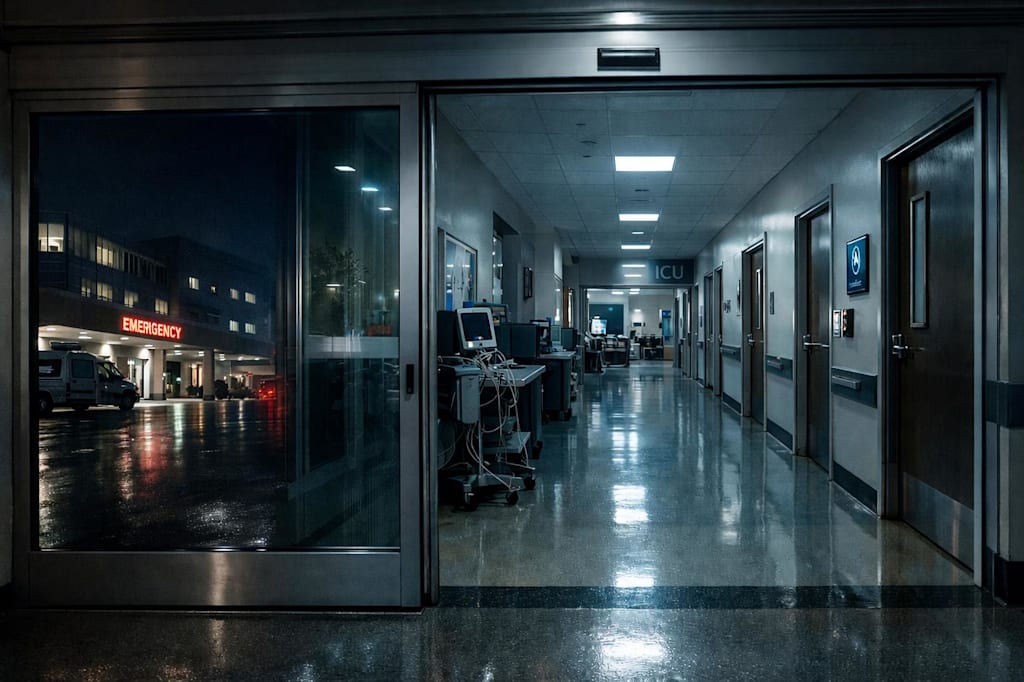
The hospital doors opened automatically when I walked toward them, and the smell hit me before I reached the reception desk—disinfectant and coffee and something metallic underneath it all that reminds you everybody who comes through those doors is there because something has gone wrong. Hospitals always smell the same, no matter what city you are in. I gave the receptionist Stella's name, and she checked her computer and told me room 417. "Is she—" I started, then stopped, because I didn't know what I was asking. Alive? Conscious? Waiting? The receptionist looked at me with the tired kindness of someone who had answered the same question a thousand times and said, "Fourth floor."
I found the elevator and pressed four. The doors closed, and for some reason I started laughing—of course, twenty years of avoiding this woman, and the universe had finally decided an elevator was the perfect place to force me to face her. When the doors opened I walked down the hall and saw her name on the door, MARA ELLISON, and I stood there with my hand on it, telling myself to go in but not moving. You drove thirty-one minutes in the rain, I thought. She asked you to come. So go in. I opened the door, and Stella was sitting upright in the hospital bed with an IV attached to her left hand. Her hair was shorter than I remembered, and there were silver strands around her temples. She looked older, obviously, because twenty years had passed, although my brain had apparently decided she was still twenty-one and standing in the high school parking lot wearing a denim jacket.
She looked at me and smiled. "You came." I walked inside and told her she'd said she needed me. "I did." "What happened?" She pointed toward the chair beside the bed and told me to sit down, so I did, and she looked at me for a long moment before she said, "I have an aneurysm." The word meant something. It also meant nothing. "Okay," I managed. "They found it two weeks ago." "Two weeks?" She nodded. "The doctor says it could rupture." I stared at her. "When?" "They don't know." My mouth went dry. "That's why you're here?" "They want to operate tonight." "Tonight?" "Yeah." I looked toward the clock on the wall—11:58—and said, "Jesus," and she smiled and said she knew.
"Why didn't you tell me?" I asked. She looked down at her hands and said she'd tried. "When?" "Every year," she said, looking at me. "Every birthday. Every Christmas. Every time I came back to town. I would find your number, stare at it, and talk myself out of calling." "You called tonight." "I got tired of talking myself out of it." The clock changed to 11:59, and I stared at the numbers until she noticed. "Funny," she said. "What?" "Last call." I looked at her, confused, and she explained that the nurse had told her she could make one more phone call before they took her downstairs. "I figured I should use it wisely," she said, smiling. I tried to laugh, and it came out wrong. "Why me?" She looked at me as though the answer should have been obvious. "Because you're the person I should have called twenty years ago."
The nurse came in carrying a clipboard and said they were getting ready to take her down. Stella nodded while the nurse checked the IV and adjusted something on the machine, then told us we had a few minutes and left. I looked at Stella and said I needed to tell her something. "I know," she said. "No, you don't." "I probably do." "I loved you," I said, the words finally coming out all at once, like something breaking loose. "I loved you then, and I loved you after you left, and I have spent twenty years pretending I didn't because I thought there would always be another chance to tell you. I thought someday we'd run into each other at a grocery store or a restaurant or somebody's wedding, and we'd laugh about high school and I'd finally tell you. I thought there would always be another phone call, another birthday, another Christmas, another stupid reason to wait."
Her eyes filled with tears. "I was scared," she said. "I know." "I thought if I told you, you'd leave." "I left anyway." She shook her head and said she knew that too, and I reached for her hand, and she gave it to me, her fingers cold. "You know what I hated most?" she asked. "What?" "That I believed you when you said you didn't love me." I closed my eyes and told her I was sorry. "I know." "I wish I had told you." "You are telling me now."
The nurse returned and said they were ready. I looked at Stella, and she squeezed my hand. "I need you to do something." "Anything." "If I come through this, take me to breakfast." I laughed through the tears and asked if she was serious—she'd almost died and she was thinking about breakfast. "I've always liked breakfast," she said. "I remember." "And Tucker?" "Yeah?" "Don't disappear again." I shook my head and told her I wouldn't.
The nurse began pushing the bed toward the door, and I walked beside her. At the elevator, Stella looked up at me and asked if I was going to answer when she called. "Every time," I said. The doors opened, the nurse pushed her inside, and I stepped back as they began to close. Stella's eyes stayed on mine until there was only a narrow space between us, and then the doors shut, and I stood there alone in the hallway with her words still inside my head. Don't disappear again.
I sat in the waiting room until the coffee machine stopped working, until the television above the reception desk switched from the late news to an infomercial, and until the rain against the windows became harder. At 2:17 in the morning, a doctor finally walked through the doors and looked around the room and said my name. I stood, and he smiled and told me she was going to be okay. For several seconds I couldn't understand him, and then my knees almost gave out. "When can I see her?" I asked. "Give her a little while," he said, so I sat back down.
At 6:42, a nurse finally came to get me. Stella was awake. She looked terrible. She also looked beautiful. "You came back," she said. "I said I would." "I wasn't sure." "I know." I pulled the chair beside her bed closer, and she looked at the clock and asked about breakfast. I laughed and asked if she had almost died and was really still thinking about pancakes. "I've been thinking about pancakes for three hours," she admitted, and I took her hand and told her that pancakes it was.
She squeezed my fingers. Outside the window, the sun was beginning to come up, turning the wet glass pale gold. The night had ended while we were sitting there, and for once I had the strange feeling that I had arrived somewhere instead of having spent another night running away. Stella closed her eyes and said she had one more thing to tell me. "What?" "I loved you too." She opened one eye. "Although you took your sweet time figuring that out." I laughed, and this time the sound came easily.
For twenty years, I had believed last call meant the moment when something was over—the final chance before the door closed and the lights went out. Sitting beside Stella as the morning came through the hospital window, I finally understood that sometimes the last call is the one that gives you one final chance to answer the phone, tell the truth, and stay long enough to see what happens when the night is finally over.
About the Creator
Tim Carmichael
Let your becoming be louder than your fear, and your smallest steps become the road you once thought impossible to walk. An Appalachian poet and cookbook author my book Beautiful and Brutal Things is on Amazon, Link 👇
Enjoyed the story? Support the Creator.
Subscribe for free to receive all their stories in your feed. You could also become a paid subscriber, letting them know you appreciate their work.
Comments
There are no comments for this story
Be the first to respond and start the conversation.