
The Museum of Unfinished Days
Time does not pass for everyone in the same direction.

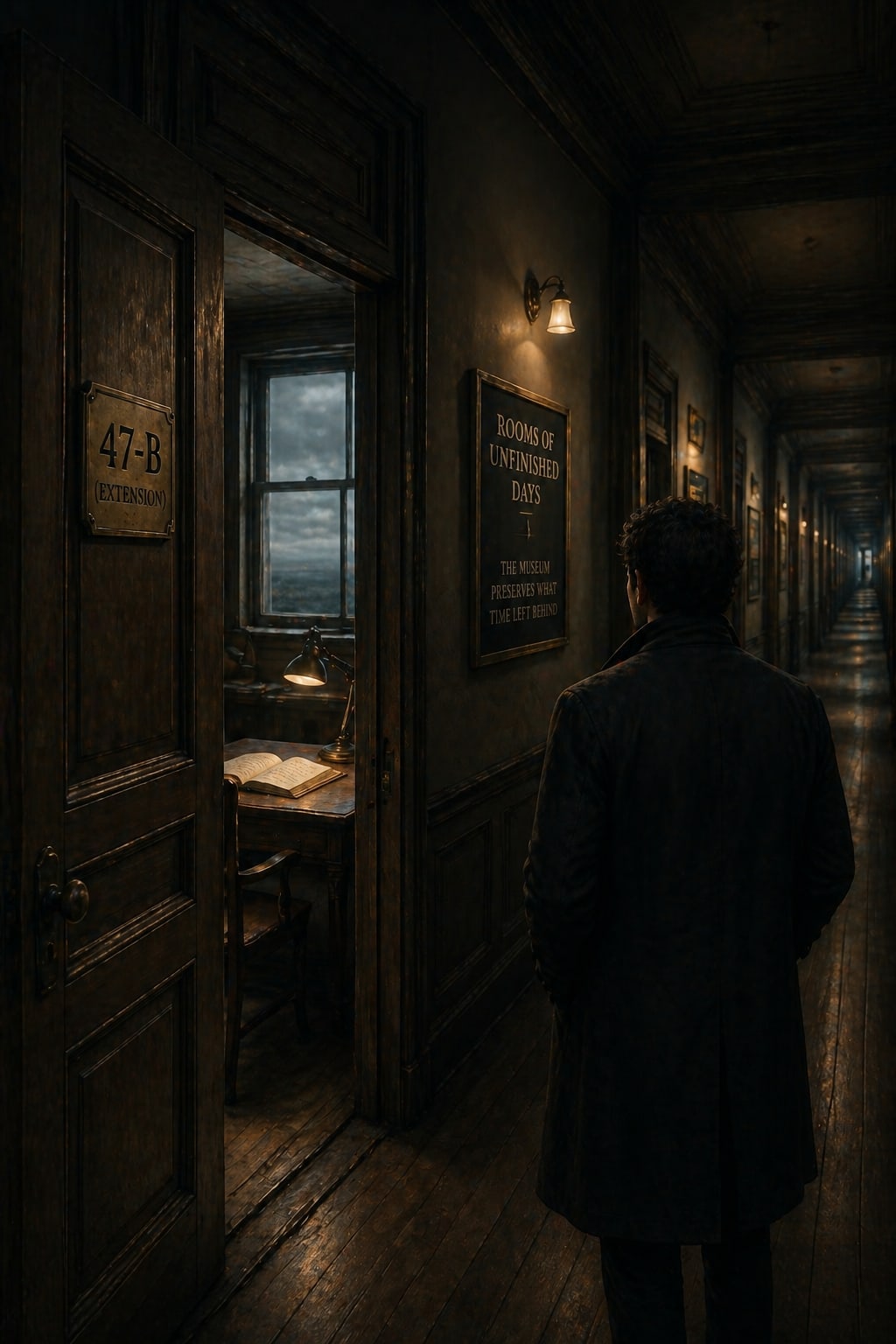
The day Tomas realized he had stopped aging, he was cataloguing a room that did not exist.
The Door That Appeared Twice
The museum had no official map.
Visitors relied on printed guides that were updated monthly, though even the curators admitted the revisions were approximations at best. Corridors extended where none had been before. Staircases looped back onto themselves. Entire wings vanished overnight, only to reappear weeks later in altered form.
Tomas had worked there for eleven years.
Long enough to stop questioning.
Long enough to understand that certainty had no place inside the building.
He specialized in temporal anomalies—rooms that did not adhere to conventional chronology. Spaces where clocks ran backward, or stalled, or fractured into multiple simultaneous moments.
Room 47-B had been stable for months.
A narrow gallery lined with glass cases, each containing objects associated with days that had never been completed. Half-written letters. A teacup with a lipstick mark fading into nothing. A coat draped over a chair beside a door that remained perpetually ajar.
Tomas had just finished logging a new acquisition—a calendar page dated April 12th, its squares blank except for a single word written in careful script: later—when he noticed the door.
It stood at the far end of the gallery.
Plain. Wooden. Slightly warped.
He was certain it had not been there before.
Then again, certainty was unreliable here.
He approached it slowly, pen still in hand.
On the doorframe, a small brass plaque had been affixed.
Room 47-B (Extension)
Tomas frowned.
Extensions were rare.
And never undocumented.
He checked his ledger.
No entry.
No authorization.
Nothing.
For a moment, he considered leaving.
Instead, he opened the door.
The Rooms That Refused to End
The space beyond was smaller than he expected.
A single desk. A chair. A window that looked out onto a gray, unmoving sky.
On the desk lay a notebook.
Tomas stepped inside.
The air felt different here.
Not colder.
Not warmer.
Just… paused.
As though the room existed slightly outside the rest of the museum.
He picked up the notebook.
The first page bore a name.
Tomas Ilren.
His own.
He exhaled, a slow, controlled breath.
Pranks were not uncommon among junior staff, though this felt… excessive.
He turned the page.
Entries filled the notebook in a handwriting he recognized with unsettling familiarity.
Day 1
I’ve found the extension. It wasn’t there yesterday. I don’t think it will be there tomorrow.
Day 3
I’ve begun documenting the rooms inside the extension. They don’t follow the usual rules.
Day 7
Time is inconsistent here. I’ve lost track of how long I’ve been inside.
Tomas flipped further.
The entries grew more erratic.
Less structured.
More urgent.
Day ?
I tried to leave. The door leads back to the same room.
Day ?
I’m not sure if I’m writing these in order anymore.
Day ?
I think the museum is changing me.
He closed the notebook.
The room was silent.
He looked at the door behind him.
Still open.
Still leading back to the gallery.
He stepped out.
The door remained.
The plaque unchanged.
For a moment, he considered reporting it.
Instead, he wrote a new entry in his ledger.
Room 47-B (Extension): Undocumented. Under observation.
The Days That Did Not Move
Tomas began visiting the extension daily.
At first, his purpose was professional.
Documentation.
Classification.
Understanding.
He mapped the rooms as best he could.
Each one similar in structure.
Desk. Chair. Window. Notebook.
Each notebook bearing his name.
Each one filled with entries.
Some familiar.
Some not.
He noticed patterns.
The earlier notebooks were coherent.
Precise.
Measured.
The later ones… were not.
Time fractured within them.
Dates skipped.
Events repeated.
Entire pages filled with the same sentence written over and over:
I am still here.
Tomas started keeping his own notes separate from the notebooks he found.
A control.
A baseline.
Something to anchor himself.
But even his own handwriting began to shift.
Subtly at first.
A letter formed slightly differently.
A line trailing longer than it should.
He began to notice other changes.
Small.
Almost imperceptible.
His reflection in the museum’s polished surfaces seemed… delayed.
Not slower.
Just not entirely synchronized.
Once, in the staff restroom, he caught sight of himself in the mirror and felt a momentary disconnect, as though the person staring back had not yet decided how to mirror his expression.
He blinked.
The sensation passed.
He told no one.
The Day That Did Not End
It happened gradually.
So gradually that Tomas did not notice it at first.
He stopped marking the date.
Then he stopped checking the time.
The museum had always distorted such things.
It seemed unnecessary to resist.
But one morning—or what he assumed was morning—he realized something.
He could not remember the last time he had left the extension.
He stood in one of the rooms, notebook in hand, and tried to reconstruct his movements.
He had entered.
He had explored.
He had documented.
He had—
Stayed.
The realization settled into him with a quiet, undeniable weight.
He turned to the door.
Opened it.
Stepped through.
Another room.
Desk.
Chair.
Window.
Notebook.
He tried again.
And again.
Each time, the same result.
The extension had expanded.
Or perhaps it had always been this large.
He had simply not seen it before.
Tomas felt a flicker of something he had not experienced in years.
Not confusion.
Not curiosity.
Something closer to fear.
He returned to one of the earlier rooms—the one he had first entered.
The notebook lay where he had left it.
He opened it.
Flipped to the last page.
Blank.
He picked up the pen.
Hesitated.
Then wrote:
Day ?
I think this is where it ends.
He paused.
The sentence felt incomplete.
He added another line.
Or where it begins again.
The Curator Who Did Not Leave
Weeks later—though no one could say how many—a junior curator named Elara reported an irregularity in Room 47-B.
A door had appeared.
Unlabeled.
Undocumented.
She hesitated before opening it.
Not out of fear.
But out of instinct.
Some things in the museum were not meant to be understood immediately.
Still, protocol required investigation.
She stepped inside.
The room was small.
Simple.
A desk.
A chair.
A window.
On the desk lay a notebook.
She approached it slowly.
Opened it.
The first page bore a name.
Tomas Ilren.
Elara frowned.
She had heard of him.
A senior archivist.
Meticulous.
Reliable.
Recently… absent.
She turned the page.
The entries were detailed.
Precise.
Familiar in tone.
Until they weren’t.
As she read, a subtle unease settled over her.
The handwriting shifted.
The structure broke down.
The entries lost coherence.
And yet, they all pointed to the same thing.
A space within the museum that did not allow exit.
Elara closed the notebook.
Looked around the room.
The air felt still.
Suspended.
She turned toward the door.
It remained open.
Leading back to the gallery.
She could leave.
Report the anomaly.
Seal the extension.
Follow protocol.
Instead, she stepped further inside.
Set her bag on the desk.
Picked up the pen.
And, after a brief moment of consideration, began to write.
The Rooms That Continue
Somewhere within the museum, a clock ticked.
Or perhaps it did not.
Time, after all, was not a reliable measure here.
The extension remained.
Unmapped.
Unfinished.
Expanding.
And in one of its many rooms, a notebook lay open on a desk.
Its pages filled with careful, deliberate handwriting.
Documenting.
Observing.
Continuing.
Because some days do not end.
They simply wait.
To be lived again.
About the Creator
Cordelia Vance
Lost in the ink-stained corridors of a life lived through pages. I write to capture the whispers of ghosts we pretend not to hear and the shadows we call home. Welcome to my attic of unspoken truths.
Enjoyed the story? Support the Creator.
Subscribe for free to receive all their stories in your feed.
Comments
There are no comments for this story
Be the first to respond and start the conversation.