

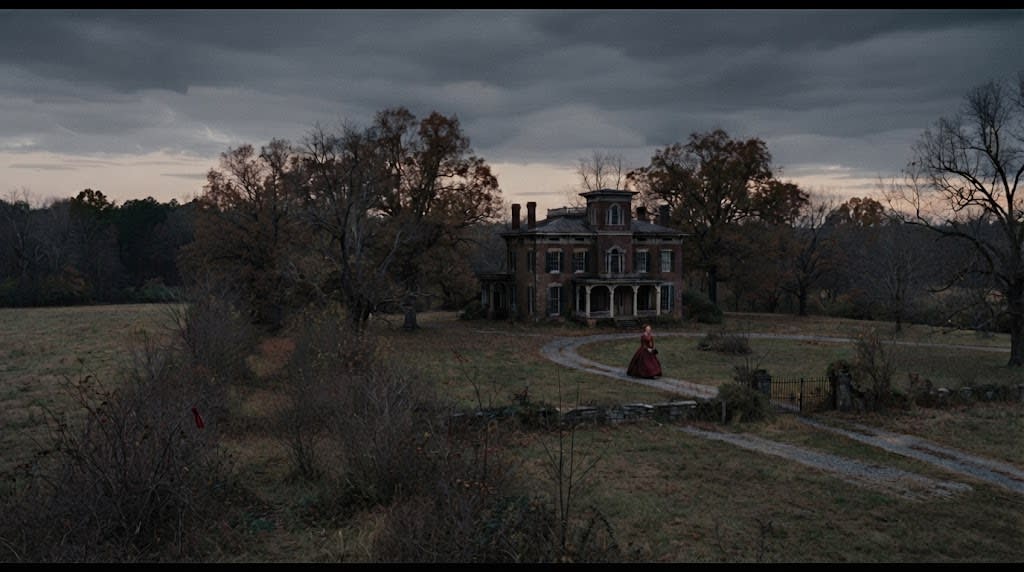
In the year eighteen hundred and seventy-one, the calendar of mourning ran with the precision of a church bell, and Honoria Vance had learned every stroke of it by heart. Twelve months, the almanacs of etiquette decreed, for a sister burying a brother: six in the deepest black, crepe upon crepe, veil drawn to the collarbone; then six more permitted to soften, gradually, toward the muted violets and greys of half-mourning, until at last, on the anniversary, a woman might step again into the full chorus of color and call herself restored.
She stood, that October morning, precisely at the hinge of the six-month mark, having worn her sorrow with the diligence of a scholar reciting scripture. Beyond her window the elms behind the townhouse had already surrendered their leaves to the first hard frost of the year, and the kitchen garden Julian once tended lay reduced to a stand of blackened stalks, the whole county having settled, as it settled every autumn, into a palette scarcely different from her own mourning wardrobe—greys deepening toward brown, browns deepening toward the same dull black the almanac required of her. The season and her sorrow had, until this morning, kept faithful company.
And so when her maid, Bess, drew back the wardrobe doors and let out a sound between a gasp and a prayer, Honoria crossed the room already certain some seam had torn, some hem had frayed.
What she found instead stole the breath entirely from her chest.
Every gown, every length of crepe, every black-ribboned bonnet she owned had turned, overnight and without ceremony, the color of a wound freshly opened. Crimson. A red so deep and so glad it seemed to hum against the pale walls of her chamber, as though the fabric itself rejoiced at some occasion she alone had failed to hear announced.
"Miss," Bess whispered, "they were black as pitch when I hung them Tuesday evening. I'd swear it on the Book."
Honoria touched the nearest sleeve, half expecting the color to smear across her fingers like paint hardly dry. It held. The weave, the weight, the very crepe crimped into its mourning folds—each remained precisely itself, altered in hue alone, as though some unseen hand had dipped the whole of her wardrobe in a dye vat drawn from the heart of a rose garden in full riot.
Had such a color arrived in May, with the county already blazing green and the first roses climbing the trellis Julian had built, a soul might have read it as the season borrowing her wardrobe for an afternoon and thought little further upon the matter. Arriving instead upon a morning when frost silvered every pane of glass and the last leaf had given up its hold on the last branch, the crimson read as something else entirely: a color left without a season willing to claim it, offered to her at the precise month when the earth itself had gone into its own long mourning and every hedgerow for miles agreed, at last, to wear black.
She sat upon the edge of her bed and considered, with the cold clarity grief sometimes lends a person, the arithmetic of her situation. She owned, beyond these transformed gowns, a single walking dress of grey wool, unsuited to any gathering grander than a walk to church, and a nightdress hardly fit for public view. Her father's estate, diminished since Julian's death by debts he had left concealed beneath his charm, allowed her scarcely enough for coal and bread, let alone a modiste's fee. To dye crimson silk back to black required a chemist's skill and a purse equal to the task—one she lacked entirely.
And this evening, of all evenings, Lady Pemberton's assembly awaited her—the gathering that closed each year's calendar of visiting before the county settled into the long grey weeks of winter, held always upon the same week in October regardless of who had died or married or been born within it. She had begged twice to be excused from attending, and been refused twice over, since Lady Pemberton held the mortgage on the Vance townhouse and considered attendance at her gatherings a form of interest paid on the debt. To absent herself would invite questions sharper than any gown could answer. To arrive in scarlet, while her brother lay six months in his grave, would invite something worse: a verdict.
Society, Honoria had come to understand across her twenty-two years, judged the soul chiefly through the eye, and rarely troubled itself to look further. A widow who wept in black earned sympathy freely given; a widow glimpsed laughing in lavender a season too soon earned whispers that followed her into every drawing room for years. The color of cloth, in this economy, stood as testimony more binding than any oath. Let a woman's heart break in silence behind her ribs—so long as her sleeves stayed sable, her grief remained above reproach. Let her heart mend in silence, equally private, equally her own affair—should her hem so much as brighten by a shade, the whole of the parish would proclaim her heartless, or worse, glad of her brother's passing.
She thought of Julian now, of his laugh that filled a room the way sunlight fills a window left open too wide, of the manner he had of turning even a scolding into an entertainment. He would have laughed at this, she suspected—would have called it a fine joke played by whatever power governs wardrobes and widows alike. Yet the thought brought little comfort, since Julian remained, whatever his opinion, entirely absent from the room where she must decide what to do.
She considered borrowing. Her cousin Eugenia, married three years past into wool money, owned a wardrobe deep enough to clothe half the county in appropriate grey, and might extend a gown for the evening out of family feeling, or out of the pleasure some women take in another's misfortune dressed as charity. Yet Eugenia lived four hours distant by carriage, and the assembly began at eight.
She considered feigning illness. A headache, a chill, a fever conveniently timed. Yet Lady Pemberton's steward called each week to collect the interest due, and a missed assembly, coming so soon after a missed payment the month prior, might be read as evasion of a different sort—one measured in coin rather than color, and equally ruinous.
She considered, finally, the single option remaining to her: to wear the crimson, and to walk into Lady Pemberton's rooms as though she had chosen it.
The decision, once made, transformed itself slowly through the afternoon from terror into something closer to defiance, the way a held breath becomes, past a certain point of suffering, its own strange comfort. Bess dressed her at seven, hands trembling around buttons that refused, at first, to slip through their loops, as though the gown itself resisted being worn into a room where it would be read as confession.
"You look," Bess said, and stopped, and tried again. "You look as though you mean it, miss."
Honoria studied herself in the glass. The crimson caught the last light through the window and threw it back doubled, so that she appeared, standing there, less a woman in mourning attire gone astray than a figure carved from flame and set loose among the furniture. Her collarbone, accustomed these six months to the modest shadow of black crepe, now framed a color so vivid it seemed to announce her presence before she spoke a word. She thought of every eye that would find her the moment she crossed Lady Pemberton's threshold, of every whispered calculation running behind powdered faces: six months only, and already red—what manner of daughter, what manner of sister—
She lifted her chin and told Bess to fetch her cloak, the plain black one, at least, that remained unaltered by whatever force had touched the rest of her wardrobe, and which she might keep drawn about her shoulders until the very last possible moment.
The cloak bought her perhaps four minutes of anonymity within Lady Pemberton's hall, four minutes during which she stood among a crowd of arriving guests and heard the usual murmur of an assembly gathering itself toward gaiety—the clink of glasses, a violin tuning somewhere beyond the doors, laughter pitched at the register reserved for people with nothing weighing on them heavier than the evening's next dance. Then a footman reached for her cloak with the automatic courtesy of his trade, and before she could summon a reason to refuse him, the black fell away, and the crimson beneath announced itself to the room entire.
The silence that followed possessed a texture she felt against her skin, thick and sudden, the sort of quiet a room falls into when a glass shatters mid-conversation. She held herself very still and watched the faces turn, one by one, the way a field of sunflowers turns toward a light that has, without warning, appeared in the wrong direction.
Lady Pemberton herself crossed the room first, her expression arranged somewhere between alarm and a hunger for scandal she scarcely troubled to conceal. "Miss Vance," she said, loud enough to carry, "how... unexpected."
"Yes," Honoria answered, and discovered, to her own surprise, that her voice held steady. "The dye ran overnight, Lady Pemberton. Every gown in my possession. I own nothing else fit to wear, and you were gracious enough to insist upon my presence this evening."
A ripple of speculation moved through the assembled guests at that, half-believing, half-delighted at so peculiar an excuse, and Honoria understood, watching it spread, that the tale would travel the parish by morning regardless of its truth, embroidered further at every drawing room it passed through. Some would call her explanation a fabrication concealing a heart already healed of grief and eager for color again. Some would call it proof of a house cursed, or haunted, or touched by a hand best left unnamed. Hardly one among them would consider the possibility she found herself considering now, standing amid their stares: that her grief and her gown had, all along, measured two entirely separate things, and society's habit of reading one from the other amounted to little more than a convenient fiction, useful for judging women swiftly and without the labor of actual acquaintance with their hearts.
She danced, that evening, a single reel with Lady Pemberton's nephew, a young man too new to town to have absorbed the significance of her color, and who complimented her gown with the guileless enthusiasm of someone unacquainted with any rule book governing its wearing. For the length of that dance, turning beneath the assembly's chandeliers in crimson silk, Honoria felt something loosen in her chest that had sat clenched there since the morning Julian's letter came, informing the family of the accident on the northern road.
She grieved him still. She would grieve him, she suspected, in some manner or shade for the balance of her life, whatever color her sleeves happened to display on any given day. Yet she found, turning through the last measures of the reel while a hundred eyes tracked the scandalous red of her skirts, a species of freedom in having the decision stripped entirely from her hands. She had never chosen the crimson. She had merely worn what remained to her, and let the room draw whatever conclusion it pleased.
Walking home past midnight, cloak drawn once more about her shoulders, dead leaves crackling to powder beneath her feet and a second frost already gathering upon the cobbles, she considered how the entire county around her had spent this same October settling obediently into brown and grey, every hedge and orchard surrendering its color on schedule, as reliable as the almanac itself. Her skirts alone, among all that failing scenery, had declined the arrangement. She wondered whether the black might return to her wardrobe as inexplicably as it had departed, some morning equally without warning, the season correcting its account at last. She rather hoped, she admitted to herself, alone on the dark street with the cold air against her face, that it might stay precisely as it was, defying the year until the year itself came round to defend it.
About the Creator
Tim Carmichael
Let your becoming be louder than your fear, and your smallest steps become the road you once thought impossible to walk. An Appalachian poet and cookbook author my book Beautiful and Brutal Things is on Amazon, Link 👇
Enjoyed the story? Support the Creator.
Subscribe for free to receive all their stories in your feed. You could also become a paid subscriber, letting them know you appreciate their work.
Comments
There are no comments for this story
Be the first to respond and start the conversation.