
The Mountain Makes Its Own Weather
A side chapter from: The Bell at Friday Harbor

Before I went into Rainier, somebody at a convenience store told me the mountain makes its own weather.
I remember thinking that sounded beautiful.
Later, I understood it was a warning.
By then, Friday Harbor was already behind me, though not very far behind. I had spent three months around water, routine, and the kind of quiet that changes a man without announcing itself. I cleaned decks while Alan Watts talked in my ears about God, death, illusion, and the strange little theater of being human. I heard the church bell ring over the island at the same time every day, as if time itself had decided to become audible.
I watched the channel breathe.
I watched the light change over the boats.
I watched work become a kind of prayer.
For a while, I thought maybe that was peace.
But the water had been teaching me other things too.
One of the first times we went crabbing, we pulled up a bait trap full of Dungeness crab. They came out of the cold water armored and alive, legs moving, claws working, bodies ancient-looking in the way sea creatures often are, as if they had been designed before kindness entered the world.
We had to break them down before the chef could prepare them. I do not remember exactly why anymore. Maybe to clean them. Maybe to remove the shell and guts so the galley could work faster. Maybe because on a boat, the ugly part gets done before the pretty part is served.
I only remember the first one.
I took too long.
That sounds small, but it was not small to the crab.
I hesitated. I tried to kill it quickly and somehow made it worse. I smashed it against the side of the dock, but it did not die right away.
The mate got pissed.
Not because I had killed it.
Because I had done it badly.
He looked at me and said, “If you’re going to kill something, don’t make it suffer first.”
That line stayed with me.
At the time, I think I felt embarrassed, maybe a little defensive too. Nobody likes being corrected while holding the evidence of his own incompetence. But he was right. There was no romance in it. No grand speech. No cinematic wisdom from the sea. Just a crab, a dock, a mistake, and a man telling me that mercy was not the same thing as hesitation.
People like to imagine mercy as softness.
Sometimes it is.
But sometimes mercy is precision.
Sometimes mercy is doing the hard thing cleanly because the alternative is making your discomfort someone else’s suffering.
The sea did not care if I was sensitive.
The crab did not need my feelings.
It needed me to be competent.
That, too, felt like masculinity, or at least some harder, cleaner version of it. Not dominance. Not swagger. Responsibility. The understanding that strength without mercy becomes cruelty, and mercy without competence can become cruelty by another name.
I left Friday Harbor with that lesson somewhere inside me, even if I did not fully understand it yet.
Suzanne was loaded again. My red Honda Shadow 750. Two backpacks. The same stubborn chrome. The same faithful engine. I was heading south, eventually toward San Diego, though the road never gives itself to you all at once. It gives itself in pieces. A highway. A turn. A gas station. A motel you cannot afford. A weather system you underestimated.
It was the middle of September, 2019.
Somewhere near the base of Mount Rainier, I stopped for the night.
It was late.
Too late.
That is how trouble often enters a journey. Not dramatically. Not with thunder. Just late enough that every better option has already closed.
The stores were shut. The practical world had already locked its doors. No extra blanket. No warmer sleeping bag. No proper cold-weather gear. No last-minute purchase under fluorescent lights from some tired clerk who did not know he was saving your life.
Just me.
Suzanne.
The dark.
And a small camp at the base of a mountain that made its own weather.
I did not have the right gear.
That sentence looks simple now. Almost stupid. The kind of thing a man writes years later with the clean intelligence of hindsight. But in the moment, it was not a sentence. It was a fact pressing itself slowly into my bones.
The cold came down hard.
Not all at once. Cold like that has patience. It does not attack you like a man in a bar. It does not shout. It does not curse. It just surrounds you and waits for your body to understand the terms.
At first, I told myself it was manageable.
I had been cold before.
I had ridden through bad weather before.
I had gone without comfort before.
Men tell themselves things like that when they are afraid and do not want to use the word.
The temperature must have dropped below forty at some point. Maybe lower. I do not know the exact number. I only know what it felt like. I know my body curled around itself like it was trying to become smaller, like if I could reduce the surface area of my life, maybe the night would take less from me.
I tried to sleep.
Sleep came in scraps.
A few minutes here. Maybe a few there. Broken pieces of unconsciousness too thin to count as rest. I think I slept two hours that whole night, and even that feels generous.
Mostly, I endured.
There is that word.
Endured.
It sounds noble from a distance. Put it in a book and it stands tall. Put it in a man’s mouth and it can become a commandment.
But inside the body, endurance is not noble.
It is teeth.
It is shaking.
It is your thoughts getting smaller until the whole universe becomes one instruction:
Stay.
I kept going to the camp bathroom.
That was the part that almost made me laugh, if I had any warmth left for laughter.
I would get up and walk through the cold, hoping the bathroom would be warmer. It was a building, after all. Four walls. A roof. Human design. Shelter, supposedly.
But the bathroom was just as cold as the outside.
Maybe worse, because it had offered the idea of warmth first.
That is a special kind of disappointment. The cruel little joke of finding shelter and realizing it has no mercy in it.
So I stood there, in that cold bathroom at the base of Mount Rainier, trying to borrow warmth from concrete, tile, plumbing, anything.
Nothing gave.
Then I went back out.
Back to the dark.
Back to the cold.
Back to my poor little camp, where the mountain did not care who I was, where I had been, or where I was trying to go.
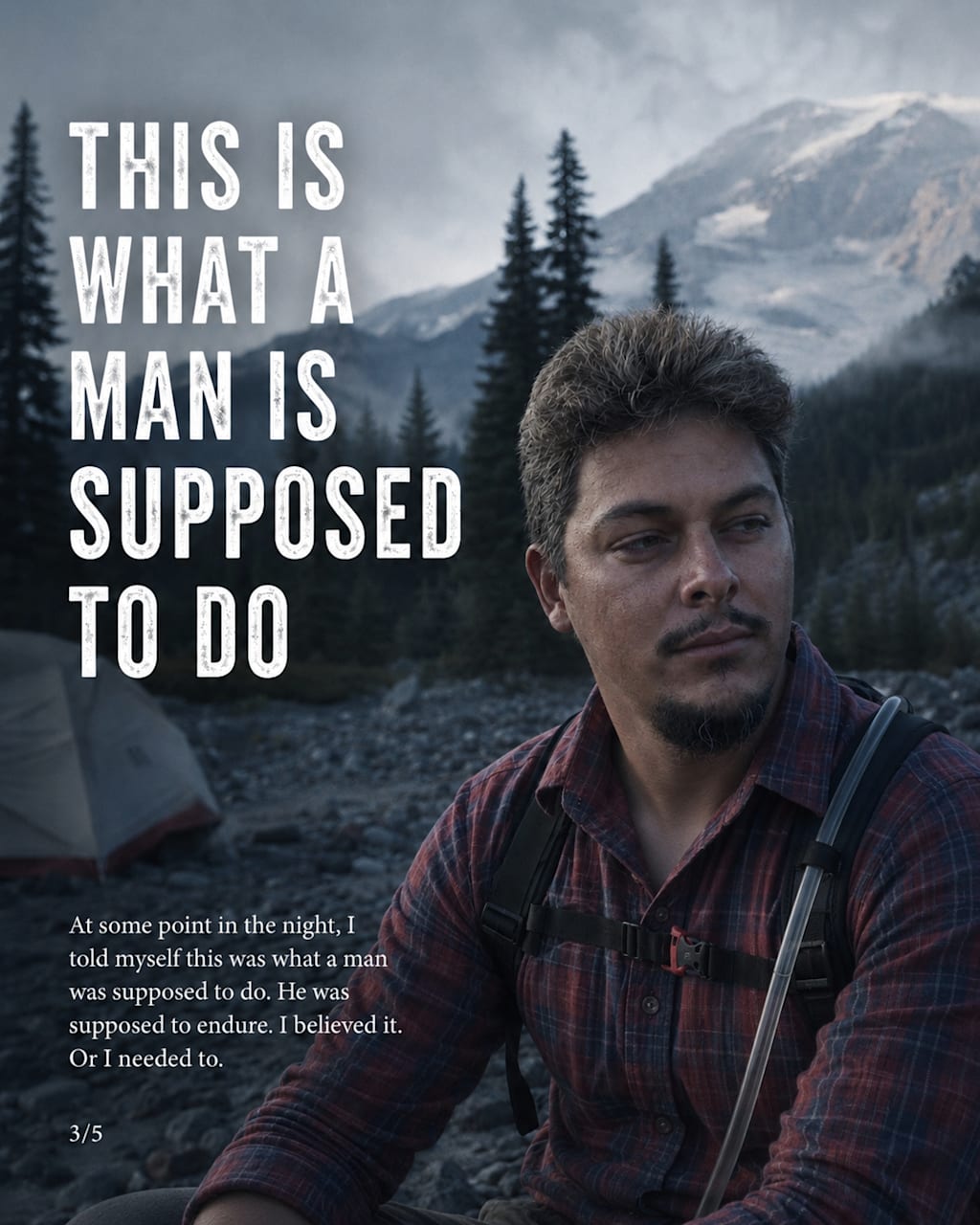
At some point in the night, I told myself:
This is what a man is supposed to do.
He is supposed to endure.
I believed it when I said it.
Or I needed to believe it.
There may not be much difference when you are cold enough.
That line had been handed to me by every invisible father in the culture. Every movie. Every hard man. Every story where pain is treated as proof. Every authority figure who mistook silence for strength. Every version of masculinity that said suffering was not something to understand, only something to survive.
So I survived it.
I lay there under the mountain, shivering through the coldest sleepless night of my life, and I made endurance into a religion because I had nothing else to hold.
No warm room.
No woman’s arms.
No captain’s calm instruction.
No bell ringing across Friday Harbor.
Just the cold, the dark, and the idea that maybe being a man meant taking it.
By morning, I was still alive.
I do not say that dramatically.
I mean it plainly.
I was still alive.
The sun did not arrive like salvation. It came slowly, pale and indifferent, lifting the shape of the camp out of the dark. My body hurt from clenching. My eyes felt scraped raw. The world looked ordinary again, which somehow made the night feel even stranger.
That is one of the quiet betrayals of survival.
The thing that nearly broke you becomes invisible once it is over.
The camp was just a camp.
The bathroom was just a bathroom.
Suzanne was just a motorcycle waiting under the trees.
And I was just a man packing his things with shaking hands, pretending the night had not taken something from him.
I got back on the bike.
Because that was what came next.
The road does not stop because you suffered. It waits, patient and gray, asking whether you are finished making meaning out of pain.
For years, I think I carried that night as evidence.
Evidence that I could endure.
Evidence that I was hard enough.
Evidence that I could be uncomfortable, afraid, exhausted, underprepared, alone, and still not quit.
And maybe that is true.
Maybe there is honor in that.
But now, when I look back, I see something else too.
I see a man confusing survival with wisdom.
I see a man so hungry to prove he was strong that he almost missed the more important lesson.
A man should endure when he must.
But he should also learn.
He should prepare better.
He should respect the cold.
He should know when the mountain is not testing him, but simply being a mountain.
The mountain did not make me a man.
The cold did not bless me.
The bathroom did not become warmer because I was brave.
I simply survived a mistake.
And sometimes survival is sacred enough without pretending the mistake was holy.
The next morning, I bought a jacket.
That may have been the least romantic part of the story.
It may also have been the truest.
Because the night told me a man endures.
The morning told me a man learns.
Still, I remember that night.
I remember the warning from the convenience store.
The mountain makes its own weather.
I remember the crab on the dock.
I remember the mate telling me that if I was going to kill something, not to make it suffer first.
I remember standing in that freezing bathroom looking for mercy and finding none.
I remember telling myself that a man is supposed to endure.
And I remember riding away in the morning, tired and alive, with Suzanne carrying me south beneath a sky that had no idea what I had just survived.
Maybe masculinity began there for me again.
Not in the suffering.
Not even in the endurance.
But in the question that came years later:
What if a man is not only measured by what he can take?
What if he is also measured by how cleanly he carries responsibility, how honestly he learns from pain, and what he refuses to romanticize after it almost kills him?
About the Creator
Alejandro Arango
A theater major, a poet, and a lover of the written word. I write to the muses that they may inspire me, and to you the reader. Hopefully you can find meaning in my words or something that will lighten your heart on this journey of life
Enjoyed the story? Support the Creator.
Subscribe for free to receive all their stories in your feed.
Comments
There are no comments for this story
Be the first to respond and start the conversation.