
The moons of our solar system.
Potential habitats for life.


Just a quick refresher on our solar system’s moons - bear with me.
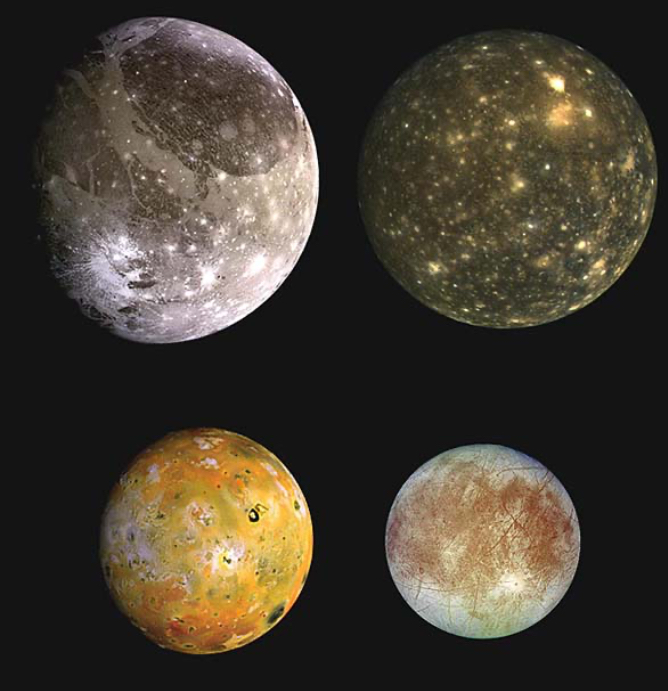
Jupiter possesses 95 officially recognized moons, the largest and most famous of which are the four Galilean satellites: Io, Europa, Ganymede, and Callisto. Discovered by Galileo Galilei in 1610, these four make up over 99.99% of the total mass orbiting the planet.
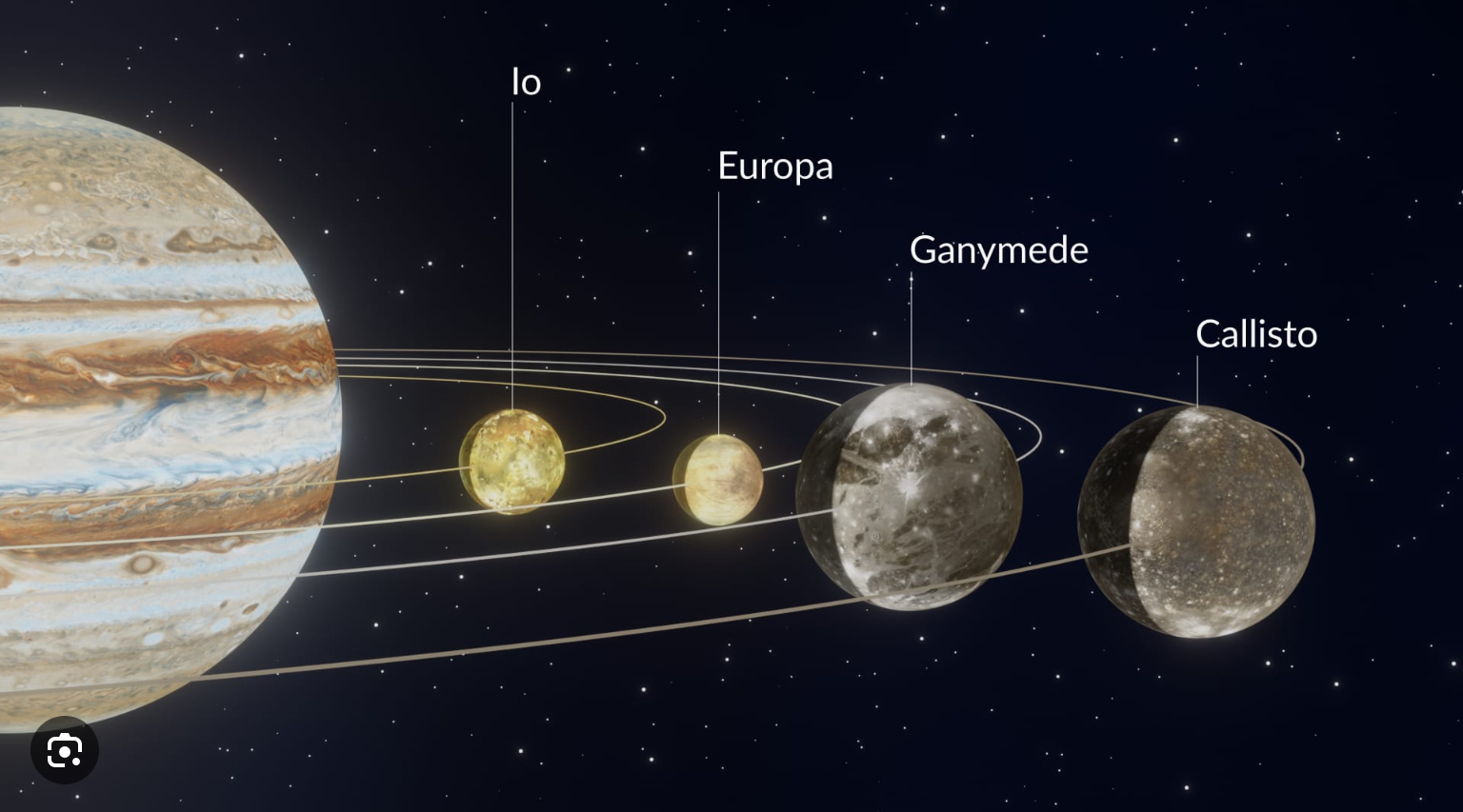
The primary moons of Jupiter include:
Io: The innermost Galilean moon and the most volcanically active body in the Solar System, fueled by intense gravitational tidal heating from Jupiter.
Europa: Covered by a smooth, cracked crust of water ice, scientists believe this moon harbors a massive, subsurface liquid ocean.
Ganymede: The largest moon in our entire Solar System (even larger than the planet Mercury) and the only moon known to generate its own magnetic field.
Callisto: The outermost of the four, it has an ancient, heavily cratered surface and may also conceal an ocean beneath its crust.
Overview.Besides the Galilean giants, Jupiter has dozens of smaller, irregular moons—mostly captured asteroids or collisional fragments—that orbit much further out
Io: Fire World
Robotic probes may someday provide close-up views of some of the most remarkable vistas in the solar system, from the canyons of Mars to the ice-geysers of Triton. For a true hot-spot, they might show us the surface of Io, one of the moons of Jupiter. It is an eerie landscape of active volcanoes, tall mountains, and plains covered with frozen sulfur.
Other than the Sun, portions of Io offer the hottest surface in the solar system. Several hundred volcanoes dot the surface, and they belch sulfur-rich lava that is hundreds of degrees hotter than the hottest lava on Earth.
Io’s interior is heated by a tug-of-war between Jupiter and the planet’s other big moons. Io is “locked” so that the same hemisphere always faces the planet, just as the same hemisphere of our own moon always faces Earth. But as the other moons move past Io, their gravity tugs at it, too. That heats Io’s interior enough to melt some of its rock, which “bubbles” to the surface.
Europa: Water World?
For decades, Mars was considered the most likely home for life in the solar system. As observations continued to show a sterile, desolate world, though, scientists began turning their attention to Europa. Europa’s icy crust appears to cover a large ocean of liquid water, where life may have gained a foothold.
Tidal gravity may have created the ocean by heating Europa enough to melt some of its ice.
There is abundant evidence of an ocean. The Galileo spacecraft found two types of terrain that may be related to water. “Chaotic” terrain looks like icebergs breaking off glaciers on Earth. The other terrain consists of smooth plains marked by ridges that are hundreds of miles long. The ridges may form as Jupiter’s gravity rips apart the thin ice sheet. In addition, the motions of salty water below the surface may generate Europa’s weak magnetic field.
Ganymede and Callisto: Ice Worlds
Ganymede is the solar system’s largest moon — larger than the planet Mercury. It consists of about half ice and half rock and metal. Grooves and ridges that crisscross its surface indicate that it has undergone great changes over the eons.
During several passes, the Galileo spacecraft saw mountains of ice, plus sheets of ice that erupted from volcanoes. It also saw deep canyons and broad, smooth plains created by the motions of Ganymede’s crust.
Like Europa, Callisto’s icy surface may conceal an ocean. The case for an ocean is more tentative, but it is bolstered by a huge basin on one side of the moon. It was created by a powerful impact billions of years ago.
But there is no jumble of rocks and mountains on the opposite side of Callisto, as there is with big impact basins on our own moon. A deep ocean could have cushioned the impact, preventing shock waves from piling up rocks half a world away.
Saturn’s moons.
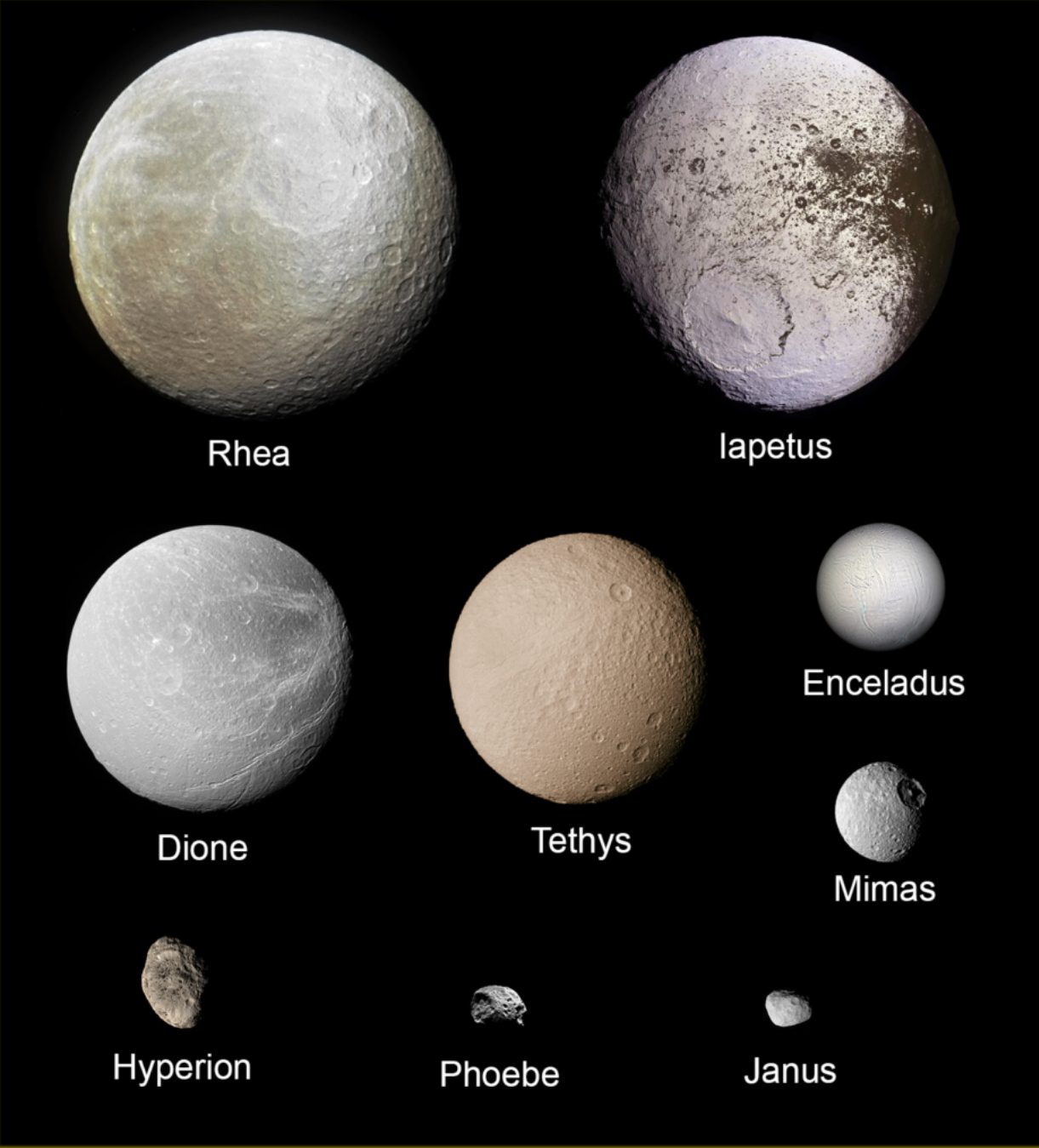
Saturn is the "moon king" of our solar system, with 274 confirmed moons varying in size from planet-sized worlds to tiny, icy bodies. Because many are small and distant, they orbit in complex systems with the planet's famous rings and are frequently updated with new discoveries.
Key Moons to Know:
Titan: Saturn’s largest moon and the second-largest in the solar system (even larger than Mercury). It is unique for being the only moon with a dense atmosphere and liquid lakes of methane and ethane on its surface.
Enceladus: A small, icy moon that hides a global subsurface ocean. It features massive cryovolcanoes (geysers) near its south pole that shoot plumes of water vapor into space, making it a prime candidate for astrobiology.
Mimas: Famous for its massive Herschel crater, which gives it a striking resemblance to the "Death Star" from Star Wars.
Iapetus: A fascinating "two-toned" moon, with one hemisphere as bright as snow and the other as dark as coal.
Other Prominent SatellitesAlongside the heavy hitters, Saturn has several other major icy moons that were primarily discovered through ground-based telescopes:
Types and OriginsSaturn’s massive collection of moons can generally be broken down into two categories:
Regular Moons:
These orbit close to Saturn in the planet's equatorial plane. They are typically made of water ice and are geologically active.
Irregular Moons:
These are primarily tiny, captured outer moons that have highly elliptical, tilted, and "retrograde" (backwards) orbits. They typically exist in clusters, which are believed to be the shattered remnants of larger moons that collided with comets or asteroids in the distant past.
Recently in the news, there has been talk about colonizing Mars and our Earth’s moon, and it might still happen, but maybe there are other options out there. Fast forward to a time in the near future when new technologies advance our capabilities:
2028:
The return to the moon by the historic Artemis IV manned mission, led by NASA, partnered by private corporations SpceX and Blue Horizens. In an exclusive news release by Newsmax, it was announced that several secret missions were performed by unmanned space craft, Falcon class, operated by Space X, in which landing craft built and operated by Blue Horizons, also unmanned, successfully landed and built a 3D printed building with all nessessary oxygen making equipment, radiation screening, solar panels and batteries, water pipes and pumping equipment, sewage treatment equipment, so that when the manned lander touched down thee crew could immediately take possession and inhabit the first colony on the moon. In classic Cold War secrecy, the USA laid the ground work for the moon village, so hostile adversaries like Russia and China couldn’t beat them to it. With in months, they invited their European Allie’s to join them, as well as their Japanese Allie’s, so that very soon the moon village tripled in size with a European neighborhood and a Japanese neighborhood.
2038:
In a historic Artemis 7 mission Mars was successfully colonized by USA and by a partnership with India. Also partnered by several private corporations. American, Indian, European and Japanese.
2048:
Unmanned flights were made to Jupiter and Saturn, to investigate closer the moons orbiting around those planets, with the goal of colonizing them. The success of the moon colony and the Mars colony with all that was being learnt and technological advances in rocketry, living capabilities, farming, mining, construction, water extraction, sewage treatment, medical breakthroughs, everything was possible And doable.
After two years of exploration of the moons orbiting Jupiter and Saturn, several candidates were chosen. Some of the moons were hot, volcanic, but they had atmospheres and water, everything needed for life. Some were frozen, also with an atmosphere. And some were watery, with rocky land appearing out of the oceans. And they had atmosphere as well. Maybe not the right atmosphere for humans to breathe, at least not comfortably anyway, but the idea to introduce primates to those moons was being bandied around and gaining traction. As was aquatic life for the watery moons, like fish, big and small, tuna, dolphins, whales, octopi, crabs, eels. Maybe penguins, seagulls.
2050:
the seeding missions were launched, unmanned, with cryogenically frozen animals transported to selected moons. Tagged for monitoring when woken and released. The scientific community was glued to their computer consoles for the next ten years.
During this time, the asteroid mining industry was booming, and the first quadrillionaires were made. Space was where it was at. More jobs were space involved than any other industry, and growing larger every year. The technology was getting better. Travel time and speed were faster every year. Space elevators were a reality now, and every space faring nation had one or two in their arsenal. Mars had one also. Private corporations had them. It was cheaper than launching a rocket conventionally. Another new technology that the Japanese invented and refined was the underwater city, and after building and testing them on Earth for ten years, we’re ready to build and live in them on the watery moons orbiting Jupiter and Saturn.
2070:
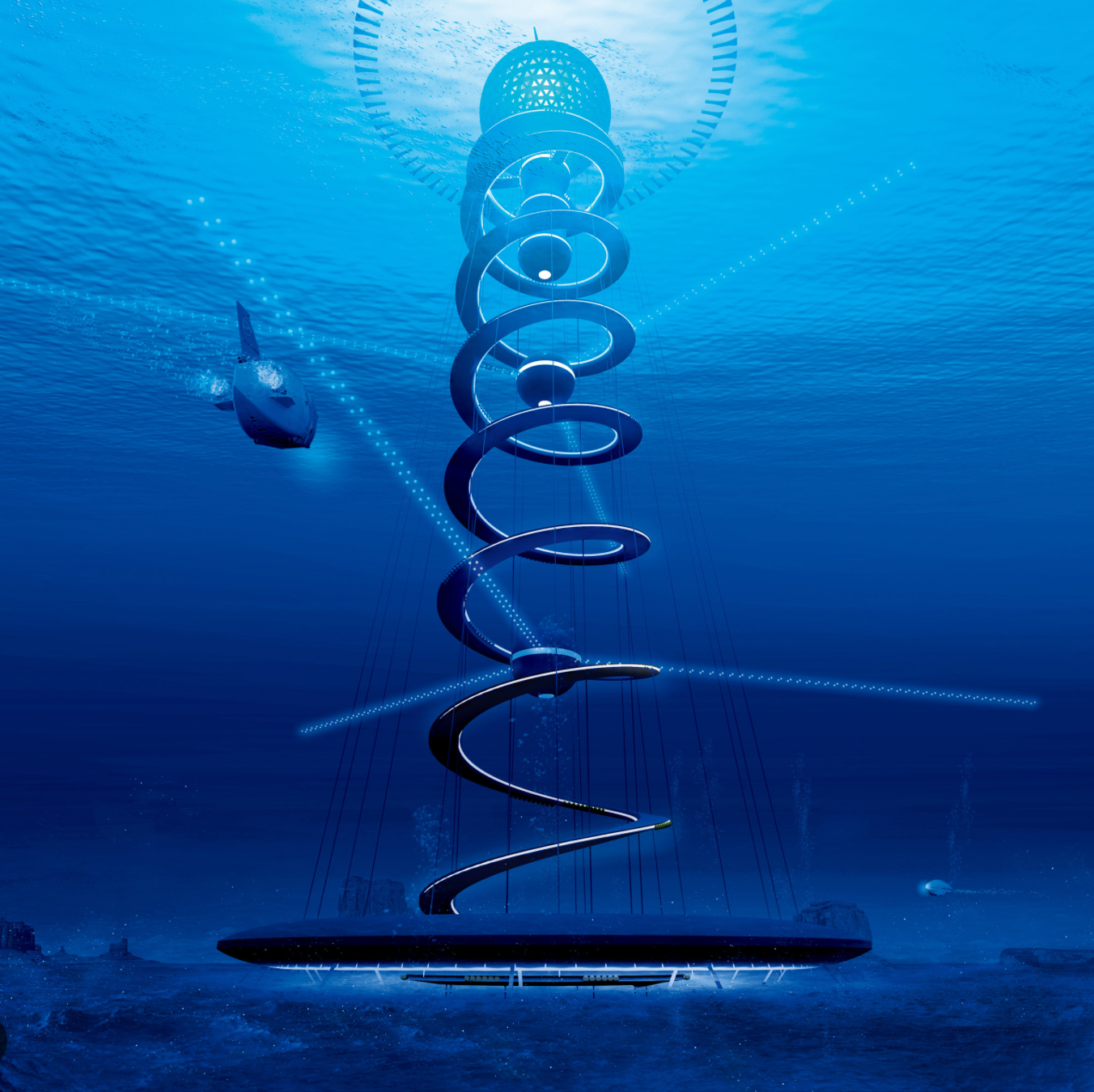
In a combined mission by NASA and the Japanese, dubbed “Gallillao 1” partnered with several private corporations, an underwater city was built on Europa, and depending on its success a second city would be built on Callisto, when Gallillao 2 would be launched. Then a third city built on Enceladus on the Gallillao 3 mission.
Japan's "Ocean Spiral" is a conceptual underwater city proposed by the Shimizu Corporation in 2014. Designed to house up to 5,000 people, the self-sufficient metropolis consists of a floating surface dome, a 9-mile-long spiral resource corridor, and an energy-generating base station on the seabed.The ambitious project relies on utilizing the ocean itself to sustain human life and generate clean energy. This was the news release back in 2014. Now, in 2070, testing and human trials have successfully been completed, and the concept is going into space.
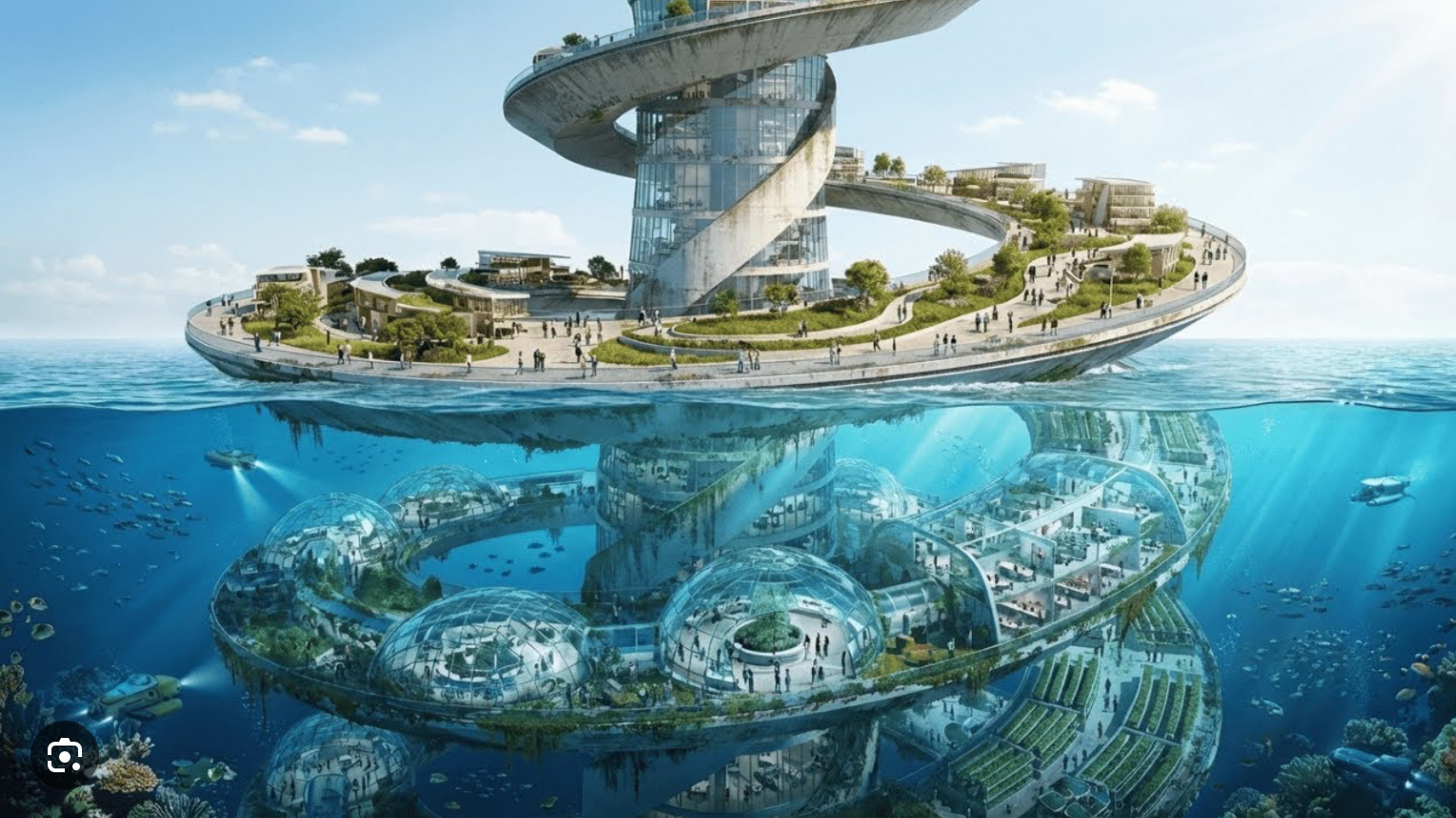
Intense exploration of Europa’s ocean led to the discovery of huge thick kelp and seaweed forests that upon many scientific analysis was found to be very rich in protein, vitamin and minerals that make a super food for humans and a medical supplement as well, richer than anything found on earth. The first city had a processing facility built into it along with a warehouse and docking capability for unmanned drone submarines to harvest the kelp. By 2080 the city was built and occupied and a thriving kelp business was operating. By 2090 two more cities were built on Callisto and Encaladus. Spacecraft were traveling from the moons to Earth and Mars every day. We we’re officially a space faring people now.
By 2080 the results of the seeding of the moons of primate species, and aquatic species, and bird life had been analyzed and found to be successful. The fish life was the most prolific. The octopus population had exploded, as had all the smaller fish. Whales had bred successfully, but not as prolific.
As for the primates on land, they survived and bred amongst themselves. In an interesting case of partnership, America joined with Chinese genetic scientists, and engineered changes to the larger primates like gorillas, orangatangs and chimpanzees to make them have human capabilities such as the ability to talk, conscious thinking. That is still an ongoing process. Time will tell.
In the meantime, we continue to explore.
Already we were looking beyond our solar system to the next frontier.
About the Creator
Guy lynn
I’m interested in history, space travel and the possibilities, Americana,( where I live now), Africa (Southern Africa, where I was born and raised), and I write about things that interest me ( bead history) and I hope will interest you.
Enjoyed the story? Support the Creator.
Subscribe for free to receive all their stories in your feed.
Comments
There are no comments for this story
Be the first to respond and start the conversation.