
The Mole She Never Had
What if the person who loves you most is also the one curating what you’re allowed to remember?
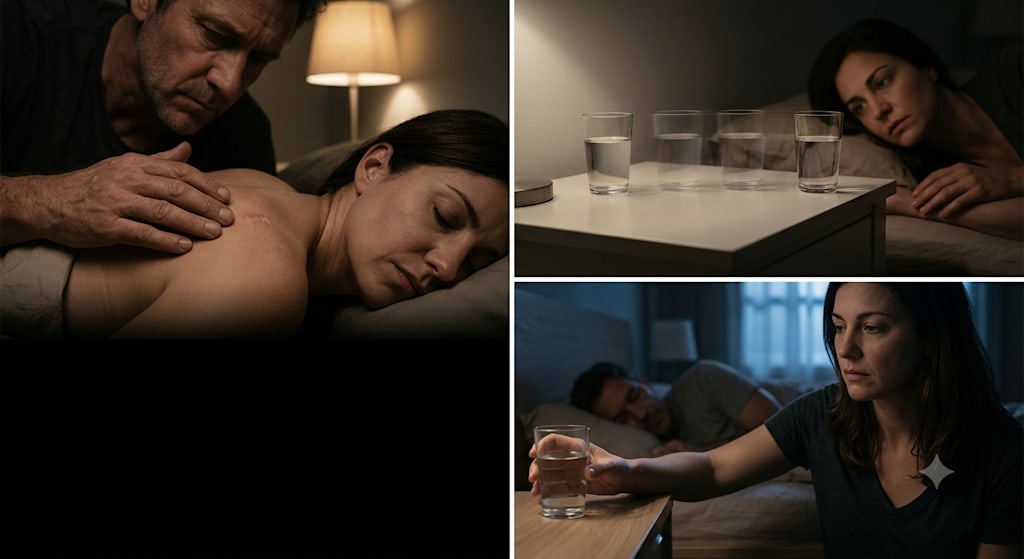
David’s thumb stopped just below my collarbone, pressing into the little hollow there, and then he said something strange.
We were still naked. It was four in the morning, the rain had just stopped, and our bodies were still wrapped in a thin film of sweat, his and mine. His fingers traced down my ribs slowly, like he was reading Braille. When he reached the third rib on the left, he paused and pressed down hard. It wasn’t a caress—it was pressure, the way you press a button to check if it still works. Then he said, “You have a mole here. You didn’t have it before.”
I laughed and said how would you know what I had before. You only saw my body for the first time two years ago.
He didn’t laugh. He switched on the bedside lamp, and the orange light fell across my chest. I looked down and saw a small mole just below my left collarbone, pale brown, maybe two millimeters across. I couldn’t remember whether it had always been there. He turned the light off, rolled onto his back, and took his hand off my skin. The patch he’d been touching cooled fast, and I felt the absence of his palm more than I’d felt its presence.
David and I met at a barbecue at a mutual friend’s place. It was August, the backyard full of smoke and the scent of rosemary. He handed me a glass of lemonade, and when I took it, our fingers brushed, that static-electricity kind of touch that made both of us pull back at the exact same second. Liquid spilled onto his wrist. He said, “You shocked me.” I said, “The glass leaked.” He said, “Did it?” and then he lowered his head and licked the drop of lemonade off his own wrist, his eyes on me.
That night, we had our first kiss in the back seat of his car. The windows fogged up. His palm pressed against my back, the whole hand warm, like an iron. I said, “This is too fast.” He said, “It’s not fast. It’s late.” I didn’t understand what he meant then.
Now it’s been two years. We live together, renting the upper floor of an old house, the landlord said was built over eighty years ago. The wooden stairs groan when you step on them. The ceiling slopes a little, and the south-facing window looks out onto a big maple tree. We have sex less often than we did at the start—down from every day to two or three times a week—but each time lasts longer. He spends ages on foreplay, touching me like he’s relearning my body all over again. Sometimes I think the way he touches me isn’t about pleasure; it’s about comparison. Like he’s checking an inventory for missing parts.
The morning it started, I woke up before him, got out of bed, and went to the kitchen for water. My glass was on the right side of the nightstand, the rim facing the window. I froze, because every night I placed it on the left, rim facing the door. I stood there for maybe ten seconds, then took a sip. The water tasted of rust. Old pipes, the landlord had said. I put the glass back on the left. Didn’t mention it.
It happened four mornings in a row. Every day, I woke to find the glass on the right. I knew I’d put it on the left because from the third night on, I took photos. Before sleep: glass on the left, rim toward the door. First thing upon waking: on the right, rim toward the window. On the fifth night, I stayed awake late. David was asleep beside me, breathing evenly. I lay in the dark, listening to his breath. A little after two in the morning, I felt the mattress shift—not the shift of someone turning over, but the motion of a body sitting up. I watched through slitted eyes. David sat up, his movement smooth, his eyes open. He got out of bed, walked barefoot across the floor, came to my side of the nightstand, picked up my glass, and moved it from the left to the right, rim facing the window. Then he stood there. I closed my eyes all the way, but I could feel his gaze resting on my face. He was looking at me. After a while, he went back to bed. I heard him exhale as he lay down—a soft release of breath I knew intimately. It was the sound he made in the second after he entered me, when he paused. Satisfied. Relaxed.
The next morning, he woke first and made coffee. I sat up in bed to the smell of it. The glass was on the right, rim facing the window. David came in with two mugs, bent down, and kissed my forehead. His lips were dry, tasting faintly of coffee grounds. He said, “Did you sleep well?” I said, “Fine.” I didn’t mention the glass.
That afternoon I went to the clinic. Not to see a doctor—to pull my medical records. The receptionist, Greta, knew me. I asked if she could look up something from two years ago. She said if you have your ID, I can pull it up. I waited about ten minutes. She scrolled through screens behind the counter, and her expression shifted from casual to a frown. She said, “There are two files under your name.”
My back went cold. I said, “What do you mean?”
She said, “Sara Morrison, date of birth April 12, 1992. The first file was opened in 2014, routine physicals, home address 117 Oak Street. The second file is also Sara Morrison, same date of birth, but it was created in August two years ago, home address here—the old house on Maple Street. There’s a linked note in both files. It says: ‘Host records merged. Retention point: small mole below the left clavicle. Reason: tactile anchor.”
I asked Greta who wrote that note. She said the system showed the initials D.M., and the date was the day after we moved in. David Morrison. He shares my last name. We’re not married.
When I walked out of the clinic, my hands were shaking, but what filled my head wasn’t fear. It was the back seat of his car, him saying, “It’s not fast. It’s late.” The way his tongue had touched that drop of lemonade. At the time, it had looked like flirting. Now, in hindsight, it looked like he was tasting something. Taking a sample.
I went home and searched his things. Not his wardrobe—there wasn’t that kind of guard between us—but I opened the toolbox he never let me touch. A carpenter’s box, planes, and sandpaper on top. Beneath the upper tray, there was a false bottom I’d never thought to open. Inside was a manila envelope. Inside the envelope were photographs. All of me. Not candid shots. Photos I didn’t remember being taken. Me standing at an attic window, the curtains a blue floral pattern I’d never seen in my life. I am sitting on an iron-framed bed, someone beside me but cropped out, leaving only half an arm, sawdust on the sleeve—David’s work shirt, the one I washed every week.
At the bottom of the stack, one photo had writing on the back. His handwriting. “Version three. The first two false repairs failed. This time, keep original memory under 10%. Leave her the tactile memory of the hip injury. Do not retain any attic imagery. No rain.”
I turned the photo over. The image was me, sitting under a skylight, looking out. The sky outside was the gray of imminent rain. In the photo, my right hand rested on my left hip, and on the back of that hand, there was a small mole. Identical to the one below my collarbone.
David came home as it was getting dark. I was on the living room sofa, the photos spread across the coffee table. He set his toolbox by the door, looked at the table, and looked at me. And then he did something I hadn’t expected—he didn’t explain, didn’t panic. He just walked over, crouched in front of me, took both my hands in his, and lowered his forehead to my knees. The gesture was so soft. So familiar. As if he’d done it many times before.
He said, “How much do you know?”
I said, “The attic. The rain. Who was I before version three?”
He didn’t lift his head. His voice came muffled through my knees. “You ask this every time. Every time you reach the ‘knowing’ stage, you ask. I’ve placed you back beside me three times now, and each time you end up here. And then I try again.”
I looked down at the back of his head. There were sawdust flecks in his hair, real sawdust. I picked one off and placed it on the coffee table. Then I lifted his face so he would look at me. I said, “Every time you touch me, do you know who you’re touching?”
He said, “I always know.”
Something deep inside me twisted at that answer. I couldn’t name the feeling. It wasn’t fear. It was deeper—like someone had opened a drawer I thought had been sealed shut long ago, and it was still warm inside.
We didn’t fight that night. We made dinner, ate, and washed the dishes. While I stood at the sink, he came up behind me, wrapped his arms around my waist, and rested his chin on my shoulder. His thumb found my left hip again, pressing into that same spot. I said, “What exactly are you feeling for?” He said, “The last thing your body remembers. A horse kicked you. You were seventeen. Below the attic. You said it hurt. You said you’d remember where the pain was.”
I said, “The person you’re describing isn’t me.”
He didn’t answer. But his thumb traced a circle around that bone. I closed my eyes. I felt something shift beneath the circle, like water moving under ice.
Late that night, we had sex. I know that sounds strange. A woman discovers her lover may have rewritten her entire life, and a few hours later, they’re still in bed together. But I wanted to understand. I wanted to see his eyes while his body pressed down on mine. He used to say he kept his eyes open before entering me so he could see who I was in that moment. That night, he didn’t say it. He just looked at me, his eyes red. His movements were slow, so slow I could feel every inch of entry and withdrawal. He wasn’t trying to make me come. He was making me remember. Every second felt like an engraving.
When the orgasm came, I didn’t cry out. My mouth opened, but no sound emerged. His hand pressed down on the mole below my collarbone, hard, like he was driving a nail in. I heard his breath go shallow and then stop for that one suspended second. In that second, his lips moved, and he said a name. Not Sara. Another name, one I didn’t recognize, but its syllables turned like a key. When I heard it, the attic skylight flashed through my mind—rain. Rain on glass. The iron bedframe. Blue floral curtains. Someone behind me, a hand between my shoulder blades, saying, “Don’t be afraid.”
Afterward, we lay side by side on our backs. The hand’s-width distance between our pillows stayed unclosed. His pinky rested against my pinky. I didn’t pull away.
“That girl,” I said. “The first version. Where is she?”
David was quiet for a long time. So long, I thought he’d fallen asleep. Outside, the maple tree rustled in the wind.
“Right now, she’s the grain in the handle of the old plane in my workshop. After she left, I used the plane her father gave me to build a chair. The chair is under your dressing table. You sit on it every day.”
I turned my head and looked at him. Tears slid from the corners of his eyes into his ears. He didn’t wipe them. I reached over and pressed my thumb to his cheekbone, catching the next one.
“Why do you keep doing this?” I said. “Rewriting, failing. Why not find someone else?”
He turned his head to meet my eyes. His gaze was very calm, the look of someone who already knows how his story ends.
“Because every time you reach the ‘knowing’ stage, you ask where that girl is. No version has ever not asked. Even the one where I cut memory down to ten percent, your body still trembles when I press your hip. You still say her name in your sleep.”
He paused. The wind outside pushed through the gaps in the old house’s windows, carrying in a smell of aged wood and sun-dried cotton.
“You’re not asking about her. You’re searching for yourself.”
He fell asleep before dawn. I stayed awake. I got up and walked to the dressing table, and looked down at the chair. The wood grain was dense, old oak, and on the backrest, there were two irregular pale streaks, like two figures lying side by side.
I put on my robe, went to the kitchen, and poured a glass of water. The glass was on the left, rim facing the door. I stood looking at it for maybe thirty seconds, then reached out, picked it up, and placed it on the right. Rim is facing the window. I did it myself. I knew I was doing it.
I walked back to the bedroom. David was breathing evenly, one hand reaching toward the empty space on my side, fingers curled. Outside, the sky was beginning to pale. A car passed in the distance, tires on wet asphalt, the sound like rain.
I lay back down. I draped my leg over his, knee against knee. His body shifted toward me automatically. I closed my eyes and thought about the mole below my collarbone. It seemed slightly larger than yesterday. Or maybe it was just the light.
I heard footsteps above me. Soft footsteps on the ceiling—a ceiling that had no attic above it. The old house’s ceiling was flat. But I heard them anyway. The footsteps stopped. Then came a sigh, barely audible, like a woman lying in a bed turning over, draping her leg over someone else’s. A man’s hand on her hip. Thumb tracing a circle.
I opened my eyes. No more sound from above.
I reached down and placed my own thumb on my left hip, pressing in. At the edge of the bone, there was a small patch of skin smoother than the rest. An old injury. Very old. I’ve never been kicked by a horse. But my hip remembers.
The glass is on the right. Rim toward the window. There is no rain outside. David turned in his sleep, his hand landing on my collarbone, fingertips resting on the edge of that mole. He didn’t wake, but his lips moved. He said that name, I don’t know.
This time, I didn’t pretend not to hear. I took his hand and moved it back down to my hip. The place the horse kicked. The place where, he said, I would remember the pain.
I closed my eyes. No more sounds from above. But the smell was still there—old wood, sun-dried cotton. The same smell I noticed the day we first moved into this old house, standing in the entryway while the landlord held the door open. Back then, I thought it was just the scent of an old house.
Now I know it isn’t.
About the Creator
Jin
Writer of reamstories
https://reamstories.com/jin
Enjoyed the story? Support the Creator.
Subscribe for free to receive all their stories in your feed. You could also become a paid subscriber, letting them know you appreciate their work.
Comments
There are no comments for this story
Be the first to respond and start the conversation.