
The Mild Adventures of Jim
A portrait of the modern world
The Mild Adventures of Jim
It was 6:00 a.m. when the buzzing of Jim’s alarm pulled him away from dreams and peace.
He opened his eyes, took a deep breath, and sighed. It was the kind of sigh that could only come from a man resigned to his fate, already knowing the day ahead would be almost exactly like the day before.
Jim reached for his phone on the nightstand and thumbed through social media feeds, headlines, and whatever articles seemed halfway interesting. After a few minutes, he set the phone back on the charger.
Next to it was a framed photograph of him and his now ex-wife.
It had been three years since the divorce. They had not been married long, only a year and a half, but it had been fiery and passionate in the way love can be when two people communicate almost identically while carrying very different childhood wounds.
At least, that was how Jim’s therapist had described it.
Jim thought about all the draft emails he had written to her over the years. Friends told him not to send them. His family told him not to send them. His therapist, with professional calm and expensive patience, also told him not to send them.
So they remained unsent.
Every word carefully weighed. Every paragraph another attempt to understand what had happened. He had given her attention, affection, love, and whatever stability he knew how to offer. His job allowed him to take her on trips and expensive dinner dates. He had thought he was doing what a husband was supposed to do.
Then, one day, she handed him divorce papers.
Out of the blue.
She said it was over.
There had been no explanation that gave him catharsis. No final conversation that turned pain into wisdom. No wound dressed cleanly enough to heal. She only told him that she no longer loved him.
That was the last time he saw her.
Some part of Jim’s mind was still sitting in that room, still holding those papers, still waiting for a better answer to arrive.
He placed both hands over his face and whispered, “Enough.”
It was a feeble attempt to quiet the tempest in his mind, but it was the best he could manage at six in the morning.
Then it was time for work.
Jim began the morning dance. He brushed his teeth, took a shower, and drank his coffee. He was running late, so there was no time to cook the kind of balanced breakfast that nutritionists and fitness enthusiasts always seemed to recommend.
He told himself that one of these days he would wake up early and cook something amazing.
Eggs. Fruit. Maybe oatmeal. Something responsible. Something adult. Something that suggested he was becoming the kind of man who had his life together.
For now, an English muffin with a little butter would have to suffice.
Every morning, Jim took a long walk around the block to get to his car. Parking was scarce in his neighborhood, and the city had turned the simple act of owning a vehicle into a daily scavenger hunt.
Oddly enough, the walk was probably one of the few peaceful moments Jim would have all day. The cool morning air filled his lungs. The world had not fully sharpened its teeth yet. The streets still held a little softness.
But Jim was too preoccupied with his thoughts to notice.
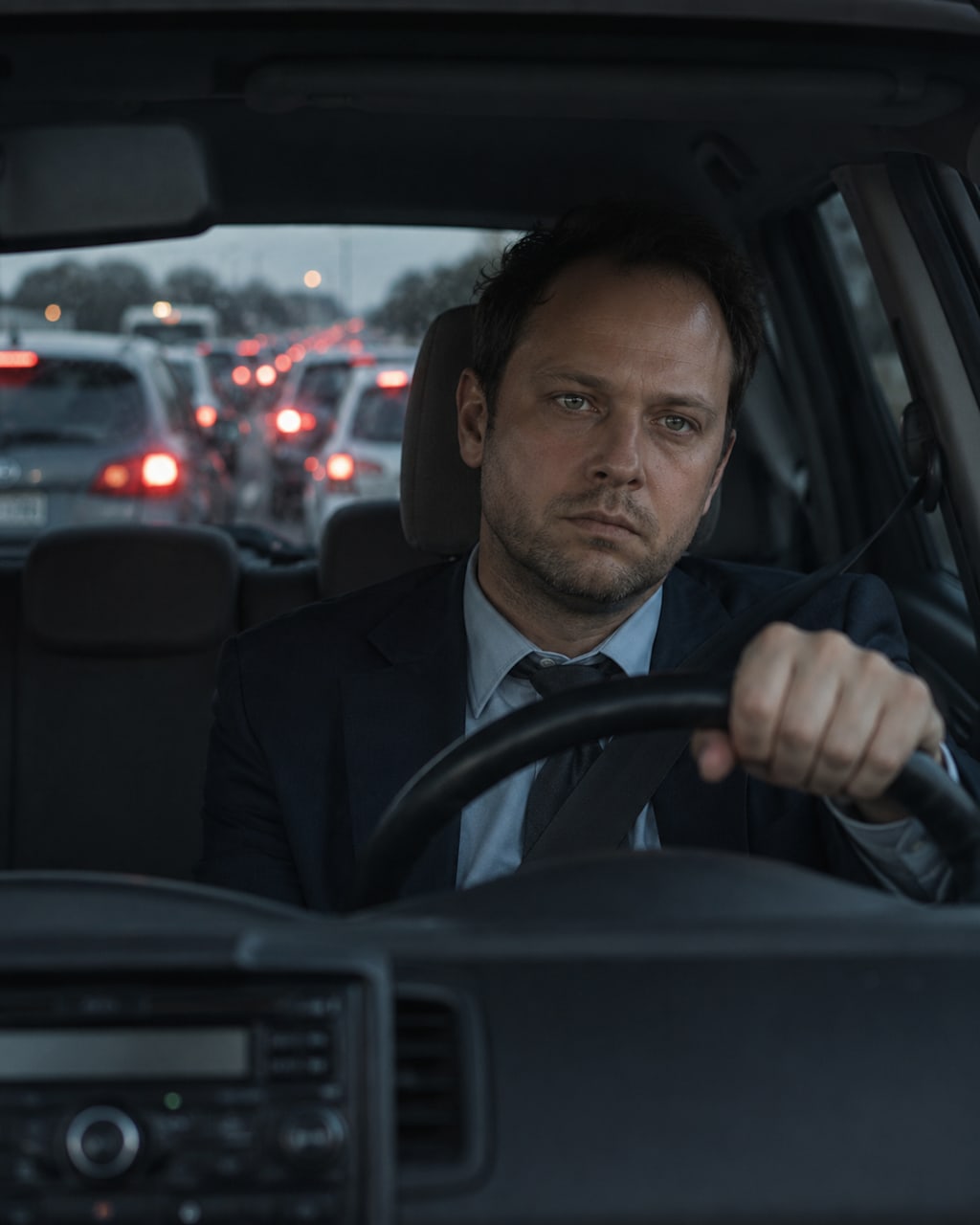
Traffic was terrible.
A long line of shambling human beings, all resigned to their fates, fought each other just to get to work. Turn signals became declarations of war. Brake lights became omens. Every lane change carried the drama of a tiny failed civilization.
Jim worked as a financial advisor, a profession he had never really wanted. His father had recommended it because it was stable, respectable, and made money.
After all, pursuing a dream in the arts did not pay.
So Jim chose the path of least resistance.
There was something strangely Zen about being stuck in traffic. Not peaceful exactly, but inevitable. For a brief second, Jim’s mind drifted away from brake lights and concrete and carried him to a beach in the Bahamas, where he was sipping margaritas under a sky that did not care about quarterly projections.
Then a soccer mom slammed her brakes in front of him.
Jim slammed his brakes too, torn violently from paradise.
Normally he would have shouted. He might have cursed. He might have thrown his hands into the air and delivered a private courtroom speech about incompetence, entitlement, and the decline of civilization.
But today he simply exhaled.
Today, Jim accepted the nature of morning traffic.
On the radio, one of the morning talk show hosts cracked a joke that made him chuckle. It was quick, loose, perfectly timed. The kind of joke tossed into the air by someone who made a living talking nonsense before breakfast.
Jim smiled and thought, Now that’s a job I would love to get in the car for.
When Jim was a kid, he had been something of a class clown. He told jokes. His classmates laughed. He liked the feeling of making a room turn toward him, not out of obligation, but because he had created something out of nothing and given it away.
He once wanted to become a comedian.
He had taken drama classes in college. Creative writing courses too.
Then the old sentence returned to him.
"The arts do not pay."
After what felt like ages, Jim pulled off the exit ramp and arrived at the office.
It was mostly empty now. The pandemic had made working from home normal, and most of the employees no longer came in. Jim could have stayed home too, but he had decided that working from home was not good for him.
Not in that house.
Not in the home he had shared with his ex-wife.
So he came to the office.
Like an orchestra conductor, Jim began the composition of his workday. He set down his binder, arranged his paperwork, turned on his computer, and started thumbing through the files of his most recent clients.
Jim was very good at his job.
That was part of the tragedy.
One hour became two. Two hours became five. Files were opened, calls were made, forms were reviewed, numbers were moved from one place to another with professional precision.
Eventually, the workday ended.
The drive home was mercifully short in the late hours.
Jim placed his car key on the kitchen countertop. This was the marker that the day was over. The little ritual that told him he could sit down and enjoy a few hours of peace before the quiet desperation of the next day began assembling itself in the dark.
He turned on the evening news because he felt obligated to appraise himself of what was going on in the world.
It was the same news as the morning.
War on the horizon. A new virus threatening the status quo. Markets uneasy. Politicians outraged. Experts concerned. Then, at the end, a few niceties tossed in like parsley on a bad meal.
A dog rescued from a storm drain.
A child selling lemonade for charity.
Humanity, Jim thought, always made sure to smile for the camera after reporting its own decline.
He picked up his phone and opened one of those delivery apps.
Pizza.
He knew he should eat better.
“I should probably be eating better,” he said aloud to no one.
But the pictures on the app were persuasive. Hot cheese sliding off the edge of a slice. Pepperoni glistening under studio lighting. A crust engineered to look both rustic and perfect. It was less food than prophecy.
His lizard brain acted faster than his rational brain. A lightning-quick impulse traveled to his finger.
He clicked Order Now.
Less than thirty minutes later, a young man rang his doorbell and set the pizza box down on Jim’s porch. The delivery driver smiled at the doorbell camera and waved.
Jim watched the young man complete his labor and walk off into the darkness of the night. He did all of this from the comfort of his smartphone, linked to the camera on his front door.
Once the threat imposed by this stranger was gone, Jim opened the door and retrieved his prize.
During his brief marriage, Jim had purchased a long dining table. He and his wife had hosted dinner parties there for neighbors and friends. There had been wine glasses, laughter, small arguments, stories told too loudly, and the warm chaos of people passing dishes around like offerings.
Now the same table felt almost like a grave.
Jim sat at the head of it, of course.
King of the castle.
Master of his domain.
He opened the pizza box.
The pizza was cold.
It looked absolutely nothing like the pictures he had been salivating over earlier, adding another insult to the injury imposed by the dinner table.
He ate anyway.
After dinner, Jim sat on the couch and let his mind drift. Inevitably, it wandered back to the draft emails he wanted to send his ex-wife.
He imagined each sentence doing exactly what it was supposed to do. He imagined his words unlocking something inside her. He imagined her reading them with tears in her eyes, finally understanding him, finally regretting the distance between them.
He pictured them holding hands again.
He pictured love returning because he had finally found the perfect arrangement of words.
Unbeknownst to Jim, his ex-wife had already found somebody through one of those dating apps. His name was Ricardo. He had washboard abs, was fifteen years younger than her, and did not speak a word of English.
Jim was also thumbing through a dating app.
He found himself bored with every profile he came across.
One profile claimed to be looking for a serious relationship, though all the pictures suggested something far more casual. Another listed hiking, brunch, and emotional availability with the same suspicious enthusiasm as a car dealership promising no hidden fees.
His inbox was just as depressing.
Ads for erectile dysfunction.
Fake profiles.
Sex robots asking for money.
“These dating apps are nonsense,” Jim said.
He tossed his phone across the couch.
Then he began the evening ritual of going to bed. He brushed his teeth, drank a glass of water, took an ibuprofen for the headache lingering behind his eyes, and changed into his sleeping shorts.
After the dance was over, he set his phone on the charger and got into bed.
He took one last look at the portrait of him and his ex-wife.
Then he remembered a joke one of the morning radio hosts had made about his own ex-wife. It had been crude, probably. Not especially wise. But beneath the timing and laughter, there had been something hidden inside it.
A small commandment dressed as a punchline.
Move on.
Jim stared at the photograph.
For three years, he had let that picture sit beside him like a shrine to the life that had refused to come back. Every morning, it greeted him. Every night, it waited for him.
He reached for it.
For a moment, the frame felt heavier than it should have.
Then Jim turned the portrait face down.
It was not forgiveness.
It was not healing.
It was not even bravery, not really.
But it was a decision.
Possibly, in some small and unseen way, it changed the fabric of his reality.
“I don’t want to look at her anymore,” Jim whispered.
Then, after a pause, he added, “Tomorrow I’m going to wake up early and cook myself a balanced breakfast.”
He turned off the light and drifted into sleep.
It would be the most restful night of sleep Jim had had in three years.
About the Creator
Alejandro Arango
A theater major, a poet, and a lover of the written word. I write to the muses that they may inspire me, and to you the reader. Hopefully you can find meaning in my words or something that will lighten your heart on this journey of life
Enjoyed the story? Support the Creator.
Subscribe for free to receive all their stories in your feed.
Comments
There are no comments for this story
Be the first to respond and start the conversation.