
The Man Who Paid for His Coffee with a Secret
Our café had one unusual rule: tell us a secret, and your coffee is free. Then a stranger walked in and told me something I wasn't supposed to know.

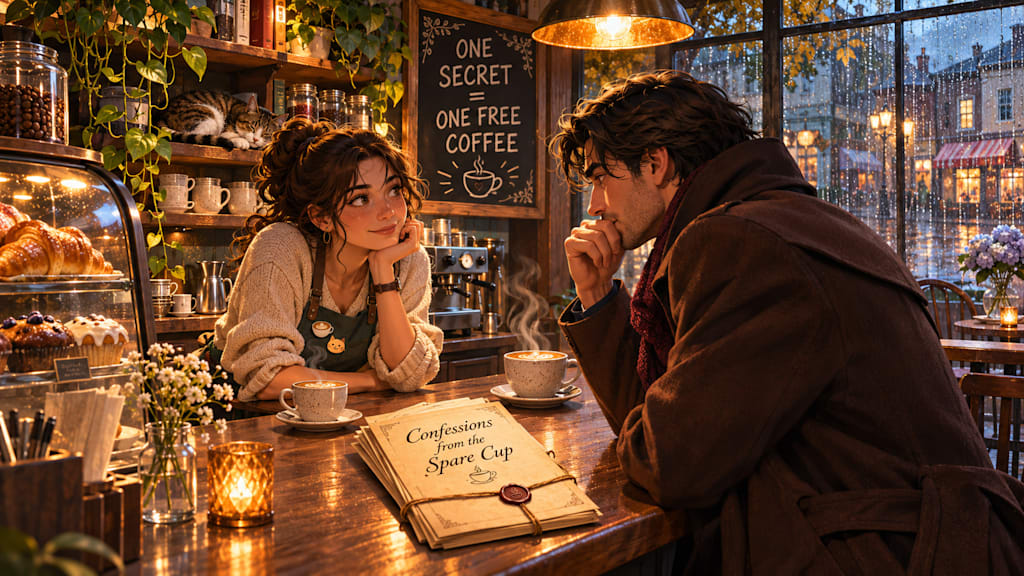
Our café had one unusual rule: tell us a secret, and your coffee is free. Then a stranger walked in and told me something I wasn't supposed to know.
The first man who paid for his coffee with a secret confessed to stealing a penguin.
To be fair, it was an inflatable penguin.
But he told the story with such seriousness that I nearly called the police.
"It was outside a seafood restaurant," he whispered. "Christmas decorations. Three in the morning. I was twenty-two."
"Did you give it back?"
"Eventually."
"How eventually?"
"March."
I handed him a cappuccino.
He looked genuinely relieved.
That was how our little tradition began.
Every Friday, anyone who told me a secret received a free coffee.
Nothing complicated. Nothing recorded. No names attached.
Just a secret and a cup of something warm.
It was the kind of idea that sounds ridiculous until people actually start showing up.
And for eleven months, it was wonderful.
Until a man in a dark brown coat walked into my café and offered me the one secret I wish I'd never heard.
The Friday Rule
My name is Leah, and I own a small coffee shop called The Spare Cup.
It's squeezed between a laundromat and a florist in a town where everybody knows everybody, and nobody seems particularly interested in minding their own business.
Our espresso machine sounds like an angry lawnmower.
The front door sticks when it rains.
And there's a customer named Frank who complains about the price of coffee every morning, then orders exactly the same thing.
I've considered putting his name on the menu.
The Frank Special: One Large Coffee, Two Complaints.
The café used to belong to my aunt Iris.
She moved to Florida two years ago after announcing that she was finished with cold weather, unreliable men, and people who ordered cappuccinos without foam.
She sold me the business at a price I could just about afford.
"Running a café isn't about coffee," she told me.
"It's about remembering that the person in front of you has had an entire day before they walked through your door."
At the time, I thought that was the sort of thing people said when they wanted to sound wise.
Then I started working behind the counter.
And I understood.
People came in carrying all sorts of things you couldn't see.
Bad marriages.
Good news they hadn't told anyone yet.
Loneliness.
Unpaid bills.
Sometimes just an overwhelming desire to scream at their boss.
One rainy afternoon, a university student realized she'd forgotten her wallet.
She looked so embarrassed that I offered to give her the coffee anyway.
"I can't just take it," she said.
"Then tell me something nobody knows."
She thought about it.
Then leaned across the counter.
"I've been telling my parents I'm studying law. I actually switched to art history."
I gave her a latte.
She gave me a smile so enormous I thought she might start crying.
The following week, I wrote a sign on the chalkboard.
FRIDAY SPECIAL
ONE SECRET = ONE FREE COFFEE
No judgment. No questions. No refunds on embarrassing confessions.
It became the most popular thing we'd ever done.
Well, except for the cinnamon rolls.
Nothing on earth could compete with the cinnamon rolls.
The Secrets People Keep
At first, people treated the whole thing like a game.
"I pretend to like my neighbor's dog."
"I've never finished a book I claimed was my favorite."
"I once accidentally congratulated a woman on her pregnancy. She wasn't pregnant."
That last one earned a moment of respectful silence.
Then the secrets started getting more personal.
Mrs. Patel, who ran the florist next door, admitted she'd been sending herself flowers on Valentine's Day.
"People are always telling me I'm lucky to work around flowers," she said.
"Sometimes I want someone to give me some."
I didn't know what to say.
So I made her a hot chocolate.
Extra whipped cream.
She came back the following Friday with a little bunch of yellow daisies.
"For you," she said.
I kept them beside the register until they started dropping petals into the tip jar.
Mr. Lewis, a retired mechanic who looked like he'd been assembled from spare car parts, confessed that he'd been learning ballet.
I stared at him.
He stared back.
"Don't laugh."
"I'm not laughing."
"You're doing that thing with your face."
"What thing?"
"The laughing thing."
I finally gave in.
He laughed too.
Turned out his granddaughter had asked him to join her at a charity performance.
"I figured if I can rebuild an engine, I can learn to point my toes."
He'd underestimated the difficulty considerably.
But he was trying.
That became my favorite part of Fridays.
People would walk in looking as though they were carrying something heavy.
They'd leave with a coffee and, occasionally, a slightly lighter expression.
I never wrote their secrets down.
Never shared them with other customers.
If someone didn't want to tell me anything, they could simply buy their coffee like everyone else.
The secret wasn't really payment.
It was an invitation to be heard.
At least, that's what I believed.
The Man in the Brown Coat
He arrived at 4:36 on a rainy Friday afternoon.
I remember the exact time because I'd been watching the clock, wondering whether I could justify eating the last cinnamon roll before closing.
He was around forty, with tired eyes, wet hair, and a brown coat that looked expensive once upon a time.
He stood in front of the chalkboard.
Read the sign.
Then looked at me.
"Is this offer still available?"
"Sure is."
"Any secret?"
"Preferably nothing that requires me to contact the authorities."
He didn't smile.
I lowered the milk jug.
"That was a joke."
"I know."
He took a seat at the counter.
"Can I have a black coffee?"
"Of course."
I reached for a cup.
He stopped me.
"I should tell you the secret first."
"All right."
He glanced toward the door.
There were only two other customers, both wearing headphones.
Then he leaned forward.
"I've written a book about this café."
I blinked.
"That's actually kind of lovely."
"Not exactly."
"Why?"
"Because I didn't ask anyone's permission."
I put down the cup.
He reached into his coat and removed a thick envelope.
Inside was a manuscript.
The cover read:
CONFESSIONS FROM THE SPARE CUP
The Secrets of a Small Town
I looked at it.
Then at him.
Then back at the pages.
"What is this?"
"My book."
"I gathered that."
"It's scheduled for publication on Monday."
My stomach tightened.
"What's in it?"
He hesitated.
"The stories people told here."
For a few seconds, I genuinely thought he was joking.
Then he turned to page seventeen.
And I saw a secret I recognized.
The Price of a Story
The story on page seventeen was about a woman who bought flowers for herself because nobody else ever did.
Mrs. Patel.
Not by name.
But the details were unmistakable.
Her shop.
The yellow daisies.
The little bell above her door.
I flipped to another page.
A retired mechanic secretly learning ballet.
Mr. Lewis.
Another page described a university student who had lied to her parents about her degree.
My hands went cold.
"How do you know these things?"
"I've been coming here for months."
I looked at him more carefully.
And suddenly I remembered.
The man who always sat near the window.
The one who ordered tea and worked on his laptop.
He'd changed his glasses.
Cut his hair.
But it was him.
"You were listening?"
He looked ashamed.
"Sometimes."
"Sometimes?"
"Leah, please—"
"How do you know my name?"
He pointed at my name tag.
Fair enough.
That one was on me.
"My name's Daniel," he said.
"I'm a writer."
"Congratulations. I'm a person."
He winced.
"I didn't mean to hurt anyone."
"Then why would you publish their secrets?"
"I changed the names."
I laughed.
Not because it was funny.
Because I couldn't believe he thought that was a reasonable answer.
"Mrs. Patel is the only florist on this street. Mr. Lewis is the only seventy-year-old mechanic trying to learn ballet. You could call him Princess Buttercup and people would still know who he is."
Daniel stared at the manuscript.
"I thought I was celebrating ordinary people."
"Did you ask the ordinary people?"
He didn't answer.
I turned another page.
And another.
Then I found a chapter about me.
The Girl Behind the Counter
It was called The Girl Who Needed Everyone to Love Her.
I almost threw the manuscript at him.
Almost.
I've always been quite attached to the idea of not going to prison.
The chapter described a lonely woman who gave away free coffee because she was desperate to feel important.
It suggested I'd invented the Friday tradition to make people dependent on me.
That I collected secrets to feel powerful.
That beneath my friendly smile was someone deeply unhappy.
I looked up.
"Where did you get this?"
Daniel shifted uncomfortably.
"From watching you."
"Watching me?"
"You always seemed so invested in everyone else's problems. I wondered if maybe—"
"You wondered?"
"Yes."
"So you made up the rest?"
He opened his mouth.
Closed it.
Then finally said, "I suppose I interpreted some things."
I looked down at the manuscript again.
There was a line about how I went home every night to an empty apartment.
That part was true.
But it wasn't because I was lonely.
It was because I liked living alone.
I liked watching terrible cooking competitions in my pajamas.
I liked eating cereal directly from the box.
I liked leaving dishes in the sink and knowing nobody would complain.
Not every quiet apartment is a sad one.
And not every woman who smiles at strangers is secretly begging to be loved.
I pushed the manuscript toward him.
"You don't know me."
He said nothing.
"And I think that's the problem with your book."
An Unexpected Meeting
I wanted to tell him to leave.
Instead, I asked when the book was going to print.
"Monday," he said. "But there's still time to stop it."
"Then why haven't you?"
His expression changed.
For the first time, he looked genuinely frightened.
"Because this is the first book anyone's agreed to publish."
I sat down opposite him.
He told me he'd been writing for twelve years.
Three novels.
Dozens of short stories.
Hundreds of rejection emails.
Then he'd started visiting the café.
Listening.
Writing.
And suddenly a publisher was interested.
"It's the first thing I've written that people actually want to read," he said.
I understood why he was scared to lose that opportunity.
I really did.
But that didn't make the book his to publish.
"Daniel," I said, "these people trusted this place."
"I know."
"Do you?"
He rubbed his face.
"I thought changing the names would be enough."
I glanced at the manuscript.
Then I had an idea.
"Come back tomorrow."
He looked confused.
"Why?"
"Because I think there are a few people you need to meet properly."
Saturday Morning
At ten o'clock, Daniel returned.
He looked like a man on his way to a dentist who had already seen the X-rays.
I'd invited a few regular customers to the café.
Not everyone.
Just those whose stories I recognized in the manuscript and could contact.
I hadn't told anyone's secrets to the others. I'd simply explained privately that someone had written about them without permission.
Mrs. Patel came carrying a paper bag of pastries.
Mr. Lewis arrived in a tracksuit.
Frank came because he'd heard there might be free coffee.
There wasn't.
He complained.
Then bought one anyway.
Daniel stood awkwardly beside the counter.
I introduced him.
"This is Daniel. He's written a book about some of the people who come here."
Mrs. Patel smiled.
"Oh! How exciting."
Daniel looked at me.
I folded my arms.
"Tell them the rest."
He swallowed.
Then explained.
Everything.
The listening.
The stories.
The details he'd included without asking.
The things he'd invented because they sounded more interesting.
When he finished, nobody spoke.
Then Frank raised his hand.
"Am I in it?"
Daniel looked down.
"Yes."
"Do I sound handsome?"
I closed my eyes.
Of course.
Of course that was his first question.
Daniel hesitated.
"I described you as distinguished."
Frank nodded approvingly.
"Good."
Mr. Lewis wasn't amused.
"You wrote about my granddaughter?"
"Yes."
"Did you ask her?"
"No."
"Then take it out."
His voice was quiet.
But nobody mistook it for a suggestion.
Mrs. Patel leafed through the pages.
She found her chapter.
Read it.
Then shook her head.
"You made me sound miserable."
Daniel shifted.
"I thought—"
"I know what you thought."
She looked up.
"Yes, I buy myself flowers. Sometimes I get lonely. But I also have friends, a business I love, and a very handsome man who comes into my shop every Thursday."
Frank looked interested.
"Who?"
"None of your business, Frank."
He leaned back.
"Well, now I'm invested."
Even Mr. Lewis laughed.
Mrs. Patel closed the manuscript.
"You took one sad thing I told someone privately and made it my entire personality."
Daniel nodded.
She wasn't finished.
"And you've written me as if I'm waiting for a man to make my life complete."
She pointed at the page.
"I bought those flowers because they're my favorite color. I don't need anyone's permission to enjoy them."
Daniel said quietly, "I'm sorry."
I expected her to say something sharp.
Instead, she sat down.
"Then do something about it."
The Secret He Couldn't Tell
Daniel called his publisher from the café.
It wasn't a pleasant conversation.
There were questions.
Arguments.
A very long silence.
Then another argument.
But eventually, he arranged to stop the book from going into production.
I didn't hear the whole conversation.
I did hear him say, "No. I don't have their permission, and I should have asked."
When he hung up, he looked exhausted.
"The book's canceled."
Nobody cheered.
It didn't feel like a victory.
More like someone had finally stopped a bad decision before it became a much bigger one.
Daniel sat at the counter.
"Well," he said, "there goes twelve years of trying to get published."
"Not twelve years," I said.
"Just one book."
He looked at me.
"You sound like my editor."
"I'll take that as an insult."
He laughed.
A small, miserable laugh.
Then he stared at the manuscript.
"I think I know why I did it."
Nobody interrupted.
He took a breath.
"I've spent years trying to write something important. And every time I start writing about my own life, I convince myself nobody would care."
Mrs. Patel leaned forward.
"Why?"
He looked embarrassed.
"Because nothing particularly interesting has happened to me."
Mr. Lewis snorted.
"You've just spent six months secretly collecting stories from a coffee shop and nearly published a book that made half the town furious."
Daniel looked up.
Mr. Lewis shrugged.
"Sounds fairly interesting to me."
Frank nodded.
"I'd read that."
There was a pause.
Then Daniel laughed.
Actually laughed.
For the first time since he'd walked through my door.
And something about that made the room feel different.
Not fixed.
Not forgiven.
Just a little less heavy.
One Last Coffee
By noon, everyone had left.
Except Daniel.
He sat at the counter, staring at the now-useless manuscript.
I started wiping down the tables.
After a while, he spoke.
"Can I ask you something?"
"Depends."
"Are you going to keep doing the Friday secret thing?"
I looked at the chalkboard.
ONE SECRET = ONE FREE COFFEE.
I thought about Mrs. Patel.
Mr. Lewis.
The student who'd switched degrees.
All the people who'd trusted me with a small piece of their lives.
"Yes," I said.
"But I might change the sign."
I picked up a cloth and wiped away the bottom line.
Then I wrote something new.
ONE SECRET = ONE FREE COFFEE
Your story stays yours.
Daniel read it.
"That's good."
"Thanks."
He stood to leave.
Then stopped.
"Wait."
I turned.
"I never got my coffee yesterday."
I stared at him.
"You're joking."
He gave me a tired smile.
"I did tell you a secret."
I considered it.
Technically, he was right.
Technically, he'd also nearly turned my entire café into a collection of unauthorized biographies.
I made him a black coffee.
Put it on the counter.
Then held out my hand.
"Three dollars."
He blinked.
"What?"
"Three dollars."
"But the sign—"
"That was everyone else's secret, Daniel."
He stared at me.
Then slowly reached for his wallet.
"Fair enough."
He paid.
And left a five-dollar tip.
I watched him walk out into the street.
For a few moments, I wondered whether he'd ever write another book.
Whether he'd tell his own story this time.
Whether anyone would want to read it.
Then the door opened again.
It was Frank.
Of course it was Frank.
He looked at the chalkboard.
Then at me.
"I have a secret."
"It's Saturday."
"I know."
"Free coffee is Friday."
"I know."
He leaned across the counter anyway.
"I don't actually hate your coffee."
I smiled.
"Really?"
"No."
He looked around as though someone might be listening.
"Best coffee in town."
I laughed.
"Then why do you complain about it every morning?"
He shrugged.
"Because it's nice having something to talk to you about."
For once, I didn't have a clever response.
I just made him his usual.
Large.
Black.
No sugar.
He reached for his wallet.
I waved him off.
"On the house."
He frowned.
"But it's Saturday."
"I know."
He took a sip.
Then pointed at the chalkboard.
"You realize this is terrible business management?"
"Probably."
He nodded.
"Your aunt would've charged me double."
"She absolutely would have."
He smiled into his cup.
And for the rest of the afternoon, he didn't complain about a single thing.
Which, frankly, was the biggest secret of all.
About the Creator
Ahmet Kıvanç Demirkıran
As a technology and innovation enthusiast, I aim to bring fresh perspectives to my readers, drawing from my experience.
Enjoyed the story? Support the Creator.
Subscribe for free to receive all their stories in your feed. You could also become a paid subscriber, letting them know you appreciate their work.
Comments
There are no comments for this story
Be the first to respond and start the conversation.