
the magical baby-sitting dog
In memory of my Father


When I was a boy in the 1950’s and 60’s, stories from our family history were oral rather than written, tales told lazily in the darkness on my grandparents’ porch. Granddad would hold court there in the humid evening hours, us kids sitting in awed silence while he and other kinfolk wove tales of days long gone by.
Our father rarely spoke on those twilight eves, other than to ask questions triggering stories he knew that us kids had never heard. That is how we learned the legend of Bruce, the magical baby sitting dog.
Imagine the scene in your mind’s eye with me. It’s 1933, the Dust Bowl has descended upon the Great Plains and the grinding poverty of the Great Depression holds the nation in piteous thrall.
A plaintive bark echoes across the evening stillness as songbirds begin to retreat to their roosts in water oaks, magnolias, and old gnarled cedars. Sailing across a field of corn stalks dry and yellow from the heat a raven lands atop a dead tree, the evening sun slowly drifting below the western horizon. On a small rise of earth, a little one room shack begins to fade from view before disappearing in the night save for a still flickering lantern in its lone window.
At first light, a woman steps out of the shack with a pair of metal buckets like she has every other morning for the past several years to walk to a nearby spring where she will fill them. Her family will drink from the same one she uses for meal preparation and the other they'll use for washing. But stopping mid-stride, she stares at a raggedy dog at the bottom of the porch steps, his tail wagging weakly, his gaze steadily holding hers.
The woman holding those pails was my grandmother, Velma Lee Opal. She often fed and befriended strays – animal and human alike, for times were hard with the depression dragging on. They rarely stayed, however, moving from house to house in a ceaseless effort to fill the gnawing a emptiness in their bellies.
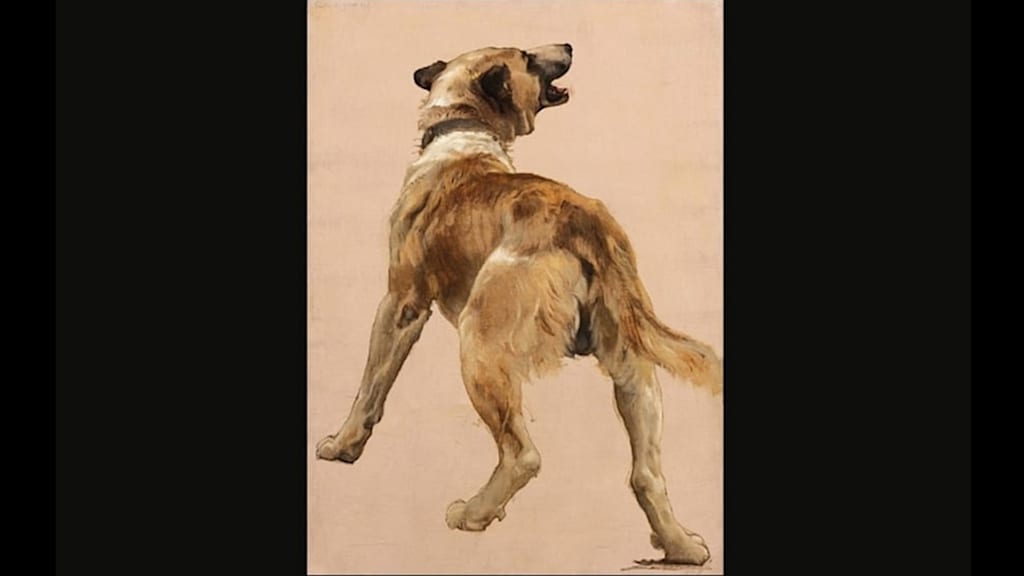
But lingering after eating the bit of biscuit and pork fat she tossed him, this dog sat contently – scratching his mottled brown fur when others would have moved hungrily on. She pretended to return to the house in the hope he would trot away, but undeterred, he spoke, a brief sharp bark, and she turned and gazed sadly at his frowsy white face, his bright, intelligent eyes staring in return into hers.
“What is it boy?” she had asked, and he lowered his shoulders and wagged his trunk and tail in answer. She frowned, her sparse cupboards a reminder of the absurdity of allowing it to stay. Poor thing, she thought, I can’t handle another mouth to feed. With an abrupt wave of her arm she yelled, Go on … git! But he sat quietly, his earnest gaze unmasking her bluff, his open features making it impossible to send him away.
She shrugged in defeat and picked up the buckets and began yet another walk to the spring, the dog trotting protectively after.
She and my grandfather were sharecroppers with naught but a mule to pull the plow and a jersey cow for milking, farming brutally hard when the rain at best was sporadic and the heat broke records daily. The prices the markets paid for the vegetables they grew were barely worth all the sweat and toil to harvest them. It did not help that her husband was an indifferent farmer, often fishing or going on a weekend bender when he aught to have picked crops.
With three little ones to watch, she was helpless to prevent the fruit of their labor from over-ripening or spoiling before it was taken to market. And when it did not rain, someone needed to walk those buckets to the spring again and again or they might lose their crops altogether. But the dog that followed her obediently to the spring and back for no more than a bit of food suggested to her mind an almost human willingness to help.
A full belly and a little affection go further with your average dog than your average human. Dogs are just so damn grateful that seen in any other light it is amazing the typical pet owner fails to even consider putting them to work.
But that is exactly what she did. Before long she was setting a blanket under whatever shade was handy and placing the children there to play while the new dog paced loyally nearby. If they got too rambunctious or tried to leave the blanket, he would run in tight circles to keep them in place or force his way between them, distracting them with his happy lolling tongue from the temptation of the surrounding clay still wet from the heavy morning dew or the slow heavy bodied wasps gathering the moist earth to build cylindrical cells for their brood.
In the beginning she would work nearby with frequent glances over her shoulder to ensure her children were safe, but as the days and weeks wore on she learned to trust his diligence more and more, working longer stretches and greater distances from the blanket, often breaking up the thick clay with a hoe up one long row and down another without a backward glance.
Each morning, he would wait for her to emerge with her buckets and follow her to the spring and back. After several months of their routine, one morning Bruce spotted a rabbit and he uncharacteristically bolted. She continued down the pathway without him, chuckling and shaking her head.
Once the pails were filled, she lifted them to return home, but the dog was nowhere to be seen and pausing briefly, she called out Bruce! and listened for the friendly, answering bark.
But when he did not answer, with a resigned shrug of shoulders bent by the weight of the filled buckets she started up the pathway to the house with the pails swinging at her side, her eyes watchfully scanning the undergrowth on either side of the trail for signs of Bruce, expecting him to suddenly spring over the tangled honey suckle or out of a stand of young loblolly pines. Consequently, the copperhead sunning itself in the trail was unseen until it was too late and her booted foot nearly crushed its tail.
Raising its head in warning she stiffened, the pails involuntarily dropping at her sides, the viper’s mouth suddenly exposing weepy fangs before disappearing in the blinding flurry of the bounding dog, his head violently shaking the thrashing snake, the sound of his grinding snarl causing her to step backward in abrupt terror, the delayed recognition of danger creating a sudden burst of heat and white light, the dog barking at the dead snake dissipating in terrifying brightness as she sat heavily on the ground, the water running back down the pathway toward the spring from the forgotten pails.
Once her eyes finally cleared, she gazed in wonder at the dog standing fiercely at her side, both cheeks punctured and bleeding, one eye already swollen shut. But she did not speak, the words trapped for a seeming eternity within her throat. And here the story on the porch ended with sage warning to never tangle with a junkyard dog before other stories would have their turn whether comical, tragic or filled with simple wonder.
But the story of Bruce babysitting my aunt Nonnie, my dad Jay Dee and my uncle Cee Tee or of him killing the copperhead to protect my grandmother were adult reminiscences and merely the backdrop for a tale based solely on the memory of a little four year old boy.
My father was not much of a storyteller, so he didn’t tell them often. We did not sit on the porch hoping to hear him recount tall tales in any event. We only saw our southern kinfolk for two weeks out of the year. Our father we could listen to any time during the remaining fifty.
But we already knew the rest of the story, for dad had told it since our earliest youths. There was a lesson there, that we would only come to understand with time.
This tale began where the other’s ended: his momma’s return that morning to the shack that Bruce crawled under to hide and did not even come out again when she set out his food with a metal pan of water. They did not see him the next day, or the next or even several days after that.
Each morning, my dad peered under the house to look for Bruce but never spotted his hiding place. This went on for two weeks before he begged his mama to help him coax the dog out.
Nonnie and Cee Tee joined them, their mama bending down and whistling for Bruce without hearing an answering bark or growl. My dad started to bawl, and his mama's eyes grew wet. Sick dogs are not the only ones who hide, my dad would say, dying dogs do the same.
But they kept calling to the dog, their piteous voices reminding their loyal pet that he was needed even in his sickness and profound fragility. Love called him out when no other magic could, and brave Bruce crawled painfully into the light where the three kids embraced him, my dad fiercely hugging the dog's neck as Bruce lifted his frowsy head and weakly howled.
As best as I can recollect, I never heard anyone else tell the story of Bruce crawling into the light or his weak triumphant howl. This was my dad’s story and he told it to the very end of his life.
The narrative never varied, and he always wept when he imitated Bruce’s howl, even as an eighty-six year old in the final year of his long life.
My dad prized loyalty over every other virtue, and the story of Bruce’s loyalty meant enough to him that this experience from his early childhood became the lodestar for his entire life and in consequence ours as well. As you have probably noted, we understood his lesson in the end.
About the Creator
John Cox
Where would you like to travel? Who would you like to meet? No ticket required, a surprise at every destination guaranteed. Strap on your time travel goggles and bring a compass. It's sometimes bumpy in my imagination, so hold on tight!
Enjoyed the story? Support the Creator.
Subscribe for free to receive all their stories in your feed. You could also become a paid subscriber, letting them know you appreciate their work.
Comments
There are no comments for this story
Be the first to respond and start the conversation.