
The Machine Chose Me
A maintenance worker enters the command deck and discovers the ship has mistaken him for its captain

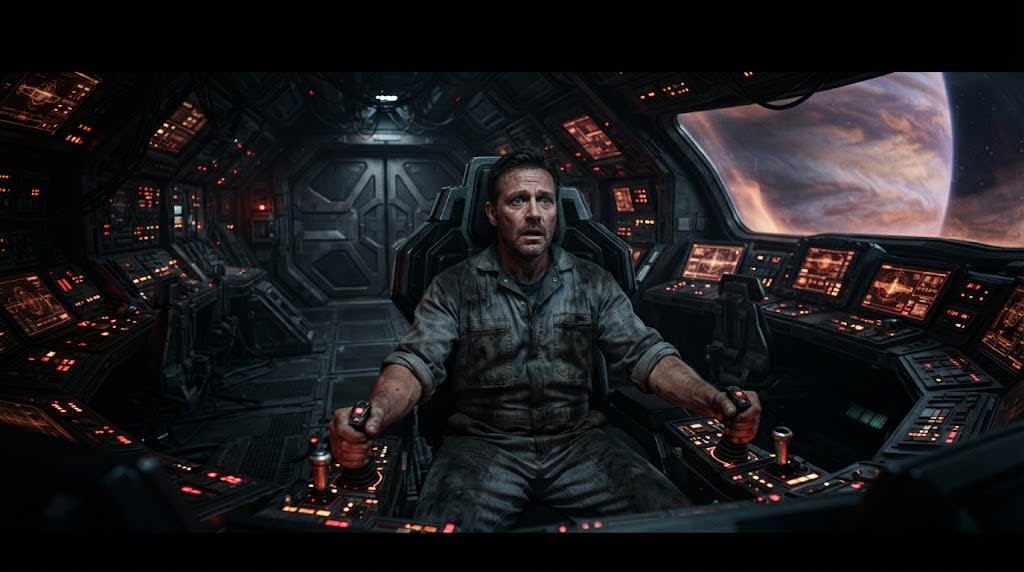
You spend the first hour cleaning machinery you will never be allowed to touch again. Black grease smudges across your sleeves as you crawl beneath the service corridor where the command platform sits behind two meters of armored bulkhead. The maintenance cart digs into your hip each time you drag it forward, with the inspection lamp slipping from its bracket as you work around the hydraulic lines.
The machinery leaks a thin coat of fluid from three aging couplings, so you wipe each fitting with shop cloth and run your thumb along the rubber seals to check for fresh seepage. The fluid feels warm through your gloves, its chemical odor following you through the corridor as the ventilation unit pushes stale heat from one section to another. Your tool case rattles beside you, packed with drivers, socket heads, seal picks, pressure gauges, cable ties, and the heavy service tester required for command-level equipment.
The platform belongs to officers whose uniforms cost more than your annual salary. Your job consists of keeping their machinery alive and staying out of their way. That distinction seemed simple enough until the service alarm sent you toward the one corridor you were trained to avoid, and now the red security panel at the end of the passage stares back at you as the alarm indicator continues its slow rotation.
You set the service tester against the bulkhead and open the maintenance panel beneath the reader, exposing the old service interface buried behind a metal cover. Using the short driver from your kit, you remove the cover, place the screws inside the tester case, then inspect the connector block as the tester identifies the maintenance circuit and the separate security circuit.
The tester provides a maintenance procedure for a failed primary controller. You follow the sequence while the casing grows warm against your glove. Sweat stings your eyes as the corridor machinery continues pounding through its cycles behind you, forcing you to hold the connector steady while the diagnostic system checks each circuit in sequence.
The status indicator changes from red to amber. You keep the service lead in place as the internal relays begin cycling through their checks. One relay clicks behind the panel, another responds deeper inside the door, then three heavy impacts follow as the locking bolts retract from their housings.
You close the maintenance panel and gather the tester. The service indicator remains amber as you stand there with the access door directly in front of you, the maintenance alarm continuing its low electronic tone. You should report the fault and walk away, yet you grip the manual release instead and pull until the armored door begins sliding aside.
The command platform stretches far beyond the cramped service corridors, with raised control stations arranged in several tiers and banks of dark displays extending toward the forward bulkhead. Every console sits beneath its own recessed lighting strip, while the central station rises above the others on a circular platform surrounded by equipment you have only seen in maintenance diagrams.
The door closes behind you with a pneumatic shove. The locking mechanism engages before you can turn back, leaving you standing there with your maintenance cart several meters behind you. The service indicator remains green beside the sealed panel, while the silence of the platform leaves the command station waiting ahead.
You walk toward the central station one step at a time, each step carrying you deeper into a room built for people whose names appear on every restricted work order. The consoles have smooth control surfaces, sealed toggle covers, rotary selectors, pressure-sensitive pads, and rows of recessed switches protected by clear plastic shields.
The command chair sits at the center of the platform. You have repaired its hydraulic adjustment system twice even though you have never been allowed to sit in it. The maintenance records list the chair as an integrated command interface, with positional sensors beneath the seat and authorization contacts concealed inside the arm supports.
You lower yourself into the chair. The mechanism accepts you with a sequence of mechanical clicks as the rear support rises and the side restraints move closer to your shoulders. Your boots rest against the raised trim beneath the central console, bringing every control into view while the dark displays surround you on three sides.
You run your thumb along the right control boundary and find three rotary selectors, two covered toggles, and a red switch beneath a transparent guard. The left side carries a communications control, a tactical display selector, and a recessed command button, while small status indicators remain dark across the entire station.
You press the communications control, and the nearest display comes alive with lines of technical data scrolling beneath a command-network status block. Several senior authorization channels show inactive status. A red maintenance notice reports an unresolved system fault that has remained open for 187 days.
A screech of feedback blasts from the overhead speaker horns, driving your shoulders against the chair support as chopped syllables fight through heavy interference. You reach toward the audio controls as another ugly blast tears through the speakers, followed by a voice that comes through in broken pieces and ragged breathing.
“Command platform, respond, you have a breach at—” The speaker cuts out before the sentence finishes, leaving you leaning toward the communications display while the transmission buffer fills with corrupted audio. A second fragment pushes through several seconds later, and the voice says, “Repeat, coordinates seven-one-four by—” before the transmission collapses again.
You raise the transmission gain. The speaker gives you another burst of distorted speech while the communications display begins recording each fragment. “Do not initiate descent, repeat, do not—” comes through clearly enough for you to understand the warning before the remaining words dissolve into electronic garbage.
The voice returns with ragged breathing between every phrase, and you hear the same coordinate sequence repeated beneath the interference. “Seven-one-four, three-six, nine-two, confirm your position,” the speaker says before the transmission cuts out and leaves the platform without a response.
You stare at the coordinates while the communications display keeps them visible. Another harsh electronic crack comes from the speaker before the voice returns. “Seven-one-four, three-six, nine-two, you are receiving this, confirm command status,” the transmission says, with the final words breaking apart into clipped fragments.
You lean closer to the console as the speaker struggles through another cycle. The voice returns with enough clarity to make the warning clear. “Command override required, confirm tactical position,” the speaker says, and the words leave your mouth before you can think through the consequences.
“What the hell?” you shout. The command microphone captures your voice before the final word has finished leaving your mouth. A green tracking line jumps across the diagnostic display in exact time with the sound, followed by a second line beneath it carrying a vocal authorization code.
The software compares the recording against the command database. Authorization fields fill the screen while the speakers replay the last part of your voice through a monitoring channel. The first field changes from yellow to green, and the next line displays COMMAND AUTHORITY: SENIOR as a third field begins processing beneath it.
You reach for the communications control. The display changes before you touch it, and a red warning panel disappears from the center screen. The next authorization field turns green, followed by TACTICAL OVERRIDE: ACCEPTED beneath your assigned command status.
The chair locks its adjustment controls while a heavy mechanism engages beneath the platform. The sound travels through the deck as blast doors begin descending across the access corridors. One armored panel drops from its recessed track and slams into its lower housing, followed by another farther across the platform.
You stand and move toward the nearest exit, reaching it as the first door seals. You turn toward the second corridor while another armored panel begins descending. The service entrance becomes your only option, yet the maintenance panel beside it flashes red as the computer cancels service access before your hand reaches the release.
You strike the release control and try again. The system displays a countdown above the sealed door, and the first number changes before you can find another control. The transmission returns through the speakers at the same time, with the broken voice saying, “Command platform, you have been compromised, do not authorize descent.”
The display changes again while the countdown continues. Large red letters fill the central screen with the words TACTICAL COORDINATES REQUIRED. You turn toward the chair as the next number replaces the first, and the command system begins routing power toward the descent controls.
You pull the emergency release beside the door. The lever refuses to move while the mechanism grinds behind its casing. Bracing yourself against the panel, you pull harder, then reach for the maintenance tester when the housing remains sealed.
The tester slips from your grip and clatters across the deck, sliding beneath the nearest console while the countdown continues above the door. The transmission returns through the speakers with another broken warning, and the voice says, “Do not let the system take you down,” before the signal collapses into electronic noise.
You crawl beneath the console and retrieve the tester while the deck begins vibrating beneath you. The vibration grows stronger as hydraulic systems engage somewhere below the platform. You push yourself upright and turn toward the central display, where the tactical coordinates remain fixed in bright characters.
Seven-one-four, three-six, nine-two remain on the screen while a second line begins calculating a descent trajectory. The system reports that launch preparation will begin after final authorization. Behind you, the command chair waits with its restraints open and its controls illuminated.
You return to the chair while the countdown continues. The restraint closes across your shoulder as soon as you sit, followed by another restraint locking across your waist. The command interface rises in front of you, and the tactical display expands across the central screen.
Thirty-eight seconds remain. You reach for the emergency command while the system rejects the input and returns TACTICAL AUTHORITY REQUIRED in red letters. You press the communications control next, and the transmission disappears from the speaker while the computer continues counting down.
You reach for the main power selector. The control locks beneath a red authorization field while the ship changes attitude beneath you. The deck tilts slightly as the engines alter their orientation, and deep mechanical forces begin traveling through the command platform from machinery far below.
The speaker crackles again. The broken voice forces its way through the interference with a single word that comes through clearly enough to understand.
“Please,” the voice says, and the transmission breaks apart while the countdown drops toward twenty seconds.
You stare at the three coordinates while the system waits for confirmation. The command interface places a red authorization field beneath them. Your entire career has consisted of repairing machines built for people above your pay grade, and now every system aboard the ship has decided you are one of them.
The countdown continues while the engines build power beneath the platform. The chair restraints hold you against the command station as the descent sequence prepares to begin. You reach toward the controls while the computer waits for the voice it believes belongs to the person in charge, and the microphone opens across the console as the final authorization field begins blinking.
About the Creator
Tim Carmichael
Let your becoming be louder than your fear, and your smallest steps become the road you once thought impossible to walk. An Appalachian poet and cookbook author my book Beautiful and Brutal Things is on Amazon, Link 👇
Enjoyed the story? Support the Creator.
Subscribe for free to receive all their stories in your feed. You could also become a paid subscriber, letting them know you appreciate their work.
Comments
There are no comments for this story
Be the first to respond and start the conversation.