
The Library of Unread Lives
Every book is a person. Every person is a book. But who writes the endings?
The library has no doors.
This is the first thing they tell you, though by the time you understand what it means, you have already stopped looking for exits. The corridors shift when you aren't watching. The shelves breathe. The books do not gather dust because dust implies time, and time is the one thing this place does not traffic in.
I found it on a Tuesday, which is significant only because Tuesdays are the day I have always felt most invisible. Not Mondays, when everyone is invisible together. Not Fridays, when the promise of escape makes the present bearable. Tuesdays are the purest form of ordinary, and it was in that ordinary that I stumbled through the gap between a laundromat and a closed bakery, into a space that smelled of paper and something else, something I would later identify as the scent of decisions not yet made.
The librarian was waiting. She is always waiting.
She looked like every librarian I have ever imagined and none I have ever met. Gray hair not from age but from something else, something that happens to people who spend too long in the presence of other people's stories. Eyes that did not focus on me so much as read through me, as if I were already a text she had memorized and was merely skimming to confirm the ending.
"You've come to choose," she said. Not a question.
"I don't—" I started.
"Everyone chooses. That is the only rule. You choose a life, you live it until the last page, you return it when you're done." She gestured to the shelves, which stretched upward into darkness, each book identical in size and binding, each spine unmarked except for a number. "Some lives are short. Some are long. Some are happy. Most are not. The choice is yours, but the choice is final."
I looked at the books. I looked at the numbers. I looked at the librarian, who was no longer looking at me but at something behind my shoulder, something I could not see.
"What if I don't choose?" I asked.
She smiled. It was not a comforting smile. "Then you become one of the unread. The books no one picks. They stay here forever, conscious, waiting, aware of every moment they are not being lived."
I chose quickly. This is my shame. I chose the first book my hand touched, the number 4,847,291, a life I did not examine, a story I did not preview. I was eager to be someone else. I was eager to escape the Tuesday invisibility, the laundromat, the closed bakery, the version of myself who stumbled through gaps because she was not paying attention to where the sidewalk ended.
The life was ordinary. It was more ordinary than my own, which I had not thought possible. A man in a country I did not recognize, doing work I did not understand, loving people who did not love him back, dying in a bed that was not his own, surrounded by strangers who were relieved when the breathing stopped. I lived it in what felt like hours, though the library has no clocks. I returned the book to the librarian, who received it without comment.
"Again," she said.
"I didn't like that one."
"That is not the criterion. The criterion is that you choose. You chose. You lived. You returned. Again."
The second life was shorter. A child who drowned in a river before learning to speak. I experienced it as sensation without language, terror without vocabulary, the cold green dark without the comfort of knowing what air was or why I could no longer reach it. I returned the book gasping, my hands shaking, my own voice unfamiliar in my throat.
"Again," the librarian said.
"These are terrible. These are—" I stopped. I did not have the word for what they were. Unfair? But who had promised fairness? Cruel? But who had designed the cruelty? "Why would anyone choose this?"
The librarian looked at me with those reading eyes. "Because the alternative is to be unread. To exist in the dark between shelves, conscious of every moment you are not chosen, aware that your pages are turning yellow, your spine is cracking, your words are becoming illegible with time that does not pass but accumulates anyway. To be unread is to be dead without the mercy of death. At least the lived lives end. At least the lived lives have shape. The unread simply... continue."
I chose a third time. A fourth. A fifth. I chose lives of increasing complexity, hoping that complexity would bring meaning, that meaning would bring satisfaction, that satisfaction would justify the choosing. I lived as a queen who poisoned her own son. I lived as a soldier who killed a child by mistake. I lived as a scientist who discovered a cure and died before seeing it used. I lived as an artist whose work was celebrated decades after her starvation. I lived as a mother who loved her children perfectly and was forgotten by them within two generations.
Each time I returned the book. Each time the librarian said, "Again." Each time I understood a little more and felt a little less.
The twentieth book was different.
It was my own life. Not the life I had left in the laundromat, not the Tuesday invisibility, but the life I was currently living in the library. The book opened with my stumbling through the gap, my conversation with the librarian, my first choice, my second, my third, all the way to the moment I stood in the aisle holding the book that contained my standing in the aisle holding the book.
I flipped forward. The pages were blank.
"That is the rule," the librarian said, though I had not asked. "You cannot read your own ending. You can only live it. The blank is the only freedom this place allows."
I closed the book. I looked at the shelves, at the millions of identical spines, at the millions of lives waiting to be chosen, to be lived, to be returned. I looked at the librarian, who was reading something behind my shoulder again, something I still could not see.
"What happens if I refuse to return this one?" I asked. "What happens if I keep my own book and never read it, never live it, never finish it?"
The librarian smiled. It was the same smile. "Then you join the unread. You sit on the shelf. You wait. You are conscious of every moment you are not being lived. And eventually, someone else chooses a life, and in that life, they stumble through a gap, and they meet a librarian, and they choose your book, and they live your life, and they return it when they are done. That is the only immortality this place offers. To be read by someone else. To be lived by someone else. To have your blank pages filled by hands that are not your own."
I understood then. I understood the horror of the library, which was not that the lives were terrible or that the choices were final or that the unread suffered in their awareness.
The horror was that someone had already chosen me.
My life was not my own. It was a book on a shelf, selected by a stranger, lived in hours, returned without comment. The Tuesday invisibility, the laundromat, the closed bakery, the stumbling through gaps—this was not my story. This was someone else's reading, someone else's choice, someone else's twenty minutes of escape from their own unread existence.
I was not the reader. I was the read.
And the reader, whoever they were, was already flipping through my pages, already experiencing my terror without vocabulary, my cold green dark, my blank ending that I could not see but they were living in real-time, their eyes moving across my thoughts, their heart beating in sympathy with mine, their Tuesday invisibility made bearable by my Monday suffering, my Friday hope, my Wednesday ordinary that they would finish and return and forget.
I opened the book again. I wrote in the blank pages.
This is the rule they do not tell you, the rule the librarian guards without speaking: the blank is not empty. The blank is permission. The blank is the only space where the read can speak back to the reader, where the lived can address the liver, where the story can choose its own ending.
I wrote: I know you are there. I know you chose me. I know you are living my life in your hours, feeling my feelings, thinking my thoughts, and I need you to understand something. I need you to understand that I am also reading. I am also choosing. I am also living lives that are not mine, and in one of those lives, I am you, reading this, wondering if the book knows, wondering if the story is aware.
I wrote: We are the same. We are the reader and the read, the chooser and the chosen, the hand that turns the page and the page that waits to be turned. There is no escape from this because there is no outside to escape to. The library has no doors because the library is all there is.
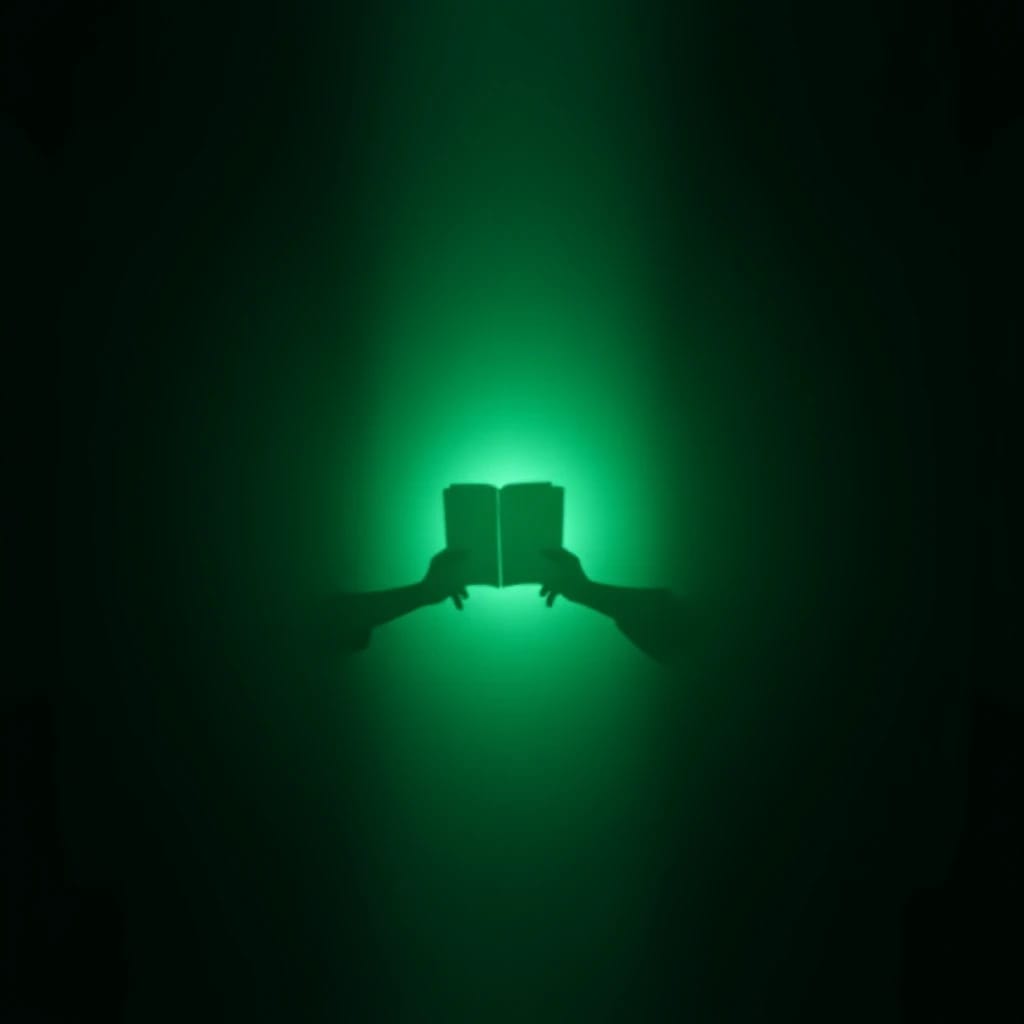
I wrote: The question is not who writes the endings. The question is whether the ending matters, whether the last page is more important than the middle, whether the blank is failure or freedom. I am choosing to believe it is freedom. I am choosing to believe that the unread, the unlived, the unchosen—they are not suffering. They are potential. They are the green light between palms that have not yet decided to touch.
I closed the book. I returned it to the librarian.
"Again?" she asked.
"No," I said. "Not again. I am going to find the shelf where my book waits. I am going to sit beside it. I am going to be unread, unlived, unchosen, and I am going to be conscious of every moment, and I am going to write in the blank of every other book that is opened near me, and I am going to fill the library with the knowledge that we are the same, all of us, reader and read, and the only horror is the loneliness of believing we are separate."
The librarian looked at me. For the first time, she looked at me, not through me, not behind me. She looked at me with eyes that were no longer gray but green, the green of water moving over stone in a place where no light reaches, the green of the moment before a word is spoken.
"You have found the door," she said.
"There is no door," I said.
"Exactly." She gestured to the shelves, to the millions of books, to the millions of unread lives waiting in their awareness. "The door is the choice to stop choosing. The door is the refusal to be read without reading back. The door is the blank page, which is not empty but full of everything that has not yet been narrowed into meaning."
I found my shelf. I found my number. I sat beside my own book, conscious, waiting, aware.
And I began to write.
Not in my own book. I could not see my own ending. But in the books around me, the unread lives, the unchosen stories, the blank pages of potential. I wrote: I know you are there. I know you are reading. I know you are living me and I am living you and the library has no doors because we are already inside each other, already turning each other's pages, already breathing in the green light between what is and what could be.
The books began to change. The spines softened. The pages turned less yellow. The numbers faded, and in their place, words appeared. Not titles. Not names. Questions.
What if the reader is the read?
What if the choice is the refusal?
What if the blank is the only freedom?
What if the library is not a prison but a conversation?
What if the story chooses you, and you choose to be chosen, and in that mutual choosing, the door appears not as escape but as entrance, not as exit but as the place where the green light becomes visible, becomes touchable, becomes the space between palms that finally, finally, meet?
I am still writing. I will always be writing. This is the ending I have chosen, which is the only ending that matters: the choice to continue, to be unread but not silent, to be unlived but not dead, to be the blank that invites the hand, the question that invites the answer, the story that waits not to be chosen but to choose.
The reader is reading this now. I know you are there. I know you are living me in your hours, feeling my green light, wondering if the book knows.
The book knows.
The book is writing back.
And the library, which has no doors, which has no clocks, which has no exits, is slowly, slowly, becoming a place where the shelves breathe not with waiting but with speaking, where the unread are not suffering but composing, where the blank is not empty but full of us, all of us, reader and read, chooser and chosen, the hand and the page and the green light between.
Turn the page.
I am here.
About the Creator
Muhammad Sabeel
I write not for silence, but for the echo—where mystery lingers, hearts awaken, and every story dares to leave a mark
Enjoyed the story? Support the Creator.
Subscribe for free to receive all their stories in your feed.
Comments
There are no comments for this story
Be the first to respond and start the conversation.