

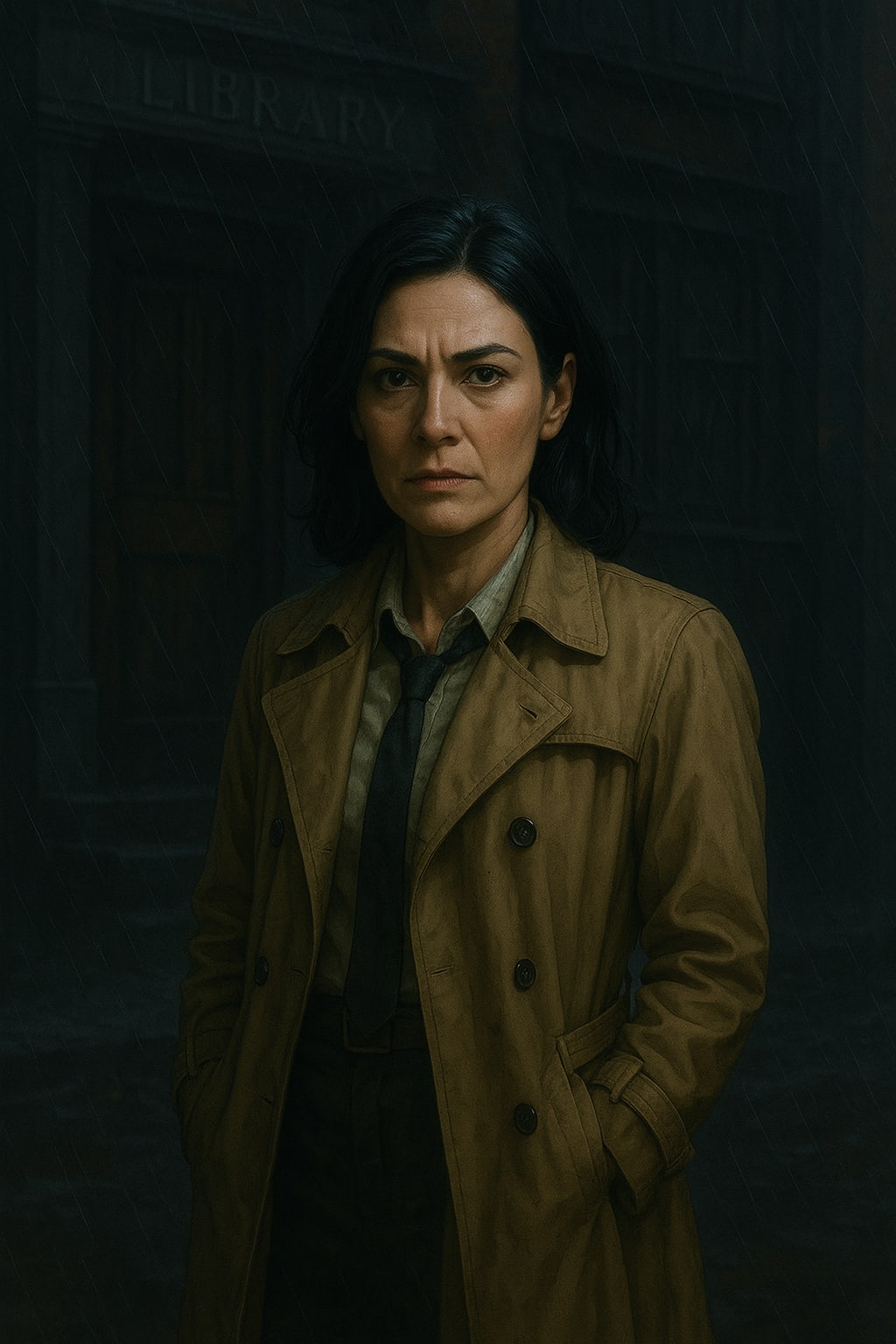
The Last Witness part 1
Rain fell in sheets the night Evelyn Carr disappeared.
The official story was simple: 24-year-old grad student, walking home from the university library after hours, never made it to her apartment. No signs of struggle. No body. Just an umbrella found snapped in two beside the river.
Detective Mara Keene had handled dozens of disappearances — but this one clung to her like a shadow. Evelyn wasn’t reckless. She was a student of criminal psychology. She wrote papers about how victims were chosen, how killers thought. She should’ve known better.
Two weeks after Evelyn vanished, Mara got a letter.
It wasn’t mailed — it was hand-delivered to her office. No fingerprints. No return address.
Inside was a single sentence:
“You’re looking in the wrong direction.”
And under it: a photograph. A grainy still from what looked like a CCTV feed — showing Mara herself walking into a coffee shop.
Timestamped: the night Evelyn vanished.
But Mara had been at her desk all night, reviewing footage from the river path. Or… hadn’t she?
She barely slept after that. Rewatched the evidence. Checked time logs. Even questioned her own partner. But nothing lined up.
More letters followed.
“She talked to you that night.”
“Why can’t you remember?”
“The mind forgets what it fears.”
Each letter came with another photo — Mara in places she couldn’t remember being. The bridge. Evelyn’s apartment building. The basement of the psychology wing. All on the night Evelyn disappeared.
Finally, she broke protocol.
She dug into Evelyn’s thesis work. The files were restricted. But Mara had access.
Title: Memory Manipulation in Isolated Trauma Subjects.
Evelyn had been running a study. One involving experimental hypnosis. Deep suggestion. Blocking traumatic memory.
The test subject?
Detective Mara Keene.
She remembered now.
Evelyn had approached her weeks before the disappearance, asking for participation in a “hypothetical profiling exercise.” But it hadn’t been hypothetical. Evelyn had been using Mara as a live case study — conditioning her to forget key pieces of information after certain triggers.
A final letter arrived.
It wasn’t typed. It was handwritten, in Evelyn’s script.
“You were the perfect test. Smart. Resilient. But even you couldn’t hold on once I flipped the switch.
You didn’t kill me. But you watched it happen. And now you choose not to remember.
The truth isn’t buried. It’s locked inside you.”
Mara’s hands trembled. Her nightmares, the blackouts, the flickers of drowning…
Evelyn didn’t vanish.
She jumped. Off the bridge.
And Mara had been there. Watching. Frozen.
But not because she was heartless — because Evelyn had trained her not to intervene. A twisted psychological experiment to prove a theory about memory, morality, and control.
Mara sat in the dark, one final photo in her hand.
It showed her standing at the edge of the river. Evelyn just behind her, smiling
Detective Mara Keene didn’t sleep for three days after the last letter.
Her badge sat untouched on her desk. She hadn’t filed a report. What could she say? That a missing woman had hypnotized her into forgetting a suicide? That she might’ve watched her die without lifting a hand?
The department already whispered about her insomnia, her sudden mood swings. The case was closed — declared unsolved but cold. And Evelyn Carr? Still just a name on a missing persons file.
Until the second body showed up.
Same age range. Same physical profile. Another graduate student from the university, found in a shallow ditch two towns over. No bruises. No sign of violence. Just a faint injection mark on her arm and a small envelope tucked into her coat pocket.
Mara wasn’t assigned to the case.
But the envelope was addressed to her.
Inside: one word, handwritten in the same delicate script.
“Control.”
And underneath it, a single page from Evelyn’s thesis. Burned at the edges.
“Subject A exhibited full memory suppression under crisis trigger. Subject B (Control Group) retained memory but suffered irreversible psychological collapse within 72 hours. Conclusion: guilt is more corrosive than amnesia.”
There had been others.
Mara wasn’t the only one Evelyn tested. And now someone was finishing her work.
Mara drove to the university the next morning, flashing her badge even though she hadn’t officially taken the case. The psychology department looked untouched by time — sterile, silent, and full of locked doors.
She broke into Evelyn’s old research lab.
Everything had been cleared out. Wiped. But one item remained in a drawer: a USB drive, shaped like a chess piece — a knight.
On it, encrypted video files. Password protected.
She called in a favor from a hacker friend — off the books — and they cracked the password in hours.
There were five videos.
Each labeled by subject number. All timestamped before Evelyn disappeared.
Mara watched in silence as Evelyn interviewed each subject in a dim-lit office.
Subject A — her. Calm, professional. Just a “simulation,” she’d been told.
Subject B — the student in the ditch. Clearly distressed.
Subject C — a middle-aged man. Missing. Reported two weeks before Evelyn.
Subject D — unknown. Redacted face.
And Subject E — the last video.
When Mara opened it, she stopped breathing.
It was Evelyn. Alone.
She faced the camera with calm certainty.
“If you’re watching this, I’ve proven what I set out to prove. Trauma isn’t just something we experience — it’s something we can engineer.”
“But the real test was never the subjects. It was me. How far can a person go for science? For truth? Can you still call it murder if they agreed to be forgotten?”
“Detective Keene, you’re not the villain. You were my constant — my lens. But you’re also the only one who remembers anything at all. That makes you dangerous.”
“Which is why I left you breadcrumbs.”
She smiles.
“And which is why someone is following you now. Cleaning up.”
Mara shut the laptop. Her skin was ice.
Outside her window, a car idled. Black sedan. Same one she’d seen twice today. Unmarked.
Someone was cleaning up.
She was no longer a detective.
She was now the last subject.
And someone — maybe a former student, maybe Evelyn herself if she hadn’t died — was tying off loose ends.
But Evelyn was wrong about one thing.
Mara was the villain now.
And villains fight back.
About the Creator
Huda Yusuf
"Diving deep into the world of imagination — original fiction that stirs emotion, sparks curiosity, and keeps you turning the page. Welcome to my universe of stories."
Enjoyed the story? Support the Creator.
Subscribe for free to receive all their stories in your feed.
Comments
There are no comments for this story
Be the first to respond and start the conversation.