
The Last Window
A Story About the Space Before the Door Closes

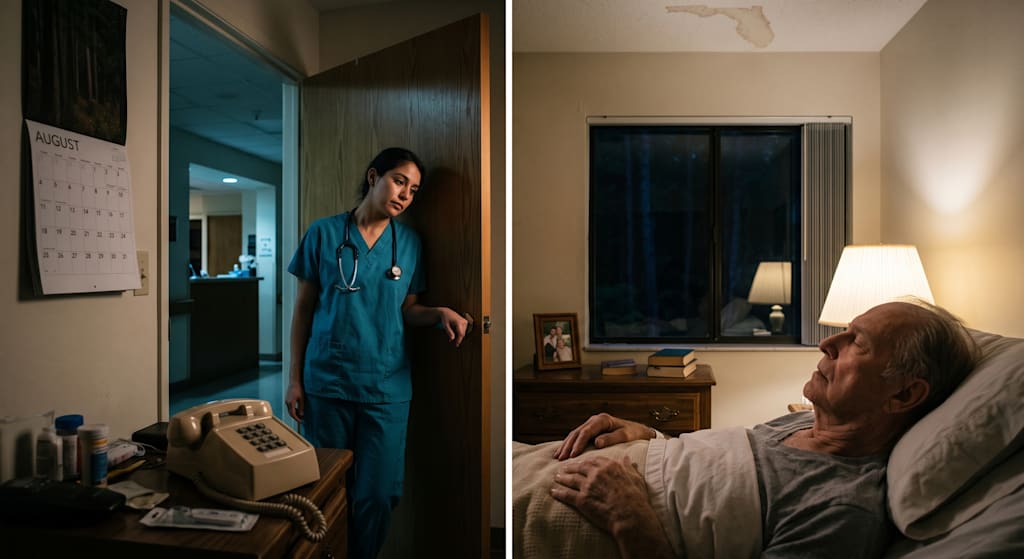
The phone on Frank Delacroix's nightstand hadn't rung in six days, and Marisol had started timing her rounds around it without admitting that's what she was doing.
"You checking on him or the phone?" Nurse Yvonne asked, catching her lingering in the doorway of Room 14 for the third time that shift.
"Both," Marisol said, which was honest, and kept walking.
Frank was eighty-one, a widower, formerly of the merchant marine, formerly of a house on Calhoun Street he hadn't set foot in for four years, and currently of Sunrise Hospice, Room 14, second bed by the window because he'd asked for the window and nobody argues with a man who's asked for so little. He had a laugh like a diesel engine catching and a habit of calling every nurse "Chief" regardless of rank, gender, or how many times they corrected him. He was, by every metric the chart used, in his final days. He was also, according to the one thing he actually talked about, waiting on a phone call from his daughter.
"She's in Denver," he told Marisol on the first night, like it explained everything. "Works in insurance. Busy people, insurance people."
"Does she know you're here?"
"She knows."
He said it the way men say things they've decided not to examine too closely, and Marisol, who had been doing this work for nine years, knew better than to pull on that thread the first night. You let people set their own pace toward the truth. Most of them get there eventually. Some don't, and you let that be theirs too.
By the third night, the thread had started pulling itself.
"We had a fight," Frank said, apropos of nothing, staring at the ceiling tile that had a water stain shaped, he insisted, like the state of Florida. "Eleven years ago. About her mother's funeral, if you want to know the truth of it. I said some things. She said some things. Neither of us called first, and then it was a year, and then it was ten, and now it's—" He gestured at the room, the IV pole, the window with its view of a parking lot and, past that, a stand of pines that at least had the decency to be green.
"You called her, though. Since you've been here."
"Left a message. Week and a half ago."
"And?"
Frank looked at the phone the way a man looks at a door he's knocked on and is waiting, with diminishing hope and undiminished pride, to hear open.
"And nothing yet, Chief."
The thing about hospice work that nobody tells you in nursing school is that time behaves differently in these rooms. Outside, in the hallway, in the break room where Yvonne kept a jar of peppermints nobody asked for and everyone stole from, time moved the way it always had—shifts starting and ending, the clock over the nurses' station ticking through its ordinary arithmetic. But inside Room 14, and rooms like it, time thickened. It got heavier at the edges. Every hour meant something specific and irreversible in a way that hours in the break room simply didn't, and everyone who worked those halls long enough developed a second, private clock that ran only in those rooms, counting down toward something nobody said aloud.
Marisol's private clock had started running for Frank three days ago, when his breathing changed. Not dramatically. A slight lengthening between breaths, a texture to it that she'd learned to hear the way a mechanic hears an engine start to go. She hadn't told him. You don't, not directly, not unless they ask you point blank—and even then you answer the question they're actually asking, which is rarely the one they said out loud.
What she did instead was call the number in Frank's file marked emergency contact—daughter, a Denver area code, and leave a message of her own.
"This is Marisol Reyes, I'm one of the nurses caring for your father at Sunrise Hospice. I don't want to alarm you, but I think it would mean a great deal to him to hear from you, sooner rather than later, and I wanted you to have all the information you need to make that decision for yourself."
She left her direct line. She did not say the word dying, because that word, spoken into a stranger's voicemail, tends to either paralyze people or send them running in the wrong direction, and she'd learned that the gentler version of the truth is usually the more useful one, provided it's not a lie.
Then she waited, along with Frank, though she didn't tell him she was waiting too.
Two days passed. Frank's diesel-engine laugh got quieter, the catch in it taking longer to turn over. He talked less about Denver and more about ships—a specific one, the SS Cape Fear, on which he'd served as a young man out of Wilmington, hauling cargo up and down a coast he clearly still loved more than he'd ever managed to say directly. He described storms off Hatteras with more animation than he'd shown discussing his own prognosis, which Marisol understood perfectly. Some men can talk about a hurricane they survived at nineteen more easily than they can talk about a daughter they haven't spoken to in eleven years. The storm, at least, had an ending he could live with.
"You ever think about calling her yourself?" Marisol asked, on what she privately suspected, from the sound of him, might be one of his last clear nights. "Instead of waiting."
"I called."
"Once. A voicemail. That's not the same as calling, Frank, and you know it."
He was quiet a long moment, long enough that she thought he might have drifted, but his eyes were open, fixed on the Florida-shaped water stain.
"What do I even say, Chief? Sorry I said what I said about your mother. Sorry it took me dying to want to fix it. That's not an apology. That's a hostage note."
"It's a start."
"Starts need time to become something. I don't exactly have a surplus."
It was the first time he'd said it plainly, and Marisol let it sit in the room without rushing to fill the silence, because filling it would have been for her comfort, not his.
"Then don't wait for the perfect version," she finally said. "Say the true version. That's the one people remember anyway."
The call came at 11:52 p.m., during the dead stretch of the overnight shift when the hallway lights dim to half and the whole building exhales into something quieter than day but not quite sleep. Marisol was at the nurses' station when her cell buzzed—not the hospice line, her own personal number, which she'd apparently included in the voicemail without fully registering that she had.
"This is Rachel Delacroix," the voice said, tight and fast, the particular urgency of someone who has been rehearsing a conversation in their head for eleven years and finally has to have it for real. "You left a message about my father."
"I did."
"Is he—" A pause, the sound of someone steadying themselves against something. "How much time does he have?"
Marisol had learned, over nine years, exactly how to answer that question, which is to say she'd learned there is no exact answer, only an honest one.
"I don't think it's days. I think it might be hours. I'm sorry to say it that plainly, but I think you'd want it plain."
"Can I call him? Right now? Is it too late to call him right now?"
And here was the thing Marisol had come to understand about the phrase last call, working these halls for nine years—it wasn't really about the clock striking some fixed, final hour. It was about the space right before that hour, the last window while the door is still, technically, open. People pictured it as a slammed door, a hard cutoff, but it almost never worked that way. It eased shut, slowly, and the tragedy wasn't usually that people ran out of time. It was that they mistook the slow closing for the door being shut already, and stopped trying to get through it a little too soon.
"It's not too late," Marisol said. "Call him now."
She carried the hospice phone into Room 14 herself, waking Frank gently, the way you wake someone you suspect might be closer to gone than asleep.
"Frank. Frank, it's Rachel. She's on the line."
His eyes opened slowly, found the phone, found Marisol's face, and something in them cleared—not strength, exactly, but focus, the particular clarity that shows up sometimes right before the end, like a candle finding one last draft of air.
"Put her through, Chief," he said, and his voice, though thin, had the ghost of the diesel catch in it.
Marisol set the phone against his ear and stepped back to the doorway, not out of the room, because Frank had made clear on the second night that he didn't want to be truly alone for whatever came, but far enough to leave the conversation his.
She heard only his side of it, which was enough. "Rachel." A long breath. "No—no, don't apologize first, that's mine to do, and I've had eleven years to get the words right and I still don't have them, so you're just going to get the true version." A pause, his eyes wet now, fixed on the ceiling's Florida-shaped stain like it was the last steady thing in the room. "I was wrong about the funeral. I was wrong for eleven years after it too. I love you. I should have called the day after the fight, not the day I found out I was dying." Another pause, longer, and Marisol watched his hand find the blanket and grip it the way sailors grip a rail when the deck starts moving underneath them. "I know. I know, baby. Me too."
He talked to his daughter for eleven minutes. Marisol knew because she checked the clock without meaning to, the private clock and the ordinary one briefly running in sync. When he finally lowered the phone, exhausted, something in his face had settled that hadn't been settled in eleven years, or maybe longer.
"She's getting on a flight," he said. "First one out. Should be here by morning."
"Good."
"Called it close, though, didn't I, Chief." It wasn't quite a question.
"You called it in time," Marisol said. "That's the part that matters."
Frank held on until 6:40 the next morning, forty minutes after Rachel walked through the door of Room 14 still wearing her coat from the flight, and got to hold her father's hand and say the rest of what eleven years had left unsaid, out loud, in a room with a window he'd specifically asked for, looking out at a parking lot and, past it, a stand of pines holding steady and green in the early light.
Last call, Marisol thought, watching from the hallway as she'd watched so many times before, isn't the moment the door shuts. It's the moment right before—the last one where somebody, if they're brave enough or scared enough or simply loved enough, still has time to walk through it.
About the Creator
Charles V Sasser Jr
Retired U.S. Army CSM, SOFREP defense analyst, and author of the thriller Led by Love of Country. I translate military doctrine into strategic insights on global conflicts, defense technology, and executive leadership.
Enjoyed the story? Support the Creator.
Subscribe for free to receive all their stories in your feed. You could also become a paid subscriber, letting them know you appreciate their work.
Comments
There are no comments for this story
Be the first to respond and start the conversation.